

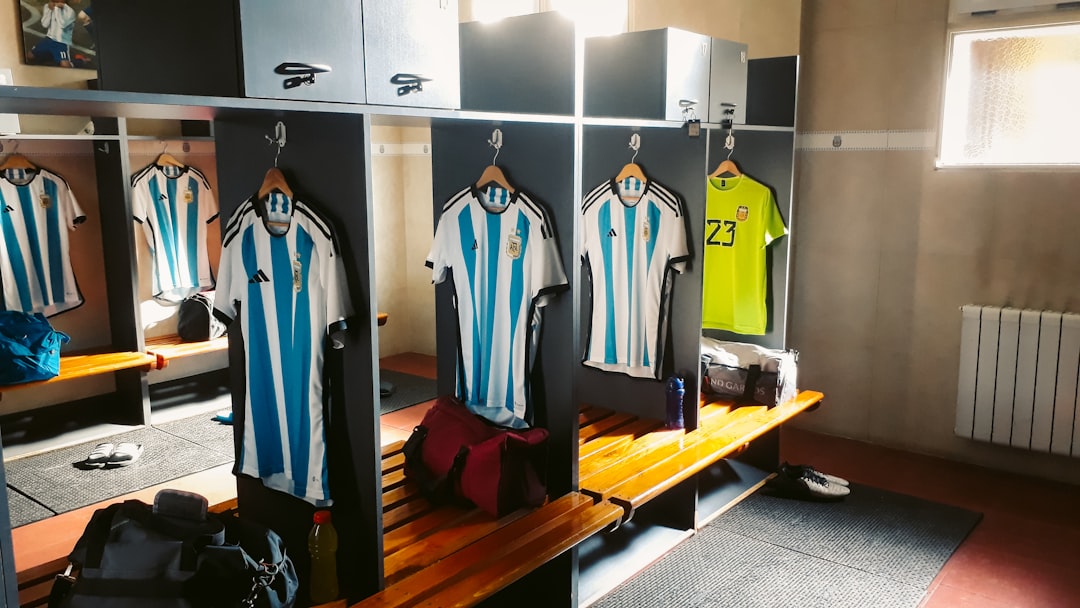




Close your eyes for a second and find it — the number that was yours.
Or the one that wasn't yours but felt like it should have been. Or the one that sat untouched in the equipment room for two full seasons because the last player who wore it tore his ACL in week three and nobody wanted to be the one to put it back on the field.
Jersey number superstitions in high school sports occupy a specific and almost entirely undocumented corner of athletic culture. They don't get the magazine feature. They don't show up in the coaching manual. They travel the way all real locker-room knowledge travels — through a senior pulling a freshman aside, through the particular weight of a silence that falls when the wrong person picks up the wrong jersey, through an equipment manager who has worked at the same school for nineteen years and knows precisely which numbers to hand out without comment and which ones to let the coach figure out on his own.
If you played high school sports, this is the world you already know. This article just gives it a name.
Why High School Jersey Superstitions Are a Different Animal Entirely
The professional tier owns the superstition narrative in sports media. Michael Jordan's Carolina shorts beneath his Bulls uniform. Wade Boggs and his pre-game chicken, every single day, for the entirety of a Hall of Fame career. These are real stories, properly documented, and they have earned their place in the cultural record of American sports.
But by the time those stories reach the audience, they have been processed. The rawness is gone. What was once a private, almost desperate ritual has become a charming quirk attached to a legend.
High school jersey number superstitions haven't been processed. They exist in their original form — unpolished, immediate, and doing genuine psychological work in the lives of athletes who are still in the middle of figuring out who they are.


The athlete superstitions around jersey numbers at the high school level function differently from their professional counterparts for reasons that are structural, not incidental:
- Numbers accumulate program history. The senior who wore 22 finished with a 31-4 record over three seasons. The number didn't produce those wins. But inside that program's culture, the number now carries them — and every player on the current roster knows it without being told.
- Numbers arrive through inheritance, not selection. You don't browse a number catalog. You earn your spot, and the number comes with it, trailing whatever history the previous wearer left behind.
- Social enforcement is immediate. No coach issues a formal penalty for disrespecting a number's ritual. But fifteen teammates can engineer a very specific kind of locker-room atmosphere around someone who violated the unwritten code, and they will do it without a meeting.
- The athlete's identity is still under construction. A professional athlete can hold a superstition loosely, carry it like a light coat. A sixteen-year-old cannot afford that looseness. The number is structural. It is part of the story they are actively telling themselves about what they are capable of.
Four Types of Number Superstitions That Actually Live in High School Programs
Not every jersey superstition operates the same way. In our experience covering grassroots sports culture across multiple programs and regions, the athlete superstitions around jersey numbers cluster into four recognizable types — each with its own internal logic, its own social texture, and its own specific consequences when violated.
The Lucky Number Inheritance
The most emotionally complex category, and the most common. A number develops a reputation inside a program — attached to a specific player, a specific season, a specific outcome the program measures itself against. The number becomes, in the collective imagination of the players who follow, a carrier of that potential.
The athlete who inherits it steps into an implicit psychological contract. The number has a standard. You are now the one responsible for maintaining it.
What makes this more than mythology is that the belief does real work. Pre-game ritual research has documented consistently that superstitious performance routines reduce anxiety and sharpen focus — not through any supernatural channel, but because completing the ritual signals readiness to the nervous system. The number is the anchor. The anchor is functional.
The inheritance typically involves specific transfer protocols: the outgoing player telling the incoming player the number's history, a verbal acknowledgment, sometimes an explicit prohibition. "You don't wear this without doing the full tunnel sequence first — that's just how it works." The specific ritual varies by program. The structural logic is identical everywhere.
The Cursed Number
Every program has one. It is not always 13, though 13 carries its own cultural freight. More often, the cursed number earned its reputation through a specific, remembered sequence of misfortunes that the program has not been able to set down. The player who wore 17 tore his ACL in game two. His replacement, also wearing 17, fractured his wrist in practice six weeks later. After that season, 17 went into the equipment room and stayed there.
What the cursed number reveals about group psychology is worth paying attention to. The belief is not individual — it is collective. The whole program operates around it. A coach who assigns the cursed number to an incoming athlete without acknowledging its cultural weight creates a specific and unnecessary problem: that athlete performs under the social burden of wearing the number everyone agreed was dangerous. That burden is an additional cognitive load during competition. It costs something real.
The cursed number is not irrational thinking. It is a rational response to a shared social fact. The number means something inside the group, and ignoring what it means has measurable consequences.
The Informal Retirement
Some numbers are functionally retired at the high school level without any ceremony. A senior carries a number through a season that becomes program legend — a state title run, a performance record that survives for a decade, a recruiting story that gets told at every preseason meeting for years afterward. The expectation that follows is unspoken but universal: this number should sit before it is passed to someone the culture decides can honor it.
Maya R., 17, ran directly into this as a sophomore midfielder handed number 10 on her varsity soccer team — the number the graduating starter had worn to back-to-back state finals. Nobody said a negative word to her directly. The room just got quiet in a specific way when she put it on, and she understood immediately what the quiet meant. She requested the switch to 24 the next morning. The coach made the change without discussion. Number 10 sat for one more full season.
The informal retirement is often more durable than a formal banner ceremony precisely because it requires no administrative decision. The meaning is community-generated. That makes it harder to dismiss and harder to disrupt from the outside.
The Personal Number System
Some athletes arrive at high school already in possession of a number. They wore it through every youth league season. A parent assigned it to them for a reason that mattered. They have worn it since they were eight years old and believe, without apology, that it is theirs.
When the program's available numbers do not include their number, these athletes negotiate. They approach upperclassmen with trades. In some programs, the pre-season number exchange runs for two weeks and involves more strategic maneuvering than some actual game plans.
This category is the most personally revealing. The personal number almost always connects to a specific memory — a first game, a family member who wore the same number in a different era, a player they watched from the stands before they ever put on a uniform. The number is a thread running back to the origin of their athletic identity, and they are not giving it up without a conversation.
Pre-Game Rituals and the Number's Active Role In Them
The jersey number does not simply hang in a locker waiting for game day. In the pre-game ritual architecture of high school athletics, the number is a participant — an active element in sequences that become rigid, specific, and genuinely non-negotiable for the athletes who depend on them.
The logic underneath pre-game rituals around lucky jersey numbers in sports is consistent across athletes and programs: the number functions as a threshold marker. Acknowledging it, touching it, completing a specific action in relation to it — these signal the transition from ordinary state to performance state. The ritual is the bridge. The number is the post at its center.
Football tends to push this threshold logic furthest — game-day rituals and superstitions in high school football are elaborate enough that they form their own distinct layer of the culture, running parallel to the number itself.
Specific pre-game number rituals documented from former high school athletes:
- Tapping the number on the back of the jersey three times before leaving the locker room, always in the same sequence, never varied
- Refusing to look directly at the jersey until a specific internal readiness state had been achieved ("If I looked at my number before I was ready, something felt broken — like I'd used up the ritual before I needed it")
- Adding the digits of the jersey number together and performing that sum as a repetition count in a specific warm-up exercise
- One basketball player who had to be the last person out of the locker room every game without exception, touching the number on every hanging jersey on his way to the door
What is consistent across all of these is not the specific action but the function it serves. Each ritual creates a deliberate, embodied moment of transition. A signal to the nervous system that something important is about to begin, and that the athlete is prepared for it.
How the Locker Room Enforces What No Rulebook Covers
There is no formal mechanism for enforcing sports superstitions around numbers in a high school program. No rulebook clause. No coaching staff penalty. No official consequence of any kind.
What exists instead is the specific quality of silence that settles over a locker room when someone has violated the unwritten code. Former athletes describe it with remarkable consistency — a shift in social temperature that is immediate, perceptible, and requires no explanation. The athlete who disrespects a number's ritual, who wears the untouchable number casually or dismisses the cursed number's meaning publicly, walks into that silence and understands what it means without a single word being spoken.
This enforcement exists because the superstition is doing collective work, not just individual work. When the team shares belief in a number's power, the player wearing it is supported by something real — the social reinforcement of fifteen people who believe alongside them. When that shared belief fractures, the player wearing the number loses that structural support.
Locker-room enforcement of number rituals is, in this specific and entirely non-mystical sense, functionally rational. It protects the shared psychological infrastructure that team performance depends on.
What the Rituals Actually Reveal About Young Athletes
Remove the specific gestures and sequences and what remains is a clear portrait of how adolescent athletes manage the psychological demands of high-stakes competition.
A jersey number superstition is a control mechanism. When outcomes are genuinely uncertain — and in high school athletics, they always are — the ritual provides the athlete with a felt sense of agency. The number is a variable within their control. The sequence of actions attached to it is something they can execute flawlessly, regardless of what the opponent does on the other side of the field.
This is not muddled thinking. It is adaptive psychology operating as designed. Research published by the American Psychological Association on superstitious pre-performance behavior found consistent performance improvements when athletes completed personal rituals before competing — not because the rituals produced any direct physical effect, but because completing them increased self-efficacy and reduced competitive anxiety. Both of those outcomes directly affect performance.
The high school athlete who taps her number three times before walking out of the tunnel is not confused about causality. She knows the tapping doesn't change the opponent's speed or her own shooting percentage. What she knows — even without the vocabulary to describe it — is that doing the ritual means she is ready. And in competitive athletics, readiness is not a minor variable. It is the variable.
If you've ever wondered what a jersey number actually says about you, the answer lives in this same territory — a number becomes shorthand for an identity the athlete is still actively building.
Lucky Numbers by Sport: The Patterns High School Culture Actually Produces
The numerology of high school jersey culture is not random. It follows patterns that are sport-specific and surprisingly consistent across programs in different regions, different divisions, and different decades. These are not universal laws — they are cultural tendencies, shaped by position conventions, professional associations filtered downward, and the accumulated lore of individual programs over time.
Football assigns personality expectations to numbers at the high school level with a specificity that mirrors — and sometimes predates — professional convention. Number 1 carries the weight of visibility: this is the player the program is telling everyone to watch. Numbers in the 50s and 60s accumulate the specific identity of the lineman who works without recognition and wears that invisibility as a point of pride. The social meaning of those numbers is part of what the athletes wearing them are performing.
Basketball lives in the shadow of number 23 in a way that no other sport lives in the shadow of a single number. High school players feel that weight acutely and consciously. Number 3 is polarizing in many programs — a scorer's number in some, a quietly unlucky number in others, depending entirely on the program's specific history with it. Number 0 carries a generational divide: popular among younger players, viewed with mild institutional skepticism by coaches who grew up in a different number culture.
Soccer has the most internationally influenced number culture of any American high school sport. Number 10 carries a lineage that runs through Pelé, Maradona, Messi, and Zidane before it reaches a sixteen-year-old midfielder in a Tuesday afternoon practice — and that lineage shapes how the athlete, the coach, and the program understand what wearing that number means. Goalkeepers, universally assigned number 1, tend to develop the most intense and personal relationships with their jersey numbers of any position in any sport across any level.
Track, cross country, and swimming operate under a structurally different superstition culture because the numbers are assigned per meet rather than worn across a season. A bib number assigned for a state championship meet can become the most significant number of an athlete's entire competitive year in the span of forty-eight hours. Athletes in these sports sometimes attempt to influence their assignments in advance. Others develop immediate, session-specific rituals built around whatever number they receive — a full pre-race sequence constructed in real time around a number they have held for two days and will never see again.
Your jersey is still out there waiting.
Design yours in minutes and see your name and number exactly the way you remember it — the number that meant something, rendered in the colors and style of the program you gave everything to.
Frequently Asked Questions
Why do high school athletes form such strong attachments to specific jersey numbers?
The attachment forms through the combination of identity association and performance memory. When an athlete wears a specific number during a significant competitive moment — a championship, a personal record, a breakthrough performance — the brain links that number to the emotional state surrounding it. Over time, the number becomes a reliable anchor for that state. Removing or reassigning it disrupts something that feels structural rather than incidental, because for the athlete wearing it, it is structural. The number is a piece of the ongoing story they are telling themselves about who they are as a competitor.
Are jersey number superstitions in high school sports more intense than at the professional level?
They are different in kind rather than degree. Professional athletes develop the ability, over long careers, to hold a ritual loosely — it becomes a personality detail rather than a psychological necessity. High school athletes cannot afford that looseness. The number is doing heavier work for a seventeen-year-old who is still constructing their competitive identity than for a veteran with a decade of performance history behind them. The superstition is also socially enforced at the high school level by peers rather than held privately, which makes it more visible, more durable, and more consequential when violated.
What should coaches understand about number assignments before the season starts?
The practical answer is that ignoring a program's number culture costs more than learning it. An athlete assigned a number the locker room has collectively decided is cursed will perform under a specific social burden — the awareness that teammates are watching, some with genuine concern, to see whether the reputation holds. That awareness is additional cognitive load during competition, which is precisely what pre-game rituals are supposed to eliminate. A brief conversation with team captains before assignments go out is usually enough to identify which numbers carry weight and navigate around the problems before they start.
Do pre-game rituals tied to jersey numbers actually improve athletic performance?
Yes, through a mechanism that has nothing to do with supernatural efficacy. The ritual attached to a number — the specific sequence of actions performed before competition — reduces anxiety and creates a felt sense of readiness and agency. Both of those psychological states are directly correlated with improved competitive performance. The number is the anchor for the ritual. The ritual is doing real, documented psychological work. The superstition is the delivery system for something that genuinely helps athletes perform.
How does a high school program informally retire a jersey number without an official ceremony?
Almost always through silence and consistent omission. The coach stops assigning the number. No announcement accompanies this decision. Younger players learn through observation — they notice the number never appears on the assignment sheet, ask an older player once, receive an answer that makes further questions unnecessary. The informal retirement holds as long as the program's institutional memory holds the reason for it. In some cases that is a year or two. In others, a number sits untouched for a decade, passed over by coaches who cannot fully articulate why but sense, correctly, that assigning it would disturb something better left alone.
See also: why high school sports still matter to adults long after the final whistle | the deeper psychology of athletic identity that forms during those years | why senior season memories feel permanently burned into your brain | what high school sports actually teach you that classrooms never could | the experience of playing under the lights on a Friday night