

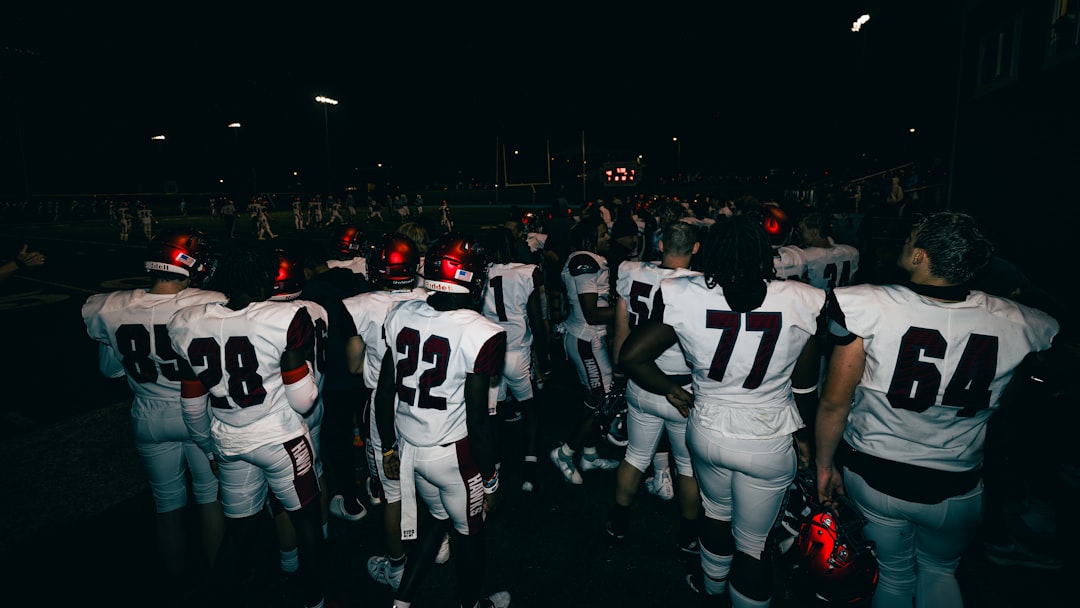




There was a piece of paper. Maybe it was taped to the gym door. Maybe it was posted outside the equipment room, or handed down the row in the locker room the day before the first game. You scanned the list fast — past the names — looking for the number next to yours.
That number. Your number.
Understanding how jersey numbers are assigned in high school sports turns out to be one of those questions with a hundred different true answers, because there was no single system. There was your coach, your program, your school's tradition, and whatever unspoken hierarchy had calcified over decades of seasons before you ever laced up. This article reconstructs that ritual — how it actually worked, what determined who got what, and why the number you wore in high school has never quite left you.
The Moment the Number Became Real
Walk back into that locker room. Not the one from movies — the actual one, with the flickering fluorescent light above the third row of lockers, the permanent smell of athletic tape and old rubber, the sound of cleats on tile.
The high school jersey number assignment process was rarely bureaucratic and almost never random. It was a ritual with its own logic, its own politics, and its own emotional weight that nobody thought to document because everyone assumed everyone else already understood how it worked.
In our experience talking to former athletes across every sport, the details of that ritual are startlingly specific in people's memories — decades later, former players can tell you not just their number but precisely how they found out they had it, who had it before them, and what it meant to get it.
That specificity is worth taking seriously. It tells you something about what the number meant.
How Coaches Actually Assigned Numbers: The Five Systems
The Seniority Model: Seniors Pick First
This was the most common system in football programs, and it spread into basketball, baseball, and soccer in various forms. The logic was simple and understood by everyone: you earned the right to choose by surviving.


Seniors walked into the equipment room first — sometimes literally, in a line organized by class year — and selected from the available inventory. Then juniors. Then sophomores. Freshmen got what was left.
What this produced was a predictable geography of numbers. The single digits went early, grabbed by the seniors who had waited four years for the right to claim them. The teens and low twenties followed. By the time the sophomore class made their selections, you were looking at the high numbers — the 50s, the 70s, the 80s — the numbers that didn't carry the same weight on their own and required the player to grow into them.
What this system also produced was aspiration. Every underclassman wearing a high number understood implicitly that their number would get lower as they moved up. The number tracked your ascent through the program.
One quiet rule sat underneath all of it: once you had a number, you usually kept it. Most programs let returners hold their number from the year before, so the seniority scramble only really played out over the numbers a graduating class left behind. You changed only when a number you wanted finally opened up — and even then, you had to decide whether it was worth giving up the one that was already yours.
The Merit System: Earning Your Pick
Some programs turned number selection into a running ledger. Players accumulated points all off-season — weight-room attendance, showing up to open gyms, holding their grades, community service hours, even fundraising for the program. When the list was drawn up, selection order ran by total points, not by class year, so the kid who never missed a 6 a.m. lift could pick before the senior who coasted through the summer. Ties happened, and coaches got creative breaking them — one coach settled a deadlock by declaring that whoever raised the most in the next week's car wash got the number. It turned the ritual into a scoreboard, and everyone in the room knew where the standings stood.
The Position Assignment Model: Function Over Preference
Certain sports developed numbering conventions that had nothing to do with seniority and everything to do with where you stood on the field. In football, this formalized into the NCAA's jersey numbering rules, which high school programs frequently mirrored even when not required to.
Quarterbacks tended toward single digits or low teens. Linemen wore the 50s through 70s. Skill positions — wide receivers, defensive backs — clustered in the 80s and 20s. Even when coaches didn't enforce these conventions strictly, players self-selected toward them because wearing the "wrong" number for your position felt like wearing someone else's identity.
In basketball, the practical constraint was different: players had to wear numbers that referees could easily signal using two hands, which limited the usable range to combinations of 0–5 in each digit position. This created an interesting compression — everyone was competing for a much smaller pool of numbers than football players were.
The Coach's Discretion Model: The List Comes Down and That's Final
Some coaches assigned numbers the way they assigned everything else — by themselves, according to criteria they may or may not have explained. The list appeared. You looked for your name. The number next to it was your number.
This system produced the widest range of emotional responses. Some coaches used it as a transparent reward system — the best players in each class got the best numbers, full stop, and if you didn't know where you stood before the list went up, you knew after. Others operated on criteria that seemed arbitrary from the outside: alphabetical, by roster order, by the coach's memory of who had impressed them at the final tryout.
Marcus T., 34, still remembers being handed #22 his sophomore year by a coach who said nothing more than "that's yours." He later found out the coach assigned numbers based on practice attitude — the players he trusted to work without being pushed got the single digits and low teens. The 22 meant something specific, even if Marcus didn't know the rubric when he received it.
The Open Selection Model: Choose Your Own Number
This was the rarest system and, for the players who experienced it, often the most memorable — because the choice itself became a statement.
Some programs, particularly in individual-scoring sports like baseball and soccer, held what amounted to an open draft. Players submitted preferences; the equipment manager resolved conflicts by seniority or a coin flip. What number do you want? Write it down.
This question, it turns out, is not simple. Former athletes who went through open selection describe a surprisingly intense process of self-interrogation: Were you claiming a number because of a player you admired? Because it felt like yours? Because nobody else wanted it and you wanted to own it completely?
The Numbers That Carried Weight
Not all numbers were equal, and everyone in every program understood the informal hierarchy — even when nobody stated it.
Single Digits: The Declaration
Single-digit numbers — 1 through 9 — were not just numbers. They were declarations. In most sports, wearing a single digit communicated something without words: that you had either earned the right through seniority, or been given the right by a coach who was making a public statement about your standing.
The #1 occupied its own category entirely. In some programs it rotated by tradition to the team captain. In others it went to the best player at the most visible position. In a few, it was deliberately left unclaimed for years by a coach who believed no one had yet earned it.
Aisha M., 28, ran point guard for her high school basketball team and was handed #3 her junior year by a coach who had worn the same number twenty years earlier. She didn't know that context until the season-ending banquet. The number had been the coach's quiet way of saying something she'd never said aloud about Aisha's role on the team.
Inherited Numbers: Wearing Someone Else's Story
Perhaps the most emotionally layered dimension of the high school jersey number assignment process was the inherited number — when a number wasn't selected but passed down.
This happened most often when a standout senior graduated and a coach, explicitly or implicitly, assigned the same number to the player they believed was the program's next standard-bearer. Sometimes the outgoing senior participated in the handoff, physically giving a younger player the jersey number as a form of blessing.
The inheritance carried weight in both directions. It was an honor — and a pressure. You weren't just wearing a number; you were wearing a reputation, a standard, a set of expectations that the locker room had established before you arrived. Some players thrived under that weight. Some transferred.
The Numbers Nobody Wanted — And What Happened to Them
Every program had them: the numbers that sat unclaimed in the equipment room year after year. The 00. The 99. The number associated with a season nobody wanted to remember, or the number a player had worn during an injury year that felt cursed by association.
What happened to these numbers varied. Some programs retired them quietly by never placing them in the available rotation. Others had players who specifically sought them out — who understood that owning a number nobody wanted was its own kind of statement, its own way of starting a new story with a clean slate.
The Politics Underneath the Process
High school jersey number selection was never purely administrative. It was social information, expressed in numbered form.
Where you fell in the depth chart had a number attached to it. Where you stood in the eyes of the coach had a number attached to it. The informal hierarchy of the program — who was trusted, who was on the rise, who was being tolerated until someone better arrived — all of it got communicated through the list on the door.
Players read these signals fluently. A junior who received a lower number than a senior of similar ability understood something about the coaching staff's evaluation. A freshman handed a number below 20 in a seniority-based system understood something else — that someone was making an early statement about their ceiling.
This was rarely spoken about directly. It didn't need to be. The numbers said it.
When You Wanted a Different Number
The request was always a risk. Asking a coach for a different jersey number — or asking to trade with a teammate — required reading the room with precision. In some programs, the request was routine and granted without drama. In others, it was interpreted as ingratitude, as a player prioritizing appearance over teamwork, as a signal that you had your priorities misaligned.
The players who successfully navigated number changes tended to use the same approach: they framed the request as a preference, not a demand, and they offered context. The number had meaning to them — a family connection, a player they'd grown up watching, a number they'd worn through every level of youth sports. Coaches who heard that context were significantly more likely to accommodate it than coaches who heard a bare request with no explanation.
What the Number Meant After the Season Ended
Here is the thing about the high school jersey number assignment ritual that only becomes clear in retrospect: the number was never really about the number.
It was about the moment of belonging — the moment the list confirmed that you were on this team, that you had a place in this program, that there was a number in the equipment room with your name next to it.
Former athletes who cannot tell you the score of a game from their sophomore season can tell you their number and precisely what it felt like to see it on that list. The number was the moment the abstract — team, season, identity — became concrete.
That's why the number stays. Not because of what it represented then, but because it was the first tangible proof that you were actually in.
Your jersey is still out there waiting.
Design yours in minutes and see your name and number just the way you remember it.
Frequently Asked Questions
How do coaches typically decide who gets jersey numbers in high school sports?
Most high school programs use one of five systems: seniority-based selection (where upperclassmen choose first), position-based assignment (where numbers reflect on-field role), coach's discretion (where the staff assigns numbers based on their own criteria), open selection (where players submit preferences and conflicts are resolved by seniority or coin flip), or merit-based selection (where players earn priority through points for attendance, grades, and effort). The most common system in football and basketball programs is the seniority model, where seniors pick first and freshmen receive whatever remains.
Can a high school athlete request a specific jersey number?
In most programs, yes — but the success of that request depends entirely on the coach and the program's culture. Open selection programs make it straightforward. Seniority-based programs allow it within the player's assigned selection window. In coach-discretion programs, a direct request is possible but carries social risk; framing the request around personal meaning (a family number, a player you admired, a number you've worn throughout youth sports) tends to be more effective than a bare preference. The earlier in the off-season the request is made, the better — before the list is finalized, options exist. After the list is posted, changes become significantly harder to arrange.
What does it mean when a high school program retires a jersey number?
Retired numbers are removed from the active roster permanently — no future player is assigned or can claim that number. High school programs retire numbers for two primary reasons: to honor a player who achieved exceptional distinction (a state championship performance, a record unlikely to be broken, a player who went on to play at the college or professional level), or to memorialize a player who passed away. The retirement is usually marked by a ceremony and, in some programs, by hanging the numbered jersey in the gym or field house. The practice is more common in football and basketball programs than in other sports, though it occurs across all major high school sport categories.
Why do some high school athletes care so much about their jersey number?
The jersey number is often the first tangible marker of athletic identity — the moment an abstract idea (being part of a team, competing at a level) becomes a specific, owned thing. For many athletes, the number also carries family significance (wearing a parent's or sibling's old number), cultural significance (a number associated with a player they admired growing up), or program significance (inheriting a number from a respected predecessor). Research on athletic identity development consistently shows that uniform elements — including numbers — function as concrete anchors for the more abstract sense of belonging that team sports produce. The number is the shorthand for the whole experience.
See also: why personalized details like a jersey number matter more than generic recognition | the deeper meaning athletes attach to their numbers and their playing days | preserving those details in a custom sports shadow box | how that number became part of your athletic identity | what those senior season moments — right down to the details on your back — still mean years later