

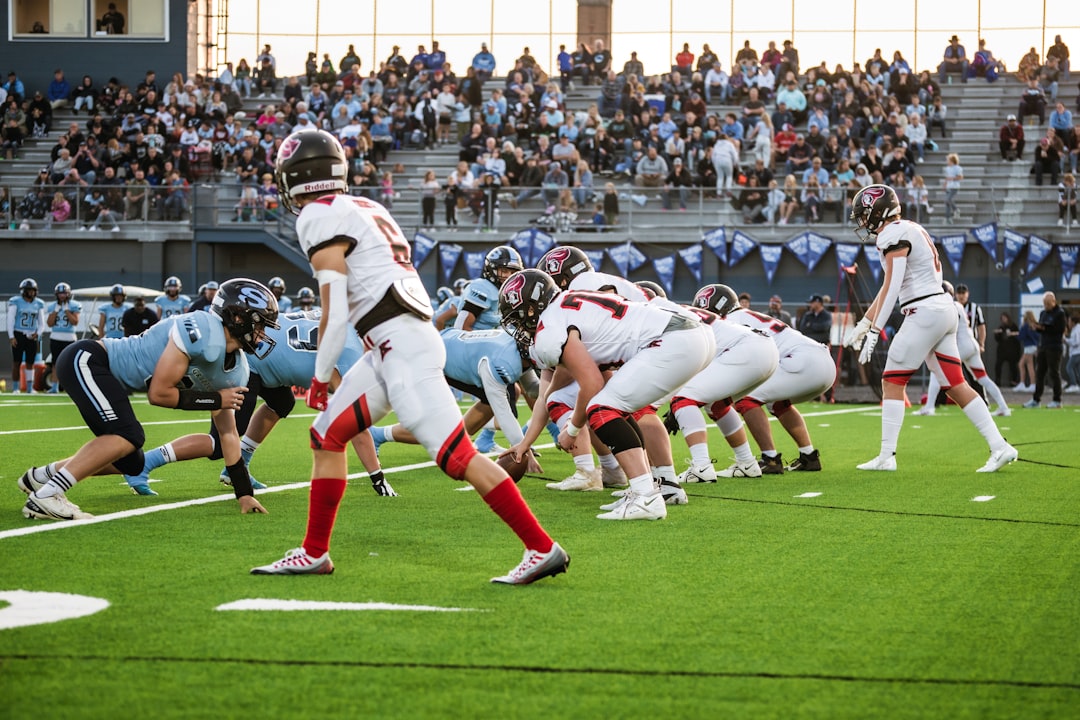



You can still hear the gym. Not a vague impression of it — the specific squeak of sneakers on the floor, the particular echo when the crowd jumped to its feet, the way sound bounced differently during warmups than during a live play. You can still feel the weight of the ball in your hands, or the starting block under your foot, or the specific ache in your legs during the third quarter of the last game of your senior year.
If you've ever wondered why do I remember high school sports so clearly — why those moments feel more vivid than most things that happened last month — you're not imagining it. Your brain was doing something specific and measurable during every practice, every game, every bus ride home. This article explains exactly what.
Your Brain During a High School Game Was Not in an Ordinary State
The science here starts with a simple premise: not all experiences are encoded equally. Your brain does not record life the way a camera records footage, capturing everything with uniform fidelity. It prioritizes. And the criteria it uses to decide what to prioritize are exactly the conditions that defined your athletic career.
The neurological process at work is called emotionally enhanced memory consolidation. When an experience carries significant emotional charge — fear, pride, anticipation, euphoria, heartbreak — the brain releases a cascade of hormones, primarily adrenaline (epinephrine) and cortisol, that directly amplify the encoding of that experience in long-term memory. The amygdala, which processes emotional significance, essentially signals the hippocampus to say: this one matters, store it fully.
High school athletics delivered that signal constantly.
Think about what a typical game actually involved, from a neurological standpoint: elevated heart rate, heightened physical awareness, genuine stakes that felt existential at the time, the presence of people whose opinions mattered deeply to you, and outcomes that were genuinely uncertain until they weren't. That combination — physical arousal, emotional intensity, social significance, and real uncertainty — is the precise cocktail that tells your brain to commit an experience to durable long-term storage.

This is not metaphor. Research published in the journal Neuron by McGaugh and colleagues demonstrated that emotional arousal at the time of an experience measurably increases memory consolidation, with adrenaline playing a direct modulating role. The stronger the emotional response during an event, the more faithfully the memory is encoded — and the more resistant it becomes to the normal decay that erodes ordinary recollections over time.
Your senior season wasn't just a season. To your brain, it was a sustained series of high-stakes, high-arousal, socially loaded events. Of course you remember it.
The Flashbulb Effect — And Why Senior Night Lives in a Different Category
You've probably heard the term flashbulb memory — the phenomenon where certain moments are recalled with photograph-like clarity, details intact decades later. Where you were, what you were wearing, who was standing next to you, what the light looked like. People describe flashbulb memories for significant national events, for the moment they got life-changing news, and — consistently, reliably — for peak moments in their athletic careers.
The mechanism is distinct from ordinary enhanced emotional memory. Flashbulb memories form when three conditions align simultaneously:
- Extreme emotional intensity — the moment feels genuinely significant, not just pleasant
- Personal relevance — the outcome of the moment directly affects you, your identity, your community
- Surprise or finality — the moment is either unexpected, or it is explicitly a last time
Senior night. The last home game. The final buzzer of a season-ending loss. The moment you cleared a personal record and knew it. These moments hit all three conditions at once. Your brain didn't just encode them — it photographed them.
This is why vivid memories of high school games often have a quality that feels almost cinematic. The sensory details are preserved with unusual completeness: sounds, smells, physical sensations, peripheral details you didn't consciously notice at the time. The amygdala's activation during a flashbulb event enhances not just the core memory but the contextual details surrounding it — which is why you remember the specific song playing in the locker room before the game, not just the game itself.
Why the Senior Season Specifically — Not Sophomore Year, Not JV
Here's something most nostalgia for high school athletics articles miss: the senior year memories aren't just vivid because you were older. They're strongest because of a specific convergence of psychological and neurological factors that only happens in final chapters.
Identity is fully formed — and fully at stake. By senior year, your identity as an athlete was no longer exploratory. You knew your position, your role, your relationship with your teammates, your place in the program's history. When something threatens or affirms an identity that is fully consolidated, the emotional stakes — and therefore the memory encoding — are dramatically higher than when identity is still forming.
The brain recognizes finality. Cognitive neuroscience has documented what's sometimes called the peak-end rule — the finding that people's memory of an experience is disproportionately shaped by its peak intensity and its ending. Senior season is, by definition, the ending. Your brain knew it. The result is that every game in that final year was encoded with a subtle emotional overlay that earlier seasons didn't carry: the awareness that this was running out.
Social bonds were at their deepest. Memory encoding is amplified by social context. Experiences shared with people you care about, in circumstances that matter to both of you, are encoded more richly than solitary experiences of equivalent intensity. By senior year, you had spent years building specific, deep relationships with specific teammates. The emotional resonance of those relationships amplified the encoding of every shared experience.
This is why the memories that come back most vividly are almost never individual athletic moments in isolation — they're moments embedded in relationship. The postgame pile-on. The bus ride home with the window down. The coach's voice in the final huddle. Your brain didn't just record what happened. It recorded what it meant to the people you were with.
Maya S., 29, is a former varsity swimmer from suburban Ohio. She can describe, in full detail, the specific light in the natatorium during her senior championship meet — the way the pool reflected blue-green up onto the ceiling, the sound of her lane assignment being called. She was six years removed from that meet when she told us about it. "I couldn't tell you what I had for breakfast the day before my college finals," she said, "but I can still feel the starting block under my feet."
What Maya is describing isn't unusual. It's the predictable result of her brain doing exactly what it was designed to do.
Adrenaline, Cortisol, and the Chemistry of Unforgettable
The specific hormonal environment of athletic competition deserves its own explanation, because it's the mechanism that makes the memory science concrete rather than theoretical.
When you stepped into a competitive environment as a high school athlete, your adrenal glands were releasing adrenaline in measurable quantities. Adrenaline doesn't just accelerate your heart rate and sharpen your physical reactions — it acts directly on the amygdala and hippocampus to enhance the encoding of the experience happening right now. This is an evolutionary adaptation: high-stress situations are exactly the ones you need to remember accurately for survival.
Cortisol, released alongside adrenaline during sustained competition, plays a complementary role. In moderate amounts during emotionally significant experiences, cortisol enhances the retrieval of those memories later — making them easier to access, more complete, and more emotionally resonant when recalled. This is why thinking about your senior season doesn't just produce information; it produces feeling. The emotional state is partially reconstructed along with the memory, because the hormone context was part of the original encoding.
There's something important here that doesn't get said in generic memory science articles: this process was happening not just during games, but during every emotionally charged moment of your athletic life. The hard practice two weeks before the championship. The conversation with your coach that changed how you saw yourself. The locker room after a devastating loss. Adrenaline and cortisol were present for all of it. Which is why all of it is still there.
The Role of Repetition — Why Practice Memories Are Surprisingly Clear Too
Most people expect to have vivid memories of big games. Fewer expect to have clear memories of ordinary practices — but many former athletes do. The smell of the equipment room. The specific way afternoon light came through the gym windows. The drills that felt endless.
The mechanism here is different from flashbulb encoding. It's repetitive emotional encoding — the way that consistent, emotionally meaningful activity builds increasingly durable memory structures over time.
Each practice didn't just teach physical skills. It created a dense network of associated memories: the people, the place, the sensory environment, the emotional texture of working hard with people you were close to. Over hundreds of repetitions across years, those associations became deeply entangled in your long-term memory architecture. Recalling one element — a specific song, the smell of a gym bag — can trigger the entire network.
This is also why the nostalgia for high school athletics often feels different from other nostalgias. It's not a single vivid memory being retrieved. It's an entire interlocked ecosystem of memories, built over years of repeated emotional experience, all coming forward together when any part of the network is activated.
What the Memory Science Tells Us About Who You Still Are
Here's what the neuroscience ultimately suggests, and it's worth sitting with: the reason these memories are so vivid is that they were genuinely formative. Not sentimentally formative — neurologically formative. The repeated high-stakes, high-emotion, high-social-significance experiences of your athletic career shaped the architecture of your memory, your emotional patterns, and your sense of identity in ways that are measurably durable.
The senior season memories are strongest not because of sentimentality, but because they came at the end of a multi-year process of identity formation that involved real stakes, real relationships, and real physical commitment. Your brain treated those years as essential data about who you are and how the world works. It stored them accordingly.
This is why wearing your number still means something. Why seeing a game from that sport on TV can stop you in the middle of whatever you were doing. Why the name on the back of the jersey was never just a name — it was attached to the most completely encoded chapter of your early life.
Your jersey is still out there waiting.
Design yours in minutes and see your name and number exactly the way you remember it.
Frequently Asked Questions
Why are my high school sports memories clearer than most of my college memories?
College athletics, for many people, involves higher technical skill and more advanced competition — but often lower emotional stakes in terms of identity formation. By college, your athletic identity was already established. The senior year of high school carries the combination of peak identity investment, clear finality, and deep social bonds that college years often don't fully replicate. The emotional encoding conditions were simply stronger during your high school career, especially at the end.
Why do certain sensory details — smells, sounds — trigger these memories so completely?
The amygdala, which drives emotional memory encoding, sits in close anatomical proximity to the olfactory system — the brain's smell-processing network. This is why scent triggers memory more powerfully than almost any other sensory input. When a smell was present during a high-emotion event, it gets encoded as part of the memory itself. The same is true, to a somewhat lesser degree, for sounds with strong emotional associations. Gym floors, equipment rooms, specific songs, the sound of a particular crowd — all of these were encoded alongside the emotional content of the events they accompanied.
Is it normal that I can recall specific games more clearly than significant life events that happened more recently?
Yes, and it's not a memory disorder — it's the expected outcome of the encoding process. Emotional intensity at the time of encoding is a stronger predictor of memory durability than recency. A highly charged event from fifteen years ago will often be more accessible than a low-emotion event from last year. If your high school games carried more emotional intensity than many of the events in your adult life, the memory hierarchy will reflect that accurately.
Why does thinking about senior season still produce a physical feeling, not just a recollection?
Because the emotional state was part of the original encoding. When the memory is retrieved, the brain partially reconstructs the hormonal and emotional context that was present when it was formed. The physical sensation — the tightening in the chest, the specific feeling in your stomach — isn't imagination. It's the body's partial re-experience of the adrenaline and emotional state that was encoded alongside the memory itself. The feeling was stored with the memory, and it comes back with it.
See also: why high school sports still matter so deeply to adults | why you still dream about those high school games years later | the emotional weight of senior night and why it never fully leaves you | how athletic identity shapes who you become after the final whistle