

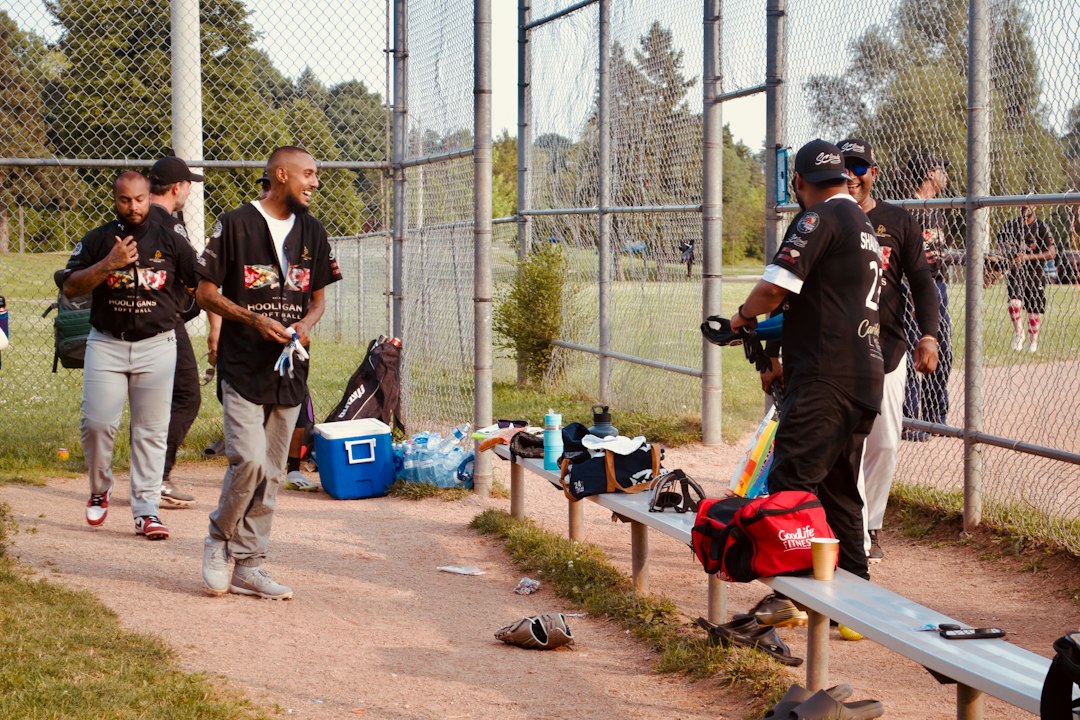




There's a moment every high school athlete knows.
You've taken the same swing a thousand times in practice. Your mechanics are solid. Your coach has told you so. But the second the game is real — the scoreboard is lit, the stands have people in them, and there are two outs in the bottom of the sixth — your body does something completely different. Your hands tighten. Your breathing changes. The swing that felt automatic three hours ago in the cage suddenly feels like something you have to think about.
That gap between what you can do and what you actually do under pressure? That's the mental side of high school sports. And for most athletes, it's the biggest untrained gap in their game.
This isn't a clinical guide. No jargon. No abstract theory. This is for the athlete who's ever walked back to the dugout confused about why their body betrayed them — and for the former player who can still feel exactly what that's like. We're going to break down what's actually happening in your head, why it happens, and give you a short, practical mental routine you can start using this week.
What's Actually Happening When Nerves Hit
Pre-game jitters aren't a character flaw. They're not a sign that you're weak or that you don't belong. They're a physiological response — your body releasing adrenaline because it's reading the situation as high-stakes. The same system that would help you sprint away from danger is now flooding your muscles with tension right before you need them to be fluid and precise.
The problem isn't the nerves themselves. It's that most athletes don't have a plan for what to do with them.
Here's what typically happens without a plan:
- The adrenaline hits, and the athlete tries to fight it — tensing up further, overthinking mechanics, telling themselves to "calm down" (which, neurologically, does almost nothing useful).
- Focus narrows too tightly onto outcome — what happens if I strike out, what happens if I boot this ball — instead of staying on process.
- Muscle memory, which runs best on automatic, gets interrupted by conscious thought. You start watching yourself perform instead of doing the performance.
The mental game of baseball and softball is particularly demanding because of the waiting. Unlike basketball or soccer, where you can burn off anxiety through constant movement, baseball forces you to sit with your thoughts between pitches, between at-bats, between innings. That waiting time is where mental discipline either holds or falls apart.


The athletes who handle pressure best aren't the ones who feel less of it. They're the ones who've built a system for what to do when it arrives.
The Three Mental Challenges Every High School Athlete Faces
Before you can build a mental routine, you need to recognize which problem you're actually dealing with. In our experience working through this content, three challenges show up over and over at the high school level — and each one responds to a different approach.
1. Pre-Game Anxiety
This is the most common one. The night before, the morning of, the bus ride to the field — the mind starts running scenarios. What if I go 0-for-4? What if I make an error? What if we lose because of me?
The underlying issue here is future-focus. Your brain is living in a game that hasn't happened yet, trying to solve problems that don't exist yet. The fix isn't to stop thinking about the game. It's to redirect what you're thinking about the game.
2. In-Game Overthinking
This one usually shows up mid-slump or in high-pressure moments. You're at the plate and instead of tracking the ball, you're thinking about your elbow position, your hip rotation, your stride. You've essentially moved the control center of your swing from your muscle memory to your conscious mind — and your conscious mind is too slow and too cluttered to run a baseball swing.
The research on this is direct: a 2010 study published in the Journal of Sport & Exercise Psychology found that conscious attention to well-learned motor skills consistently disrupts performance — what researchers call "paralysis by analysis." It's not a mental weakness. It's mechanics, and it has a mechanical solution.
3. Recovering From a Bad Play
This might be the hardest one. You've booted a ground ball. You've thrown a wild pitch that let two runs score. The at-bat went badly. Now you have to stand back out there and perform again — in the same inning, sometimes on the very next pitch.
How quickly you can reset after a mistake is one of the highest-value mental skills in sports. The athletes who do it well aren't compartmentalizing through denial. They've practiced a specific reset trigger — a physical action that signals to the brain: that's done, this is now.
Building a Mental Routine That Actually Works
A mental routine isn't a motivational speech you give yourself. It's a repeatable sequence of small actions — almost like a physical warmup, but for your focus. The reason routines work is that they give your nervous system a known path to walk down before high-pressure moments. Familiarity lowers threat response.
Here's a simple three-part framework that works at the high school level. It's not complicated. It doesn't require a sports psychologist or an app. It requires about ten minutes of deliberate practice a few times a week.
Part One: The Pre-Game Reset (The Night Before and The Morning Of)
The night before a game, write down exactly three things:
- One thing you did well in the last game or practice.
- One specific thing you want to execute in tomorrow's game (not "play well" — something concrete, like "stay back on off-speed pitches" or "field every ball with two hands").
- One thing you're going to do when nerves show up (because they will).
That third one matters most. Decide in advance what your move is. Some athletes take three slow, diaphragmatic breaths. Some have a specific phrase they say to themselves. Some have a physical anchor — stepping out of the box, adjusting their batting glove, tapping their helmet brim. The specific action matters less than the fact that you've chosen it deliberately and practiced it.
The morning of the game, read what you wrote. Don't add to it. Just read it.
Part Two: The Focus Cue (Between Pitches and At-Bats)
Handling pressure in games starts with this realization: you cannot stay intensely focused for a three-hour baseball game. Nobody can. The athletes who look focused the whole game have actually learned to focus on cue — to turn intensity up at the right moment and let it down between plays.
Pick one physical action that becomes your "focus on" signal. This is your trigger to shift from rest-state to ready-state. Common ones:
- Digging your back foot into the dirt of the batter's box
- Taking one deliberate breath and releasing it slowly before getting into your stance
- A specific grip adjustment before fielding position
Use the same trigger every single time. After enough repetitions, the physical action starts to carry the mental state with it. This is the foundation of what sports psychology calls a pre-performance routine — and it works because habit and ritual reduce the cognitive load right before execution.
Part Three: The Reset Trigger (After a Bad Play)
This is the one most high school athletes skip — and it's the one that pays off the most over a full season.
After a mistake, you have about five seconds before your brain starts running the replay on a loop. Use those five seconds deliberately. Pick a physical reset action — something you do on the field, that takes about two seconds, that signals a hard line between what just happened and what's happening next.
In our experience covering mental performance for high school athletes, the most effective reset triggers are:
- A specific breath pattern (in for 4 counts, out for 4 counts, once)
- A physical self-talk phrase said quietly, like "Next play" or "Here we go" — something in the present tense, not a correction of the past mistake
- Looking at a fixed point — the outfield wall, the foul pole, something stable — and then deliberately looking back to the field of play
What you're doing is breaking the loop. You're not pretending the mistake didn't happen. You're choosing the moment when you stop processing it and start playing again.
A Story From the Diamond
Maya R., 17, a shortstop from a suburban Chicago high school, came into her junior season with a .340 batting average and a reputation as one of the steadiest defenders in her conference. Then she had two bad games back-to-back — a throwing error in one, an 0-for-5 game at the plate in the next — and the spiral started.
"I'd get to the plate and I already knew it wasn't going to go well," she said. "I'd set up in my stance and I could hear myself thinking about my hands. That never happened before."
She started using a pre-at-bat ritual: adjusting her left batting glove strap before every single pitch, then one slow breath out. Nothing fancy. She paired it with a reset phrase — "See ball" — which she'd say quietly after a called strike or a poor swing. By the third week of doing it consistently, the chatter in her head had quieted enough for her muscle memory to come back online. She finished the season at .318. Not perfect. But back to herself.
The routine didn't fix her mechanics. Her mechanics were always fine. It gave her focus something to do instead of running loose.
Focus in Sports Is a Skill, Not a Trait
One of the biggest misconceptions about mental toughness is that some people just have it. That the athletes who perform under pressure are built differently — more confident, more composed, less affected by the moment.
That's not what the evidence shows, and it's not what the best high school coaches will tell you.
Focus in sports is trained the same way a curveball is trained. Repetition, feedback, deliberate practice. The athlete who seems unflappable in the seventh inning isn't feeling nothing — they've just practiced the sequence of returning to the present moment so many times that it's become automatic.
Here's what that practice looks like at the high school level, broken into two concrete skills:
Skill 1: Attention control — the ability to choose what you pay attention to. In a batter's box, that means ball tracking: finding the ball in the pitcher's hand early, following it through the release point. When your attention drifts (and it will), you practice noticing the drift and returning. Same as a physical rep.
Skill 2: Present-moment anchoring — the ability to stay in this pitch, this play, this moment instead of ahead (outcome anxiety) or behind (mistake replay). Physical anchors — the dirt under your cleats, the grip of the bat, the sound of the crowd — help the brain stay grounded in the now instead of floating into the imagined future.
Both skills improve with intentional practice. Neither requires special talent. Both are trainable starting today.
What Coaches and Parents Can Do (Without Overdoing It)
A quick note for the adults reading this — because the mental game doesn't happen in a vacuum.
The most common way coaches and parents accidentally undermine a young athlete's mental game is by focusing exclusively on outcome after a performance. "You went 0-for-3" or "you gave up three runs" without any conversation about process leaves the athlete with nothing actionable to improve. Outcome feedback tells them how it went. Process feedback tells them what to work on.
Two things that help:
- After a game, lead with one specific process-level observation. "I noticed you were staying back on breaking balls better today" gives the athlete something concrete to build on.
- Normalize the bad game. Every high school athlete — every professional athlete — goes through stretches where the game feels hard and the mental noise gets loud. Treating it as a crisis amplifies the problem. Treating it as a normal part of the season that has a solution keeps the athlete in problem-solving mode.
The mental side of high school sports is a team project. The athlete does the internal work. The people around them set the conditions for that work to take root.
Your jersey is still out there waiting.
Design yours in minutes and see your name and number exactly the way you remember it.
Frequently Asked Questions
How long does it take to build a mental routine that actually works?
Most athletes start noticing a difference within two to three weeks of consistent daily practice — not because the routine is magic, but because repetition builds the habit strong enough that it kicks in automatically under pressure. The key word is consistent. A pre-game routine practiced only on game days takes much longer to become automatic than one practiced every day, including practices and scrimmages. Start with one piece — the pre-at-bat focus cue — and add the others once the first one feels natural.
Is what I'm feeling before games actually anxiety, or is it just excitement?
Often both — and physiologically, they're closer than most people realize. Elevated heart rate, heightened awareness, faster breathing: these are the same physical markers for anxiety and excitement. Research on performance psychology suggests that reappraising pre-game nerves as excitement ("I'm ready for this") rather than anxiety ("I'm scared of this") measurably improves performance outcomes. The physical sensation doesn't have to change. The interpretation of it can.
What should I do if I'm in a slump that's lasted more than two weeks?
First, separate the mental slump from any potential mechanical issue — have your coach watch video of your swing or mechanics from before the slump and compare it to now. If the mechanics look the same, you're dealing with a mental pattern, not a physical one. At that point, the most effective intervention is usually to simplify your focus cue to a single, very specific thing — for a hitter, that might be "track the ball out of the hand" and nothing else. Slumps that persist often do so because the athlete is trying to fix too many things at once. Pick one thing. Let the rest go. The game tends to come back when you give it space to.
Can these mental techniques help with positions that don't involve hitting, like pitching or outfield?
Absolutely — and in some ways, the mental game matters even more for pitchers, who have to maintain composure over a long outing and reset after every hitter. The same framework applies: a consistent pre-pitch routine (grip the ball a specific way, take one breath, get the sign), a reset trigger after a bad pitch (step off the rubber, look at the outfield, come back), and intentional attention control (focus on the catcher's glove target, not the batter's reaction). Outfielders can use the same reset technique after a misread fly ball. The structure of the routine adapts to the position; the underlying mechanics are identical.
See also: athletic identity after high school | what high school sports teach you that nothing else could | grief that comes with the end of your athletic career | why you still dream about high school games | the gap between your athletic memory and your current body