

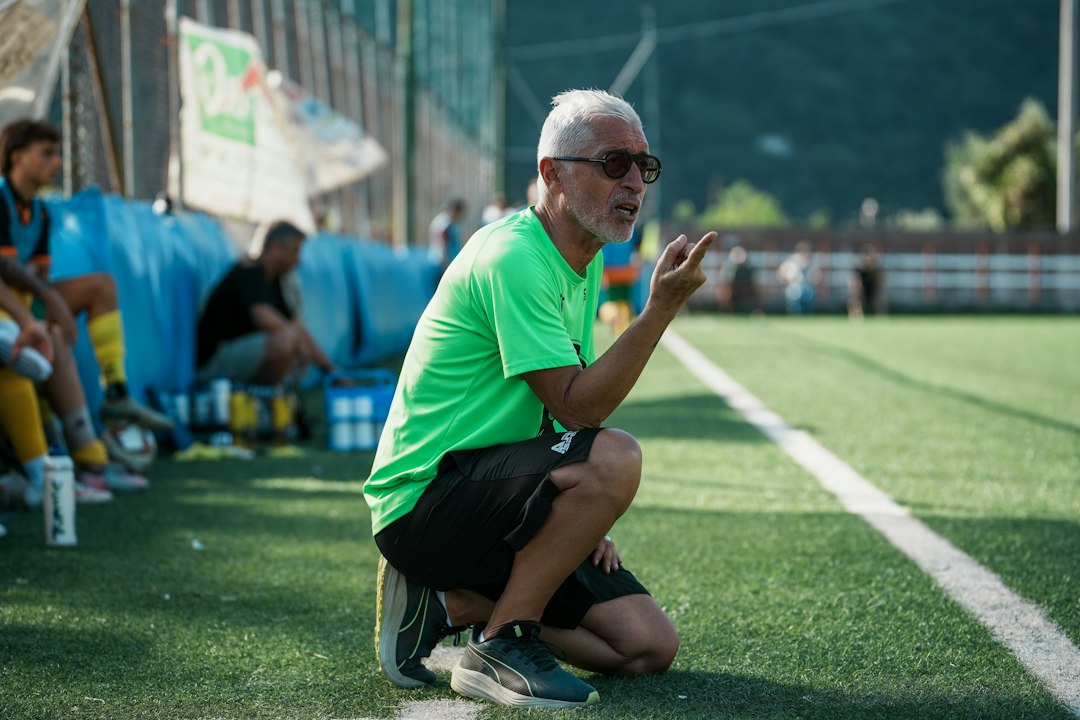




You remember the moment you made the promise to yourself.
Maybe it was the coach who dressed you down in front of the entire squad over a mistake that was more anxiety than incompetence. Maybe it was the one whose favoritism was so undisguised that the team manager's son got more floor time than your hardest-working teammate. Or maybe there was no single incident at all — just a long, slow accumulation of seasons under someone who treated victories as personal trophies and players as expendable equipment.
You said: When I coach, I won't be anything like that.
Now you're coaching my own kid's team — or you're a few weeks from it — and somewhere around the third practice, something quietly uncomfortable surfaces. A phrase comes out of your mouth and you recognize it immediately. Not because it's yours. Because it belongs to someone else. Someone you spent years leaving behind.
This article is for that moment. And for every one that follows it.
The Former Athlete Trap: When Your Playing Career Becomes Their Burden
Here is what the standard youth-sports coaching manual will not tell you: former athletes are simultaneously the most passionate and the most potentially harmful coaches that youth sports produces.
The passion requires no defense. You know the sport at a level that cannot be faked. You have muscle memory, tactical fluency, and a genuine relationship with the game that no weekend certification course can manufacture. When you break down a pick-and-roll, a hitting sequence, or a defensive scheme, you are not reading from a binder — you are drawing on ten thousand lived repetitions inside your own body.
The hazard moves more quietly. It runs in two specific directions.
Direction one: You coach the sport you played, not the sport your kid is playing.
The game has changed. The science of youth athletic development has changed. Training loads, periodization philosophy, the research-backed emphasis on sport sampling over early specialization — all of it has shifted substantially from what passed for standard practice even fifteen years ago. The methods your coach applied to you were the product of that era's knowledge and assumptions. Some of those methods were genuinely useful. Others caused harm that nobody fully understood at the time. Almost none of them translate intact to a nine-year-old standing on the baseline in front of you today.


In our experience with former athletes who have taken on youth coaching roles, the drill that "worked" for you frequently worked despite how it was delivered, not because of it. You had the motivation and resilience to push through a suboptimal coaching environment. The kid who disappears from the roster after two seasons may not have had that same reserve — and you would never know what they might have grown into.
Direction two: You coach your kid as though they are an earlier version of you.
This one is more personal and considerably harder to catch from the inside. You know precisely what it cost you to reach the level you reached — the hours, the setbacks, the specific adjustments you had to make to keep progressing. When you watch your son or daughter on the field or the floor, you see potential — sometimes genuinely present, sometimes projected — and you begin coaching that potential with the quiet urgency of someone who is also, beneath the surface, trying to resolve something that never fully closed in your own story.
That is not coaching. That is your unfinished autobiography being written at your kid's expense.
The research from the Aspen Institute's Project Play initiative points consistently to the same finding: early dropout from youth sports correlates most strongly not with a shortage of talent but with a loss of perceived fun — and the adults positioned on the sideline are the primary variable shaping that perception.
What Your Language Reveals About How You're Actually Coaching
One of the most immediate self-audits available to any youth sports coach parent requires nothing more than listening carefully to yourself during practice.
Not to what you are teaching. To whose words you are using to teach it.
If you are correcting a movement pattern and the cue you reach for is something your old coach said to you word for word — pay close attention to that. Language is never neutral. It carries an entire emotional relationship inside it: the temperature of the original delivery, the power dynamic it emerged from, the unspoken assumptions of your sport at a different moment in its history. Kids absorb all of that. They don't only process the instruction. They feel everything running underneath it.
Former athlete coaches tend to fall into a few specific language patterns:
- Era-specific terminology that carries no meaning for a child who has no reference point for your playing years
- Implicit autobiography — "When I was your age..." constructions that are personal history dressed up as coaching
- Premature outcome language — describing what the finished skill should look like before a player has the physical development to produce it, then registering visible frustration when the gap remains
The correction is not to discard your knowledge. It is to translate it. What did your body actually do when a particular cue finally clicked for you? What did the correct movement feel like from the inside? Give them the sensation to aim for, not just the image to approximate.
The Rule That Holds: Two Distinct Roles, One Clear Boundary
Every former athlete who coaches their own child eventually reaches the same moment. Practice ends. You are in the car. Your kid is in the back seat, quiet, reading the atmosphere to determine which version of you is about to speak first.
The coach — who spent the last ninety minutes cataloging every missed assignment, every technical error, every opportunity left unrealized — or the parent.
The rule, stated directly: you are their coach during practice. You are their parent the moment practice ends.
This is a structural commitment, not a motivational concept. In daily terms it means:
- Coaching feedback stays at the facility. In the car, at dinner, at bedtime — you are the parent. You ask how they felt, what they enjoyed, whether they want to stop somewhere on the way home.
- If something significant needs to be addressed, it waits for the next practice and is delivered exactly as you would deliver it to any other player on the team.
- You give your kid the one thing no other player on the roster receives from you: a parent at home who has genuinely stepped out of the coaching role.
Holding this boundary is harder than it sounds, especially when a difficult practice is still fresh and the frustration hasn't fully settled. But the parents who maintain it consistently — not only when things are going well — tend to observe the same result: their kid begins talking about the sport again, unprompted, because the ride home stopped being an extension of practice and became neutral ground.
A Self-Audit Checklist for Before Your Next Practice
Marcus T., 41, a former college baseball shortstop now leading his daughter Sofia's 10U softball team, did not register how completely he had drifted toward his old coach's methods until another parent approached him after a session and said quietly: "You might want to pay attention to how you're speaking to the kids when they miss the cutoff throw."
He sat with that observation for several days and traced back through the previous three weeks. The pattern was clear once he looked for it. He had been running a conditioning drill that his old coach had used as a form of punishment — reframed on the surface, but identical in its emotional structure. The players had no idea why they were running extra laps. They only understood that he was dissatisfied. That is not a coaching environment. That is atmospheric pressure with no explanation attached.
He made specific changes. Not by abandoning structure or softening standards, but by explaining the purpose behind each drill before it started, by watching deliberately for the moment a concept landed for an individual player and naming it aloud, and by making the recognition of progress as visible as the correction of errors.
Use this checklist before your next session — honestly, not charitably.
On your communication: - [ ] Have you explained the purpose of each drill, not only the mechanics of executing it? - [ ] Are your corrections running at a ratio of at least 3 affirmations to 1 corrective note? - [ ] Does every player — including your own kid — understand what success looks like at their current developmental stage? - [ ] Are you using your child's name in corrections more often than any other player's name?
On your methods: - [ ] Have any drills carried over from your playing days without being evaluated for age-appropriateness? - [ ] Have you made any comparison — spoken or implied — between your playing career and your kid's current performance? - [ ] Do players leave practice feeling capable and energized, or uncertain and deflated?
On the ride home: - [ ] Did your kid get ten minutes of conversation unrelated to sports before practice came up? - [ ] Did anything from the session follow you out of the facility and into the evening? - [ ] Did you ask what was enjoyable about practice — not only what they are working to improve?
No score, no grade. But if you worked through that honestly and found more than two or three boxes you couldn't check, you have a specific and actionable direction to move.
The Coaching Mistakes Former Athletes Make Most Often
These patterns surface repeatedly — not because former athletes are inadequate coaches, but because the specific experience of having competed at a meaningful level creates specific blind spots that are genuinely difficult to see from inside them.
Mistaking intensity for development. The practices that forged your toughness were not developmentally optimal — they selected for athletes who could survive that particular environment. An unknowable number of players with genuine potential exited the sport before you ever had the opportunity to see what they might have become. Sustained high intensity at the 10U or 12U level does not build the next generation of athletes. It reduces the pool of kids who stay long enough to find out.
Coaching the exception, not the rule. You were likely ahead of your peers athletically from an early age. You likely responded well to a particular style of coaching because you had the physical foundation to execute what was being asked of you. Your least-developed player is not you at a younger age. They are a distinct person on a distinct developmental path, and what they need from you is almost certainly not what your coach provided to you.
Over-coaching every repetition. The knowledgeable former athlete's instinct is to insert a correction or cue into every moment of a drill. Some of the most durable learning in youth sports happens when a player makes an independent decision, observes the result without immediate adult commentary, and has enough uninterrupted time to process what occurred before anyone speaks. Not every moment requires a coaching response. Some moments simply need room to breathe.
Treating your kid's career as a second opportunity. This deserves to be said plainly. If your own athletic career ended with something unresolved — a recruitment that didn't come through, an injury at the wrong moment, a ceiling you hit and could not break past — that story belongs to you. It is yours to carry and to work through, ideally away from the field. It does not belong to the eleven-year-old who is quietly wondering, on the drive to practice, whether today you are going to be their coach or their parent.
How to Actually Become the Coach You Wished You'd Had
None of this is a case for lowered standards or softened expectations. The coaches who produce the most resilient long-term athletes — across sports, across levels — are not the permissive ones. They are the coaches who hold high expectations inside a high-trust environment. Those two things are not opposites. They are the specific combination that works, and the research on long-term athletic development supports it consistently.
In practice, becoming the coach you wished you'd had means four concrete commitments:
- Name what players do correctly, with precision. Not "nice work" — "Sofia, your weight transfer on that throw was exactly right. That is the adjustment we have been building toward." Specific affirmation lands and stays. Generic praise dissolves before the player reaches the dugout.
- Correct privately when the situation allows — especially with your own kid. Public correction has its place, but it carries the risk of activating shame rather than learning. A correction delivered one-on-one communicates that the feedback belongs to the player. A correction made in front of the group communicates something else.
- Ask questions more frequently than you provide answers. "What were you seeing develop on that play?" builds more than "Here is what you should have seen." The player who learns to read the game independently becomes the athlete who can self-correct when you are not present.
- Hold your kid to the same standard as every other player on the team — not a harder one, not an easier one. Favoritism in either direction erodes the team's trust in your judgment and places your child in a position they never asked to occupy.
One of the most consequential coaching mistakes to avoid — and one that feels like dedication precisely because it involves effort — is merging the coach role and the parent role so thoroughly that your kid cannot find the line between them. They need both from you. Just not simultaneously, and not in the same space.
Your jersey is still out there waiting.
Design yours in minutes and see your name and number exactly the way you remember it — a tribute to the player you were, in the style of the sport you gave everything to.
Frequently Asked Questions
How do I handle it when my kid has a rough practice and I can feel the coach and the parent competing in my head at the same time?
Build a physical transition, not only a mental one. The moment practice ends, the coaching role ends with it — mark the shift with something concrete. Some coaches remove a hat, put away a clipboard, deliberately change their posture walking off the field. The physical act of stepping out of the role reinforces the internal one. If frustration from the session is still present in the car, name it directly: "I need a few minutes to step out of coach mode before we talk." That honesty is good parenting on its own terms. It also models emotional regulation in a way that no drill can.
My kid tells me I treat them differently than the rest of the team. Are they right?
Almost certainly, yes — and the more useful question is which direction. If you are harder on them, it is typically because you perceive more potential and feel more license to push. If you are easier, it is usually because the parent relationship overrides the coaching standard when things get uncomfortable. Both versions are unfair to your child and to the team. A practical adjustment: identify two or three players at a similar developmental stage to your kid and calibrate your feedback and expectations consistently across that group. At practice, your child should be indistinguishable from that group in how you address them.
What is the single most impactful change I can make right now if I want to coach my child more effectively?
Stop coaching in the car on the way home. No practice review, no corrections, no "what do you think went wrong?" — none of it. This one change shifts the entire emotional experience of the season for your kid. It removes the portion of the day that most youth athletes dread most, which is not the demanding practice or the losing game but the debrief with the parent-coach who cannot fully step out of the role. The ride home belongs to your kid, without conditions. Start there, and everything else becomes considerably easier to build on top of.
See also: what high school sports actually taught you | athletic identity that never fully goes away | adult recreational leagues as a healthier outlet