

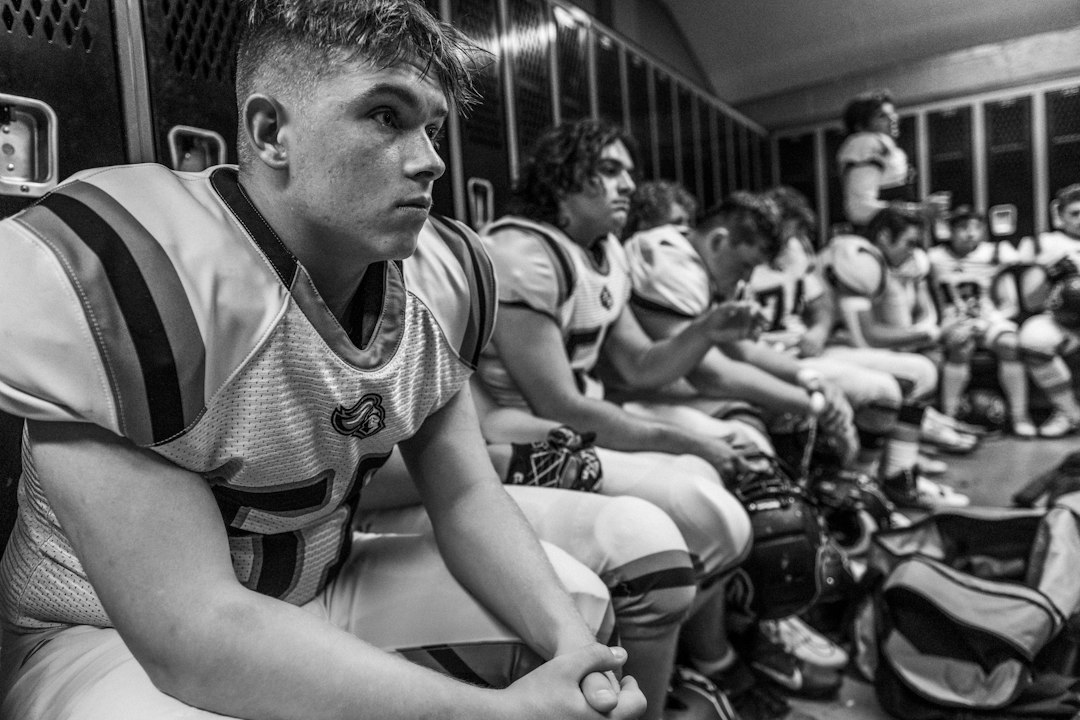




What high school sports taught me about failure is probably the most durable education I received — in any classroom, in any season, under any coach who ever blew a whistle at me.
Not because the lessons were delivered clearly. They weren't. Nobody hands you a framework between the third quarter and the fourth. Nobody pulls you aside after a strikeout and says, here is precisely what this loss is building in you. The education happened the way most real education does: sideways, through repetition, in circumstances you didn't fully choose and couldn't always control.
This isn't a piece about grit as a buzzword or resilience as a motivational poster. It's about the specific, unglamorous mechanics of what actually happens when failure is baked into your weekly schedule — and what that does to a person over four years of showing up anyway.
The Classroom Said Failure Was Final. The Scoreboard Said Try Again.
Here's a contrast that doesn't get stated plainly enough.
In school, a failing grade is an event with permanence. It lives in a gradebook. Teachers circle it. Parents sign off on it. It follows you — to honor roll calculations, to college applications, to the private story you tell yourself about whether you're "good at" a particular subject. A bad test result is archived. It marks a fixed point in time where you were measured and came up short, and that measurement does not expire.
In sports, failure is the curriculum.
In our experience covering athletes and their stories, the single most consistent thread isn't the championship memory or the highlight play — it's the cumulative texture of all the times things went wrong. The at-bats that ended in strikeouts. The free throws bricked under pressure. The relay leg that came in second because the handoff got fumbled. Those weren't exceptions to the athletic experience. They were the athletic experience, week after week, in front of coaches, teammates, and stands full of people who drove across town to watch.


What that repetition does — quietly, without anyone announcing it — is dismantle the idea that failure is an identity.
A kid who strikes out in the fourth inning and bats again in the sixth doesn't have time to build a narrative about being "bad at hitting." The lineup card doesn't offer that luxury. You're back in the box regardless. That enforced return — that structural refusal to let the bad moment be the last word — is not something most academic environments are built to provide. Sports provides it on a schedule.
What the Losing Streak Actually Teaches You
The singular loss — the heartbreaker, the championship that slipped away in the final seconds — gets most of the storytelling attention. Coaches give speeches about it. Films are made about it. Reunion conversations always come back to it.
That's not where the real education happens.
The real education happens in the losing streak.
Three games down. Five. A month where nothing clicks no matter what adjustments get made. A season where the talent is present but the results aren't, and the scoreboard keeps telling the same inconvenient story. That extended experience — where the obvious fixes have been tried and still haven't worked — is where something deeper than skill gets tested.
This is where learning from losing in sports stops being about tactics and starts being about character.
A sustained rough patch teaches things that a single bad game cannot:
It teaches you to separate effort from outcome. At some point in an extended rough patch, the choice becomes visible: stop working hard because hard work isn't producing wins, or continue giving full effort regardless of the result. Athletes who choose the latter — and do it genuinely, not performatively — develop something that transfers directly into professional life. They learn that effort is the only variable entirely within their control. Everything else is partially negotiable.
It teaches you what teammates actually are. You don't discover who your people are when you're winning. You find out in the fourth quarter of a game you're losing by fourteen points, when no outcome is salvageable and everyone is still in it together anyway. The teammates who shut down, assign blame, or coast through the final minutes — you see that. The teammates who dig deeper, stay loud, find something to play for even when the result is decided — you see that too. You carry both observations forward.
It teaches you the mechanics of return. Not just literally walking back onto a field after a bad result — but the internal process of absorbing a loss, sleeping on it, and then choosing to reengage with the same thing that hurt you. That is a skill with transferable application. Most people never develop it systematically, because most environments don't require it on a weekly schedule.
The Crucible Nobody Signed Up For
Marissa T., 34, played varsity volleyball in central Ohio and describes her junior season as "the year I almost quit — and the year I became who I am." Her team dropped eleven of their first fourteen matches. She missed critical serves in multiple close games. The stat sheet was unforgiving.
"I remember sitting in the parking lot after one game thinking that failing in front of people you respect is the worst feeling there is," she said. "And then thinking — I have practice Monday. So now what?"
That now what is the question that builds resilience from high school athletics in a way nothing else quite does. It isn't philosophical. It's logistical. The schedule exists. The team needs you. The season isn't finished. Now what?
Marissa's team finished 14-14 — not a winning record by any measure. She went on to play club volleyball in college, became a regional sales director in her early thirties, and traces her capacity for handling sustained underperformance — without spiraling — directly to that junior season.
"Nobody in my office has experienced what a losing streak with people counting on you actually feels like. I have. It makes every bad quarter survivable."
What the Locker Room Teaches That No Classroom Can
There's a specific geography to the athletic experience that matters and almost never gets acknowledged in retrospect: the locker room after a loss.
It isn't like any other space. It's private in a way that public life isn't. The masks come off — literally and figuratively — and what remains is a group of people who all failed together, sitting with it, trying to figure out what to say or not say. No curriculum covers this. No textbook describes how to conduct yourself when you've let teammates down, or they've let you down, or everything went sideways and everyone's exhausted and there's still homework due tomorrow.
What you learn in that room — through awkward silences, through a coach choosing words carefully, through the senior who cries and the sophomore who lands one joke that lands exactly right — is how to be present and functional in the middle of something that didn't go your way.
Coping with failure as an athlete isn't formally taught. It emerges from repeated exposure to exactly that environment, in all its uncomfortable specificity. You learn that people process differently. You learn that silence is sometimes correct. You learn that the teammate you expected to fold holds it together, and the one who seemed unshakable needs ten minutes alone. These are graduate-level observations about human behavior. They're happening in ninth grade, delivered by the consequences of a scoreboard, with no textbook involved.
What High School Sports Taught Me About Failure That I Still Use Today
Across the practices in the rain, the early buses, the games that felt enormous in the moment and settle into statistics in hindsight — the most transferable lessons aren't the tactical ones.
They're these four:
Failure is information, not verdict. A loss tells you something. A missed assignment tells you something. A botched play in a big moment tells you something. The athlete who survives a difficult season learns to ask what does this tell me? rather than what does this say about me? Those are different questions. They lead to very different places.
The comeback is a practiced skill, not a personality trait. Popular culture frames resilience as something people either have or don't — distributed unevenly at birth, fixed in place. What high school sports demonstrate, over and over, is that returning after failure is something you practice. Every time you come back to Tuesday's practice after Saturday's loss, you are practicing the skill of return. Do it dozens of times across multiple seasons and you have a functional, refined competency for it. Earned, not inherited.
You can perform under observation while imperfect. This one is underrated. Most professional and creative work involves doing something imperfectly while other people watch. Sports trains you for that specific experience from early adolescence. You make errors publicly. You fail in front of crowds. You continue anyway. That particular combination — failing visibly, continuing visibly — is something many adults spend entire careers trying to avoid. Athletes learn in their teens that it can be survived. More than survived: navigated.
Consistency outlasts talent. The most gifted player on most teams often wasn't the most improved by season's end. The athletes who got better were the ones who showed up, processed the losses, made adjustments, and showed up again. Over four years of high school athletics, that lesson compounds into something that functions as a genuine competitive advantage in adult life.
The Person Who Came Out the Other Side
There's a reason so many people look back at their high school sports years as formative in a way that's distinct from their academic experience — even when they weren't stars, even when the team never won a title, even when the memory holds more losses than wins.
The academic environment, for all its value, is structured primarily around getting things right. The grade rewards correctness. The test measures mastery. The goal is to demonstrate competence, not to practice falling down and getting back up.
Sports inverts that structure. Research from the American Psychological Association on youth sport development consistently shows that the challenge-and-recovery cycle — not winning itself — is the active ingredient in the character outcomes athletes describe decades later. The scoreboard is almost beside the point. It's the cycle that does the work: failure, required return, failure again, required return again.
Somewhere in the middle of a season you barely survived, in a sport that sometimes felt bigger than it was and sometimes felt exactly as important as everything, you were being changed by that cycle.
Most of us didn't notice it happening. We were too busy trying to make the next play.
But it happened. It built something specific. And you've been drawing on it ever since — in meeting rooms, in hard conversations, in every moment where the outcome wasn't what you needed and you had to figure out what came next anyway.
Your jersey is still out there waiting.
Design yours in minutes and see your name and number exactly the way you remember it.
Frequently Asked Questions
Does playing high school sports actually build resilience, or is that something athletes tell themselves later?
The evidence suggests it's not nostalgia. Longitudinal research on youth athletics consistently shows that adolescents who participate in team sports demonstrate higher rates of emotional regulation and stress tolerance in early adulthood — not because sports carry any inherent magic, but because the structure of competitive athletics forces repeated exposure to failure and recovery in an environment where continuation is expected. The benefit isn't automatic and depends meaningfully on coaching quality and team culture. But the underlying mechanism is real: the weekly requirement to return after losing does, over time, build a functional and durable capacity for it.
What if I rarely played — sat the bench most of the time? Does the experience still transfer?
Often more than people expect. The athlete who practices with full effort and rarely sees game time, who processes the frustration of limited opportunity and continues showing up anyway — that experience contains nearly every psychological benefit that transfers to adult life. Exposure to team dynamics under pressure, sustained commitment without guaranteed reward, the locker room culture of shared failure and shared purpose — none of that requires a starting position. Some of the most durable lessons come from exactly the athlete who had every reason to check out and chose not to.
How do you actually apply what sports taught you about failure to a job or career situation?
The translation is more direct than it first appears. The three most portable skills are: separating effort from outcome, which means continuing to work with full engagement regardless of short-term results; returning after visible failure, which means taking the next step before the feeling of failure has fully passed; and treating loss as information rather than verdict, which means identifying one specific thing to adjust rather than reassessing your entire capacity. In practice, this looks like delivering a weak presentation and immediately preparing for the next one rather than avoiding future presentations. The mechanism is identical to the one you practiced on a playing field. You've already done it hundreds of times. You're doing it again.
See also: the grief that comes with the end of your athletic career | what high school sports teach you that nothing else could | that long bus ride home after a loss | how your athletic identity shaped who you became after high school