

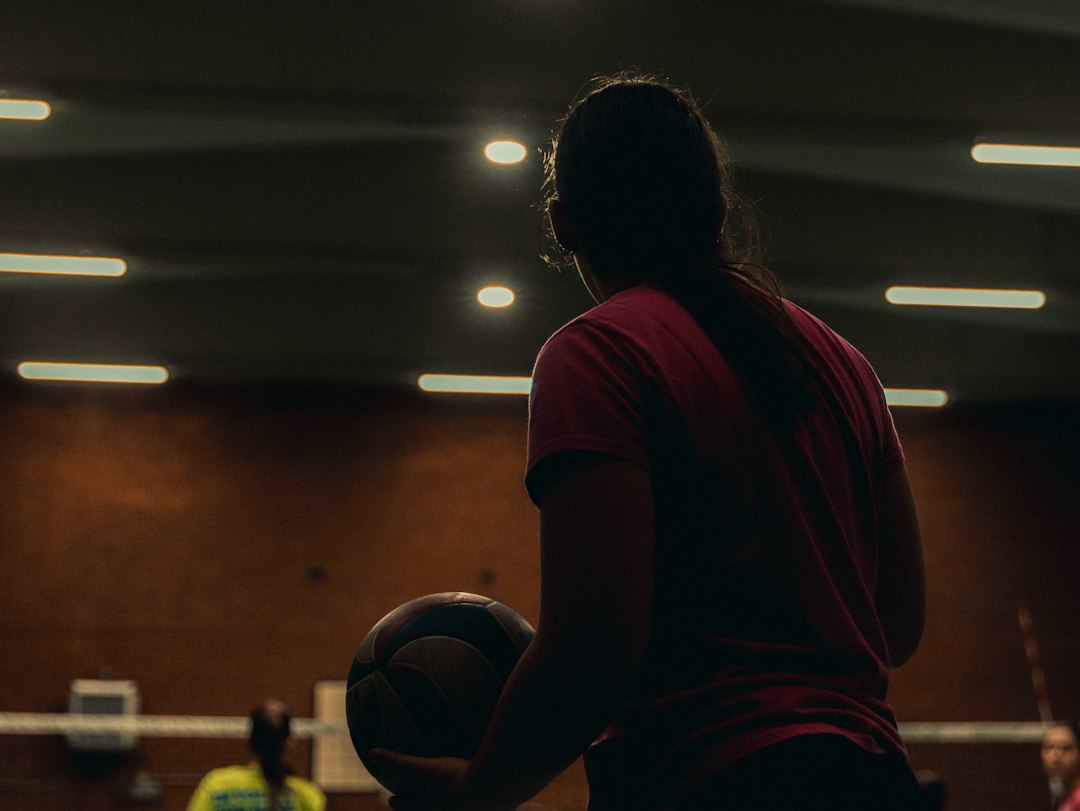




There's a specific moment every former volleyball player knows.
You're somewhere ordinary — clearing out a closet, scrolling through old photos on your phone, watching a high school match at your niece's gym — and it hits you. Not the score from some regional semifinal. Not a stat. The jersey. You remember exactly what it looked like. The color. The number. The way the armholes sat against your shoulders when you reached up for a serve. You remember which side the name was printed on. You remember if the font was block or italic.
Volleyball jerseys are one of those objects that lodge themselves somewhere deeper than memory. They become part of how you understood yourself at sixteen, seventeen, eighteen — before you fully had language for identity. This article isn't about buying one. It's about what the one you wore actually meant, and why the details of it — the cut, the school colors, the number on your back — are still so precise in your mind years later.
The Jersey Was a Uniform. The Number Was a Contract.
When a coach hands you a jersey, what's actually happening isn't administrative. It's not just "here's what you wear on game days." It's the physical transfer of belonging. You are now part of something that existed before you and will exist after you. The jersey is the proof.
High school volleyball jerseys, specifically, carry a particular weight because the sport is one of the few where every player's position on the court is visible and rotating. Unlike a football jersey where your number indicates your position before you move, a volleyball uniform marks you as part of a system — a six-person machine where your absence creates a specific, irreplaceable gap. That number on your back wasn't decoration. It was an assignment. A promise. I will be in this spot when it matters.


In our experience covering team sports and the athletes who played them, the players who remember their numbers most vividly are the ones who took that promise seriously. The number wasn't a favorite. It was issued. And yet — you made it yours.
This is the first thing the jersey meant: you were accountable to something larger than yourself, and you had a specific identity within it.
What the Number on Your Back Actually Communicated
Volleyball numbering doesn't carry the same rigid positional coding as football or baseball, but numbers still circulate in informal hierarchies at the high school level. Certain numbers tend to cluster around setters, liberos, and captains — not because of rules, but because of tradition within programs. When a senior starter hands a jersey number to a sophomore coming up through the program, something transfers with it. An expectation. A standard.
If you wore a number a great player had worn before you, you probably knew it. Your coach may have mentioned it. A teammate definitely did.
That's not just sports mythology. That's identity construction through object continuity — the same psychological mechanism that makes a grandmother's ring more meaningful than a new ring of identical material and design. The history embedded in the object changes how the object feels to wear.
School Colors and What It Felt Like to Wear Them in Public
Here's something worth naming directly: school colors for a volleyball jersey are one of the few contexts in adolescent life where wearing your affiliation openly is not embarrassing. It's expected. It's correct.
Walking through the school hallways on game day in your high school volleyball jersey — that specific, sanctioned permission to be identified — is a social experience most former players underestimate when they're living it. You represented the school. You were visually legible as someone who does something. The school colors weren't just aesthetic; they were shorthand for a whole set of truths about who you were that day.
This is why so many former players remember the specific shade. Not "blue" — that particular blue, the one that photographed slightly differently than it looked in person, the one that clashed perfectly or imperfectly with the away team's colors, the one that shows up in yearbook photos and looks exactly right.
Color memory is identity memory. The school colors of your volleyball uniform are encoded alongside the feeling of belonging to that team in that place at that time in your life. They are not separable.
The Away Jersey Was Different — And You Knew It
Most programs have a home jersey and an away jersey, and if you played long enough to wear both regularly, you know they felt different. Not just aesthetically — emotionally.
The away jersey was the one you wore when you were the visiting team. When the gym wasn't yours. When the noise was against you instead of for you. Playing in away colors, in someone else's gym, with their student section behind the opposing bench — that version of the jersey asked something different from you.
Some players prefer the away jersey for exactly this reason. It proved something a home jersey couldn't.
The Cut of a Volleyball Jersey and Why It Was Never Just Practical
Volleyball jerseys are sleeveless. This is not controversial — it's functional. Full range of shoulder motion matters for serving, setting, hitting, and digging. But the cut of a volleyball jersey also does something the sport's designers probably didn't engineer intentionally: it makes the player visible in a specific way.
A sleeveless uniform shows the work. You can see shoulders, arms, and the physical reality of someone who has been in a gym several hundred hours over the course of a season. The volleyball jersey cut doesn't hide effort — it displays it.
For many players, this was complicated. For others, it was motivating. For almost everyone who wore one through a full season, the way the jersey fit by the end of the year was different from the way it fit at the first practice. Not just because of physical changes — because of what had happened while wearing it.
The jersey absorbed the season. By the time you wore it in your last game, it had been through every practice, every road trip, every comeback win and bad loss. The fabric holds none of that, of course. But the player wearing it does.
Mia T., 29: The Jersey She Didn't Want to Give Back
Mia T., 29, played libero for her high school team in central Ohio for three seasons. At the end of her senior year, she delayed returning her jersey for two weeks — long enough that her athletic director sent a reminder. "I knew it was just a piece of fabric," she said. "But it felt like returning it was admitting it was over. I wasn't ready for it to be over." She eventually turned it in, but she'd already photographed it from six different angles the night before.
The jersey didn't belong to her program. But what it represented — that version of herself, in that gym, with those teammates — belonged to her entirely.
What the Jersey Said About the Team Before Anyone Played a Point
There's something that happens before a volleyball match that doesn't get enough credit: the visual moment when both teams take the court in their uniforms for warmup.
A well-matched team uniform — consistent fit, clean school colors, properly numbered — communicates something to the other team before the ball is served. It communicates organization. Investment. Seriousness. This is not psychological gamesmanship in some theatrical sense; it's the natural human response to visual coherence. A team that looks cohesive projects cohesion.
Coaches at every level understand this, which is why uniform decisions are almost never left to chance in successful programs. The volleyball uniform is part of the team's presentation of itself — and at the high school level, where recruiting and optics intersect with athletic culture in complex ways, how the team presents itself on the court matters beyond the scoreboard.
Some of the most memorable programs in high school volleyball history have had instantly recognizable uniforms. The color combination, the font, the cut — these details compound over years into something that becomes program identity. Former players carry that identity with them. When they see the same jersey on a current player, they feel it.
This is why uniform continuity matters to programs with long histories. It's not brand management. It's the visible thread connecting every player who has ever worn those colors.
What Manufacturing Actually Determines About the Jersey You Remember
This is practical but worth knowing: the way a volleyball jersey fits, holds color, and survives a season is entirely a function of how it was made.
Brands like Under Armour and Champro volleyball jerseys occupy different parts of the performance and budget spectrum, and the differences are not trivial. Under Armour's moisture-wicking constructions and compression-fit options became standard in higher-budget programs because the technical performance is genuine — the fabric moves differently under athletic stress. Champro, long a staple of mid-budget high school programs, has produced reliable, durable uniforms that hold up across a full season of washing and wearing without losing shape or color saturation.
Neither is inherently superior as a memory object. The jersey you remember isn't remembered because of its manufacturing specifications. But the way a jersey fits and feels during play absolutely affects how you wear it — and how wearing it feels becomes part of the memory. A jersey that gaps at the armhole or rides up during a dive is a jersey you're aware of while you're playing. A jersey that disappears into the background of your physicality lets you be fully present in the game.
The best volleyball jerseys, regardless of manufacturer, are the ones you stopped thinking about two minutes into warmups. Because they fit like they were made for what you were about to do.
Why the Memory of the Jersey Outlasts the Jersey Itself
Most high school athletes don't keep their jerseys. Some programs collect them back. Others fade or get lost in moves, storage units, or the specific category of "things I meant to keep track of." And yet the visual memory of the jersey persists with a precision that most physical objects in a person's teenage life don't achieve.
The reason for this is not complicated, but it's worth naming: the volleyball jersey was worn at moments of maximum emotional intensity. Winning a close set. Losing a match in heartbreaking fashion. Making a dig you couldn't believe you made. Standing in a line with your team while a crowd made noise because of what you were doing together.
The brain encodes memories differently during high-arousal emotional states. The details that surround those moments — the sensory specifics of the environment, the physical objects present — get encoded with unusual precision. This is why trauma survivors remember details that seem irrelevant to an outside observer, and it's the same mechanism that makes former athletes remember what they were wearing on the best day of their athletic life.
Research in memory consolidation consistently shows that emotional arousal during encoding produces stronger, more detailed long-term memories. The volleyball jersey is remembered so specifically because it was present at the moments that mattered most.
It's not sentimentality. It's neuroscience.
The Number You Wore and Whether You Would Choose It Again
Here's a question worth sitting with: if you could go back and choose your jersey number — really choose it, with full knowledge of what those years would mean — would you choose the same one?
Most former players, in our experience, would. Not because of superstition or sentiment in the simple sense. But because the number became inseparable from the specific version of themselves they were while wearing it. Changing the number would be changing something that doesn't feel changeable.
This is one of the quiet proofs of how completely an athletic identity forms around the jersey. You didn't choose the number. The number was assigned. And then, through the specific alchemy of wearing it through something difficult and real and important, it became yours in a way that goes beyond possession.
That's what the jersey did. It gave you a fixed point of identity during a time in life when almost everything else was shifting. It said: this is who you are here, in this context, with these people. And that specificity was a gift, even if you didn't recognize it as one at the time.
Your jersey is still out there waiting.
Design yours in minutes and see your name and number exactly the way you remember it.
Frequently Asked Questions
Why do volleyball players remember their jersey numbers so specifically?
Jersey numbers in volleyball are worn during moments of high emotional intensity — wins, losses, personal bests, team milestones. Memory research consistently shows that emotional arousal during an event strengthens and sharpens the encoding of surrounding details, including physical objects like uniforms. The number you wore is encoded alongside the most significant athletic experiences of your playing career, which is why it stays precise while other details from the same period fade.
What did the school colors on a volleyball jersey actually represent beyond the school?
School colors on a volleyball jersey function as a form of visible affiliation — a signal, worn in public, that you belong to a specific group with specific standards. At the high school level, where identity formation is intensely social, wearing school colors on game day carried a particular kind of permission: to be publicly identified as someone who does something and belongs somewhere. The colors became associated with the feeling of that belonging, which is why former players often remember the specific shade, not just the general color.
Does the brand or manufacturer of a high school volleyball jersey affect how players remember it?
Indirectly, yes. The manufacturing quality of a volleyball jersey — how it fits, moves, and holds up over a season — affects how present or absent the jersey feels during play. A jersey that fits well disappears into the background of athletic performance; a jersey that doesn't fit creates distracting physical awareness. Because the best game-day experiences tend to occur when a player is fully absorbed in play rather than managing equipment, the jerseys associated with peak performance are often those that were made to move correctly. Brands like Under Armour and Champro have both produced jerseys that meet this standard across different budget levels.
Is it normal to feel emotional about returning a high school sports jersey?
Completely. The jersey functioned as a daily physical confirmation of identity and belonging throughout your playing career. Returning it is, symbolically, the moment that chapter closes. What you're feeling isn't attachment to fabric — it's recognition that a significant phase of your life had a specific, now-concluded form. That's worth acknowledging, not minimizing.
Can you recreate a high school volleyball jersey from memory?
Yes — and the specificity with which former players remember their jerseys (color, number, font style, cut, name placement) typically provides more than enough detail to reproduce something accurate. Custom jersey services that allow number, color, and name configuration let former players reconstruct the specific object their memory has preserved, sometimes with greater accuracy than they expect.
See also: why personalized sports gifts hit differently than generic ones | the psychology of why high school sports still matter to adults | how your athletic identity shaped who you became after the final season | why your senior season memories are so unusually vivid | what your old varsity letter jacket still means — and what to do with it