

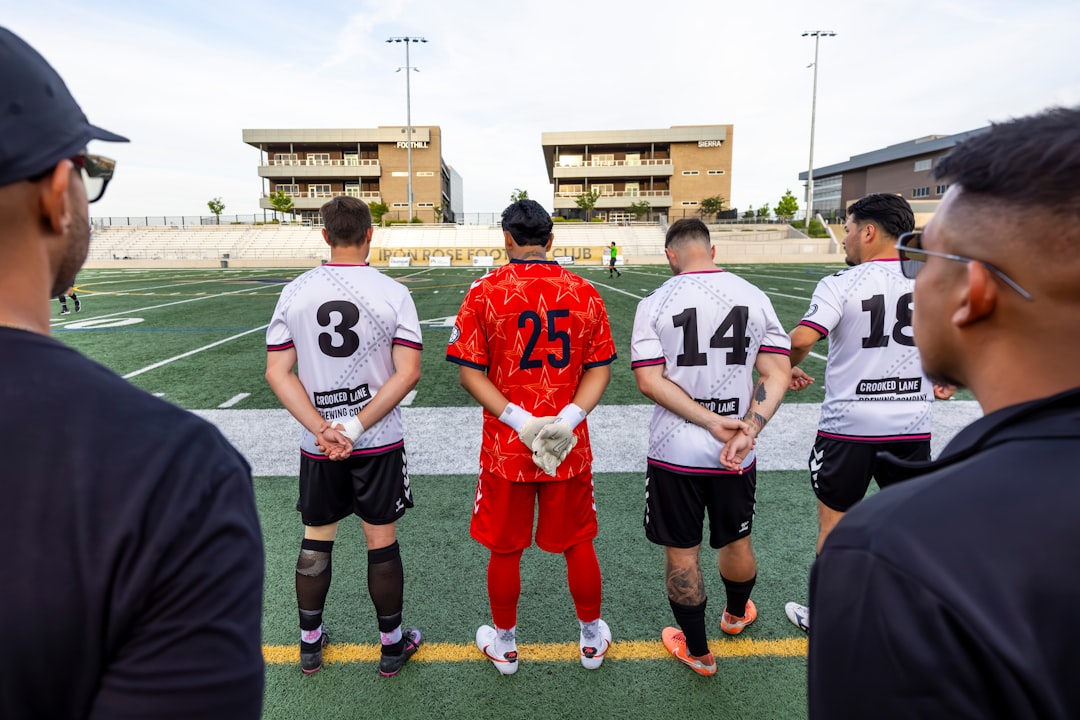


You already know the feeling before you can name it.
The final whistle. The buzzer. The last out. And then — before you've fully processed what just happened, before the score has settled into something you can carry — someone is lining you up. Coaches at both ends, a corridor forming, two rows of jerseys moving toward each other.
The handshake line.
Sports sportsmanship memories live in a lot of places: the smell of a locker room before a big game, the walk from the locker room to the field, the sound of cleats on gymnasium floors, the particular weight of a jersey when it's soaked through. But nothing carries the emotional freight of those ten seconds in the handshake line. Not the winning shot. Not the recruiting letter. Not even the final game you played before you stopped playing for good.
Those ten seconds were different. They were unscripted, unwatched by the scoreboard, and entirely yours.
The Most Honest Ten Seconds in Sports
Here's what nobody talks about in those ten seconds: how much information passes between two people who just competed hard against each other.
A handshake in the handshake line is not a social nicety. It's not the kind of handshake you give a business acquaintance or a distant relative at a family gathering. It's something older than that — something that sports preserved when the rest of modern life let it go.
When you won, you had to look at someone who was devastated and reach for their hand anyway. When you lost — and losing hurts more for players than fans — you had to look at someone who was celebrating and do the same. Neither version was comfortable. Neither version was supposed to be.
In our experience talking with former athletes across every level of competition, the handshake line shows up in almost every conversation about what sports actually taught them. Not the championships. Not the stats. The lines. The moments when you had to locate some version of your character under conditions that made character genuinely difficult to access.

The player who beat you to the ball on the play that ended your season. The pitcher who struck you out looking with two runners on. The point guard who crossed you over and hit the shot that sent your team home. You shook that person's hand. You looked them in the eye. You said something — even if it was only "good game," even if it tasted like nothing in your mouth — and you meant it, because you were an athlete and athletes did this thing.
That was the whole point.
What You Were Actually Learning When You Thought You Were Just Playing
The coaches called it sportsmanship. The adults in your life called it respect. But what you were actually being trained in — game by game, season by season, line by line — was something with a much longer shelf life than any of those words suggest.
You were learning how to face an outcome you didn't choose and remain recognizably yourself.
Think about what the handshake line required of you on a losing day. You were physically tired. You were emotionally raw. Your teammates were right there, and whatever you felt, you felt it in front of them. The other team was right there, and whatever they felt, they felt it in front of you. There was no pause, no preparation time, no chance to compose a measured response. You had seconds.
And somehow — because your coaches had put you in that line after every game since you were old enough to understand what the line meant — you found something to say and a way to say it that didn't diminish what you'd just been through and didn't diminish the person in front of you either.
That's not a sports skill. That is a life skill that sports happened to be very good at teaching.
Every former athlete who has navigated a difficult professional conversation, a complicated family moment, a relationship under pressure, has reached back into some version of that muscle memory. The specific moment you learned to face something hard and keep your chin up and extend your hand — that moment happened in a gymnasium or on a field, and it was probably not even one of the moments you remember specifically. It just became part of how you move through the world.
The Lines You Still Carry
Every former athlete remembers at least one line that stopped them. One handshake that was different from the others.
Maybe it was the kid on the other team who was crying and still held his hand out. Maybe it was the veteran player on the losing side who gripped your hand with more dignity than you thought you'd have in the same position. Maybe it was an opponent you'd built up into something almost mythic in your head over weeks of preparation, and then you were standing in front of them in those ten seconds and they were just a person — sweaty, breathing hard, working through the same thing you were working through, just from the other direction.
Jessica R., 34, played club volleyball through high school and two years of college before an injury ended her playing career earlier than she'd planned. She describes the handshake line after her last competitive match — a loss in a regional semifinal — as one of the clearest memories she has from her entire athletic career. Not the match itself. The line. "I remember shaking hands with their libero, who had just played the game of her life against us, and thinking: I would want someone to do this for me the way I'm doing it right now. And I tried to make sure she felt that."
That's the line. That's what those ten seconds were actually for.
The ritual was never really about the twenty players moving through it in sixty collective seconds. It was about each one of those exchanges — each private, fleeting, unrepeatable moment when two competitors stood close enough to see each other's exhaustion and chose something decent anyway.
Why the Ritual Mattered More Than the Score
Scores are public. They go in record books, get posted on scoreboards, get reported in the kinds of local newspapers that sit in stacks at the back of hometown diners. Scores have a permanence that feels meaningful until you realize that almost no one can recall the specific score of a specific game from fifteen years ago — including the people who played in it.
But the handshake line? The lines live in the body.
There's a reason that former athletes who haven't played in decades can still feel the particular grip of a postgame handshake, still remember the walk from their team's side of the field to the starting point of the line, still recall the specific instruction their coach gave them before the first player in the queue started moving: head up, look them in the eye, good game.
The instruction was simple enough that a ten-year-old could follow it. It was demanding enough that it required something real from a seventeen-year-old who had just lost the game they'd prepared for all season.
Sports sportsmanship memories work this way because they're stored differently than information. You don't remember the handshake line as a fact. You remember it as a felt experience — something your nervous system encoded because it mattered at the time, because it cost something, because it required you to be more than you felt like being in that specific moment.
That kind of memory doesn't fade the way scores do. It becomes part of the foundation.
The Character That Traveled With You Off the Field
There's a particular kind of pride that former athletes carry that has nothing to do with trophies or records or conference championships. It's quieter than that. It shows up in small moments — the way you handle a professional disappointment, the way you speak about a competitor, the way you move through difficulty without requiring everyone around you to manage your emotional state.
It comes from the lines.
Not just the handshake line, though that's the most concentrated version of it. It comes from the entire architecture of athletic competition, which was, when you trace it carefully, an extended education in how to be a person under pressure. How to win without becoming someone who needs to win to feel whole. How to lose without becoming someone who can't function in the presence of having lost. How to compete at full capacity and then, when the competing is over, return to being a person who can extend a hand.
The sports world doesn't always get this right. There are coaches who teach it wrong, cultures that skip it entirely, moments when the adult behavior surrounding youth sports is worse than anything the kids are doing. None of that erases what the ritual itself is trying to accomplish.
When it works — and you've been in enough lines to know the difference between when it works and when it doesn't — the handshake line is a compressed course in one of the hardest lessons in human experience: you can be fully in something and then fully at peace with how it ended — coming to terms with your last game — even when how it ended wasn't what you wanted.
That lesson, learned in ten-second increments over years of athletic competition, is one of the most durable things sports gave you. It's more durable than the muscle memory of your shooting form. More durable than the specific plays you ran or the strategies you studied. More durable, even, than the relationships you built with teammates — because those relationships eventually scatter, while the character forged in those lines goes with you into everything.
The Handshake Line You'll Give Someone Else
If you coached youth sports — or if you ever will — you already know that the handshake line is one of the most important things you manage all season. Not the most technically complex. Not the most strategically demanding. But one of the most important.
Because the kids in your line are learning something they don't have words for yet. They're learning that competition has a beginning, a middle, and an end — and that the end requires something specific from them. They're learning that how you carry yourself when it costs you something is part of the record, even if it never makes the scorebook.
They will remember the lines. They won't always remember the scores.
When you watch a young athlete go through a handshake line after a hard loss — head up, eyes forward, hand out — you're watching someone receive the same gift you received. You're watching the athlete they're going to be, taking shape in ten seconds.
That's worth noting. That's worth protecting.
Your jersey is still out there waiting.
Design yours in minutes and see your name and number the way you remember it.
Frequently Asked Questions
Why do athletes remember the handshake line more vividly than the game itself?
The handshake line involves a combination of physical, emotional, and social demands that creates unusually strong memory encoding. Research in sports psychology suggests that moments requiring self-regulation under emotional stress — which is precisely what the postgame handshake line asks of athletes — are stored more vividly because of the cognitive and physiological effort involved. The game itself is a sequence of hundreds of moments; the handshake line is one discrete, high-stakes ritual with a clear beginning and end. That compression makes it memorable in a way that the game's larger arc often isn't.
Is the handshake line unique to American sports culture?
The postgame ritual of competitors acknowledging each other is far older and more universal than any single sport or culture. Versions of it exist in martial arts traditions, in European football, in rugby, in cricket, and across dozens of other competitive traditions worldwide. The specific form — two teams filing past each other in parallel lines — is more common in North American youth and scholastic sports, but the underlying impulse is essentially universal: competition between people who have genuinely tested each other demands some form of mutual acknowledgment when it ends. The form varies; the meaning doesn't.
What's the right thing to say in a handshake line after a devastating loss?
The athletes who handle it best tend to keep it simple and real. "Good game" works if you can say it without sarcasm. "Good luck" works if the other team is advancing. Making direct eye contact and offering a firm grip communicates everything that words might fumble. What doesn't work is the performative version — the mechanical, eyes-down shuffle that technically completes the ritual without actually participating in it. The purpose of the line is the brief, genuine acknowledgment between competitors. Two seconds of real contact beats ten seconds of going through the motions.
How do you teach young athletes to handle the handshake line after an emotionally charged game?
The most effective approach is consistent practice across low-stakes games, not only the high-stakes ones. When young athletes go through the handshake line after every game regardless of outcome, the ritual becomes automatic enough that it doesn't require conscious effort in moments of high emotion. The specific instruction — head up, eye contact, firm grip, two words — is simple enough to follow even when emotions are running high. Coaches who model the behavior themselves, walking the line alongside their players or shaking hands with the opposing staff with genuine warmth, teach the lesson more effectively than any pregame speech.
See also: why moments like that still hit so hard decades later | the science behind why those ten seconds are burned into your memory | what it felt like when the final whistle meant it was really over | the lessons in character and competition that no classroom ever taught | the bus ride home after a loss when no one said a word