






There's a specific weight to a last high school sports game memory — not the heaviness of sadness exactly, but something denser. A fullness that didn't have a name when you were living it, and still doesn't quite fit one now.
You probably remember the details without trying. The temperature of the air. The specific sound the gym made when it was that loud, or that quiet. The way your uniform felt — broken in, familiar, yours. And then it was over, and you walked off the field or the court or the mat, and nobody stood at the exit to tell you: that was the last one.
That's the part that stays with people. Not that it ended. But that it ended without ceremony.
If you've been carrying that game longer than you expected to — if after the final game still surfaces at the strangest moments, years later — you're not being dramatic. You're being human. And this piece is for you.
What Nobody Tells You About "The Last Game"
Most athletes don't know it's the last game while it's happening. That's not a flaw in memory — it's a structural reality of high school sports. Unless you lose in the final round of a tournament you knew was your last shot, the ending usually comes sideways. A regular-season loss. An injury. A senior night that felt celebratory and then, two weeks later, just stopped. The season ends and the team disperses and somewhere between the last day of practice and the first week of summer, you realize: that's it.
Research into athletic identity from sports psychology literature consistently shows that athlete retirement (even at the high school level) triggers a genuine identity disruption. The role of "athlete" isn't just a weekend activity for most teenagers. It's a lens through which they understand themselves: their schedule, their friendships, their physical confidence, their place in a community. When the season ends permanently, that lens goes dark without warning.

This isn't about being overly attached. It's about the reality that sport, at its most serious amateur level, is a complete world. And complete worlds, when they end, leave a mark.
What complicates high school sports specifically is the lack of formal closure. Professional athletes have press conferences. College athletes have senior days. High school athletes often get a banquet, a photo on a wall, and then: normal life, immediately.
The grief that follows isn't always loud. Sometimes it looks like this:
- Watching a Friday night game on your way home from work, ten years later, and feeling something you can't explain
- Keeping the jersey in the back of your closet when you've donated everything else from that era
- Not being able to watch the sport casually without something tightening in your chest
In my experience as a former player, this particular flavor of unresolved feeling is one of the most common, and least discussed, parts of growing up in competitive sports.
The Specific Shape of That Grief
Processing the last game is harder than processing most losses because it doesn't announce itself as a loss. It hides inside a transition that everyone around you treats as normal and expected: you graduated, you moved on, great, congratulations.
But here's what was actually happening in that final season, in those final games:
You were operating at a level of physical and mental integration that most people never reach again. The combination of peak physical development, years of trained skill, a team that knew your tendencies, a coach who had shaped your approach, a crowd that knew your name — that confluence doesn't repeat. It was, for most athletes, the most complete version of their physical self they will ever be.
It's a real thing to acknowledge.
The specific grief that athletes describe when high school sports ended comes in a few recognizable forms:
The "I didn't know" grief. The loss you feel specifically because you weren't present for the ending. You were just playing. If you had known it was the last game, you would have been different. You would have looked up more. Stayed in the moment. Said something to your teammates. This is the grief of the unmarked exit.
The "who was I then" grief. Years later, you catch a glimpse of yourself in an old game photo or find a jersey in a box, and the person looking back at you is so clearly themselves — confident in a way that felt effortless because it was built on thousands of hours of practice — and you realize you don't fully feel that way anymore. This isn't depression. This is the natural distance between a formed identity and a future self still finding shape.
The team grief. The loss of that specific group of people, in that specific configuration, moving toward a shared thing. Teammates aren't the same as friends, exactly. They're something more particular: people who have been in your body's peripheral vision during the most physically demanding moments of your life. That bond dissolves slowly after the final game, and most athletes don't have language for what they've lost.
Naming these shapes matters. It's the first step in actually sitting with the memory instead of just carrying it.
A Reflective Process: How to Actually Sit With It
This is where most pieces on athletic identity stop short — they name the experience and then offer general encouragement. What follows instead is a specific guided process. Not therapy. Not a formula. A set of prompts that, if you take them seriously, will give the memory the attention it has been asking for.
Step one: Return to the sensory details.
Not the scoreboard. Not the outcome. The physical details. What were you wearing under your jersey? What did the locker room smell like on game days? What song, if any, was playing when the team warmed up? What did your hands feel like in the last few minutes of that final game — cold, steady, shaking?
These details are not trivial. Sensory memory is the language of the body's emotional archive, which is why songs, smells, and sounds still take you back to high school sports. When you retrieve them, you're not being nostalgic — you're allowing the memory to surface fully instead of staying compressed.
Step two: Write down what you would have said.
If you had known it was the last game, what would you have said to your teammates before it started? To your coach? What would you have wanted to remember to notice?
Write it now. It doesn't matter that it's years later. The act of articulating it, putting the unsaid thing into words, does something that carrying it silently doesn't. This is what narrative therapy practitioners call externalization: the moment a story stops being something that happens to you and becomes something you are telling.
Step three: Identify what that version of you knew.
This is the step people resist most, because it requires honesty. What did that athlete — you, then — understand about effort, commitment, teamwork, physical courage, losing well, winning without cruelty, showing up when you didn't want to? What did high school sports teach you that you sometimes forget you know?
The final game is where that knowledge was completed and handed forward to the next version of you. Identifying it clearly is the beginning of carrying it consciously instead of accidentally.
When the Jersey Becomes the Artifact
Marcus T., 34, played varsity soccer through his senior year at a school in central Ohio. He kept his jersey in a gym bag for eleven years — not hung up, not displayed, just in the bag. He pulled it out once when his daughter started her first season of rec soccer at age six, held it for a minute, and put it back.
"I don't know what I was waiting for," he told us. "I think I needed to be ready to look at it like it was finished. Not like I was still supposed to be in it."
There's a reason athletes hold on to jerseys, and it's more structural than sentimental. The jersey is the physical object that carried the identity. It has the number you wore. It has your name. It absorbed the work.
For many athletes, the jersey sits in an uncomfortable middle space: too significant to discard, too painful or unresolved to display. It lives in the closet or the box or the gym bag, waiting for a moment that never quite arrives. When the moment finally comes, whether to keep, donate, or frame your high school jersey is a decision worth making deliberately.
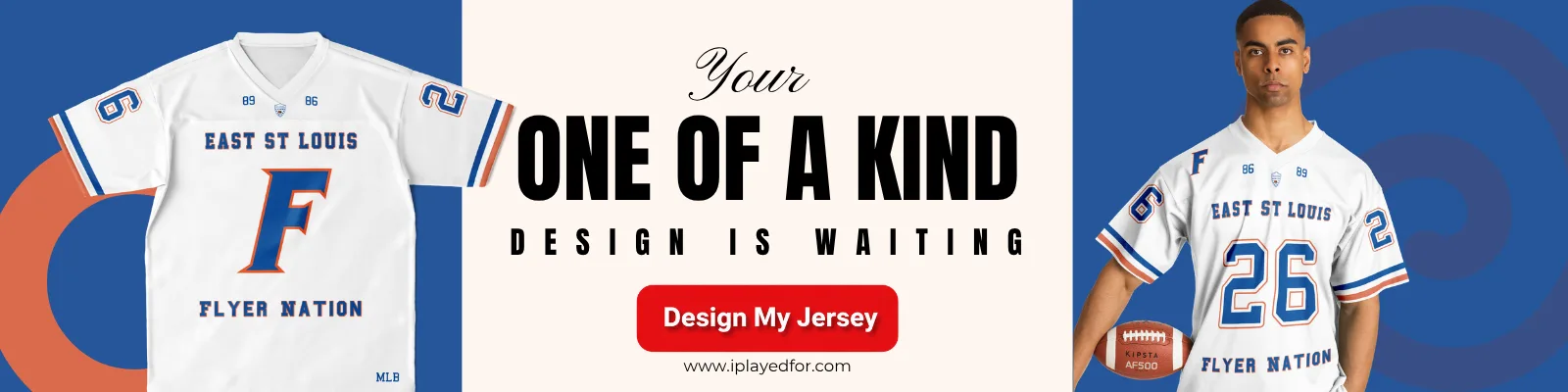
What Marcus eventually did — and what a surprising number of athletes describe as genuinely meaningful — was have a custom version made. Not to pretend the original game happened differently. But to create an artifact that could be displayed, honored, lived with — the name and number as an object of pride rather than a relic of incompleteness. Something that could sit on a shelf or a wall and say: that happened, it mattered, and it's part of who I am.
That's a different relationship with the memory. It's not closure exactly. It's more like framing.
The Longer Arc: What You Carry Forward
Here's what's true about your last high school game, regardless of how it ended, regardless of the score, regardless of whether you were the best player on the team or the one who sat the bench more than you wanted to:
You showed up for something that was hard. You did it for years. You subordinated your individual preference to a team's need repeatedly and without credit most of the time. You learned to perform under pressure (real pressure, the kind that matters to you even if no one outside the gymnasium is watching) and you learned what it feels like when your body and your training and your will align in a high-stakes moment.
That is not a small thing. And it didn't end when the season did.
The challenge of after the final game isn't really about the game. It's about integrating the athlete you were into the person you're becoming (the long work of reclaiming your identity as an athlete, even years later), not leaving them behind in a gym bag, but not being stuck in the past either. It's about the specific, underrated act of saying: I was that. It shaped me. I carry it forward deliberately.
Athletes who do this, who find a way to honor the memory concretely rather than keeping it in an ambiguous, slightly painful suspension, report something consistent: not that the grief goes away, but that it transforms. The weight becomes something they can hold differently. Pride instead of ache. Identity instead of loss.
The last game was real. It counted. It changed you. That deserves to be acknowledged — specifically, intentionally, on your own terms.
Your jersey is still out there waiting.
Design yours in minutes and see your name and number exactly the way you remember it.
Frequently Asked Questions
Is it normal to feel grief years after high school sports ended?
Yes, and it's more common than most athletes realize. Sports psychology research consistently identifies "athletic identity" as a significant component of self-concept for serious high school athletes. When that role ends abruptly and without formal closure, the resulting adjustment can resurface for years, especially during transitions (becoming a parent, watching younger athletes, milestone birthdays). The feeling is the specific, unprocessed experience of a meaningful identity chapter ending without ceremony, rather than a general nostalgia for youth. Naming it accurately is the first step in working with it rather than around it.
What if I can't remember the details of my last game clearly?
This is extremely common, and it makes sense: you weren't encoding it as a final memory while it was happening. You were just competing. The sensory details that do remain (often fragmentary, non-linear) are still valid starting points for the reflective process. You don't need a complete narrative. You need whatever pieces the body kept. Often, talking with former teammates unlocks details you didn't realize you'd stored. And sometimes, the emotional weight of the memory is more important to process than the factual sequence of events.
How do athletes typically find healthy closure after high school sports?
There's no universal path, but several practices appear consistently across athlete accounts. Verbal or written articulation of what the experience meant (not the statistics, but the meaning) is one of the most reported helpful steps. Physical ritual matters too: some athletes display their jersey, have one made, frame a photograph, or participate in a commemorative activity. Re-entering the sport as a coach, official, or recreational participant gives some athletes a way to maintain connection to the identity without requiring the original competitive context. The common thread is intentionality: moving from carrying the memory passively to engaging with it actively, on your own terms.
Does it matter if my team won or lost that final game?
Less than you might expect. Athletes who ended on championship wins report similar emotional complexity to athletes who lost in the first round. The defining variable is the abruptness of the ending and the lack of acknowledged transition, rather than the outcome. A championship win, if it's the last game you ever play, still ends without ceremony in terms of your personal identity as an athlete. The work of integrating that identity is the same regardless of the scoreboard.
See also: the grief nobody talks about when your athletic career ends | how athletic identity shapes who you become after high school | why your senior season memories feel more vivid than almost anything else | the weight of Senior Night and why it still gets to you | why you still dream about playing years later