

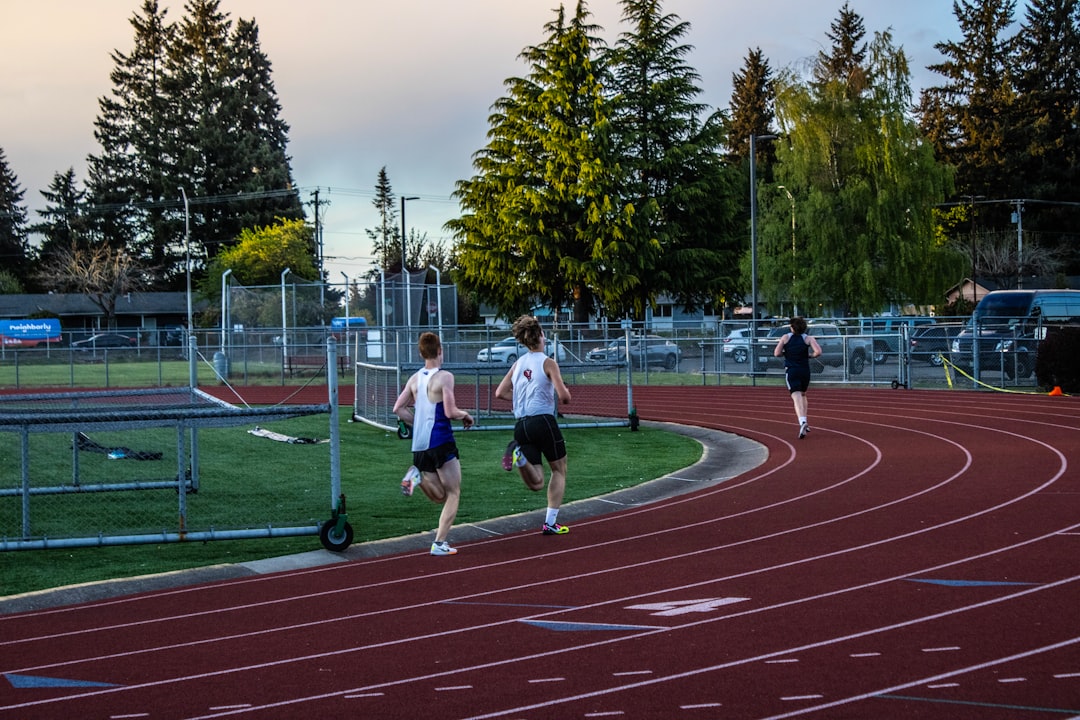



You woke up in the fourth quarter.
The crowd was loud. The turf smelled exactly the way it did in October. Your jersey number was right. Your legs felt the way they did at seventeen. And then you opened your eyes, stared at the ceiling of your bedroom, and realized you are not seventeen anymore, and haven't been for a long time.
If you've typed why do I dream about high school sports into a search bar at 6am still half-inside that dream, you're not alone, and you're not being sentimental. Something specific is happening inside your brain when you dream about those games, those courts, those teammates, those moments when everything felt like it mattered at exactly the highest volume possible. This article explains what that something is, with the actual psychology and neuroscience behind it, not forum speculation.
The answer is different from what most people expect. Longing for your youth is not the explanation, and neither is regret. What these dreams point to is identity — specifically, a version of your identity that your brain never fully filed away.
What Your Brain Is Actually Doing When You Dream About the Game
Sleep researchers have a term for the way the brain processes emotionally significant experiences during REM sleep: memory consolidation with emotional tagging. When an experience carries high emotional weight (triumph, failure, belonging, fear, physical peak performance), the brain doesn't just store it. It keeps returning to it, flagging it, testing it against your current sense of self.
Matthew Walker's research at UC Berkeley on REM sleep documents how the sleeping brain treats emotionally charged memories differently from neutral ones. During REM cycles, the brain essentially re-runs high-stakes experiences in simulation, not to replay them for pleasure but to process the unresolved emotional residue attached to them.
High school sports are almost engineered to produce this kind of residue.

Think about what those years actually contained: a developing identity under extreme social pressure, physical peak performance (often the most physically capable you would ever feel), compressed high-stakes competition, profound belonging to a team, and, critically, a version of yourself that existed fully and then ended. Not faded. Not gradually replaced. Ended. The season finished. You graduated. The jersey went into a box.
Your brain doesn't always know what to do with that kind of clean ending.
The Identity Gap Your Dreams Are Navigating
Here is the specific mechanism worth understanding. Between roughly ages fourteen and eighteen, the brain is building what psychologists call identity scaffolding, the framework of self-concept that anchors how you understand who you are. Sport, for athletes, becomes one of the primary structural beams in that scaffolding.
You were the runner. You were the point guard. You were the girl who started every game since sophomore year. That identity didn't just describe what you did after school; it shaped how you moved through hallways, how you understood your own body, how you measured your worth, how you fit into a community that mattered to you.
When sport ends at that developmental stage, the scaffolding doesn't disappear. The brain retains the architecture. And during sleep, when the prefrontal cortex (the rational, "I'm 34 years old" part of the brain) is less dominant, the brain accesses those structural memories directly.
The dream isn't pulling you backward. It's testing a question it never fully resolved: Who are you now, relative to who you were then?
Why the Dreams Feel So Real — And Why They're Often Stressful
One of the most consistent reports from people who dream about high school sports is the vividness. The smell of the gym. The exact weight of the ball. The specific voice of a coach who hasn't crossed your mind in years. The particularity of it is disorienting in a way that ordinary dreams are not.
This vividness has a specific neurological explanation. The hippocampus (the brain's memory indexing system) stores sensory-rich experiences with exceptionally high fidelity, which is exactly why songs, smells, and sounds still take you back to high school sports. Physical experiences that engaged your proprioceptive system (the internal sense of your body in space), your cardiovascular response, your stress hormones, and your emotional state simultaneously are stored with unusual density. They are thick memories, layered, multi-sensory, and stamped with the biological intensity of adolescence when hormonal levels made everything feel amplified.
When your sleeping brain retrieves them, it retrieves the full package. Not an abstraction. The turf. The noise. The jersey. The specific pressure of game-time.
Why the Dreams Are Often Anxious, Not Pleasant
Many people report that their high school sports dreams aren't pleasant replays of their best moments. They're anxious. You can't find your uniform. You show up to the game and realize you haven't practiced in years. You're on the court but your legs won't respond the way you expect — muscle memory, when your body still remembers the game suddenly out of sync with the body you have now. You're being called to perform and something is wrong.
This pattern is psychologically coherent. The brain isn't staging a highlight reel. It's running a simulation — and the simulation is stress-testing your current identity against the demands of your past peak performance self.
The anxiety in the dream reflects a real psychological gap: the version of you that could do that thing no longer exists in that form, and some part of your brain is still processing what to do with that information.
This is a healthy, ordinary response rather than pathology, depression, or unresolved trauma. It is the normal, if sometimes uncomfortable, way that a brain handles the permanent retirement of a high-performing identity at an age when identity was still being constructed.
The Psychology of Sports Dreams: What Research Tells Us About Athlete Identity
The psychology of sports dreams connects directly to a well-documented phenomenon researchers call athletic identity foreclosure. This occurs when an athlete's sense of self becomes so fused with their sport role that the end of competition creates a genuine identity disruption, not metaphorical but measurable in self-concept assessments.
Research on athletic identity (pioneered by Britton Brewer, Judy Van Raalte, and Albert Petitpas and developed by many others since) has established that the more central sport is to a person's self-concept during their playing years, the more pronounced the identity disruption they tend to experience when competition ends. Athletes who built their sense of self primarily around their sport role face a harder adjustment at retirement than those whose identities were broader and less fused with sport. That unresolved disruption is one of the things that surfaces, years later, as the vivid, recurring dreams so many former players describe.
The variable that predicted the most vivid and frequent sports dreams wasn't the level of competition. It wasn't whether you were a star or a bench player. It was the degree to which sport was central to how you understood yourself at the time.
If sport was your primary answer to "who am I?" during those years, your brain is still working with that equation.
Maria T., 38, played varsity volleyball through all four years of high school and captained her team as a senior. She tells a story that lands with almost everyone who hears it: "I dream about serves. Specifically, the serve I missed in the state semifinal. I've probably dreamed it fifty times. But in the last few years, the dream changed — I started making it. I think my brain finally filed it."
Maria's experience captures something important. Dreams about high school sports often evolve over time — from anxious and unresolved to something more integrated. The serve she missed in real life became, eventually, something her sleeping brain could resolve fictionally. That resolution, researchers suggest, is the brain's way of completing the emotional processing the original event left unfinished.
The dreams don't mean something is wrong. In many cases, they signal that something is working — that the brain is doing exactly what it's designed to do with experiences that mattered.
What the Dreams Are Really Telling You About Your Identity Now
Here is the reframe that most forum threads miss entirely, and the one that tends to change how people feel about these dreams when they hear it.
The frequency and vividness of your high school sports dreams is a measure of how formative that experience was to your identity, not how much you miss the past. More interestingly, it often intensifies during periods when your current identity is under some form of pressure or transition — the very moments when reclaiming your identity as an athlete becomes a live question.
People commonly report spikes in sports dream frequency during:
- Career transitions: starting a new job, leaving a long-held role, being passed over for promotion
- Major life milestones: getting married, having children, significant birthdays
- Periods of physical change: injury, illness, weight change, the recognition that the body is different now
- Loss: of a parent, a relationship, a community that once anchored identity the way a team once did
This is not coincidence. The brain returns to its most stable, resolved identity templates when current identity feels unstable. Your high school athlete self — whatever their flaws and limitations — was a self that knew exactly who it was, what it was for, and where it belonged. That clarity is what the brain is reaching for when current life feels less clear.
Three Things Worth Taking From This
If you want to make something useful out of the psychology behind these dreams, here are the constructions that tend to be most meaningful for people who've thought this through:
-
The athlete you were is not gone. The identity structure built around sport (the discipline, the team orientation, the capacity to perform under pressure, the physical self-knowledge) was never archived. It is part of the scaffolding that built who you are now. You didn't leave that self behind. You built on it.
-
The dreams are a signal about your current life, not a sentence about your past. If the dreams are intensifying, it's worth asking what's shifting right now. Not because something is wrong, but because your brain is telling you that your current identity could use the same kind of clarity and belonging your athletic identity once provided.
-
Honoring that chapter isn't regression. Some people feel vaguely embarrassed by how much they still think about high school sports, as if it means they peaked too early, or can't move on. The research suggests the opposite. The people who had richly formed athletic identities during those years often have more developed capacity for team belonging, performance under pressure, and physical self-awareness in adult life — not less. The dreams are evidence of depth, not stuck-ness.
Memories of High School Games: Why Certain Moments Stay With You Specifically
It is worth saying something about the specificity of sports memory — because most people who dream about high school games aren't dreaming about a season in general. They're dreaming about that game. That play. That moment in the locker room before it started.
Episodic memory (the brain's storage of specific autobiographical events) is dramatically strengthened by emotional and physical arousal. A game that mattered, where you were physically pushed to your limit, where the social stakes were high, and where the outcome was uncertain, is precisely the kind of experience that gets encoded at maximum fidelity.
The brain tags those experiences with what researchers call emotional significance markers, essentially flags that say: this one mattered, retrieve it often, use it as a reference point.
Your memories of high school games aren't vivid because you're being nostalgic. They're vivid because your brain judged them — correctly — as experiences worth keeping sharp. They are reference points for what you're capable of, what belonging feels like at full intensity, and what it means to give everything to something with other people.
Those are not small things to carry.
In my experience as a former player, the people who feel most at peace with their sports dreams are the ones who've found some way to honor that chapter tangibly — not by wishing they were back in it, but by acknowledging that it was genuinely formative and treating it as something worth marking.
Your jersey is still out there waiting.
Design yours in minutes and see your name and number exactly the way you remember it.
Frequently Asked Questions
Why do I dream about high school sports so many years later?
The most direct answer: because your brain stored those experiences at high fidelity and keeps returning to them as identity reference points. High school sports typically involve a rare combination of peak physical performance, deep social belonging, high emotional stakes, and a clearly defined self-concept, all during a developmental period when the brain is actively building its core identity structure. That combination produces durable, frequently-accessed memories. The passage of time doesn't reduce their retrieval frequency; in many people, the dreams intensify during adult periods of identity transition or stress.
Is dreaming about being an athlete a sign of regret?
Not necessarily, and probably not primarily. Research on athletic identity and sports dreams suggests the content of the dream matters more than the fact of dreaming. Anxious sports dreams (can't find the uniform, can't perform, can't remember the plays) are typically the brain stress-testing identity questions, not rehearsing regret. Dreams where you perform well, or where the experience feels resolved, often signal that the brain is completing its emotional processing of a formative chapter. Regret is one possible element, but it's rarely the dominant one.
Why are my high school sports dreams more vivid than other dreams?
Because the original experiences were stored with exceptional sensory and emotional density. The hippocampus encodes experiences that involved simultaneous physical arousal, emotional intensity, and social significance with much higher fidelity than neutral experiences. High school athletic competition almost always hits all three markers at once. When the brain retrieves these memories during REM sleep, it retrieves the full sensory record, which is why you can smell the gym, feel the court under your feet, or hear the specific sound of the crowd in a way that ordinary dreams don't replicate.
Do these dreams ever stop?
For most people, they shift rather than stop. The anxious versions, where you're unprepared, lost, or failing, tend to decrease as the underlying identity questions they're processing become more resolved in waking life. Many people report that the dreams become less frequent during stable, fulfilling periods and return during transitions. Some people continue to have vivid sports dreams throughout their lives, particularly around significant milestones. This is normal and, according to sleep researchers, evidence that those experiences remain meaningful reference points in the brain's ongoing self-modeling — which is not a problem to solve, but a feature of having lived something that mattered.
See also: the psychology of athletic nostalgia | why quitting felt like losing yourself | the grief of losing your athletic career at 18 | why your senior season memories are so vivid | the detailed psychology behind these recurring dreams