

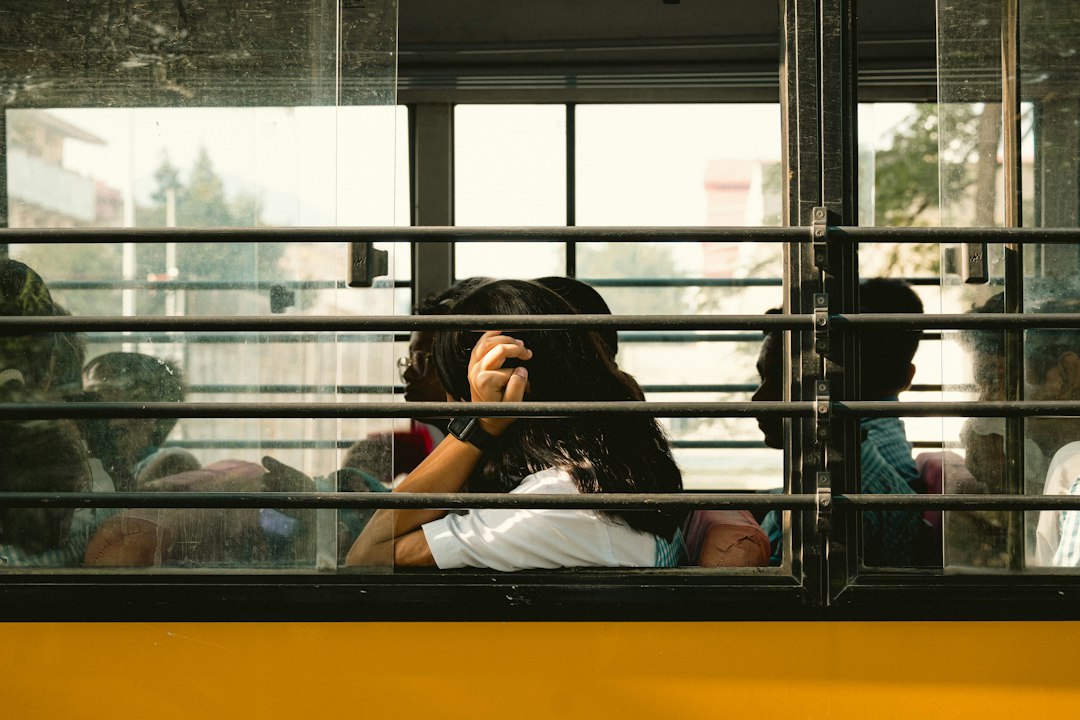




It's 4:47 AM and the parking lot is almost dark. Your bag is too heavy. The air smells like October and exhaust. And somewhere in the back of that yellow bus, three of your teammates are already singing a song that shouldn't be funny but is, and you're laughing before you've even climbed the steps.
That moment — that specific, unrepeatable, slightly chaotic moment — is what high school sports bus trip memories are actually made of. Not the scoreboard. Not the trophy. The bus.
Nobody writes about this. Sports journalism covers the game. Coaches write about preparation. But the forty-seven minutes on a school bus before a rivalry match, wedged between a sophomore who talks too much and a senior who somehow sleeps through everything? That's where the real team got assembled. That's where inside jokes from sports were born and friendships were cemented in ways that a dozen practices never could.
This piece is for the girl who remembers the exact song that played when your team drove home after winning state. For the one who still knows whose shoulder she fell asleep on during the three-hour ride to regionals. And for every player who understands, without needing it explained, why traveling with teammates was the most underrated part of the whole experience.
The Bus Was Its Own World — And Everyone Knew It
The moment that bus door closed, something shifted. The school was behind you. The pressure was still ahead. And for however long the ride lasted, you existed in a suspended space that belonged entirely to your team.
There was a social geography to it that every player understood without being taught. Seniors owned the back. Not because anyone announced it — it was simply known. Freshmen navigated this carefully. You'd find your seat and read the room: who was quiet and locked in, who had headphones in, who was openly nervous and needed distraction, who was the one who brought snacks that she distributed without making it a moment.


The back of the bus was loud in a different way than the locker room. The locker room had coaches walking through. The bus belonged to you.
In our experience watching teams build over a season, the bonds that form on bus rides tend to be more durable than those formed in any other context — because they form under low-stakes conditions with nowhere to hide and nowhere to be except exactly there with each other. You couldn't perform on the bus. You were just a person in a seat, tired and hopeful, heading somewhere that mattered.
That combination — vulnerability plus shared purpose plus confined space — is a remarkably efficient engine for producing genuine closeness.
The Rituals That Every Team Invents and Never Forgets
Here is what didn't happen: your coach didn't assign the rituals. Nobody held a team meeting and decided that you would always stop at the same Waffle House, or that the same song had to play for the last ten minutes before arrival, or that your point guard would do her pre-game braiding while sitting sideways in her seat.
These things emerged. They accumulated. And then they became law.
Away game rituals on a school bus are a specific form of team culture — invented organically, maintained collectively, and remembered individually long after the season ends.
The Playlist Protocol
Every team had a playlist. Usually it was held by one specific person — often a junior, often the player with the most confident music taste, occasionally the one who'd argued loudest for the aux cord. The playlist itself mattered less than what it communicated: we are a team with a sound. We arrive places with a soundtrack.
Certain songs became inseparable from certain moments. Not because they were the most objectively great songs, but because they were playing at the exact right second — when the bus pulled onto the highway after the biggest win of the season, or when someone started crying on the ride home and someone else turned the music up instead of asking what was wrong, which was exactly the right call.
The Breakfast Stop
For early morning departures, the breakfast stop was sacred. It didn't matter that the pancakes were mediocre or that the service was slow. What mattered was that you were eighteen people in a diner at 6 AM wearing matching warm-ups, taking up three tables pushed together, and someone always ordered something ridiculous that became the joke for the rest of the season.
The breakfast stop was the first social moment of the day — before the game, before the pressure fully arrived, while it was still possible to just be a group of people eating eggs in a town that wasn't yours.
The Window Seat Agreements
These were negotiated without words. Across a season, partnerships developed — who sat with whom, who got the window, who was allowed to sprawl when she was tired. These arrangements communicated something about the team's internal structure more honestly than any captain's meeting ever did.
The Pre-Game Silence
The most underrated moment on any team bus: the last fifteen minutes before arrival, when the music lowered (or stopped entirely) and the conversations tapered off and everyone went somewhere internal. The coach might say a few words. Someone might throw up. Most people just looked out the window.
That silence was a form of collective preparation. You were doing it together, even without speaking. Especially without speaking.
Sleeping on a School Bus: The Trust It Requires
Let's talk about sleeping on the bus, because it is genuinely more significant than it sounds.
Sleeping on a school bus during a long away trip requires a specific kind of trust. You don't know exactly what face you're going to make. You might drool. You will definitely not look composed. And yet somewhere around the ninety-minute mark, exhaustion wins — and you close your eyes in front of teammates and that is, in its own way, a form of intimacy.
The teammate whose shoulder you use as a pillow without asking. The one who puts her jacket over you when you're asleep and acts like she didn't when you wake up. The one who falls asleep mid-sentence and somehow nobody mentions it when she comes back around.
Maddie R., 24, played varsity soccer for three years in rural Tennessee and still talks about the six-hour ride to a state semifinal her junior year. "I fell asleep with my head on the window and woke up with my friend Kira's arm around my shoulder — she'd fallen asleep too, mid-reach, just kind of frozen there trying to be nice. We were both mortified for about two seconds and then laughed so hard we woke up the whole bus. That was fifteen years ago and we still talk about it."
That story contains everything: the vulnerability, the kindness attempted, the absurdity, the laughter, the permanence. The bus gave it room to happen.
The Ride Home After a Loss
This is the one nobody romanticizes. But it should be named, because it's real and it's formative.
The ride home after a loss — especially a close one, especially a rivalry game, especially in playoffs — is one of the more emotionally honest experiences a teenager can have. There's nowhere to go. The result is the result. You're on a bus for forty-five minutes or two hours and you have to exist inside the outcome together.
Different teams handle this differently. Some coaches spoke. Some sat quietly. Some players put their headphones in immediately and looked out the window. Some cried openly. Some cried into a jacket pressed against a window so no one would see.
What happened on those rides was: you learned something about each other. You saw how your teammates handled disappointment. You saw who went quiet and who reached out. You learned whether your team was the kind of team that could survive a hard loss with its relationships intact.
In most cases — across most seasons, across most sports — the answer was yes. Because you were already sisters by then. The bus had made you sisters before the loss ever happened.
And in the way these things work, the loss became part of the story too. Not the best part. But a part. One of the true parts.
Inside Jokes From Sports: The Bus Was the Laboratory
A significant portion of every team's internal mythology — the shorthand, the callback references, the phrases that make everyone laugh at dinner eight years later — was invented on a bus.
The conditions are nearly perfect for joke generation: confined space, slightly deranged from early waking or post-game adrenaline, surrounded by people you trust, with time to kill and nothing to do but talk.
The anatomy of a bus inside joke usually follows a pattern:
- Something absurd happens or is said (usually in the first half of the trip)
- Someone names it — gives it a phrase or a voice or a reference
- It gets called back once, then twice, then becomes vocabulary
- By the end of the season, the original event has been completely mythologized
These jokes were not transportable. You couldn't explain them to people who weren't there. They existed inside the team like a language — and that untranslatability was part of what made them valuable. They were yours.
Inside jokes from sports don't just produce laughter. They produce identity. They're how a group says: we have a shared history. We were there together. We remember the same things.
The Anthem: One Song That Belongs to Your Season
Every team that traveled together for a full season eventually found one song.
Not necessarily the song that was played most often. The song that was playing at the exact right moment — before the biggest win, on the way home from the game that proved you were actually good, at the moment when seventeen girls started singing without being asked and the bus driver turned it up instead of down.
That song belongs to your season now. It does not belong to anyone else's season. It belongs to that specific group of people on that specific bus in that specific fall, and when it comes on shuffle ten years later, you are back in that seat immediately.
This is not metaphor. It is how emotional memory and music are encoded together — context and sound stored as a single unit, retrievable in full when either element resurfaces. Your brain did not catalog a song. It cataloged a moment that happened to contain music. The music is now the door back into that moment.
The song isn't nostalgic. The song is a working portal.
What the Bus Actually Taught You
You didn't know you were being taught anything. That's the thing about the best formation — it doesn't feel like formation.
But the bus taught real things.
How to hold space for someone who is struggling. You learned this from sitting next to a teammate the night before the hardest game of her high school career and saying nothing useful but staying anyway.
How to be in a room — or a bus — after a loss. Without fixing it. Without performing recovery. Just being in it.
How to be genuinely, uncomplicatedly happy for someone. When your friend did something incredible in the game you watched from the bench, and the bus ride home was hers, and you were happy about it without reservation. That's harder than it sounds. The bus made it easier, somehow.
That the game and the people are different things. The game ends. The people stay. The bus, with its enforced proximity and its hours of unstructured time, made this undeniable.
Your jersey is still out there waiting.
Design yours in minutes and see your name and number exactly the way you remember it.
Frequently Asked Questions
What made team bus rides so much more bonding than regular practice?
Practice is structured and coach-directed — there's a task, there's evaluation, there's hierarchy. The bus had none of that. It was unstructured time in a confined space with people who shared your exact stakes. Nobody was performing for anyone. The proximity and lack of agenda created conditions where real relationships form faster than in almost any other team setting.
Why do high school sports bus trip memories feel so vivid decades later?
Emotionally significant events — especially those tied to strong group identity, sensory detail, and shared experience — are encoded more deeply in long-term memory. The bus concentrated multiple memory-formation conditions simultaneously: novelty, emotional charge, group belonging, and often physical sensation (exhaustion, hunger, cold, excitement). That combination produces what researchers call "flashbulb memories" — unusually detailed, durable recollections of specific moments.
Is it normal to feel more bonded to bus-ride teammates than to teammates from the same team who didn't travel?
Yes, and it's consistent across sports. Players who traveled together for away games consistently report stronger long-term connections than those whose team relationship stayed in the gym or on the field. Shared travel — especially overnight or early-morning trips — compresses the timeline of relationship formation by removing the social structures that slow it down in everyday settings.
What away game rituals were most common across different sports and regions?
The breakfast or fast food stop is nearly universal, appearing across sports and regions with remarkable consistency. Designated playlist control (one person with the aux cord) appears across most teams. Pre-game silence in the final stretch before arrival is common even in teams that were otherwise loud and social. These rituals emerge independently across different programs because they serve the same psychological function: creating shared identity and managing pre-game anxiety through familiar, predictable group behavior.
See also: the bus ride home after a loss | why high school sports still matter to adults | why your senior season memories are so vivid | reconnect with former high school teammates | what high school sports taught you that nothing else could