

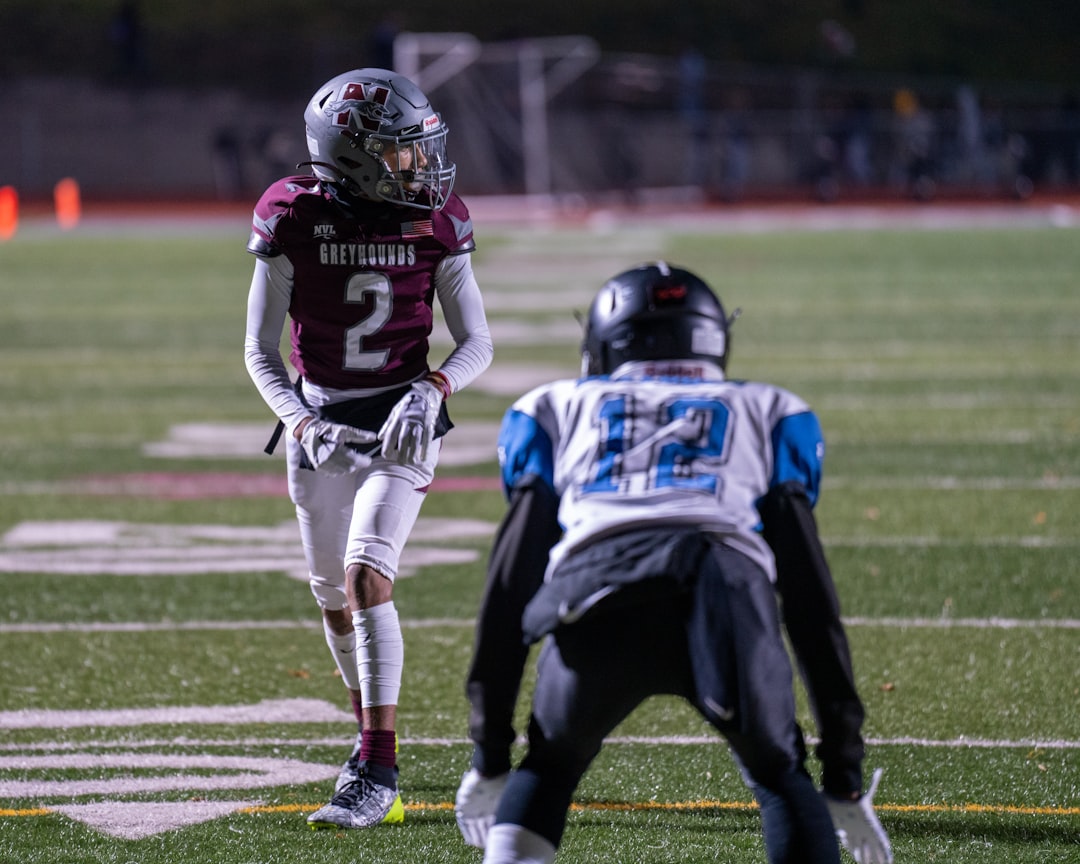



The lights hadn't changed. The field hadn't changed. But the moment your cleats hit that concrete tunnel floor and you heard the crowd begin to build somewhere beyond the dark, something shifted in your chest that had nothing to do with your pads.
You already know the one. The walk from locker room to field in high school football. The pre-game walk that lasted maybe thirty seconds and somehow left a mark that's still with you now, years later, every time you smell fresh-cut grass in August or hear a brass section warming up somewhere across a parking lot.
This isn't about the game. This is about those thirty seconds before it.
The Locker Room Was the Last Place You Were Just a Kid
There's a particular quality to the silence that fills a high school locker room in the final few minutes before a game. It's not actually silent. Someone is always taping their wrists too tight, someone is always pacing the same six feet of tile, a coach is saying something in a low voice you can't quite make out from two rows of lockers away. But underneath all of that, there is a silence that belongs to each player individually.
You were in it. That interior quiet where you ran the first play in your head again, where you pictured the defensive end you'd been watching on film all week, where you reminded yourself, for the fourth or fifth time, to keep your hips low on the snap.
And then somebody banged a locker door, or the coach clapped once, hard, like a starter pistol, and the silence broke. Everybody stood up at the same time the way a flock of birds lifts off a wire.
That was the beginning. Not the kickoff. Not the coin toss. The beginning was the moment you stood up in that locker room and understood, somewhere below language, that the next version of the next thirty minutes was going to happen to you whether you were ready or not.

The helmet went on last. Always last. There's a reason for that. When the helmet goes on, you're no longer in the building. You're already on the field, even if your body is still standing on concrete.
The Walk Itself: What Your Body Knew Before Your Mind Did
The high school football pregame walk from the locker room to the tunnel and then to the open field is not a walk in any ordinary sense. It is a threshold. Every athlete who has made it, regardless of what sport, regardless of what level, carries the specific sensory memory of that crossing in a part of their nervous system that does not respond to ordinary recall. You don't remember it like you remember what you had for breakfast. You remember it the way you remember the first time you heard a song that meant something.
Here is what the body registered in those thirty seconds, whether you were consciously tracking it or not:
The sound changed before you could see anything. This is the detail most former players land on first when they talk about it: not the crowd, not the lights, but the specific acoustic shift when you moved from the contained reverb of the hallway to something open. Sound doesn't bounce back at you the same way. It goes somewhere. It keeps going. That's how you knew you were almost there before you could see the field.
The temperature dropped two degrees, then rose. The concrete corridor was always cooler than the locker room. Then the field carried whatever the night had brought: the humid weight of a September in the South, or the sharp clean cold of an October in Ohio. Your skin registered the change before your eyes processed the light.
The grass smell came first. Not a gentle scent. A smell with mass to it, especially if it had rained that week or if they'd watered the field that afternoon. That specific biological richness of cut turf and clay and something that has no name. That's the smell that lives in the deepest filing cabinet of the brain, the one that gets pulled open without warning decades later at a gas station near a high school practice field.
Then the light. Stadium lights (even modest ones, even the older kind that flickered slightly at startup) hit differently than anything else in a teenager's visual experience up to that point. They flatten nothing. They illuminate everything. When you ran out of the tunnel or walked out of the corridor and those lights found you, there was a physical sensation in the chest that is not adequately described by any single word. The closest is: expansion.
And then the noise resolved. Because for the first few steps, it isn't noise. It's a wall. A pressure. It's your nervous system processing a volume of sensory input it hasn't calibrated for yet. Somewhere in the second or third second of being on the field, individual sounds inside the noise begin to separate: a horn, a specific voice yelling a specific name, the slap of a ball against someone's palms in warm-ups nearby. That's when it became real. That's when your body understood: this is happening.
The Weight of What You Were Wearing
There is a thing that happens when you put on a full football uniform as a high school player that civilian life almost never gives back. You are, for those hours, physically larger and more protected than your body normally is. The shoulder pads. The helmet. The way the jersey hangs differently over all of it.
The part of the helmet you still remember is the way it changed your relationship to sound. You hear everything through it differently. Your own breathing sounds important. Like it matters. Like you're in something.
That's exactly it. The helmet doesn't just protect. It signals to the wearer that whatever is about to happen is significant enough to require this. That significance, felt in the body, not processed in the mind, is part of what made the walk from the locker room to the field feel like something that had never happened before, even when you'd done it a dozen times that season.
The weight was real. The weight of the helmet was its own kind of memory. A full game-ready helmet and pads added meaningful pounds to a sixteen-year-old's frame. But players rarely experience that weight as heaviness. They experience it as substance. You were more substantial in that walk than you were in any other context of your life at that point. The locker room could strip that feeling away the moment the pads came off. But out there, walking toward the field in full gear, you were as physically present in the world as you knew how to be.
Why the Pre-Game Walk Becomes a Permanent Sensory Memory
Neuroscience has a framework for why certain sensory experiences, particularly those tied to high emotional stakes and physical arousal, encode with unusual durability. Research on episodic memory and emotional encoding suggests that experiences occurring during heightened states of physiological arousal are consolidated differently than neutral memories, often producing what researchers describe as "flashbulb" quality recall: memories that feel vivid and immediate regardless of how much time has passed.
The pre-game walk from the locker room to the field checked every one of those conditions simultaneously.
You were seventeen or eighteen years old — the period of peak emotional intensity in most humans' lives. You were in a state of heightened physiological arousal (elevated heart rate, adrenaline, acute sensory alertness). The moment was novel enough to register as significant but familiar enough (after several games) to carry the layered meaning of the entire season. And it was finite — thirty seconds, maybe less, between two completely different states of being.
The brain, presented with all of those conditions at once, does not file the experience in the ordinary way. It keeps it. It keeps it with a specificity that ordinary recall doesn't produce. This is why a former high school football player in their fifties can close their eyes and describe the exact sound of the tunnel, the exact quality of the light, the exact smell of that first breath on the field — in a way they cannot describe their college graduation or their first day of work.
The walk was, in neurological terms, important. The brain agreed with what the body already knew.
What Those Thirty Seconds Actually Did to You
This is the part that most postgame stories, most highlight reels, most Friday Night Lights narratives miss entirely: the walk from the locker room to the field was not preparation for the game. It was transformation before the game.
You entered the tunnel as a high school student. Someone who worried about grades and noticed who was looking at them in the cafeteria and had a complicated relationship with at least one parent and wasn't entirely sure what they were doing with their life. You emerged — thirty seconds later — as a player. A specific role with specific responsibilities within a specific group of other people who had all just made the same crossing.
That transformation is not metaphorical. It is the reason player ritual exists across every organized sport at every level. The physical act of crossing from the private interior space (locker room) to the public performance space (field) is the ritual that signals to the nervous system: the mode has changed. Athletes who don't have this crossing — who warm up on the field and stay on the field and never experience the threshold — report a qualitatively different psychological experience of competition.
The locker room existed so the walk could exist. The walk existed so the player could exist. The player who emerged in those final steps onto the turf was a version of you that was, in many ways, the most organized and purposeful and present version you had access to at that point in your life.
That is not a small thing.
The Other Side: Running Off the Field After the Final Whistle
The walk back is different. Everyone who has made it knows this without being told.
The final whistle is a sound you can still feel decades later, long after the score has faded.
The return walk from the field to the locker room — after the game, after the final play, after the crowd has already begun dispersing — is one of the most disorienting experiences in a young athlete's life. Not because of the outcome. Not only because of the outcome.
Because the transformation doesn't reverse cleanly.
You are still wearing the gear. You are still physically the player. But the game is over, and the field is emptying, and the lights are going to go off in fifteen minutes. You are walking back through the same space you walked through to become someone, and the passage back doesn't return you to who you were before. You are not the same person who stood in that locker room before the first walk.
Win or lose — though it matters differently in each case — you are altered. The season accumulates in those post-game walks in a way the box scores never capture. What you carry back to the locker room after the last game of your senior year is the sum of everything those thirty-second crossings built in you. The composure. The ability to exist inside high stakes without fracturing. The understanding that a group of people who've agreed on a common purpose can do something that none of them could do alone.
You don't know any of that on the night. You just know the lights are going off and somebody's mom is waiting in the parking lot and your shoulder is sore and you're thirsty.
You find out what you built later. Sometimes much later, in the Saturday morning ritual of ice and soreness and replaying the night in your head.
Your Jersey Is Still Out There Waiting
The walk you took — that specific Friday night, in those specific colors, with that specific number on your back — was yours. Nobody else walked onto that field in that jersey on that night in that moment. That's not a metaphor either. It's just true.
Design yours in minutes and see your name and number exactly the way you remember it.
Frequently Asked Questions
Why do so many former football players remember the pre-game walk so vividly decades later?
The walk from the locker room to the field combines several conditions that neurologists associate with high-durability memory encoding: peak emotional arousal, a clearly bounded sensory experience, and personal significance. When all of those conditions occur simultaneously — as they do in those thirty seconds — the brain consolidates the experience differently than ordinary daily events. Former players often describe the memory with sensory precision that surprises even them, decades after their last game.
Is the sensory memory of running out of the tunnel common across different sports?
Yes. Athletes across virtually every team sport describe a specific threshold-crossing experience — the walk from the locker room to the court, the ice, the pitch — as one of the most durable experiential memories of their athletic careers. The specific sensory details differ by sport and setting, but the psychological mechanism is consistent: the physical crossing from private preparation space to public performance space triggers a state shift that the nervous system encodes as significant.
What makes high school football pregame rituals feel different from college or professional ones?
For most players, high school is the only level at which the pre-game walk contains genuine novelty alongside genuine stakes. College athletes have more preparation and infrastructure; professional athletes have done it hundreds of times. The high school version occurs when the experience is new enough to feel unprecedented and the player's identity is malleable enough to be genuinely transformed by it. That combination — high stakes, genuine novelty, formative identity — is why the high school pregame walk tends to occupy a singular place in a former player's memory, even for those who went on to play at higher levels.
Can you recreate the feeling of that walk as an adult?
You can't recreate it exactly, and that's not quite the right question. What you can do is honor what it built in you. The composure, the ability to perform under pressure, the experience of belonging to something with a shared purpose — those don't disappear when the cleats come off. They become part of how you move through adult situations that require the same qualities. The walk lives in you in a more useful form than any recreation could provide.
See also: why high school sports still matter to adults decades later | playing under the Friday night lights | why your senior season memories are so vivid | the athletic identity you carried off that field