

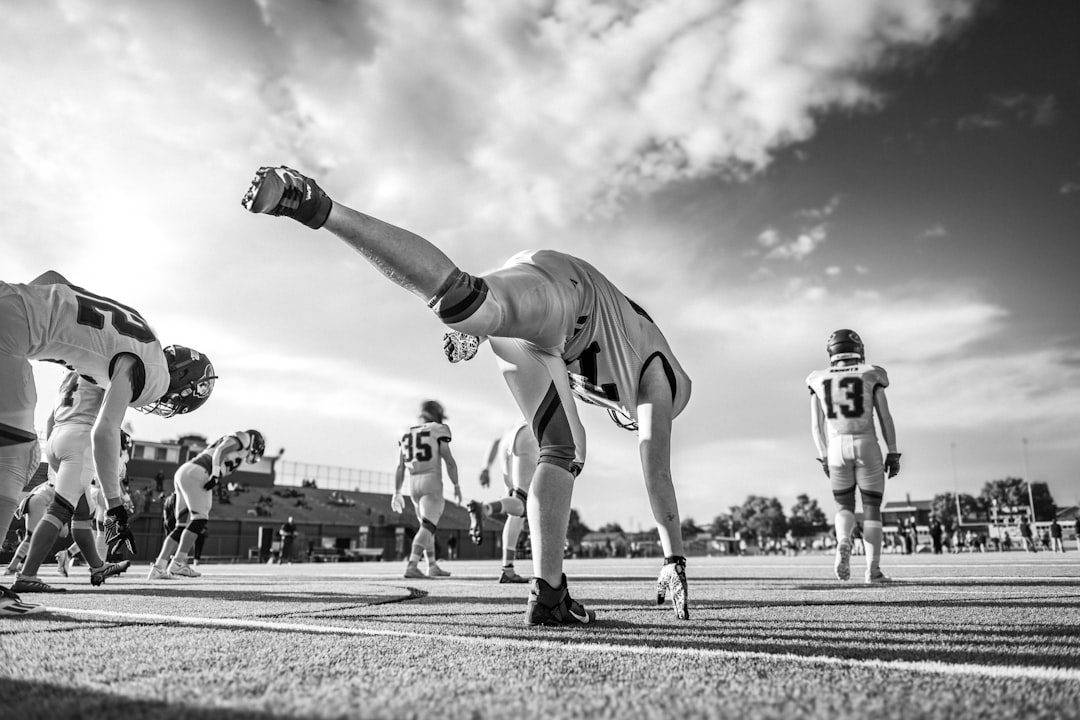




You didn't know it was the last one.
That's the part nobody warns you about. Not the coaches, not the parents lined up along the fence, not even the seniors who had just been through it themselves twelve months earlier. You walked off that field — or that court, or that mat — and somewhere between the handshakes and the ride home, the whole thing shifted into a category you didn't have a name for yet.
Why your last high school game stays with you isn't a question most people think to ask until they're thirty-four years old, driving somewhere completely ordinary, and a song comes on that was playing in the locker room that afternoon. And then, without warning, the whole thing is back. The smell of the grass. The specific weight of your uniform. The sound of that final whistle cutting through the air like a door swinging shut.
That's not nostalgia. It's something more precise than that. There are real, documented reasons why that final memory doesn't fade the way other memories do — why it arrives uninvited, fully intact, years and decades after the fact.
This article is about those reasons.
The Moment You Didn't Know Was the Last One
There's a particular sharpness to the way athletic careers end in high school. Unlike college or professional sports — where retirement is often deliberate, announced, processed — the final high school game almost never announces itself.
Seniors know their season is winding down. But even then, the brain doesn't fully register "final" while the game is actually happening. You're in it. You're watching the clock, tracking the score, running the same patterns you've run hundreds of times before. The body executes. The mind manages the moment. There's no bandwidth left to absorb the fact that this is the last time you will ever do this in this context, with these people, wearing this number.


And for everyone who wasn't a senior — the junior who tore a ligament in the third quarter of the regional semifinal, the sophomore whose family relocated across the country, the kid who simply stopped being selected — the final game was even more invisible. It was just another game, right up until it permanently wasn't.
What the brain does with an event it didn't have time to mark is one of the more striking phenomena in memory research. The psychologist Endel Tulving's work on episodic memory established that memories tied to strong emotional and sensory context — what you felt, what you smelled, what was at stake — are stored differently than ordinary procedural memories. They don't thin out at the same rate. They don't blur at the edges the way a random Tuesday practice does.
The last high school game is almost always an episodic memory stored at maximum intensity. Even when you didn't know it was the last one.
Especially when you didn't know it was the last one.
What Your Brain Was Actually Doing That Day
Here's what most retrospectives about high school sports miss entirely: the permanence of that final game memory isn't primarily about the game itself. It's about the density of everything happening inside you at the same time.
Consider what was active in a typical athlete during a high school game in their final year:
- Identity: For many athletes, sport is the primary organizing structure of adolescence. You were a soccer player, a wrestler, a point guard, before you were most other things. The game wasn't something you did — it was a context in which you existed.
- Belonging: The team was a social structure built over years. The locker room had its own language, its own rituals, its own specific atmosphere. The belonging it provided was total in a way that few adult experiences come close to matching.
- Physical peak: Most high school athletes are operating at or near the sharpest physical form of their entire lives. The body is fast, responsive, elastic. The coordination built through years of practice is running at full capacity.
- Consequence: The outcome mattered in a way that felt absolute. No nuance, no partial credit. You advanced or you went home for good.
When memory encodes an event, it encodes everything that was active during that event — the emotions, the sensory details, the social context, the physical state. For the final high school game, every one of these dimensions was running at maximum intensity simultaneously.
This is why the memory doesn't just stay — it stays complete. Former athletes don't vaguely remember their last game. They remember the specific play, the specific score, the specific moment the whistle blew. They remember who was standing next to them. They remember exactly what it felt like to be in that body, in that uniform, in that particular moment of winning or losing.
The brain filed that day in a folder it rarely opens — and labeled it formative.
The Identity Disruption Nobody Talked to You About
Marcus T., 41, played defensive back for his high school team in central Ohio. He described standing in the end zone after the final playoff loss — four points, no second chances — watching his teammates drift toward the sideline.
"I just stood there a second longer than everyone else. I didn't know why at the time. Looking back, I think some part of me understood that if I stayed on the field long enough, it wouldn't be over yet."
What Marcus was experiencing — without any vocabulary for it in that moment — is what sports psychologists call athletic identity disruption. It's not grief exactly, though it borrows grief's architecture. It's the moment when a primary organizing structure of your sense of self becomes permanently inaccessible.
For years, being an athlete answered questions you didn't even consciously ask: What am I good at? Where do I belong? Who are my people? What do I do when things get hard? The game — that specific physical, competitive, team-based context — was the environment where you built answers to all of those questions over and over again.
When the final whistle blows on an athletic career, those questions don't disappear. But the context that used to answer them does. And the brain, which is exquisitely sensitive to unresolved loops, keeps returning to the moment the loop closed — or to the absence of closure entirely.
This is one of the deepest reasons why the last game memory stays with you across decades. It wasn't just an ending. It was the beginning of a question that took years to fully answer.
Why the Final Whistle Hits Differently Than Any Other Loss
Athletes lose games throughout their careers. They adapt to it, functionally. You lose on a Friday, you practice on Monday, you play again the following Friday. The cycle absorbs the loss. Meaning is deferred because the season continues.
The final game removes the cycle entirely.
There is no Monday practice to reset the story. There is no next Friday to reclaim what was lost, or to defend what was won. The final whistle is the last data point in a narrative that had been actively accumulating for years. And the brain, confronted with a story that ends without the resolution it expected, returns to it — not obsessively, but persistently. The way you return to a book you loved and finished too quickly.
Even athletes who won — who went out at the highest possible moment — report this same quality of return. The memory doesn't belong only to the ones who lost. It belongs to everyone who played, because what ended wasn't the game. It was the version of yourself who existed inside that specific context, on that specific team, in that specific chapter.
That version doesn't get a sequel. The memory is the only place it still lives at full volume.
The Sensory Detail That Follows You
Ask any former high school athlete to describe their last game memory and pay close attention to what they reach for first. It's almost never the scoreboard. It's rarely a strategic sequence or a coaching decision.
It's almost always something sensory.
The way the gym smelled. The specific quality of late-season afternoon light on a baseball diamond. The sound of cleats on a tunnel floor. The weight of a volleyball during warmups. The way cold air felt in your lungs on the opening possession of a November game.
These details persist because episodic memory stores sensory information alongside emotional information — they're encoded together, and they surface together. In our experience talking with former athletes across many sports, the sensory trigger is consistently what catches people off guard years later. You're not sitting around thinking about your final game. You're in a parking lot and you catch a combination of grass and cold air that means October, and then the entire architecture of that last game memory is suddenly, completely present.
This is the brain doing exactly what it was built to do: using sensory signals to retrieve memories with high personal relevance. Your brain coded your athletic identity as significant. It coded the people you competed alongside as significant. It coded the emotional stakes of that final game as significant.
So when a sensory signal matches the stored context, the retrieval is automatic, involuntary, and complete.
You don't choose to remember it. It remembers itself.
What That Memory Is Actually Telling You
Here's what tends to get lost in the conversation about last game memories: the fact that the memory returns so readily isn't a problem requiring a solution. It's information.
The persistence of that final whistle in your memory is a signal about what genuinely mattered to you during the most formative period of your development. It's a record of what you were capable of, what you built, what you belonged to. The memory returning decades later doesn't mean you're stuck. It means you had something real.
Not everyone gets that. Not everyone had a context in which they were fully present, fully committed, fully part of something that demanded everything they had. The athletes who carry that final game memory — who feel it rise up at unexpected moments in completely ordinary circumstances — are carrying evidence of something that mattered in the truest sense.
The question isn't how to make the memory stop returning. The question is what you do with it when it does.
Your jersey is still out there waiting.
That number. Your name on the back. The specific colors of that team, in that era, in that chapter of your life that the final whistle closed.
Design yours in minutes and see your name and number exactly the way you remember it.
Frequently Asked Questions
Why do I still get emotional about my last high school game even though it happened decades ago?
Because the memory isn't only about the game — it's about the entire identity structure that existed within that context. Your brain encoded your athletic career as a primary social and personal framework during a critical developmental period. When that framework ended, the memory of its ending was stored at high intensity. Emotional responses to high-intensity episodic memories don't diminish the way routine memories do, particularly when the memory is tied to unresolved identity questions. The emotion you feel decades later is proportional to how much that experience genuinely mattered, not to how recently it happened.
Is it normal to remember specific sensory details from my last game but almost nothing from other games that same season?
Yes, and the reason is the intersection of emotional intensity and singularity that marked that final event. Memory research consistently shows that emotionally significant experiences — especially those representing endings or major transitions — are stored with greater sensory specificity than routine events. Your brain was operating at elevated alertness during that game, even if you didn't consciously register it as the last one, because the emotional stakes were unusually high. The sensory details are stored alongside the emotional content and surface together when triggered. Other games from that same season were procedurally familiar, which means they were stored more generically.
Does the experience of a final game memory affect former athletes differently based on whether they won or lost?
Meaningfully, yes — but not in the way most people expect. Athletes who lost their final game often report a persistent, unresolved quality to the memory, a sense that the story didn't finish the way it should have. Athletes who won report a different texture: the memory feels preserved at its peak, sometimes accompanied by a quiet awareness that they never got to surpass it. Both types of memories are highly durable, and both are connected to the identity disruption that comes with an athletic career ending. The emotional character differs, but the mechanism — and the permanence — is essentially the same across both outcomes.
Why does my last high school game feel more significant than athletic experiences I had afterward?
Several converging factors make the high school athletic context distinctly formative. High school sport typically coincides with the peak period of identity formation in adolescence. The team structure tends to be unusually close — daily practice alongside the same people, often across multiple years. For the majority of athletes, high school represents the highest competitive level they reached, which means it's the context where ability, effort, and belonging all peaked at the same time. Post-high school athletic experience, for most people, carries less identity weight — which means endings register differently and encode less intensely.
Is holding onto that final game memory useful, or is it better to move past it?
The memory doesn't ask you to stay inside it or to leave it behind — it asks to be integrated. The final whistle marked the end of one chapter, not the erasure of what that chapter built. The discipline, the resilience, the specific way you operated under pressure, the knowledge of what it meant to be genuinely part of something — those aren't stored only in the memory. They're stored in you. Honoring the memory, treating it as part of your story rather than a remnant of a past version of yourself, is not the same as being unable to move forward. For many former athletes, the most grounded relationship with that final game is treating it as evidence of what they were capable of — and what, in the ways that matter most, they still are.
See also: the grief that comes with losing your athletic identity | why high school sports still matter to adults decades later | the science behind why your senior season memories feel so vivid | what senior night really means to the athletes going through it