

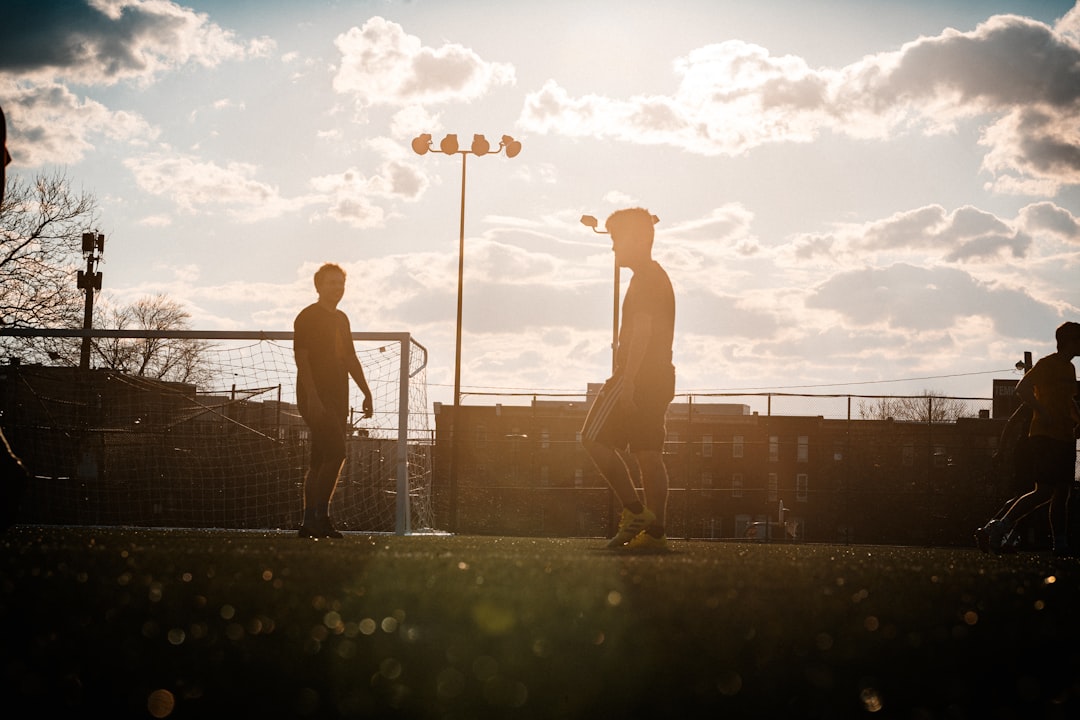




Nobody clocks out at the end of a two-a-day.
There's no overtime form for the film session that runs until midnight after a road loss. No paid holiday for the athlete who showed up to voluntary workouts when they were anything but voluntary. Labor Day is the one Monday of the year Americans stop and acknowledge the people who built things with their hands and their backs and their hours — and if you've ever played a sport at any serious level, you already know: labor day sports belong on that list too.
This isn't a take. It's a description of what athletic participation actually is: organized, repetitive, physically demanding labor performed under conditions most workplaces would never allow — and done, for most of the people who do it, for no paycheck at all.
The Invisible Workforce Nobody Counts on Labor Day
The AFL-CIO counts union members. The Bureau of Labor Statistics tracks hours worked per week across industries. What neither document captures is the 15-year-old defensive back who was on the field at 5:45am in August, before school, in full pads, in a heat index of 103°F.
That's labor.
The word has a specific meaning that athletes understand at a cellular level. Labor is effort that costs something — time, energy, recovery, years off joints that won't be young again. Labor is showing up when you don't want to. Labor is the negotiation between your body telling you to stop and your mind telling you one more rep.
What separates athletic labor from other kinds isn't the absence of a paycheck — it's the reason behind the work. Factory workers build widgets. Athletes build themselves. The process is the product. And the process is grueling.
In our experience covering sports culture, the people who feel this most intensely aren't the professionals with endorsement deals. They're the high school lineman who ran bleachers until he couldn't see straight. The club volleyball player who spent every Saturday of her junior year in a gymnasium three hours from home. The youth hockey family whose entire calendar bent around ice time. They labored. Without cameras. Without NIL deals. Without anyone telling them it counted.


It counted.
What Two-a-Days Actually Are (For People Who've Never Lived Them)
"Two-a-days" sounds almost manageable until you've done one.
For the uninitiated: two-a-days are double practice sessions, typically run during preseason football (though the structure exists in other sports under different names). Morning session. Break. Afternoon session. The break is barely long enough to rehydrate, eat something that won't make you sick when you're running again, and close your eyes for 20 minutes that don't feel like sleep.
The NCAA limits full-contact two-a-days for college football programs — which tells you something about what they do to the human body when unregulated. At the high school level, many states have adopted heat acclimatization protocols after high-profile player deaths. This is not a sport being precious about effort. This is labor being taken seriously as a physical hazard.
But here's what doesn't make it into the policy discussions: the psychological labor of two-a-days.
You wake up sore from yesterday. You go anyway. You perform at a level that earns your spot. You come back in the afternoon and do it again. Every single rep in that second session happens against the backdrop of everything you already spent that morning. That is not toughness as a character abstraction. That is a specific, trainable mental skill that most adults who've never played a sport at that level have never had to develop.
Labor Day should feel personal to anyone who's been through a preseason camp. Because they know something about work that most of the world doesn't.
The Labor Nobody Sees: Film Rooms, Early Ice, and the Sixth Practice
Football gets the two-a-day conversation. Every sport has its version of invisible labor.
The film session. Coaches pause. Rewind. Ask questions no one wants to answer in front of the team. You watch yourself miss an assignment in real-time, in front of everyone, and you sit with it. Then you watch it again. Film sessions after losses are a specific kind of hard — the kind that requires sitting in discomfort while processing failure in a group setting. That's an emotional labor skill that therapy offices charge by the hour to teach.
The 5am ice slot. Youth hockey families understand this in a way that requires no elaboration. The rink is cold, the coffee is bad, the parking lot is dark, and you're there because the only available ice is at 5:15am on a Tuesday. Parents who've done this for years aren't just supporting a kid's sport — they're running a logistics operation that would exhaust most project managers.
The sixth practice. Whatever your sport, you know the one. The workout that wasn't on the schedule. The extra film. The conditioning test that showed up after someone decided the team wasn't in good enough shape. The labor that doesn't get counted because it wasn't official. Those reps live in the body regardless.
The mental load of being a student-athlete. Manage a practice schedule. Manage a school schedule. Manage recovery. Manage the social cost of being unavailable for things that matter to 16-year-olds because you have film on Friday night. Managing competing obligations under performance pressure is a form of executive function labor that we don't acknowledge nearly enough.
One Story That Says Everything
Marcus T., 34, played offensive line at a D-III school in the Midwest. He was never going to go pro — he knew that by sophomore year. He played anyway, through two knee surgeries and a shoulder separation, because he said the work itself was the thing he couldn't let go of.
"I had a job after college," Marcus told us. "Good job. Decent hours. And I remember sitting in a staff meeting thinking, 'None of these people have ever had to do something this hard on purpose.' Not to be arrogant about it. Just — I knew how to be uncomfortable and keep moving. The line taught me that."
He has his old college jersey framed above his desk. Not for the wins. For the two-a-days nobody else remembers — and for the sights and sounds of late-season ball that never quite left him.
That's the specific thing about athletic labor: it leaves a mark that doesn't show on a resume but shapes everything after — the personal ethics high school sports built into you. The early mornings become your baseline for what effort actually looks like. The film sessions become your standard for honest self-evaluation. The sixth practice becomes the reason you don't fold when something hard shows up in the rest of your life.
Labor Day and the Athlete's Calendar: A Specific Kind of Symmetry
There's an accidental poetry to when Labor Day lands on the athletic calendar.
In the United States, Labor Day is the first Monday of September. By that point:
- College football is two weeks in. Preseason camps — the genuine labor — are done. The results of the work are being tested.
- High school football is in full swing across most of the country, with playoff positioning already beginning to form.
- Youth fall sports seasons are launching: soccer, cross country, volleyball, field hockey. Kids and families are deep in the logistics of early-season practices.
- The NFL regular season opens the week of Labor Day, built entirely on the foundation of training camps that ended weeks prior.
In other words: Labor Day doesn't just coincide with sports. It arrives at the exact moment when the labor that was done in July and August becomes visible. For the former football player, the holiday is that last barbecue before the Friday night lights come back. The games being watched on Labor Day Monday are the public face of work that happened in private. The crowds watching the results have, for the most part, no idea what the weeks before looked like.
Athletes know. Their families know. Their coaches know.
The rest of the world watches the game. The athletes celebrate the labor that made it possible.
How to Honor Athletic Labor on Labor Day (Without Making It Sentimental)
If you played — at any level, in any sport, for any amount of time — Labor Day has a specific claim on you. Here's what that can actually look like:
-
Name the specific labor. Not "I worked hard." The specific thing: the 6am weekend practices. The weight room in July. The drill you ran until you got it right. Name it. Saying it out loud is how it gets counted.
-
Reach out to a teammate. Labor Day is a holiday about collective effort. The people who were in the film room with you, who ran the same conditioning test, who sat in the same ice bath — they shared the labor. A text takes 30 seconds. The labor was years.
-
Find the artifact. The jersey. The photo. The letter. Whatever physical object marks the time you put in. Take it out. Look at it with the specific respect it deserves, not as nostalgia but as documentation. That thing represents real work.
-
Tell a young athlete something true. If there's a kid in your life who's in the middle of their athletic labor right now — in preseason camp, starting a new season, grinding through something hard — tell them something real about what the work is worth. Not "it builds character" (too vague). Something specific: what you learned, what it cost, what it gave you that nothing else did.
Your Jersey Is Still Out There Waiting
Design yours in minutes and see your name and number exactly the way you remember it.
The jersey you wore during the labor deserves to exist somewhere beyond a cardboard box. A custom re-creation keeps the work visible — and visible is how it gets honored.
Frequently Asked Questions
What is Labor Day and how does it connect to sports?
Labor Day, observed the first Monday of September in the United States, commemorates the contributions of workers and the labor movement. Its connection to sports is more than coincidental timing — organized athletics at every level involves genuine physical, mental, and logistical labor that often goes unacknowledged. The holiday's arrival in early September places it squarely in the middle of the fall sports season, when the results of preseason training camps and summer conditioning become visible in actual competition. For athletes and their families, Labor Day carries a personal resonance that goes beyond the public narrative of workplace labor.
Does Labor Day apply to unpaid athletes, not just professionals?
Absolutely — and in some ways, unpaid athletes embody the purest version of labor. They perform physically and mentally demanding work without financial compensation, motivated entirely by the craft, the team, or the personal growth the sport produces. High school athletes, club sport participants, and college athletes (many of whom receive no scholarship) are investing real hours, real physical cost, and real opportunity cost into their sport. That constitutes labor in every meaningful sense of the word.
What sports have the most demanding preseason labor?
Football — at the high school, college, and professional levels — is consistently cited for its physically demanding preseason structure, including two-a-days, full-contact practices, and conditioning tests. Hockey preseason training, wrestling weight management and conditioning, and distance running sports like cross country also involve significant preseason labor demands. Rowing (crew) is frequently cited by athletes who've played multiple sports as among the most physically grueling training environments. The common thread across all of them is the gap between what the public sees on game day and the preparation work that happens out of view.
Why do athletes keep playing when the labor is this hard?
The honest answer varies by athlete, but the most common through-line is this: the labor itself becomes the reward. Not despite the difficulty — because of it. The combination of collective effort, measurable improvement, and the specific kind of identity that comes from doing hard things on purpose is not easily found anywhere else in life. Most athletes who step away from competitive sport describe missing the structure of the work more than they miss the competition itself. The two-a-days are what they remember. The grind is what built them. That's what makes athletic labor different from most other kinds: it doesn't just produce a result — it produces a person.
See also: what high school sports actually teach you that nothing else can | the athletic identity that gets built through all those hours | the grief of watching that career end without much acknowledgment | going back to watch the film from those seasons | why those early mornings still live in your memory so clearly