

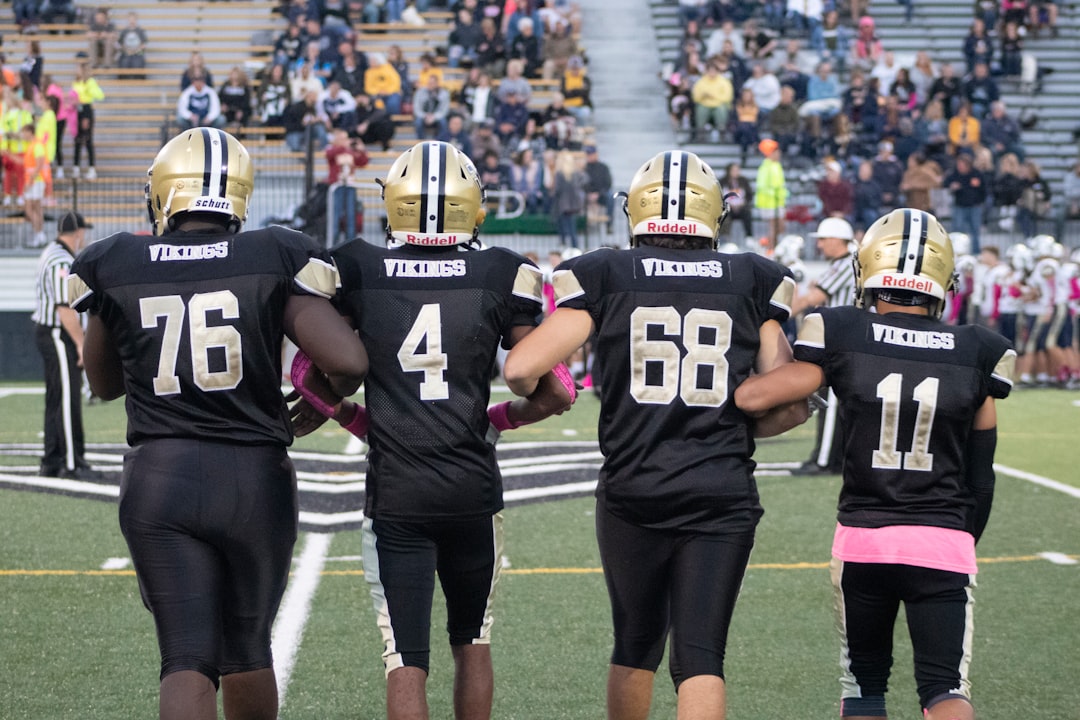




There is a specific kind of silence that only former athletes know.
It happens in the seconds before a game starts — when the warm-up noise fades, when the coaches step back, when it is just the people on your team standing together looking at each other. No words. No instructions. Just the recognition of what is about to happen, and the absolute certainty that the only people who fully understand what this moment asks of you are the ones standing right beside you.
Understanding what it means to be part of a team is not something you acquire by watching from the stands, reading about it in a leadership book, or sitting through a team-building seminar at work. It is something that happens to you through accumulated repetition, shared suffering, shared ridiculous joy, and the specific kind of trust that only forms when people have failed together and chosen to stay anyway.
This is not a criticism of people who never played. It is simply an acknowledgment of a truth that former athletes carry quietly into every room they enter for the rest of their lives: there is a layer of experience here that cannot be conveyed, only recognized.
The Bond That Forms Before You Know It's Forming
Nobody announces the moment a team becomes a team.
You don't realize it's happening when it happens. You realize it later — usually when you're in a moment that doesn't involve sports at all, somewhere in your adult life, when a situation demands something of you and you find yourself thinking in a way that people around you aren't thinking. You are scanning for your role. You are calculating what the person next to you needs. You are already halfway through a decision before you can explain your reasoning, because the reasoning isn't analytical — it's instinct built through years of practice inside something larger than yourself.


That instinct was forged in ordinary moments. In a practice that ran forty-five minutes late and everyone stayed anyway. In a van ride where someone said something that made the whole group laugh so hard the driver almost pulled over. In a film session where a coach pointed out precisely what went wrong and the person responsible sat there and took it and then asked what they could do differently.
These moments don't feel significant when they're happening. They feel like Tuesday. But they are the material the bond is made from — the reason so many former athletes still count their teammates who became your best friends among the closest people in their lives.
The people who never played in an organized team — never showed up for a game that mattered, never had their individual performance directly affect the outcome for others who were counting on them — missed Tuesday. They missed hundreds of Tuesdays. And those Tuesdays are the entire education.
What the Word "Accountability" Actually Means
Leadership content loves the word accountability. You will hear it in corporate retreats, in management training, in motivational speeches delivered by people with excellent slide decks. Accountability, in those contexts, is usually described as taking responsibility for your outcomes, owning your mistakes, and maintaining your commitments.
Former athletes do not argue with any of that. But they know something more specific.
Accountability on a team is not primarily a personal discipline. It is relational. It is not about a standard you hold yourself to in isolation — it is about the specific, named people whose performance is directly constrained by whether you did your job. And the constraint ran in every direction, from the starters to the players who never saw the field, because every role on the team mattered when one missed assignment could undo everyone's work.
Every former athlete remembers the specific moment they let the team down. Not in a vague, general sense. In a specific, replaying-it-in-the-shower-years-later sense. The missed block that opened the gap. The thrown error that cost two runs. The slow rotation that left someone exposed. The specific face of the specific teammate who looked at you in the specific aftermath.
That is what accountability actually means. It means having a face in your memory. It means the consequence of your failure wasn't abstract — it landed on someone you knew, someone you respected, someone who had shown up for you on the days when you needed them to.
This is the piece that cannot be simulated. You can tell someone that their work affects the team. You cannot give them the memory of a specific teammate's face after a specific failure. That memory is what makes accountability real rather than conceptual. And it is only earned by having played.
The Language Underneath the Language
Every team develops a private vocabulary. But that's not the most important thing about team communication.
The most important thing is what happens underneath the vocabulary — the reading of information that was never spoken. A glance that carries a complete message. A tone of voice that tells you whether the joke is actually a joke or whether something is wrong. The specific posture that means someone is about to push back and you need to either strengthen your position or step aside. The energy that moves through a huddle and tells you, before anyone says a word, whether the group is ready or whether something needs to happen.
Former athletes learn to read rooms in a way that transfers directly into every professional and personal relationship they navigate afterward. They learned it not in a communication class but by standing close to the same group of people under high pressure for months or years — sometimes people who were once rivals who became teammates — where missing a social signal had immediate, visible consequences.
Marcus T., 34, played four years of varsity soccer and still orders his custom replica jersey every time he moves to a new city — a ritual, he says, of reminding himself where his real education happened. He described it once as learning to listen with his body. You knew your teammates' rhythms so well that you could feel when something was off before anyone said it. That's not a soft skill. That's pattern recognition trained under pressure.
Non-athletes can develop excellent interpersonal awareness through other routes. But the specific crucible of team sport — where reading people incorrectly costs you and your teammates something real and immediate — produces a particular kind of social fluency that is difficult to replicate outside of it.
Belonging That Doesn't Need to Be Earned Every Day
There is a particular kind of exhaustion in adult social life that former athletes feel more acutely than they can always explain.
In adult professional and social environments, belonging is often conditional on performance. You earn your place through competence, through charm, through continuous demonstration of your value to the group. Stop performing and the belonging quietly recedes. Most people accept this as simply the way things work.
Former athletes accept it too — but they know it is not the only way things can work, because they experienced something different.
On a team, belonging was established early and depended on commitment, not continuous performance. You were part of the team because you showed up, did the work, and were willing to be in the difficulty together. A bad game didn't end your membership. An awkward week didn't put your belonging at risk. There was a stability to the relationship that had nothing to do with how well you performed on any given day.
This is specifically what makes former athletes sometimes feel a restlessness in conventional professional environments that they struggle to name. They are not performing worse. They are simply aware, at some level, that the kind of belonging they once had — unconditional, commitment-based, identity-level belonging — is rare in adult life. And they miss it with a specificity they can't always explain to people who never had it.
The Specific Weight of Needing Someone
Here is something that does not appear in leadership seminars: the experience of being in a situation where you genuinely needed another person to do their job, where you had no control over whether they would, and where the outcome mattered enough that you would have taken on their role yourself if you could — but you couldn't.
Dependence is not comfortable. Most adult environments are designed to minimize it. We build redundancies, systems, backups. We optimize for autonomy. We celebrate people who need the least support.
Athletes were trained in the opposite direction. The entire structure of team sport is built around the acknowledgment that no individual is sufficient. You are explicitly, structurally, unavoidably insufficient without the people around you. And then you are put into high-stakes situations where that insufficiency is demonstrated in real time, in front of everyone.
What comes out of surviving that — not just once but hundreds of times — is not a therapy breakthrough about vulnerability. It is a practical, bone-deep understanding that needing people is not a weakness. It is the condition under which the best things happen.
Former athletes bring this into relationships, into work, into the way they ask for help and the way they offer it. They are not uniformly better at collaboration than people who never played. But they have a different starting relationship with dependence — one that was forged through necessity rather than chosen through preference.
What Losing Together Does That Winning Together Doesn't
Winning binds a team. But losing is the test of whether the team was real.
Every former athlete who played long enough has experienced both versions of a losing locker room. The kind where it falls apart — where people look for someone to assign the failure to, where the temperature drops and relationships crack. And the kind where it holds — where nobody says much because there isn't much to say, but people stay close, and the silence is warm instead of cold, and you leave feeling somehow more certain of the people around you than you were before the game started.
The second kind of losing locker room is an experience with no civilian equivalent. It is the specific revelation that a relationship can hold under strain — not because the strain wasn't real, not because it didn't hurt, but because the bond beneath it was built from enough material to absorb the weight.
People who have only experienced loss as individuals — where the failure is private and the processing is solitary — missed this. They know what losing feels like. They don't know what losing with someone else feels like when the relationship survives it. That survival is its own kind of education. It tells you what you're actually made of together.
Your Jersey Is Still Out There Waiting
The team you played for shaped something permanent in you — and that doesn't disappear when the season ends.
Design yours in minutes and see your name and number just the way you remember it.
Frequently Asked Questions
What does it mean to be part of a team in the context of former athletes?
For former athletes, being part of a team means something more specific than collaboration or shared goals. It means having been structurally dependent on specific people, having failed and succeeded in front of them, and having developed a form of trust and belonging that is identity-level rather than transactional. It is an experience that shapes how former athletes communicate, take accountability, and navigate relationships long after the sport ends — often in ways they recognize but can't fully explain to people who never played.
Why do former athletes often feel a sense of belonging that's hard to replicate in adult professional life?
Team sport produces a specific kind of unconditional belonging — one that is based on commitment and shared difficulty rather than continuous performance. In most adult environments, belonging is implicitly tied to demonstrating ongoing value. Former athletes who experienced the commitment-based belonging of a team often feel a background restlessness in professional environments, not because those environments are deficient but because the team experience set a standard that is genuinely rare outside of sport.
Can people who never played on a team understand what it means?
They can respect it, observe it, and intellectually grasp its components. What they cannot access is the experiential layer — the specific memories, the specific faces, the specific moments of failure and recovery that form the foundation of the understanding. This is not a hierarchical claim about the value of different life paths. It is simply an acknowledgment that certain forms of knowledge are only available through experience, and team sport is one of the more specific and irreplicable sources of that experience.
Does the sport matter, or is the team experience universal across sports?
The surface details differ — the locker room culture of a swim team is different from a football team, which is different from a volleyball team. But the underlying architecture of the experience is consistent across sports: shared stakes, individual accountability within a collective outcome, the formation of trust under pressure, and the specific kind of belonging that comes from having been in genuine difficulty together. Former athletes across sports tend to recognize each other's experience immediately, regardless of which sport they played.
See also: what high school sports actually teach you | the bus ride home after a loss | the difference between a sports fan and someone who actually played | why high school sports still matter to adults