

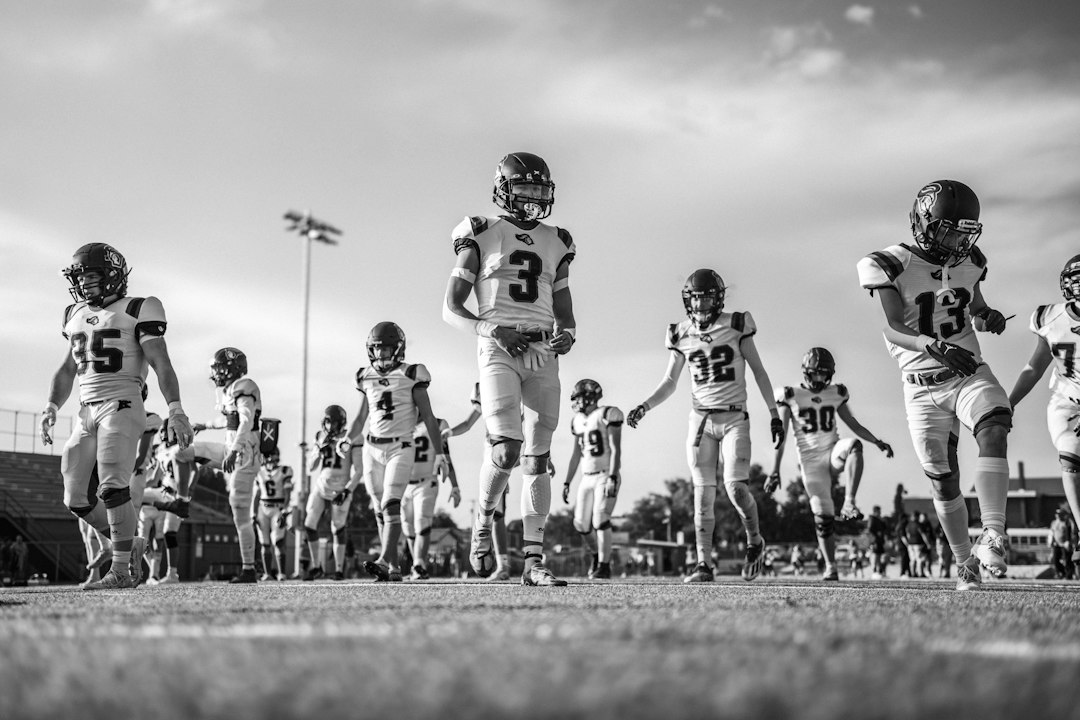




It is August. The alarm goes off at 5:45 AM. You are already sweating.
That is the first memory. Before the pads, before the whistles, before the first collision of the morning — your body is already soaked in it, because the air in August doesn't cool down at night, not really, and the dorm or the locker room or your childhood bedroom holds every BTU from the day before. You lie there for exactly three seconds feeling sorry for yourself. Then you get up.
If you ever played high school football, your high school football two-a-day memories don't live in a highlight reel. They live somewhere older and more physical than that — in the specific weight of waterlogged shoulder pads, in the smell of cut grass baked by a sun that has no mercy, in the sound of a teammate retching behind the blocking sled while the coach pretends he doesn't notice. They live in the specific dark comedy of shared suffering that turns a group of teenagers into something that resembles, however briefly, a unit.
This article is not about the glory. It's about the other part — the absurd, miserable, hilarious part — and why former players don't just survive that memory but actively compete over it.
The Heat Was Not a Metaphor
People who've never been through two-a-day practices sometimes imagine fall camp as a montage. Clean jerseys, sharp routes, a coach with a clipboard nodding slowly at a promising snap count. The reality is that the first thing you encounter, every morning, before any of that, is the heat — and the heat is not a backdrop. It is the primary antagonist of the entire experience.
August in most of the country means temperatures that climb into the mid-90s before noon. Add equipment — helmet, shoulder pads, knee pads, the full armor of a game you haven't played yet this season — and the heat index against your body can push past 105 degrees in direct sun. The NFL banned two-a-days for its players years ago partly because of exactly this physiological reality. High school programs operate under varying state regulations, and in many places, particularly in the South and Midwest, young players still do a version of this — two full practices in a single day, with a break in the middle for a meal and whatever recovery is possible in three hours.


What you learn very quickly is that the heat has a personality. It is not indifferent. It feels specific and personal. By the second practice of the day, usually starting around 3 or 4 PM when the sun is at its highest angle of attack, the field is radiating heat back up from below even as it descends from above. You are cooking from both directions. Your pads have never dried from the morning session. Your socks have given up entirely.
In our experience — and anyone who wore pads in August knows this — there is a specific moment that happens on day two or day three of fall camp, usually during a conditioning drill, when your body sends a very clear message that it is done cooperating. Your legs go liquid. The edges of your vision do something interesting. You either push through it, or you go down.
And here is the thing that separates two-a-days from other hard things: you look over, and the guy next to you is having the exact same experience. And somehow that makes it funny.
The Dark Humor Only Survivors Understand
Nobody documents the dark humor of football fall camp memories accurately, because it doesn't translate. You either lived it or you didn't.
There is a specific kind of comedy that exists only in extreme shared discomfort — the kind that emerges when everyone is suffering equally and there is nothing to do about it except make each other laugh. Military historians write about it. Disaster survivors describe it. Football players who came up through two-a-days recognize it immediately.
It sounds like this:
A teammate goes down during a conditioning run — not injured, just his body staging a protest — and he's lying face-up on the 40-yard line with his arm over his face, pads still on, and someone from across the field yells something so specific and absurd about his situation that the entire team is laughing before the coaches can react. The teammate on the ground is laughing too. In four minutes he'll be back up and running.
It sounds like a lineman, 280 pounds of misery, describing in anatomical detail what the heat is doing to his inner thighs while stretching in the end zone, and somehow his delivery is perfect, and even the coach has to walk away to compose himself.
It sounds like someone at breakfast on day four — the meal that happens between sessions — eating whatever the cafeteria has produced with the look of a man who has made peace with his circumstances, saying absolutely nothing, just eating, and everyone at the table understanding completely.
This humor doesn't work among strangers. It only works because by day four, you are not strangers. You have seen each other at the outermost edge of your respective capabilities. You have seen the guy you thought was tough fall apart in the third conditioning set, and you have seen the quiet kid from the JV squad finish every single one without complaint. Shared suffering produces an inventory of real information about who people actually are, and that inventory is the foundation of genuine trust.
What Surviving Together Actually Builds
Here's what's rarely said clearly about suffering together football experiences: the bond isn't a metaphor, and it isn't produced by the suffering itself. It's produced by the choice each person makes, repeatedly, to stay in it when leaving is an option.
Because it is always an option. You can quit. Players quit every year. Some coaches make it so miserable that players quit intentionally — that is a real and legitimate critique of two-a-days as they have sometimes been run. But in the programs where it works, the ones former players remember with complicated pride, what happens is this: the door is always technically open, and every single morning you choose not to go through it.
When the people around you are making that same choice, you see them make it. Not once. Not in a single dramatic moment. Over and over, for two weeks, in the accumulation of small, unglamorous decisions to stay. That's different from choosing to play through a big game moment. That's a quieter kind of character, and it's visible in a way that game performance isn't.
Marcus T., 34, remembers the moment his two-a-day experience became something he was proud of rather than something he just endured: it was the last conditioning run of the second week, everyone was wrecked, and the guy next to him — someone he'd barely spoken to before camp — grabbed his facemask as they lined up and said, simply, "We got this." They finished together. "I went to his wedding eleven years later," Marcus says. "That's not nothing."
That story is not unusual. Ask any former player about surviving two-a-days and within two minutes you'll have a name — a specific person, a specific moment, a specific detail that doesn't make sense unless you were there. The specificity is the point. These memories didn't happen to "a team." They happened to these people, in this heat, on this field, and that particularity is exactly what makes them irreplaceable.
The Bragging Rights Nobody Can Fake
There is a specific phenomenon that happens when former players get together — at reunions, at games, at weddings, at any gathering where the shared past is present — and fall camp comes up. The stories that emerge are not the touchdown stories. Those have been told. Those have been softened and polished by retelling.
The two-a-day stories are still raw.
They involve specific details that are not flattering: the player who actually cried during a gasser and then set a school record at the next combine. The coach who made the team run until someone vomited, and the fact that it was the starting quarterback, and the fact that the starting quarterback never let anyone forget it because he got it out of the way first. The lineman who passed out in the locker room between sessions and came back for the afternoon practice anyway and nobody said a word about it because what was there to say.
These stories don't get told with shame. They get told with competition over who had it worse, and the competition is affectionate, and the affection is real, and the realness is the thing that's worth understanding.
High school football conditioning didn't just prepare bodies for a season. At its best, it provided something that is genuinely rare in adolescent experience: a structured context in which suffering was shared equally, where no amount of social status or natural talent exempted you from the same physical reality as everyone else, and where the only currency that mattered was showing up again the next morning.
That's not nothing. That's actually quite a lot.
The Things That Don't Make the Official Story
The official story of two-a-days — the one coaches tell at booster banquets and the one that appears in sports movies — is about toughness. Mental fortitude. The crucible that separates those who want it from those who don't.
That story is true, but incomplete.
The complete story also includes:
- The specific smell of a locker room at 6 AM in August, which no cleaning product fully addresses, and which is somehow already nostalgic.
- The food. Whatever the cafeteria or the booster-supplied meal tent produced between sessions, it was consumed with a focus and gratitude that no restaurant meal has since matched, because no restaurant meal has ever followed a three-hour morning practice in 95-degree heat.
- The silence on the bus back from a two-session day. Nobody talks. Everyone is calculating how many hours until they have to be back. The silence is not sullen — it is profoundly companionable.
- The specific social leveling that happens when everyone is equally destroyed. The politics of the locker room, the hierarchies of high school, the performance of toughness — all of it gets sandblasted off somewhere around day three, and what's underneath is just people, in varying states of physical distress, trying to get through together.
And then there is the moment — it comes at a different time for every player, but it comes — when you realize you are not going to quit. Not because someone told you to gut it out. Not because of a speech. But because you have been choosing to come back every morning, and at some point that choice accumulates into identity, and the identity holds.
Former players brag about two-a-days because the bragging is really about that moment. The heat is the detail. The vomiting is the detail. What they're actually describing is the specific time in their lives when they found out they were the kind of person who comes back.
Your Jersey Is Still Out There Waiting
Your jersey is still out there waiting.
Design yours in minutes and see your name and number exactly the way you remember it — the number you wore through two-a-days, through August, through every morning you chose to come back.
Frequently Asked Questions
Why do former football players brag about two-a-days instead of just remembering them?
Because two-a-days represent something specific that other football memories don't: a sustained, daily choice to return to something genuinely difficult. Scoring a touchdown is a performance. Showing up for the fifth straight morning of two sessions in 95-degree heat is a decision that compounds — and former players recognize that the compounding is the thing worth talking about. The bragging is shorthand for "I found out something about myself here, and I still think about it."
Were two-a-days actually effective for conditioning, or were they mostly tradition?
The physiological picture is complicated. Research on heat stress and athletic performance — including work published in sports medicine literature from the American College of Sports Medicine — consistently shows that training in heat does produce meaningful cardiovascular and thermoregulatory adaptations over time. However, it also shows real risks from heat illness, which is why the NFL and many state athletic associations have moved toward modified protocols with mandatory rest and hydration requirements. The conditioning value was real. So were the risks when programs ran them without proper safeguards.
What's the difference between a two-a-day that builds something and one that just breaks people down?
The programs that former players remember with genuine pride — as distinct from the ones they resent — generally share a few specific qualities: the suffering was equal (coaches weren't exempted from physical presence), it was purposeful (not punishment disguised as conditioning), and there was an understood collective goal that made the individual misery coherent. When two-a-days feel arbitrary or punitive, they produce resentment. When they feel like a shared initiation into something real, they produce the kind of bonds and memories that show up at weddings 15 years later.
Do players still do two-a-days, or is the tradition mostly gone?
The full, unrestricted two-a-day format — two padded, full-contact practices per day with minimal recovery protocols — has been significantly curtailed at both the professional and collegiate level, and many state high school athletic associations now regulate heat practice guidelines, mandatory rest periods, and equipment restrictions during extreme heat. What persists in most places is a modified version: two sessions per day, often one in pads and one in helmets only, with hydration requirements and rest periods built in. The experience is still demanding. The memories still stick. The vomiting remains optional but not uncommon.
Is the bond from two-a-days real, or does it fade?
Both, depending on the relationship. The general sense of having survived something together — the background warmth toward anyone who wore the same pads in the same August — that persists. It's the thing that makes two strangers who played at the same school in different decades recognize each other immediately when the topic comes up. The specific bonds — the guy who grabbed your facemask on the last conditioning run, the lineman with the perfect delivery at breakfast — those depend on what happened after, like any relationship. But the origin point stays. Nobody who went through it together forgets what the other person chose to do every morning for two weeks.
See also: why high school sports still matter to adults | what high school sports teach you that nothing else can | the science behind why your senior season memories are so vivid | athletic identity after high school