

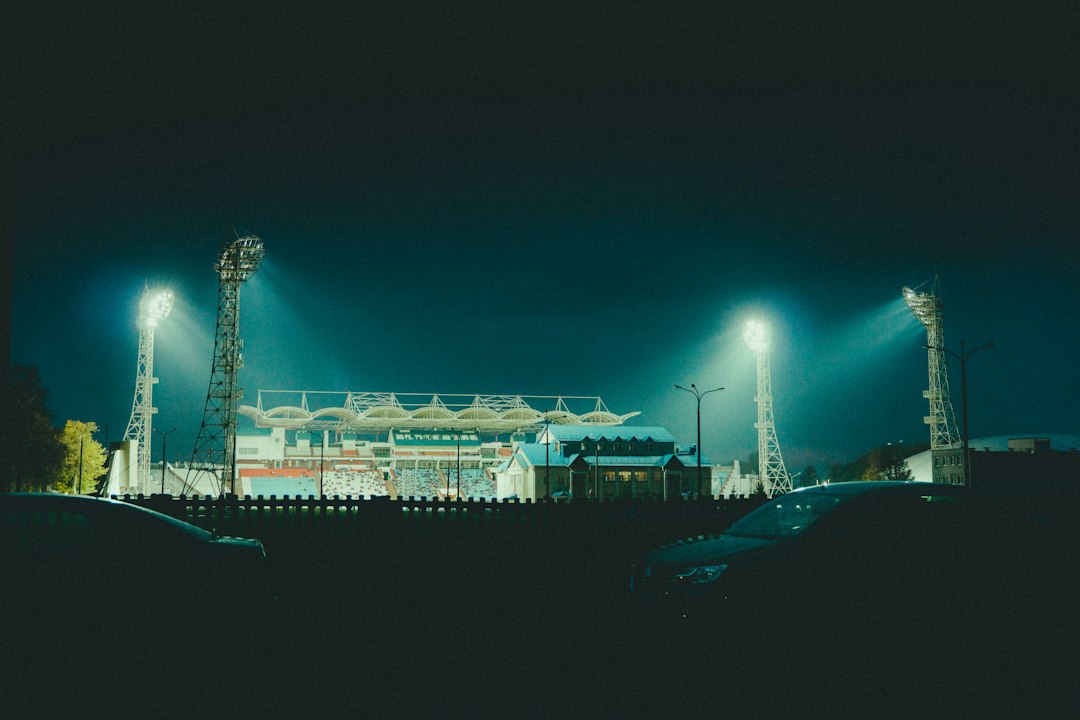




You're not even fully awake yet.
It's 6 a.m. on a Tuesday, thirty years removed from the last time you laced up cleats, and somehow you just ran a seam route through the fog of a dream — cut sharp at fifteen yards, looked the ball in, felt the hit before it came. You woke up before the whistle.
If you've ever typed why do I dream about high school football into a search bar, you're not alone, and you're not being sentimental in any weak sense of the word. What you're experiencing has a name. Several names, actually. And the science behind it is more interesting — and more validating — than anything you'll find in a "those were the good old days" essay.
This is the real explanation for why those Friday nights are still with you.
Your Brain Treated Those Games Differently From the Start
Most of what you experienced between the ages of 14 and 18 is gone. Not forgotten in the casual sense — structurally unavailable. The brain consolidates selectively, discarding the redundant and retaining the novel, the emotional, and the survival-relevant.
But football Friday nights weren't redundant. They were the opposite.
The combination of factors present at a high school game — physical exertion at maximum output, high-stakes social evaluation, team identity, crowd noise, sensory saturation, uncertainty of outcome — produced a neurological environment that memory researchers now understand as close to optimal for long-term encoding.
Dr. Roger Brown and James Kulik introduced the term flashbulb memory in 1977 to describe memories formed during events of high emotional arousal and personal significance. The original research focused on public events — assassinations, disasters — but subsequent neuroscience has extended the mechanism to intensely personal high-stakes experiences. The criteria map almost perfectly onto a varsity football game in front of your hometown crowd.
When emotional arousal spikes, the amygdala signals the hippocampus to consolidate what's happening with exceptional detail and permanence. The norepinephrine flood that accompanies fear, excitement, and competitive pressure essentially tells the hippocampus: save everything, full resolution. The result is a memory that retains sensory specificity — the smell of cut grass, the specific weight of your shoulder pads, the exact trajectory of a ball coming out of stadium lights — that ordinary memories never achieve.


This is why high school football memories are vivid in a way that, say, a Tuesday afternoon class never was. The neurochemistry of competition created conditions that your brain treated as survival-critical encoding events.
What the Amygdala Remembered That You Didn't Know It Was Recording
The amygdala doesn't ask permission. It doesn't wait for you to decide that something is important before it begins the enhanced encoding process. It responds to the physiological state — elevated heart rate, cortisol and adrenaline present in the bloodstream, heightened sensory processing — and initiates deep consolidation automatically.
This is why you can remember a specific play from a game in October of your junior year with more clarity than conversations you had last month. The neurochemical environment of that October night was rich enough that your amygdala flagged it as high-priority storage. Last month's conversation was not.
The implication: you didn't choose to remember those games so vividly. Your brain decided for you, based on criteria that had nothing to do with nostalgia and everything to do with the intensity of what you were experiencing at the time.
The Reminiscence Bump: Why Adolescent Athletic Memories Hit Hardest
There's a second mechanism at work, and it operates on a longer timeline than the flashbulb effect.
Memory researchers have documented what they call the reminiscence bump — a consistent finding across cultures and age groups that autobiographical memory is disproportionately dense with events from roughly ages 15 to 25. When adults over 40 are asked to name their most vivid personal memories, the adolescent and early adult years dominate the response in nearly every study.
Two explanations have strong support.
The first is novelty. Everything that happens during late adolescence is, by definition, happening for the first time. First team, first starting role, first loss that actually meant something, first crowd noise directed at you specifically. Novel experiences receive preferential encoding because novelty is a signal the brain uses to update its model of the world. When the world is constantly new — as it is between 15 and 18 — everything gets that preferential treatment.
The second explanation is identity formation. This is the one that explains why the memories don't just persist but actively recur — in dreams, in involuntary recall, in the way a particular song from that era can stop you mid-stride.
Identity Theory and Why Football Specifically Won't Let Go
The years you played football were not just years of intense experience. They were the years you were building a self.
Developmental psychologists, following the work of Erik Erikson, describe adolescence as the critical period of identity consolidation — the phase in which a young person constructs the narrative of who they are, what they're capable of, and where they belong. The experiences that happen during this window don't just get stored as memories. They get stored as identity-constituting evidence.
Playing football in high school — the discipline, the physical transformation, the team belonging, the competitive outcome — wasn't just something you did. It was formative evidence that answered the question every adolescent is asking at full volume: Who am I? What am I made of?
When you dream about a Friday night game, your sleeping brain isn't simply replaying a pleasant experience. It's revisiting a scene from the origin story of your self-concept. The psychologist Dan McAdams calls this the narrative identity — the story we construct to explain ourselves to ourselves. High school athletics tend to occupy significant real estate in that story, because they happened at exactly the moment when the story was being written.
This is the part that the "it was a special time" explanations get backward. It wasn't special because it was football. It was special because it happened when your brain was in the process of deciding who you were — and what happened on those Friday nights became part of the answer.
Why the Dreams Are Often About Losing, Not Winning
In our experience working through the topic with readers who've shared their stories, one pattern appears consistently: the most recurring dreams aren't always the great games. They're often the ones that went wrong.
The final-second interception. The snap that came in too low. The game you should have won.
This tracks with what we know about memory consolidation and emotional salience. Negative outcomes under high-stakes conditions produce even stronger encoding than positive ones in many cases, because the brain weights potential loss more heavily than equivalent gain — a well-documented asymmetry that behavioral economists call loss aversion. Your brain may have stored the loss more completely than the win precisely because the stakes registered as higher.
There's a quieter version of this too: the dream where you're back in the locker room, or on the sideline, or warming up before a game that somehow hasn't started yet. The game that's always about to begin. Sleep researchers suggest that these anticipatory dream structures often represent unresolved emotional material — not trauma, but significance that the waking mind hasn't fully integrated.
Marcus T., 47, played defensive end for a 3A program in rural Ohio. He told us he had the same dream for fifteen years: the state semifinal, fourth quarter, his team down by four. In the dream, he always gets the sack. In reality, the quarterback got the throw off. "What I finally figured out," he said, "is that the dream isn't about football. It's about what I thought I was supposed to be capable of." The dream stopped recurring the year he coached his son's freshman team. The narrative, it seems, found its resolution.
The Science of Athletic Nostalgia: Why It Intensifies With Age
Here's something counterintuitive: for most people who played high school sports, the memories don't dim with time. They frequently intensify.
This is not sentimentality or the selective forgetting of bad experiences (though that does happen). It's partly explained by what researchers call retrieval-induced strengthening — every time you recall a memory, you consolidate it further. The act of remembering makes the remembered thing more durable. If you've told the story of a certain game dozens of times over the decades, you've reconsolidated it dozens of times. It's more structurally sound in your memory now than it was the year it happened.
But there's a social dimension too. Athletic memories are among the most frequently shared social memories in American culture. You tell the story at the reunion. Your former teammates tell versions of it. The collective retelling maintains the neural pathways, and — importantly — the social function of those memories shapes which version persists.
The science of athletic nostalgia also involves what psychologists call self-continuity — the psychological need to experience oneself as a continuous person across time. As the distance between who you are now and who you were at seventeen increases, those vivid high school memories serve a function: they provide a through-line. They are evidence that the person who made that fourth-quarter block and the person sitting at a desk three decades later are the same person, connected by an unbroken story.
When the Dreams Are Most Likely to Return
The psychology of sports dreams suggests they tend to spike at recognizable life junctures:
- Major life transitions — job change, divorce, children leaving home — that trigger identity re-examination
- The season itself — late summer through November, when the cultural cues (school starts, leaves change, Friday night games on local radio) activate contextual memory retrieval
- Milestone ages — the decades especially tend to prompt autobiographical review
- Physical limitation — injury, aging, or the simple recognition that the body can no longer do what it once could
The dream isn't random. It's responsive to the question your waking mind is circling without directly asking: Who have I been? Who am I still?
What the Brain Is Actually Doing While You Sleep Through It
Sleep research adds the final layer to this.
During REM sleep — the phase in which most vivid dreaming occurs — the brain is engaged in a form of active memory processing. It's not simply replaying recordings. It's doing something more complex: integrating new experiences with older memories, extracting patterns, and resolving emotional valence attached to stored events.
When your sleeping brain revisits a high school football game, it may be using that emotionally rich, high-resolution stored memory as a processing template — running current emotional material through a familiar structure. The Friday night game is the brain's preferred emotional gymnasium, in a sense. It's familiar, it's loaded with rehearsed emotional responses, and it has clear stakes and clear roles.
Two things tend to happen in these dreams that distinguish them from ordinary memory replay:
- The rules shift — you're somehow on the field but also observing, or the opponent is someone you know from your adult life, or the game is in a place that doesn't match any real stadium.
- The feeling outlasts the image — you wake up not with a clear picture of what happened but with the specific feeling of competition, belonging, or urgency.
Both of these patterns are consistent with what neuroscientists describe as the brain's use of memory during REM: it borrows the emotional structure of the stored event to process current material, which is why the scenario blends past and present in ways that don't survive strict logical scrutiny but feel completely real while they're happening.
Your Jersey Is Still Out There Waiting
The game didn't end when the final whistle blew. Your brain made sure of that — and now you know exactly why.
If you're ready to bring that chapter back in a form you can actually hold, design your custom jersey the way you remember it: your name, your number, your colors.
Frequently Asked Questions
Why do I dream about high school football specifically, not other sports I played?
Football tends to dominate athletic dream content for former players for several overlapping reasons. The team size and role specificity of football means your individual identity within the group was clearly defined — you had a position, a number, a specific job. The physical contact and high-stakes crowd environment also produce stronger amygdala activation than lower-intensity sports. If football was your primary identity sport during adolescence, your brain encoded it as the most identity-constituting athletic experience, which is why it surfaces most frequently in dream content.
Is it normal to dream about playing football decades after high school?
Completely normal, and well-supported by what we know about memory and identity. The reminiscence bump, flashbulb memory encoding, and narrative identity theory all predict that high-intensity adolescent experiences will produce recurring autobiographical recall — including during sleep — throughout adulthood. There's no duration after which these dreams become unusual. Many former athletes report them well into their 60s and 70s.
What does it mean if I dream about a specific game I lost rather than one I won?
Loss under high-stakes conditions often encodes more completely than victory, because the brain weights potential loss more heavily than equivalent gain. Beyond pure encoding strength, losses that occurred during identity-forming years tend to carry unresolved significance — the question of what might have been, or what the outcome said about capability. Dreams about specific losses often decrease in frequency when the emotional significance of the event finds integration through other life experiences — coaching, mentorship, telling the story to someone who understands it.
Does talking or writing about these memories make them stronger or weaker?
Stronger, in most cases. Retrieval-induced strengthening means that recalling a memory — through conversation, writing, or deliberate reflection — reconsolidates it and makes it more durable. The more times you've told a particular story from a particular game, the more structurally robust that memory is now compared to the original encoding. This is also why collective memories shared among teammates tend to be among the most persistent memories any of the individuals hold.
See also: the psychology behind why you still dream about high school games | why your senior season memories are so vivid | what playing under the Friday night lights actually felt like | athletic identity after high school and why it still shapes who you are | the gap between your athletic memory and your current body