

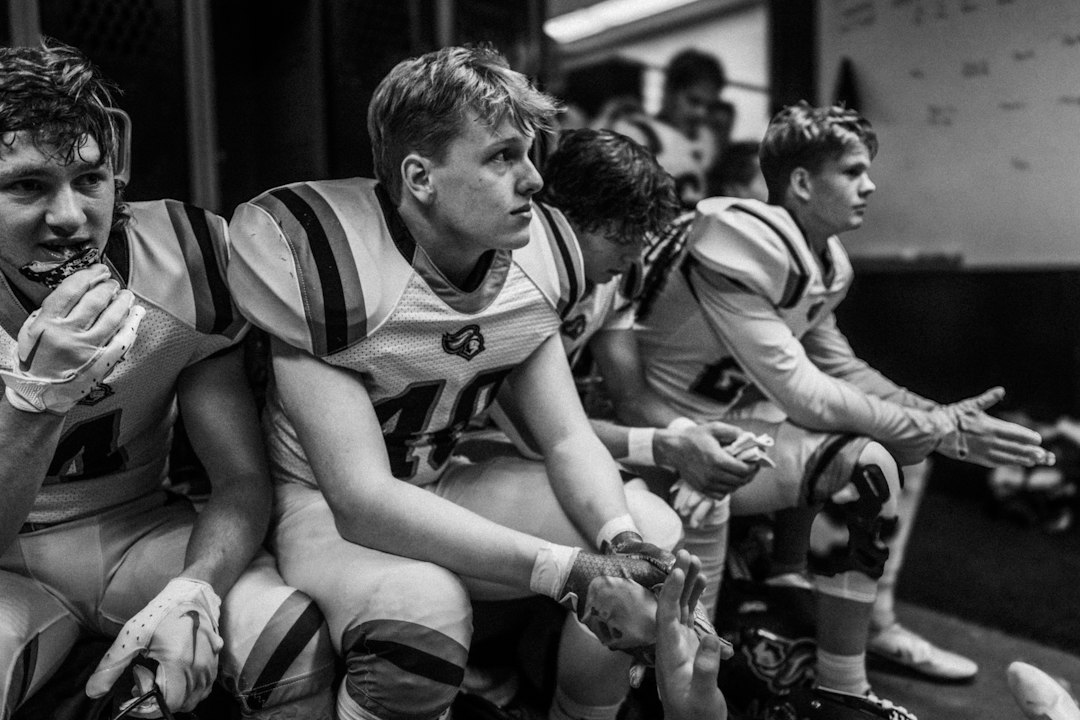




You didn't pick your number the way you picked your shoes. You didn't spend an afternoon comparing options against a rubric. You heard the number, or you asked for the number, or the number was handed to you — and from that moment forward, something clicked into place. The significance of jersey numbers is something athletes feel before they can explain it. You wore that number through the best games of your life and the worst. You wore it when your legs gave out in the fourth quarter and when you crossed a finish line you'd been chasing for two years. That number got sweat-soaked and washed and worn again until the font cracked at the edges. And it still means something now, years removed from the last time you laced up.
This is the piece that tries to explain why.
The psychology behind sports numbers isn't soft or sentimental. It's grounded in real research about identity, symbol formation, and the way human beings attach meaning to arbitrary markers. What happens when a coach hands you a jersey with digits sewn across the back is not nothing. It is, in a specific and documentable way, the beginning of a new identity layer — one that most former athletes carry for the rest of their lives without fully understanding why.
Numbers as Identity Anchors: Why the Brain Holds On
There is a concept in psychology called identity fusion — the phenomenon in which an individual's personal identity and a group or symbol become so thoroughly merged that the symbol starts to feel like part of the self. Research on sports fandom has explored this extensively, but the same mechanism applies — perhaps more intensely — to the athlete who actually wore the uniform.
Your jersey number was not just a team designation. It was a public label for your body, your position, your role. When the announcer called your number, your nervous system responded before your mind processed the words. When your parents pointed to your number from the stands, they were pointing to you — not the fabric, not the print, but the person.


Psychologists who study self-concept use the term personal fable to describe the stories people build about themselves that feel uniquely significant, even when they are objectively shared by millions of others. Every athlete who wore number 11 believed, somewhere beneath the rational surface, that number 11 had specific meaning in the context of their life. And they were not wrong. The meaning was real — not because of the digits, but because of what those digits witnessed.
The number becomes an anchor for episodic memory. Neuroscience has established that memories are not stored as neutral recordings — they are stored in clusters, tied to emotional states, physical sensations, and symbolic markers. Your jersey number is one of those markers. When you see it — on a scoreboard, on a street sign, in a random phone number — your brain does not just register the numeral. It pulls the cluster. The field. The smell of cut grass or gymnasium floor wax. The weight of the moment when everything was on the line.
That is not nostalgia. That is memory architecture.
The Numbers That Athletes Choose — And What the Choice Reveals
When athletes have the option to select their number, the patterns are not random. In our experience tracking the stories behind custom jerseys, the numbers athletes choose, re-choose, and request for their kids fall into recognizable psychological categories.
Legacy numbers are chosen because someone meaningful wore them first. A father's number. An older sibling's number. A coach who changed everything. The choice is an act of connection — the athlete is not just selecting digits, they are enrolling in a lineage. The jersey becomes a form of tribute that travels with them into every game.
Identity numbers emerge from a different source. The athlete chooses a number that feels like them — often a birthdate numeral, a number that appeared in a formative moment, or a number that simply felt right in a way the athlete cannot fully articulate. Numerologists would have one explanation for this. Psychologists have another: familiarity breeds fluency, and numbers attached to significant life events carry a warm cognitive signal that feels like recognition.
Inherited numbers — numbers assigned without input — tell a different story. Many athletes who had no say in their number develop the strongest bonds with it, precisely because the number was not chosen. It was given, and they made it theirs. There is something in the human psyche that responds powerfully to the challenge of owning what was arbitrarily handed to you. The number becomes proof of what you brought to it.
Position, Tradition, and the Unwritten Code
In certain sports, jersey numbers are not just personal — they are positional, hierarchical, and encoded with collective meaning. The significance of jersey numbers in baseball, for instance, runs so deep that Major League Baseball retired Jackie Robinson's number 42 across all teams in 1997 — the only league-wide retirement in American professional sports history. That decision was not administrative. It was a recognition that a number could carry more historical weight than any individual franchise could contain.
Baseball jersey numbers meaning extends beyond honor: catchers traditionally wore numbers in the 10–19 range. Outfielders ran higher. These conventions evolved organically, and players who violated them were sometimes viewed as disrupting something older than any written rule. Even athletes who never knew the tradition felt the social gravity of it when they suited up for the first time and saw what the equipment manager handed them.
Football operates similarly. The NFL's jersey number rules assign numeric ranges by position — quarterbacks in the 1–19 range, linebackers in the 40s and 50s, offensive linemen in the 60s and 70s. For decades these weren't flexible guidelines; they were enforced classifications. An offensive lineman who somehow appeared on the field in a number under 60 triggered a penalty. The number was not just an identifier — it was a position declaration, a shorthand for role and responsibility that any knowledgeable observer could read from the stands.
Every former athlete who played within one of these number traditions carries that layer of meaning without having to articulate it. You knew what your number said about where you stood on that field. So did everyone watching.
What Number Envy Actually Tells You About Yourself
If you played long enough, you wanted someone else's number at some point. Maybe you wanted the single digit — the ones that went to the stars, the veterans, the players who'd already earned their reputation before you arrived. Maybe you wanted the number your favorite athlete wore when you were twelve years old and convinced you were going to play professionally. Maybe you were handed a number you considered bad luck and you spent the first three weeks of the season waiting for something to go wrong.
Marcus T., 38, a former high school point guard from the Midwest, spent his entire sophomore season wearing number 24 because the junior he'd expected to transfer out of the program stayed. He'd had 24 in mind since middle school. His first two seasons, he wore 21. "I played differently with 21," he says now. "Not worse, necessarily. But differently. Like I was still figuring out who that player was." When he finally got 24 his junior year, something settled. He averaged 19 points that season — his best — and still has the jersey folded in a box in his home office.
What Marcus describes is not superstition, though it shares some surface features with it. It is closer to what psychologists call enclothed cognition — the influence that symbolic clothing has on the psychological processes of the person wearing it. A 2012 study by Hajo Adam and Adam Galinsky at Northwestern University demonstrated that wearing a coat they were told belonged to a doctor increased participants' attention and precision on cognitive tasks. The meaning of the clothing changed the performance of the wearer.
Your jersey number is not neutral fabric. It is a symbol you have assigned meaning to, and that meaning travels with you into every performance context in which you wear it.
The Numbers You Never Forget — And the Ones You Gave Away
Every former athlete remembers their number. Not always the season stats. Not always the final score of the most important game. The number. Ask any former competitor — even the ones who haven't touched their sport in fifteen years — what their jersey number was, and they will tell you without pausing. They will tell you immediately, the way they tell you their childhood phone number or the name of their third-grade teacher. It is stored differently than other information. It is stored as identity, not as fact.
If you played, you know the specific quality of pride that came from seeing your number in the program. You know what it felt like the first time a younger teammate asked if they could have your number when you graduated. Some athletes give it away easily, passing a number along like a clean tradition. Others hold it longer than is strictly reasonable, acknowledging privately that the request stings because the number feels too personal to simply transfer.
What do numbers on jerseys mean when they are passed from one generation of players to the next? They mean continuity. They mean that the role carries more permanence than any single person who fills it. They mean that you were part of something that existed before you and continues after. And for some athletes, that is the most meaningful thing the number ever communicated — not individual achievement, but participation in something larger.
Baseball Jersey Numbers, Football Heritage, and the Cross-Sport Thread
The question of jersey number meaning shows up differently across sports, but the underlying psychology is consistent. In baseball, the single-digit numbers were historically reserved for the most prominent players or the highest spots in the batting order — Joe DiMaggio wore 5, Babe Ruth wore 3. Over time, those specific numbers accumulated layers of association that no subsequent wearer could fully separate themselves from. To wear a low number in professional baseball was to step into a freight of history whether you wanted it or not.
In soccer and rugby, different national traditions govern number meaning entirely. In traditional rugby union, the number 10 jersey belongs to the fly-half — the architect of the offense, the player expected to control the game. In Argentina, in New Zealand, in England, that number carries cultural weight that goes beyond the individual. When a player wears it, they are accepting responsibility for a lineage that includes some of the most storied performances in the sport's history.
The cross-sport thread is this: wherever numbers become associated with role, achievement, or specific individuals, they accumulate meaning that outlasts the original association. The digits become a shorthand for something larger. And when a former athlete carries that number forward in memory — or has it reproduced on a custom jersey decades after the last game — they are not just preserving a detail. They are keeping a piece of that larger meaning alive and personal.
Your jersey is still out there waiting.
Design yours in minutes and see your name and number exactly the way you remember it.
Frequently Asked Questions
Do numbers on jerseys mean anything beyond team identification?
Yes — and the meaning operates on several levels simultaneously. At the most practical level, jersey numbers identify players to officials, scorers, and spectators. At the positional level, many sports use number ranges to designate specific roles — quarterbacks, infielders, and forwards often occupy defined numeric territories depending on the sport. At the personal level, the significance of jersey numbers for individual athletes is psychological: the number becomes an identity anchor tied to specific memories, performances, and relationships. Research on enclothed cognition suggests that the symbolic meaning athletes assign to their numbers can influence how they perform when wearing them.
How about in a jersey — does the specific number placement or font affect the meaning?
The physical presentation of a number — its size, font, placement on the back versus chest, and the quality of the lettering — contributes to how it is perceived and how the wearer experiences it. A number that is crisp, correctly placed, and matched to the specific sport's conventions reads differently than one that appears casual or generic. For athletes recreating a jersey from memory, accurate font and placement are often the details that matter most. The specificity of the reproduction is what makes it feel real rather than approximate.
Why do jersey numbers feel so personal even when they were assigned without input?
Psychological research on identity formation suggests that people develop strong attachments to symbols associated with meaningful experiences, regardless of how those symbols were initially assigned. The process of wearing a number through challenging, high-stakes situations — practices, competitions, losses, wins — layers experiential meaning onto what began as an arbitrary designation. Over time, the number stops feeling like something that was given and starts feeling like something that was earned. The athlete made the number meaningful through what they did while wearing it, and that ownership feels genuine because it is.
What is the significance of retired jersey numbers in professional sports?
Retiring a number is a formal declaration that the individual who wore it brought something to the role that the organization considers unrepeatable — or too significant to place on another player's back without diminishing the original. The practice acknowledges that numbers are not neutral identifiers; they accumulate the reputation, performance, and character of the athletes who wore them. A retired number is a permanent record that says: this specific person, in this specific number, at this specific time, changed what this organization means. The number becomes a monument rather than a tool.
Is it strange to want your old jersey number on a custom jersey years later?
Not at all — and the psychology behind that impulse is well-documented. The desire to recreate or preserve a meaningful symbol is a normal expression of identity continuity. Former athletes who commission or design custom jerseys with their original numbers are not living in the past; they are acknowledging that a specific chapter of their history was meaningful enough to keep visible. The jersey number is a shorthand for an entire era of physical effort, competitive identity, and community belonging. Wanting to hold onto that symbol is the same impulse that drives people to keep photographs, frame awards, or return to places that shaped them.
See also: why high school sports still matter to adults | athletic identity after high school | why your senior season memories feel so permanent