

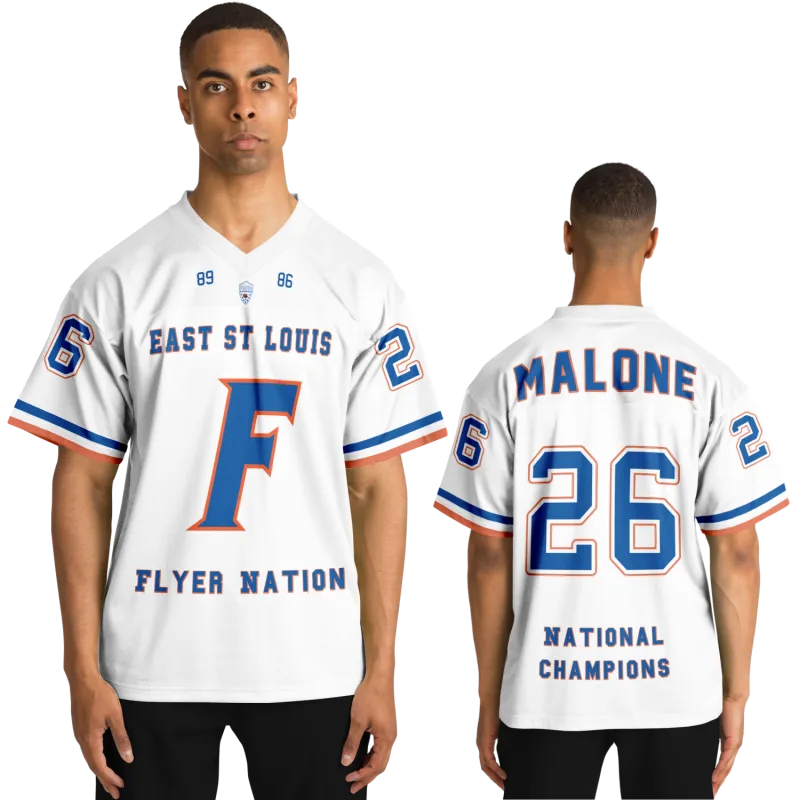
There's a moment every former soccer player knows. You're watching a match — maybe your kid's, maybe a reunion league game — and something in you shifts. You don't just want to watch anymore. You want a jersey. Not some off-the-rack shirt with someone else's name on the back. Your name. Your number. The one that meant something.
So you go looking. You find a site that does custom soccer jerseys. You start filling out the form. And then you hit the sizing page, and the whole thing stalls.
Because custom soccer jersey sizing was never designed with you in mind. It was designed for the lean, wiry 17-year-old version of you. The one who ran 90 minutes without thinking about it. The one whose chest measurement matched a men's medium because that's just what happened when you were that age.
You are not that person anymore. And ordering a jersey that doesn't account for that fact means you'll receive something that fits in exactly none of the ways that matter.
This guide is for the adult former player who wants a kit that fits their actual body right now — not a nostalgia-soaked reminder of how they used to fit into things.
The Real Problem With Standard Jersey Sizing Charts
Most custom jersey sizing charts are built around two assumptions: that you're ordering for organized team play, and that your body falls neatly into a retail athletic silhouette. If you played competitive soccer at any level, you already know that neither of those assumptions ages well.
Athletic sizing in the jersey world runs narrow through the shoulders and torso and short through the body. That was fine at 17, when your metabolism was running at full sprint and your dimensions were genuinely proportional to what the chart expected. But adult bodies — even very fit, very active adult bodies — distribute differently. Shoulders widen. Torsos lengthen. Chest and hip measurements that were once in clean proportion to each other drift apart. And if you've spent 20 years at a desk between pickup games, the jersey that fit in 2005 is not the jersey you need now.
The other hidden problem: soccer jersey sizing runs small by design. Kits are cut for performance — tight through the torso to reduce fabric drag, short in the body to clear the waistband of the shorts. That cut works on a 17-year-old. On an adult wearing a custom jersey because it means something to them, it produces the exact wrong result: a jersey that rides up when you reach for anything, pulls across the chest when you take a deep breath, and looks like you borrowed it from a younger sibling.
Understanding this before you order is the first move that changes everything.
Before You Measure: Understanding the Two Types of Adult Fit
Not every adult who orders a custom soccer jersey wants the same thing from it. Before you touch a measuring tape, you need to decide which category you're in — because the right sizing strategy is different for each.
The Athletic Fit Buyer wants a jersey that performs. They're playing in it. Pickup games, adult league, a charity match, a reunion tournament. The jersey needs to move, breathe, and stay in place during actual soccer activity. For this buyer, sizing up one from the standard chart is usually the right call — not dramatically, but enough to provide genuine range of motion without the jersey pulling across the back on a throw-in.
The Identity Fit Buyer wants a jersey that looks right. They're wearing it to watch their kid play, to a bar for a big match, to frame on the wall of a home office, or to pull out for the occasional Sunday barbecue where someone mentions they used to play. For this buyer, the athletic cut can be abandoned entirely in favor of the cut that looks and feels intentional on an adult frame. Sizing up two from the standard chart, or looking for suppliers who offer a "relaxed" or "fan cut" jersey option, is often the better answer.
Most guides skip this distinction entirely. It's actually the first question you should answer, because it changes every measurement decision that follows — adult sizing is nothing like what you wore in high school, as we lay out in our full fit guide.
How to Measure Yourself for a Custom Soccer Jersey
Every former athlete remembers the fitting room at the start of a new season. The coach with the clipboard. The manager calling out sizes. You stepped up, held your arms out, got tagged as a medium or a large, and that was that. Nobody measured you. Nobody needed to — you were 16 and built like a winger.
Ordering a custom jersey as an adult requires actual measurements. Four of them. All of them matter, and none of them are the same as your shirt size.
Step 1: Measure your chest. Wrap a soft measuring tape around the fullest part of your chest — not your ribcage, not your collarbone, but the widest point across your pectoral muscles, with the tape parallel to the floor and your arms relaxed at your sides. Do this in just a base layer or nothing at all. Write this number down. This is your most important measurement.
Step 2: Measure your shoulders. Run the tape from the edge of one shoulder — the bony point where the shoulder meets the arm — straight across your back to the same point on the other side. This measurement tells you whether a jersey will pull across the back during movement or hang correctly. Broad-shouldered former athletes consistently find that the chest-to-shoulder proportion in standard jersey sizing doesn't match their actual proportions, which is one reason kits feel binding even when the chest measurement seems right on paper.
Step 3: Measure your torso length. Stand straight and run the tape from the top of your shoulder (same bony point as above) down to your hip — the point where you'd want the jersey to end. Most soccer jerseys end 2–3 inches below the waistband, which is correct for the pitch. If you want it to look like a jersey and not a crop top when you raise your arms, add 2 inches to whatever the standard chart recommends for jersey length.
Step 4: Know your waist and hip measurement if ordering a women's cut. Women's cut soccer jerseys are designed with a tapered waist. Without this measurement, you are guessing — and the difference between a jersey that flatters and one that fits like a trash bag is almost always a waist-to-hip ratio the chart couldn't account for.
Once you have these numbers, you're ready to use the sizing chart intelligently — not as a lookup table but as a starting framework you're prepared to adjust.
How to Read a Sizing Chart When You Know What You're Looking For
Here's what most sizing guides don't tell you: the chart is a starting point, not a verdict. It was built on averages. Your body is not an average.
Before you translate, learn the words the chart actually speaks. Supplier sites rarely say "athletic cut" — they say "player fit" or "performance fit," the body-hugging cut that runs 2–3 inches tighter through the arms and body, versus "fan fit," "regular fit," or "standard fit" on the looser, more forgiving end. If you're the Athletic Fit Buyer, "player fit" is the language of your people; if you're the Identity Fit Buyer, treat that "player fit" label as your cue to size up. The words changed — the decision didn't, and once you know the code, every chart opens up.
The translation process works like this. Find the row that matches your chest measurement. Then check the shoulder measurement column — not every chart includes this, but the better custom jersey suppliers do. If your shoulder measurement is at the top of the range for your chest size, you're at the border between two sizes. Always go with the larger.
One number that never appears on the chart matters more than most that do: tolerance. Custom jerseys are cut individually rather than stamped out by the thousand, and performance fabrics can give up a little length in the wash, so plan for roughly 1–2 inches of variation in either direction. That's not a flaw — it's just how a piece made one at a time for you behaves, and it means a chart that says "medium" is really saying "medium, give or take." It's exactly why the borderline call should break toward the larger size: an extra inch is easy to live with, while a jersey that comes up a half-inch short never stops bothering you. When you're on the fence, take the room.
For torso length, look for jerseys that distinguish between standard and tall cuts. A number of quality custom jersey suppliers now offer this distinction, and for any former player over 5'11" or with a long torso relative to their height, this option changes everything. A standard-cut jersey on a long torso looks like it was designed to end exactly where it doesn't.
Priya S., 38, a former collegiate midfielder who ordered a custom jersey for her club's 15-year reunion, ran into this exact problem. She'd measured her chest correctly, sized up one from the chart, and still received a jersey that sat two inches above her preferred hemline and pulled across the shoulder blades when she reached forward. The culprit was her torso length — longer than average, completely ignored by the standard chart. On her second order, she requested the tall cut and adjusted the shoulder size independently. The result was a jersey she described as "the first one that's ever fit me like it was actually made for me."
Common Sizing Mistakes Former Players Make
Adult former players make different sizing mistakes than first-time buyers. You already have opinions about how a jersey should fit — and some of those opinions were formed on a teenage body and haven't been updated since.
Ordering your playing-days size. You were a medium at 19. You are probably not a medium now. This isn't a comment on your fitness — it's a comment on physics. Adult bodies, especially adult male bodies, carry more width across the chest and shoulders than teenage bodies of the same height. Order based on your measurements today. What you remember doesn't help you here.
Trusting a single measurement. Chest alone doesn't capture enough. A jersey that fits your chest can still pull across your shoulders, ride up at the hem, or gape at the collar if you stop at one number.
Forgetting about sleeve length. Soccer jerseys are cut with short sleeves that hit mid-bicep. On a leaner arm, this is fine. On a more developed arm — former athlete, consistent gym-goer — a mid-bicep cut can feel tight and constricting. Some suppliers offer a slightly longer sleeve option. It's worth asking.
Ignoring the fabric weight. This isn't a sizing mistake exactly, but it affects how the jersey fits in practice. Lighter performance fabrics drape differently than heavier traditional cuts. A performance-weight jersey in the correct size can feel loose in a way that looks sloppy; a heavier fabric at the same size carries structure. If you're ordering for display or identity wear rather than actual play, a slightly heavier fabric construction often produces better results at the same measurements.
Sizing for Specific Situations
Not every custom jersey order is the same ask. Here's how the sizing strategy adjusts depending on what you're actually doing with it.
For adult recreational play: Size up one from your chest measurement and use your actual shoulder measurement to check whether you're near a size border. Prioritize shoulder range of motion over everything else — the jersey needs to let you raise both arms without tension across the back.
For display or frame: Fit is secondary to proportion. Order one size smaller than you'd wear — a jersey flat on a wall reads differently than one on a body, and the one that fits correctly on a body often looks oversized when framed. Your name and number should be visible and centered, which they will be regardless of size — but the proportions matter for how it reads as a display piece.
For youth players who've grown: If you're ordering a jersey to match a childhood one — recreating a specific team or kit from your playing days — you may be ordering from a supplier whose adult chart runs differently than the youth chart you were on before. Don't assume the adult large is simply the grown-up version of your youth large. Measure first.
A Practical Sizing Checklist Before You Hit Submit
Before you confirm your order, run through these points:
- You measured your chest at the fullest point, not the ribcage.
- You checked your shoulder measurement against the chart and confirmed you're not at a size border.
- You added 2 inches to the recommended jersey length if torso coverage matters to you.
- You selected the right cut for your intended use (athletic vs. relaxed/fan).
- You verified the supplier's return or exchange policy for custom items — most custom jersey suppliers will not accept returns on personalized pieces, which makes getting the sizing right before you order genuinely important — and our care guide will help you keep the colors from cracking, fading, or peeling once it arrives.
The FIFA Equipment Regulations offer a useful baseline for understanding how sizing standards are established at the professional level — worth a read if you want to understand why soccer jerseys are cut the way they are before you decide how much to deviate from that standard for your own use.
Your jersey is still out there waiting.
Design yours in minutes and see your name and number exactly the way you remember it.
Frequently Asked Questions
How much should I size up for a custom soccer jersey as an adult?
For most adult buyers ordering for casual or identity wear, sizing up one from your standard chart size produces a better fit than ordering true to size. If you're ordering for actual play and want a performance fit, size up one and then verify the shoulder measurement falls within range — shoulder fit is harder to compensate for than chest fit. If you're between sizes on any measurement, go with the larger option.
Do women's cut soccer jerseys fit differently than men's?
Yes, significantly. Women's cut jerseys are tapered at the waist and cut shorter through the torso. For many adult women ordering custom jerseys, the women's cut produces a far better result than a men's cut sized down — but only if you have your waist and hip measurements alongside your chest measurement. Without the waist-to-hip ratio, you're guessing at a cut that is specifically designed around that proportion; our women's fit guide covers what former female athletes should know before they order.
Can I specify custom dimensions when ordering a custom soccer jersey?
Some suppliers offer fully custom sizing — you submit your measurements directly and the jersey is cut to match. This is the gold standard for adult fit, particularly for buyers whose proportions don't align neatly with standard sizing (wide shoulders relative to chest, long torso, etc.). It typically costs more and has a longer production time, but for a jersey that genuinely means something, it's worth asking whether the option exists before defaulting to a chart size that doesn't quite fit.
What if the sizing chart only shows chest measurements and nothing else?
A chest-only sizing chart is a limitation worth flagging before you order. At minimum, ask the supplier for their jersey's actual garment measurements — not body measurements, but the flat measurements of the jersey itself. Compare those to your own measurements with the appropriate ease allowance (usually 2–4 inches for a standard fit). If the supplier can't or won't provide garment measurements, that's useful information about the quality of the ordering experience you're about to have.
See also: jersey size chart for numeric sizes | adult recreational leagues for former high school athletes | the gap between your athletic memory and your current body | personalized sports gifts versus generic options