

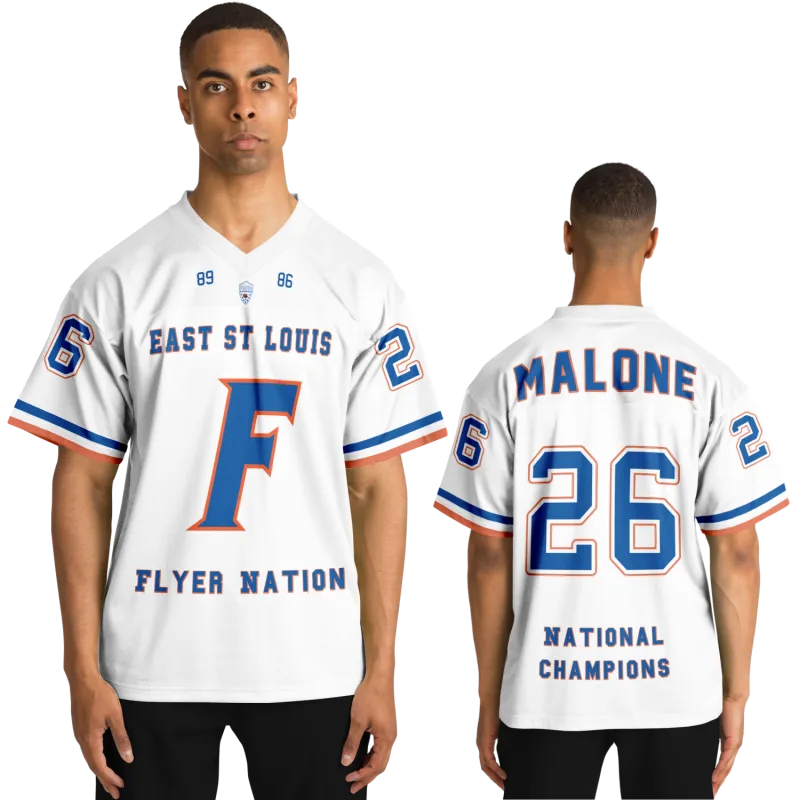
If you played football at any level, you remember the equipment manager sliding a jersey across the table without asking a single question. Size XL. Boom. Done. It fit or it didn't, and either way you wore it.
Custom football jersey adult sizing doesn't work that way — and that's actually the part nobody warns you about. You can pick the color, the font, the number you wore in your junior year. You can get the nameplate you always wanted. And then you enter your size from memory, order it, and spend the next two weeks waiting for something that fits your high school body instead of the one you're living in now.
That's the mistake this guide is built to prevent.
Your body changed. Your chest filled out. Your shoulders broadened. Maybe your torso lengthened, or your midsection shifted. The sizing chart you unconsciously remember from the early 2000s was built for a seventeen-year-old in pads — not for you in 2026 with thirty-pound more muscle and a completely different frame. Getting this right takes about ten minutes and a cloth tape measure. Getting it wrong takes two to three weeks of shipping, a return, a reorder, and the nagging feeling that you rushed something that should have been great.
Here's the process.
The One Thing Sizing Charts Won't Tell You About Football Jersey Fit
Most jersey sizing charts give you two or three measurements: chest, waist, and a vague "size" column that maps to S through 3XL. That works fine for a basic t-shirt.
Football jerseys are not basic t-shirts.
They're cut with extended shoulder seams, a broader chest panel, and — depending on the manufacturer's template — a body length that accounts for the tucked-in position a player holds during a game. That means a jersey that measures correctly in the chest can still pull across the shoulders, ride up when you lift your arms, or balloon at the waist like something borrowed from a larger man.
The chart doesn't know your shoulder width. It only knows your chest circumference. Those two numbers almost never agree with each other on an adult athlete's frame, especially if you trained through college, played recreationally into your thirties, or spent years doing any kind of upper body conditioning. Chest circumference grows along one measurement axis. Shoulder width grows along a completely different one.
In our experience reviewing customer feedback on custom jersey orders, the most common complaint isn't "I ordered the wrong size" — it's "I ordered the right size and it still doesn't fit." That's the shoulder-to-chest discrepancy problem, and it's nearly invisible until the jersey is on your body.
The solution is to take both measurements, compare them against the chart, and let the larger one govern your size selection.
The Four Measurements That Actually Govern Custom Jersey Fit
Before you touch a sizing chart, take these four numbers. You need a soft cloth tape measure — a steel measuring tape won't flex correctly around body contours and will give you measurements that are off by an inch or more in the wrong direction.
Measurement 1: Chest Circumference
Wrap the tape measure horizontally around the fullest part of your chest — directly across the nipple line, arms relaxed at your sides. Don't expand your chest for the measurement. Don't suck in either. Stand naturally, exhale gently, and read the tape. Write down the number in inches.
This is the measurement most charts lead with. It's important. It's not the only one that matters.
Measurement 2: Shoulder Width
This is the measurement most adult athletes need and most sizing guides skip entirely.
Have someone help you with this one if you can — measuring your own shoulder width accurately is genuinely difficult. The tape goes from the outermost point of one shoulder (the bony end of the shoulder joint, not where your arm begins) straight across your upper back to the outermost point of the other shoulder. The tape should lie flat across your upper back in a straight horizontal line.
For context: the average adult male shoulder width falls between 17 and 18 inches. If you played linebacker, tight end, or any position requiring significant upper body development, your measurement is likely 18.5 to 20 inches or beyond. That's a different jersey than the chart suggests.
Measurement 3: Body Length
This one prevents the embarrassing ride-up problem.
Measure from the top of your shoulder (at the base of your neck) straight down to where you want the jersey hem to fall. If you plan to wear it untucked, measure to where an untucked shirt would sit on your hip. If you plan to tuck it into athletic pants the way you would have on the field, measure to mid-hip.
Body length varies more than people expect. A 6'2" former offensive lineman and a 6'2" former defensive back have completely different jersey length requirements based on torso proportion alone.
Measurement 4: Sleeve Length (Optional but Recommended)
For sleeveless practice jerseys, skip this. For full game-style jerseys, measure from the center back of your neck, across your shoulder, and down to the point where you want the sleeve to end — usually just above the elbow for a traditional football silhouette.
Most adult men ordering custom jerseys discover their sleeve length is longer than the chart's default. This doesn't require a custom sleeve extension in most cases — it just means knowing whether the jersey's standard cut will land where you want it.
How to Use Your Measurements Against a Sizing Chart (Without Getting It Wrong)
You have four numbers. Here's what to do with them.
Step 1: Find the chart's chest and shoulder columns.
Some manufacturers list shoulder width as a separate column. Most don't — which is precisely the problem this guide is solving. If the chart only shows chest circumference, you'll need to do a simple comparison.
Step 2: Identify where each measurement places you on the chart.
Your chest circumference might put you at an XL. Your shoulder width — if you convert it using the standard proportional relationship — might put you at a 2XL. Write both down.
Here's the conversion the chart doesn't show you: if your shoulder width is 18.5 inches or greater, you're in the territory where most XL jersey shoulder seams will sit an inch or more short of your actual shoulder joint. That produces the "pulling across the back" fit failure that no amount of chest measurement accuracy can prevent.
Step 3: Let the larger size govern the order, then check the body length.
If your chest says XL and your shoulders say 2XL, order the 2XL. Then cross-reference your body length measurement against the 2XL's listed body length. If the 2XL runs long and your torso measurement is shorter than the jersey length, that's still the right call — excess length you can address with a tuck. Shoulders that pull across the back cannot be adjusted.
Step 4: Contact the manufacturer before ordering if your measurements split between two sizes.
This is the step most people skip because it feels unnecessary. It isn't. A ten-minute exchange before ordering prevents a three-week return process. Any reputable custom jersey supplier will tell you their template dimensions if you ask. Get the shoulder width of the specific size you're considering and compare it to your measurement directly — the diligence that lets you order an affordable custom jersey without sacrificing quality with confidence.
The Former Athlete Proportionality Problem (And Why It's More Common Than You Think)
Every former athlete remembers being one size. It's almost involuntary — you played at 185 pounds and wore a medium. That number lives in your body memory the way your number lives in your memory. You don't look it up. You just know it.
The problem is that athlete bodies don't age proportionally. They build muscle in specific places based on what the sport demanded, then shift over the years as training frequency changes and lifestyle evolves. A former wide receiver might carry his weight differently than a former fullback even if they're currently the same total weight. A former defensive lineman might have a chest that stayed broad while his waist changed substantially. A former quarterback might find that years of throwing developed his dominant shoulder significantly more than his non-dominant side — which actually shows up in shoulder width measurement discrepancy.
Marcus T., 44, a former high school offensive lineman, ran into this same problem. He ordered a custom jersey for his son's flag football team photo — and included one for himself since it was a family order. He went with the same size he remembered from his playing days. The jersey arrived with the right chest fit and shoulders that pulled so tight across the back he couldn't raise his arms above his head. One reorder, one additional shipping wait, and one return later, he had a jersey that fit. The fix was going up one size and comparing actual shoulder width measurements against the manufacturer's template — something the original order skipped entirely.
What "Athletic Fit" vs. "Classic Fit" Actually Means for Adult Bodies
Custom jersey suppliers frequently list two cut options: athletic fit and classic fit. For a seventeen-year-old ordering his first jersey, the distinction barely matters. For an adult with a former athlete's frame, it matters significantly.
Athletic fit is cut with a tapered torso — broader through the chest and shoulders, narrower at the waist. This is the right cut for someone who maintains an active training schedule and has a genuine V-taper to their frame. It will look sharp on that body. On a body that's carried more evenly, it will feel constricting at the waist while being accurate in the shoulders.
Classic fit is cut with a consistent chest-to-waist ratio — essentially a more uniform tube shape through the body. It accommodates the realistic proportions of an adult male who played seriously but isn't training at peak competitive volume anymore. It also looks closer to the traditional game jersey silhouette from the eras most former athletes remember — and how jersey fabric has changed since you played is worth understanding before you order.
The wrong choice here doesn't show up in the measurements. It shows up when the jersey arrives and fits correctly by every number on the chart but feels wrong on the body. Before ordering, identify which cut the manufacturer offers and match it to your actual current frame — not the frame you had at your peak.
Your jersey is still out there waiting.
Design yours in minutes and see your name and number just the way you remember it.
Frequently Asked Questions
What if my chest measurement and shoulder measurement put me in different sizes?
Always let the larger size govern the order. Shoulder fit cannot be adjusted after the fact — a jersey with correct chest measurement but short shoulder seams will pull across the upper back every time you move your arms. A jersey that's slightly larger through the torso can be worn untucked or layered over a compression shirt. The shoulder seam landing correctly on the actual shoulder joint is the non-negotiable fit priority for a football jersey.
Should I measure over a t-shirt or on bare skin?
Measure over a thin, fitted t-shirt — the kind you'd wear under a jersey on the field. Football jerseys are designed to be worn over a base layer, and the slight additional volume a fitted shirt adds is already accounted for in the way jersey templates are built. Measuring on bare skin produces a result that's technically accurate but practically slightly small when layered. If you wear a compression shirt under your jersey, measure over the compression shirt.
How do I measure shoulder width without a second person?
The cleanest solo method: stand against a flat wall with your back touching it and your shoulders relaxed. Use a pencil to mark the wall at the outermost point of each shoulder, then step away and measure the distance between marks with a rigid ruler. It's slightly less precise than having someone run a tape directly across your upper back, but it gives you a workable measurement within half an inch — which is close enough for size selection purposes. If you're genuinely between sizes, repeat the measurement three times and use the median result.
Can I use my old high school jersey size as a reference point?
Use it as a starting point only — never as the final decision. Your high school jersey size tells you approximately where on the size spectrum you began as an athlete. It doesn't tell you where you are now, how your proportions shifted, or whether the current manufacturer's template matches the one your school used. Take your four measurements regardless of what size you wore at seventeen. It takes ten minutes and eliminates the only reliable path to a return.
What if the custom jersey I'm ordering doesn't list shoulder width in their sizing chart?
Contact the manufacturer's customer service before ordering and ask for the shoulder seam width of the specific size you're considering — measured from the outer edge of one shoulder seam to the outer edge of the other across the back panel. Any manufacturer producing custom jerseys should have this dimension readily available. If they don't, that's a meaningful signal about the detail level you can expect in the order overall. The ten-minute conversation before ordering is always worth it.
See also: jersey size chart for numeric sizing | the gap between your athletic memory and your current body | personalized sports gifts that actually make a former athlete feel seen