

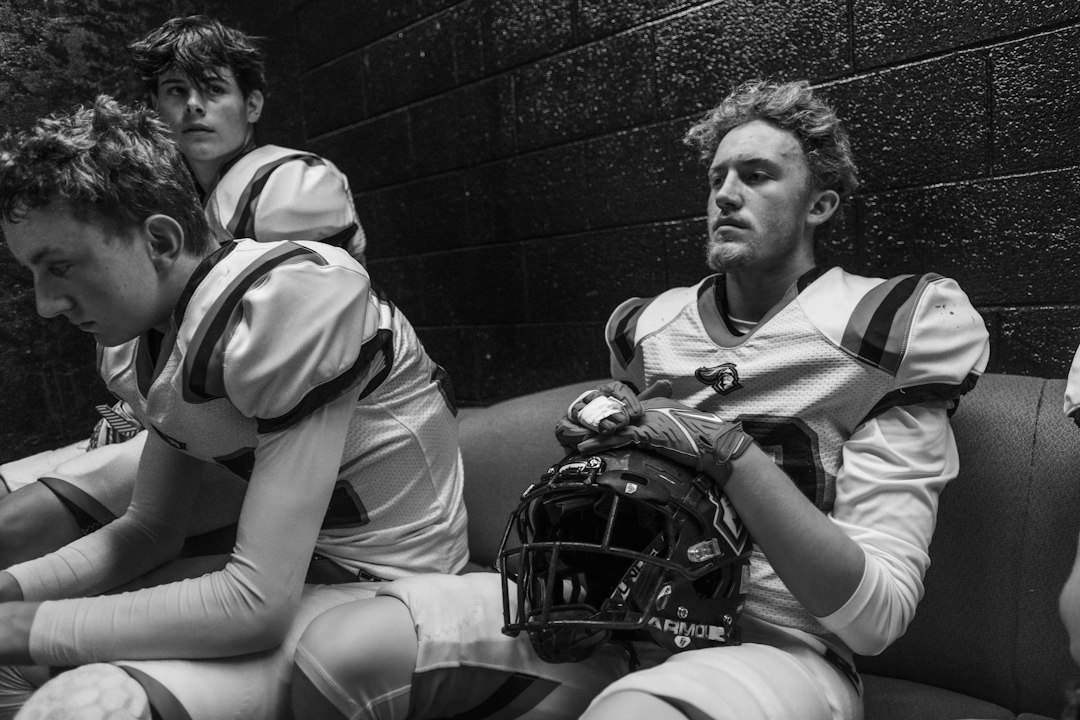




There's a specific moment every former player carries somewhere in their memory. You're working through a box in the garage, or an old teammate tags you in a photo from senior night, and there it is — your number, your colors, the cut of mesh that felt like armor on Friday nights. The thought lands fully formed: I want that back.
The trouble is that every guide to football jersey custom design online is written for a head coach with a purchase order and a vendor relationship. Bulk minimums, team store configurations, uniform package tiers — that is the world those guides cover. None of them address the person reading this: one former player who wants one jersey that honors one very specific chapter of their life.
This walkthrough covers the complete custom football jersey design process as former players actually work through it — pulling usable reference from yearbook photos, matching school colors without an official Pantone number, finding single-unit ordering paths that do not carry team-minimum pricing, and finishing with a jersey that genuinely reflects the one you wore.
The Gap Every Other Custom Football Jersey Guide Leaves Open
Standard ordering guides assume you already know your colors, your fonts, and your number set — because they are written for teams that do. That assumption creates three specific blind spots that stop former players before they complete an order.
Blind spot one: Reference gathering. A current team placing a seasonal order has last year's art files, a vendor on record, and an equipment manager who remembers the details. You have a memory, a photograph that may or may not be sharp, and whatever the school's current website happens to show — which could be two uniform redesigns removed from what you wore.
Blind spot two: The single-unit path. Team-order platforms are built around minimums of 12, 24, or 48 units. A path for ordering one jersey often exists, but it is buried under team-first navigation. Miss it and you either absorb team-minimum pricing or walk away empty-handed.


Blind spot three: Vintage construction details. Current jersey builders surface current-season templates. If your high school wore tackle twill numbers in a specific outlined block font in 1997, that style is not on the first screen of any major builder. Knowing where to look for it — or how to brief a custom shop to achieve it — is knowledge those guides never provide.
This walkthrough closes all three gaps. Work through each step in order, even if you feel confident about one in particular. The reference-gathering step catches specification problems that cause failures much later in the process.
Step 1: Build Your Reference File Before You Open Any Builder
This is the step that determines whether your finished jersey looks right or merely looks close. Most former players skip it because they trust their memory. Memory is not a specification document.
Pull Every Image Available to You
Begin with physical sources before going digital. Open the yearbook to the team photo spread, the sports section action shots, any image where the jersey details are legible. Lay the yearbook flat on a white surface and photograph the relevant pages with your phone in good natural light. You want images you can zoom into without losing clarity.
Then move through digital sources:
- Your school's current athletic department page — official colors are often listed even when the uniform design has since changed entirely
- Your state high school athletic association — many maintain archived team rosters and photos going back to the 1980s and 1990s
- Your county library's digitized local newspaper archive — game coverage from your era frequently includes sideline photography with clear jersey detail
- Facebook alumni groups for your school — in a group of a few hundred former students, someone almost always has clear photographs you have not seen
In every image, look for four things: the precise shade of the primary color, the precise shade of the secondary color, the number font style including whether it is outlined or shadowed, and the construction method — tackle twill versus screen print versus heat transfer.
The Yearbook Color-Matching Method
This approach is the most reliable color-matching tool available to someone without access to the school's original vendor files, and it requires nothing beyond a phone.
Open your clearest yearbook photo in your phone's editing app. Use the color picker or eyedropper tool — built into the native editors on both iOS and Android — to sample directly from the jersey in the image. Write down the hex code that appears.
One adjustment to account for: offset printing from the 1990s and early 2000s ran warm. Reds in yearbook photos often print more orange than the actual jersey color; blues often print more purple. Treat your sampled hex code as a starting point, then cross-reference against any official documentation for your school's colors. If the school's current website or the state athletic association lists Pantone or hex values, those are your authoritative reference. Where the yearbook sample and the official record differ, adjust toward the official record.
If no official documentation exists anywhere, submit the yearbook-derived hex code with your order and note in the special instructions that it was sampled from a printed photograph — a reputable shop will flag any production color concerns before manufacturing begins.
Step 2: Document Every Specification Before You Open a Builder
With your reference file assembled, write down every specification before touching any ordering platform. Arriving mid-builder without these answers means making decisions under pressure — which is precisely where specification errors enter the process.
The specification checklist:
- Primary color — hex code or closest Pantone equivalent
- Secondary color — hex code or closest equivalent
- Your number — as it appeared on the original jersey, including whether it was a single or double digit (this affects both sizing and placement)
- Number construction — tackle twill, screen print, or heat transfer
- Nameplate — yes or no; if yes, the spelling and whether it carried your surname only
- Number and name font — block, outlined, shadowed, or a school-specific style
- Jersey cut era — pre-2005 jerseys were longer and wider; post-2010 jerseys run slim and short; identify which era yours belongs to
- Fabric type — traditional game jerseys used mesh; some practice jerseys did not
If your reference photos do not give you enough detail to identify the number font, search your school name plus "football" in Google Image Search and use the Tools filter to restrict results to a date range matching your playing years. Alumni networks surface clear sideline photographs regularly.
Step 3: Choose Your Platform Based on Your Actual Order Quantity
This is where the single-order workflow diverges completely from the team-order workflow. Choosing the wrong platform means paying team-minimum pricing for one jersey, or discovering at checkout that your order cannot be submitted without an institutional account.
Platforms That Actually Support One-Unit Orders
The major athletic brand channels — Nike football uniforms and Under Armour football jerseys among them — operate through team-sales programs built for schools and organizations. Those channels require account credentials and carry purchase minimums. They are the right option for a program placing a seasonal uniform order. They are not the right option for one former player ordering one jersey.
For a genuine single-unit custom order, the market organizes into three categories:
Sublimation jersey builders — full-color dye sublimation printing with no minimums. The right choice if your original jersey used a sublimated design, which became common in high school programs after roughly 2008. Colors are permanent and vivid; the construction is lightweight. Search "custom football jersey no minimum sublimation" to find current operators and compare sample quality before committing.
Tackle twill specialty shops — smaller operations, often family-run, that specialize in the sewn-on number and letter construction that defined football jerseys through the 1990s and into the early 2000s. This construction method is what makes an older-era jersey feel like a tribute to the original rather than a generic garment with a name on it. Search "custom tackle twill football jersey single order" and always request a physical sample before placing a deposit.
Throwback and vintage jersey specialists — for a jersey from an era or in a style that reads as vintage, this segment of the market applies construction standards used for period-accurate tribute pieces. The quality benchmark most custom shops in this space recognize is the construction approach seen in throwback NFL tribute pieces — tackle twill numbers, felt lettering, period-correct mesh weight. Mitchell & Ness football jersey construction is the reference language most vintage-specialist shops understand immediately when you describe your quality expectations. You are commissioning an original custom piece in the style of a specific era, not a licensed product — but using that construction language communicates your standard precisely.
For reference points beyond American football: the vintage England football jersey and vintage German football jersey collector markets operate through the same authenticated resale and custom-tribute channels. If you have played internationally or want period-accurate construction from another tradition, specialist dealers in those markets apply equivalent standards.
Platform Red Flags Worth Knowing
Skip any platform that cannot provide a physical sample of their tackle twill work on request, does not offer a digital proof before production begins, or carries no documented revision policy. Confirm all three points before placing any deposit.
Marcus T., 38, worked through this process to commission a jersey in the style of the one he wore as a starting linebacker at a mid-sized Texas high school in 2003. His school had updated their uniform program twice in the years since, and the original vendor was no longer operating. He located a clear team photo in a digitized issue of the local school newspaper, used the color picker method to extract working hex codes from the image, and brought that complete reference file to a tackle twill specialty shop. The shop's construction sample confirmed the number font was a close approximation of what appeared in his photographs. His finished jersey arrived six weeks after proof approval — accurate enough in its number placement and color that his daughter asked if it was the original from the box.
Step 4: Work Through the Builder — or Brief the Custom Shop in Detail
If you are using a self-serve sublimation builder, your reference file carries most of the work. You have the hex codes. You have the full specification list. You are not reconstructing details from memory under time pressure.
Move through the builder in this order:
- Set the primary color first. Every other decision gets evaluated against this baseline, so establish it before anything else.
- Place the number — size and position. Check placement against your reference photograph. Traditional football jersey numbers sit high on the chest, not at mid-torso. This is one of the details that most distinguishes a period-accurate result from a modern default.
- Add the nameplate if applicable. Match the font as closely as the builder's library allows, and document any font discrepancies in your proof request so the shop can address them directly.
- Set sleeve and collar details. Stripes, piping, and panel colors are what distinguish a genuine tribute piece from a generic jersey with a name applied. Do not move past this section quickly.
- Request the digital proof before approving anything. Review it side by side with your reference photograph on the same screen. This is the last point at which you can identify a color shift or a placement error before the jersey enters production.
If you are working with a custom shop rather than a self-serve platform, send your complete reference file — every image gathered in Step 1 — along with the full specification sheet from Step 2. A shop that responds with clarifying questions is reading your materials carefully. A shop that confirms production immediately without any questions is not.
Step 5: Review the Proof and Approve Only When It Matches
The proof review is not a formality to move past. It is the quality-control step that determines whether the finished jersey aligns with your reference or falls short of it.
When reviewing:
- Compare number placement against your reference photograph, not against your recollection
- Confirm that the colors in the proof reflect the hex codes you specified — ask the shop to state the production color values in writing if the proof is a digital render rather than a physical strike-off
- Read the nameplate lettering character by character — letter spacing errors are the most common correction needed at this stage
- Where something requires correction, be specific: "The number appears centered on the torso. In my reference photograph it sits approximately three inches higher, just below the chest seam."
Approve only when the proof aligns with your reference file. Most reputable shops include at least one revision round in the base price; confirm this before submitting your first approval.
One Honest Note on Licensed Designs
If your original jersey was connected to a licensed program — a school that later joined a conference with uniform licensing agreements, or a state program that adopted a commercially licensed design — a tribute piece incorporating those protected elements may not be available through the custom market. Licensed uniform details cannot be reproduced without authorization from the licensing body.
In those situations, the standard approach is to commission a custom piece inspired by the original: the same colors, the same number, the same general character — without incorporating any protected design elements. That framing, a tribute to the original rather than a duplication of it, is both the legally sound and practically achievable outcome. The National Federation of State High School Associations maintains uniform standards documentation that can help you identify whether any element of your original jersey falls under current licensing frameworks.
For the majority of high school football jersey projects, no licensing consideration applies. The custom design process described in this walkthrough is the complete path forward.
Your jersey is still out there waiting.
Design yours in minutes and see your name and number exactly the way you remember it.
Frequently Asked Questions
Can I order just one custom football jersey, or do most platforms require a minimum?
Single-unit orders are available through sublimation jersey platforms and tackle twill specialty shops — no team account or minimum quantity required. Platforms that enforce minimums of 12, 24, or 48 units are built for institutional purchasing and are not the right channel for an individual order. When evaluating a platform, look for an explicit no-minimum statement or a quantity field that accepts "1" before investing time in the builder. If the checkout flow requests a team name and institutional contact before you can specify quantity, you are in the wrong part of the market.
How do I match my school's colors if I cannot find official Pantone or hex values anywhere?
Use the yearbook color picker method from Step 1: photograph the clearest available image of your jersey, open it in a photo editing app, and sample the color directly to extract a working hex code. Cross-reference that code against your school's current athletic website or your state high school athletic association listing. Where the yearbook sample and official documentation differ — which is common because offset printing from the 1990s ran warm — adjust toward the official record. If no official documentation exists at all, submit the yearbook-derived code with a clear note in your order's special instructions explaining the source and asking for the closest available production color.
How long does a single custom football jersey order take from start to finished jersey?
Sublimation orders typically run two to three weeks from proof approval to delivery. Tackle twill orders — which require cutting and sewing individual numbers and letters by hand — generally run three to six weeks depending on the shop's current workload. Build in time for at least one proof revision round, which can add three to five business days to the timeline. For a project where construction accuracy matters more than speed, working within the standard timeline rather than rushing it is consistently the right call.
What if my original jersey used a number font that does not appear in any standard builder library?
Custom shops specializing in tackle twill work can cut any number font from a reference image — they are not limited to a preset library the way self-serve builders are. Send your clearest reference photograph and ask specifically whether they can produce the font from the image rather than from their standard options. If a close approximation rather than a precise match is the honest answer, ask to see their nearest available alternative alongside your reference before approving anything. For sublimation platforms with fixed font libraries, the closest available option is the realistic outcome — document the gap so you can brief a tackle twill shop if you commission a second jersey down the line.
See also: personalized sports gifts vs generic options | jersey sizing numbers like 44, 48, and 52 explained | what to do with your old varsity letter jacket | the psychology of why high school sports still matter to adults