

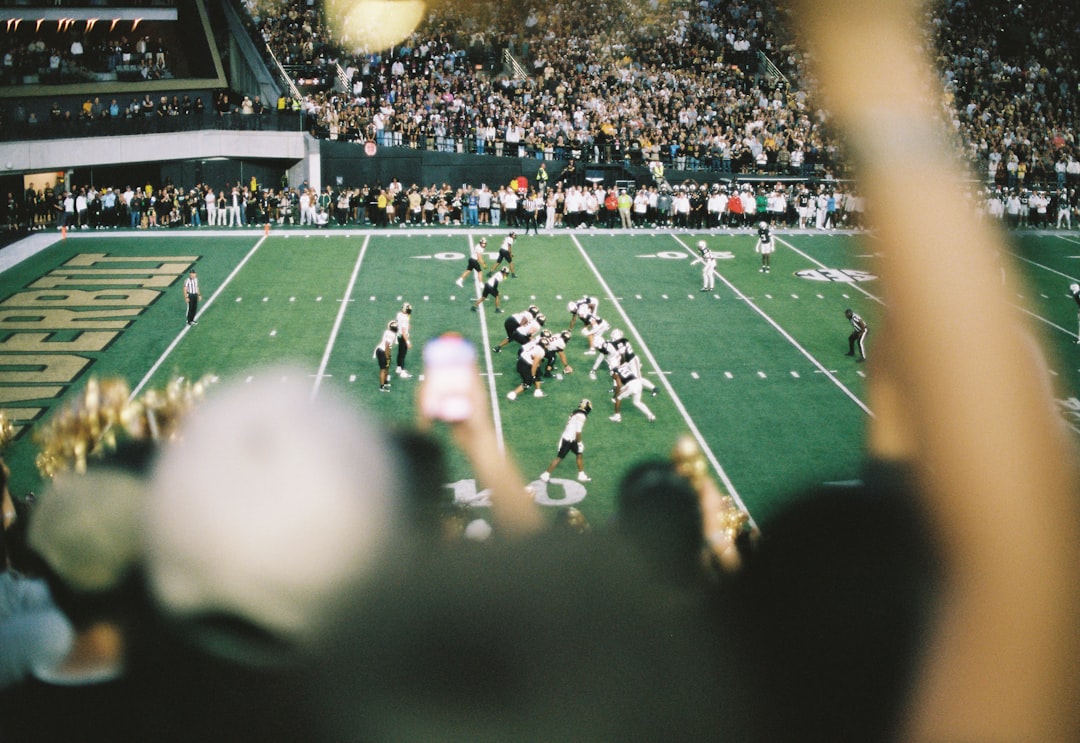




You know the feeling before you can name it.
It starts somewhere behind your sternum — not quite pain, not quite excitement — and it spreads outward until your hands are doing something they didn't ask permission to do. Tapping. Gripping. Pulling at the hem of your jersey. The physical sensations of high school sports aren't stored in your memory the way a photograph is stored. They're stored in your muscles, your nervous system, the specific calibration of your body at sixteen years old when everything was still being written.
Nobody writes about this part. The nostalgia lists cover the friendships, the team bus, the scoreboard. But they don't get close to what the body remembered — and still remembers, decades later, when the right smell or the right sound reaches you without warning.
These seven sensations are for the athletes who know exactly what we're talking about.
1. The Butterflies Before a Game That Were Never Actually Butterflies
The phrase "butterflies before a game" is technically accurate and completely wrong at the same time.
What you felt in the locker room thirty minutes before tip-off, or in the tunnel before kickoff, or crouched in your starting blocks with the crowd noise bleeding through the concrete — that was not a flutter. That was your sympathetic nervous system performing a full-scale activation sequence. Adrenaline and cortisol entering the bloodstream simultaneously. Blood redirected away from your digestive system (hence the hollow, unsettled feeling in your gut) and toward your major muscle groups. Your pupils dilating whether you wanted them to or not.
It felt like nausea because it was physiologically adjacent to nausea. The same mechanism that produces motion sickness was being co-opted for something your body understood as survival-level urgency.
What made it specific to high school — different from any adult stress you'd carry later — was that there was nothing else competing for it. No mortgage behind it. No work email waiting. Just this gym. This floor. That scoreboard. Your body had everything it needed to feel the thing completely, and it did.


In our experience talking with athletes across every sport and era, this is the sensation they reach for first. Not the wins. Not the stats. The thirty minutes before, when everything was still possible and the body was already running at a frequency it would spend the next forty years trying to find again.
2. The Feeling of Adrenaline Before Kickoff — and the Moment It Converted
There is a distinct physical threshold in the feeling of adrenaline before kickoff — or before the opening pitch, the starting whistle, the referee's first gesture — where the pre-game anxiety converts into something else entirely.
Athletes describe it differently. It clicked. I stopped thinking. Everything slowed down. What they're describing is the moment the prefrontal cortex — the part of the brain responsible for self-monitoring, second-guessing, social anxiety — temporarily yields to the older, faster systems underneath. The limbic system. The motor cortex. The parts that don't narrate. They just move.
The physical sensation of that conversion is unmistakable. Your shoulders drop about half an inch without you deciding to drop them. Your jaw unclenches. The hollow stomach feeling resolves not into calm but into something more electric — a full-body readiness that has no civilian equivalent.
That conversion point is what separated the athletes who performed from the athletes who got in their own way. Not talent. Not preparation. The specific neurological moment when the body stopped waiting for permission and started doing what it had been trained to do.
You can't manufacture that feeling in a gym. You can't find it in a morning run. It requires the crowd, the opponent, the uniform, and the specific irreversibility of the first moment of competition. Once it's gone, it's gone — but your body keeps the memory of it filed under something it's always half-looking for.
3. Runner's High as a Teenager — Before You Knew What It Was
If you ran — cross country, track, any sport with extended cardio — you remember the first time you ran through the wall.
The wall comes at different points for different athletes. Somewhere between mile two and mile four, typically, when lactic acid has accumulated past the point of comfort and your brain sends a signal that translates roughly as this should stop now. Most recreational runners stop there or slow down. Trained athletes run through it. And on the other side is one of the most specific physical sensations the human body is capable of producing.
Runner's high as a teenager is pharmacologically identical to the same state in adults: endorphin release, endocannabinoid system activation, a measurable reduction in pain perception and a simultaneous increase in something that feels very close to euphoria. Research published in Cerebral Cortex confirmed that the euphoric component is driven primarily by endocannabinoid signaling, not endorphins — the same receptor system activated by cannabis.
But as a teenager, you didn't know any of that. You just knew that at some point in the fourth mile, the suffering dissolved. Your stride opened up. The air felt different in your lungs. The world got quieter even as it got brighter. You ran the last mile faster than the first three without understanding why your body was suddenly cooperating.
The specificity of experiencing that state before you had the vocabulary or the neuroscience for it — before you had anything to compare it to — made it something entirely its own. It wasn't like anything. It was just what happened when you went far enough.
4. Exhaustion After Practice That Was Different From Any Tiredness Before or Since
There is a category of physical exhaustion that only high school athletes know, and it is not the tiredness of a long workday or a bad night's sleep or a weekend of physical activity. It is a specific, total-body depletion that is simultaneously the worst you've ever felt and, somehow, deeply satisfying.
The sting of shin splints was part of it. So was the specific texture of muscle fatigue in your quads after three hours of drills, when climbing stairs required a conscious decision at each step. Your hands ached from grip work you'd stopped noticing during practice. The back of your neck held heat from two hours under stadium lights or afternoon sun.
And underneath all of it — this is the part that's hardest to explain to someone who didn't live it — was a profound physical rightness. The exhaustion after practice wasn't the exhaustion of depletion without purpose. Your body knew exactly what had been asked of it and why. Every sore muscle was evidence of something. The tiredness had a shape.
Marcus D., 34, a former high school wrestler from central Ohio, still talks about the drive home after Tuesday practices. "My dad would pick me up and I'd get in the passenger seat and I couldn't have held a conversation if I'd wanted to. But I wasn't miserable. I was just… used up. In the best possible way."
That sensation — full-body, purpose-driven depletion — doesn't come back easily in adult life. When it does, even in fragments, athletes recognize it instantly.
5. The Specific Physical Experience of a Crowd That Was There for You
This one is harder to describe than the others because it lives at the intersection of sound, pressure, and something closer to electricity.
A high school gymnasium at capacity sounds different from any other enclosed space. The frequencies are wrong in a specific way — too much bass from the bleachers, too many overlapping voices, the squeak of sneakers cutting through it at irregular intervals. When the home crowd reacts to something you do — a made shot, a clean tackle, a stolen base — the physical sensation is not just auditory. It moves through the floor. You feel it in your feet before your brain has processed the sound.
The body's response to crowd noise is real and measurable. Elevated heart rate. Increased cortisol. Enhanced performance on tasks that require power or speed, with a corresponding decrease on tasks that require fine motor precision. The crowd was doing something to your physiology whether you acknowledged it or not.
What made this particular to high school was the specific composition of that crowd. Your parents were in those bleachers. Your classmates. The person you were hoping would notice. The coach who either believed in you or didn't. You were performing inside a social universe that contained your entire world at that time — not a stadium of strangers but a room full of everyone who knew your name.
The pressure was specific in a way that professional athletes, performing for anonymous thousands, rarely describe. And the physical sensation of being inside that specific pressure — visible, known, performing — is one your nervous system filed under permanent memory.
6. The Sting of Shin Splints and Everything You Learned to Play Through
Pain in adult life tends to mean stop. In high school athletics, pain had a more complicated relationship with permission.
The sting of shin splints — medial tibial stress syndrome, the almost universal companion of runners and court athletes in growth — is a very particular physical experience. It begins as tenderness along the inner edge of the tibia, escalates to a burning sensation during the first ten minutes of activity, and then, in a phenomenon that confuses everyone who hasn't experienced it, often fades to a dull background ache once the body has warmed up enough. Then it returns, sharply, in the cool-down.
Every athlete who dealt with it developed a personal relationship with that specific sensation. You learned to distinguish "this is the kind of pain I can run through" from "this is the kind that gets worse if I push it." You learned your own body's negotiation language. This was not a skill anyone taught you — it emerged from necessity and repetition and the specific motivation of not wanting to sit on the bench while your teammates played.
Playing through manageable discomfort — distinguishing between pain that signals damage and discomfort that signals effort — is a physical literacy that high school athletics produces and almost nothing else does at that age. The sting of shin splints was part of how you learned it. Your body still carries the tuition receipt.
7. The Feeling in Your Legs on the Walk Off the Field for the Last Time
This one doesn't announce itself. That's what makes it the most specific sensation of all.
You don't know, walking off the field or the court or the track for the final time, that it's the final time. Your legs feel the way they always feel after competition — the specific combination of fatigue and residual adrenaline and the physical memory of every movement from the last two hours. Your cleats are still caked from the same infield they've always been caked from. The locker room sounds the same as it always has.
And then, somewhere — weeks or months or years later — it becomes clear that that walk was the last one. And your body, which filed it as routine, suddenly has to retroactively understand it as permanent.
Athletes who retired from high school sports without continuing in college often describe a specific physical grief that surprised them. Not sadness exactly — something more embodied. The absence of the sensation of being in uniform, ready, in your position, connected to the specific weight of your sport's equipment and the specific temperature of the air in that specific venue.
The body grieves the absence of physical sensations the way the mind grieves the absence of people. It keeps reaching for something that isn't there anymore. Which is, maybe, why so many athletes spend decades reaching back toward it — looking for the specific frequency their body was running at during those years.
Your jersey is still out there waiting.
Design yours in minutes and see your name and number exactly the way you remember it.
Frequently Asked Questions
Does the body actually remember physical sensations from high school sports, or is that just nostalgia?
It's not just nostalgia — it's physiology. The nervous system encodes motor patterns and somatic experiences alongside declarative memories. Research in embodied cognition supports the idea that the body stores procedural and physical memories independently of conscious recall. When a sensory cue (a smell, a sound, a specific temperature or pressure) matches the conditions of a stored physical experience, the body can reproduce elements of that original physiological state — elevated heart rate, muscle activation patterns, even hormonal responses. High school athletics, with their intensity, repetition, and emotional loading, create some of the most durable somatic memories the body stores.
Why do the physical sensations of high school sports feel more intense than adult athletic experiences?
Several factors compound during adolescence to amplify physical experience. Hormonal levels — testosterone, estrogen, growth hormone — are at developmental peaks. The nervous system is still forming, which means sensory experiences are processed with less filtering and more raw intensity. The social stakes are higher per unit of experience: your entire social world is present in that gymnasium or on those bleachers. And critically, you have no prior template for what you're feeling. The first time your body runs through the wall, or converts pre-game anxiety into competition readiness, or processes the physical sensation of a crowd responding to something you did — it files that as primary experience, not comparison experience. That's why it hits differently.
Can you recreate these sensations as an adult through recreational sports?
Partially, and meaningfully — but not identically. Adult recreational leagues, masters athletics, and competitive fitness communities all produce real versions of some of these sensations: genuine pre-competition adrenaline, real endorphin responses, authentic physical exhaustion with purpose. What's structurally absent is the social totality of the high school context — the crowd that contains your entire world, the stakes that feel existential because you haven't yet developed the adult perspective that reduces them. Many athletes report that returning to competition in any form recovers more of these sensations than they expected. The body's memory is cooperative. It doesn't need identical conditions — just close enough to start filling in the rest.
What's the difference between the exhaustion after high school practice and regular adult tiredness?
The distinction is purpose architecture. Adult fatigue — from work, from life, from accumulated stress — is often diffuse. It doesn't have a specific shape. High school practice exhaustion was precisely structured: every depleted muscle had a specific cause, a specific drill, a specific coach's instruction behind it. The body experienced that depletion as evidence of effort toward something defined, with clear social accountability (your teammates, your coaches, your own position on the depth chart). Psychologically, that's profoundly different from the tiredness of a long week. The body knows the difference. Most athletes describe the high school version as harder and also more restorative — because the sleep that followed it had the specific quality of genuine physical completion.
See also: why high school sports still matter so deeply to adults | the science behind why those memories feel so crystal clear | what it felt like to play under the Friday night lights | why so many former athletes still dream about those games | the shared silence of the bus ride home after a loss