

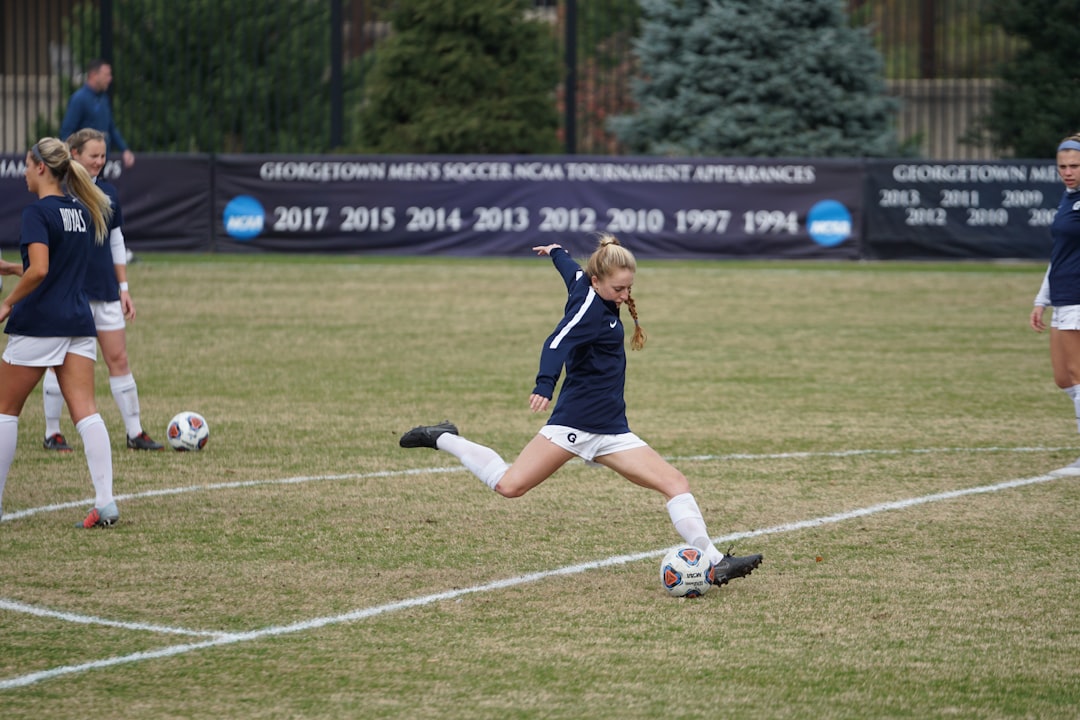




High school soccer memories don't live in highlight reels, trophies, or the statistics someone kept in a scorebook that nobody can find anymore. They live in a specific field — your field — with its particular mud, its particular lean in the near-side post, its particular way of holding the low October light at the end of a Tuesday practice when you were too tired to do anything but feel it.
If you played, you already know this feeling. The field wasn't much to look at. You knew that then. One corner went to mud the moment it rained, which in your part of the world meant it spent half the season as mud. The center circle had surrendered its grass entirely by the second month, leaving a scuffed red-brown oval where the real work got done. The goals sat slightly off-true — not enough to fix, just enough to be a known thing, like a particular habit in someone you've lived with for years.
And yet you loved that field in a way that had nothing to do with its condition. You would have played on it in the dark. You probably did, if you count the late November practices where you tracked the ball more by sound than by sight, relying on something that wasn't quite vision anymore.
That field made you. The question is: what did it make?
The Geography Every Soccer Player Carries Inside Them
Not a dream field. The actual field — the one where you learned that you could play, and then learned, practice by practice, how much better you could get.
For some players, it was a municipal park the school borrowed three afternoons a week, where the goalposts were shared with a youth football program and always seemed slightly too close together. For others, it was a school field at the edge of a parking lot, where a mishit shot disappeared under the bumper of someone's station wagon. A few of us played somewhere genuinely beautiful — a slope above the town, the kind of place where warm-up laps felt like something more than fitness work.


None of that topography was accidental to the player you became.
A narrow field taught you to play vertically, to find passes through tight angles, because width was never available and you had to solve the problem some other way. A wide, open pitch built comfort in transition — you learned the long diagonal, learned to trust space, learned a kind of expansiveness that players from smaller fields sometimes spend years trying to acquire. You absorbed the geometry of your home ground the way you absorbed language: completely, without effort, permanently.
Coaches understand this and rarely say it plainly: the field teaches before the coach does. You still feel it when you watch a match now. You still see the field inside the field — the way a pass opens up a particular channel, the way a run exploits a particular shape of space. Your eyes still move the way they moved on your field, reading what was always there.
What the Smell of Cut Grass Is Actually Doing to You
It isn't nostalgia in the soft, decorative sense. When the smell of freshly cut grass stops you in a parking lot, or during a walk past a school field in September, what's happening is something closer to retrieval — the body recognizing a context before the mind has finished identifying it.
Research in sports psychology has consistently shown that memories formed during intense athletic activity are encoded with unusual durability and sensory richness. The conditions of formation matter: high physical arousal, strong emotion, repeated experience over years. You weren't merely present on a soccer field — you were maximally present, with your attention and your body fully committed, session after session, across multiple seasons. Those recordings don't fade the way ordinary memories do.
This is why October afternoons can return you somewhere specific without warning. The combination of low light, cold air, and something that might be lineman's chalk or might just be the smell of that particular school's grounds — and you're briefly, completely back. Not as a visitor. As the person who actually lived there.
In our experience talking with former players, the sensory trigger that comes up most often isn't the roar of a crowd or the feeling of a goal. It's smaller than that: the sound of boots on frozen ground during warm-up. The particular weight of a wet jersey in the second half of a November match. The walk from the locker room to the field — those thirty quiet seconds before a match when you crossed over from whoever you were at school that day into the person who was about to play. The way your breath came out visible on early-morning practice days when no one really wanted to be there and everyone was glad they were.
These weren't decorative experiences. They were the medium in which you were formed.
The Jersey in the Back of the Closet
Every former player has a specific memory attached to a piece of kit, and that attachment doesn't follow the rules of ordinary sentiment.
Priya S., 34, played four years of varsity soccer as a central midfielder in the Pacific Northwest. For six years after graduating, she kept her senior-year jersey folded at the bottom of a closet — not displayed, not donated, just kept. When she finally took it out to decide its fate, she held it for a long time before putting it back. "It wasn't about the jersey itself," she said. "It was about what it meant to be someone who had earned it." She eventually had a custom version made with the same number, the same colors — one she could actually wear to a game or a reunion without worrying about the original. The original is still in the closet.
What Priya named is something most former players recognize without being fully able to explain. The jersey isn't memorabilia in the museum sense. It's evidence. Evidence that you were that person, in that place, doing something that mattered more to you than almost anything else at the time.
You don't part with evidence of who you were just because the season ended.
The number mattered too. Some players fought for a specific number — fought quietly, by being first to claim it when numbers were assigned, by wearing it in youth leagues and hoping it carried over. Others were given a number they hadn't chosen and spent a season or two growing into it until it became indistinguishable from their identity on the field. Either way, the number eventually stopped being arbitrary. It became the number. The one that looked right on the back of something.
What the Goal Mouth Taught You That the Stands Never Could
From the stands, a soccer goal looks large. Generous. It looks like a problem that motivated athletes should be able to solve regularly.
From the penalty spot, it shrinks. From the six-yard box with a ball arriving at an awkward height and a goalkeeper already committed to a direction — it becomes something that seems nearly impossible, and then sometimes you score anyway, and the geometry stops mattering entirely.
The goals you missed live in memory with the same specificity as the goals you scored. The one that would have equalized in the last two minutes of your junior year. The one you put away against the team that had beaten you twice already, the one where you didn't think, just acted, and the ball went where you needed it to go. Both of them are still completely present. Both of them still tell you something.
What the goal mouth taught — what you understand now in contexts that have nothing to do with soccer — is the specific relationship between pressure and precision. You didn't learn that from a book or a classroom. You learned it in your body, on actual grass, against opponents who were also trying as hard as they knew how. That knowledge transferred in ways you probably didn't predict. It shows up when something matters and you have to be accurate under conditions that make accuracy harder — when your body still remembers the game and moves before your mind has had time to catch up. The field is fifteen years behind you. The lesson is still working.
The People Who Already Knew How You Moved
Teammates from high school soccer occupy a category that ordinary adult life doesn't have a clean word for.
They aren't quite friends in the way that formed later — the friendships built through years of shared adult choices and mutual history. What you had with your teammates was something that came before all of that. You knew these people through your body first. You knew how they called for the ball. You knew whether they wanted the pass played to their feet or into the space behind the fullback. You knew who went quiet under pressure and who got louder. You knew who would still be running hard at the ninetieth minute and who needed someone to run alongside them to keep going.
That kind of knowledge forms in conditions that adult life rarely reproduces:
- Shared physical effort at the edge of what each person can sustain
- Shared failure that belongs to all of you, not to any one individual
- Shared success that feels different from anything you achieve alone
- Repeated exposure across years, in weather, in difficulty, in the full range
The bonds that form in those conditions are laid down at a depth that ordinary professional or casual social contact can't reach. Some of those teammates you've lost track of entirely. Some of them are the people you call first. A few surface in your mind occasionally without any particular trigger — during a long run, on a quiet drive — and you don't quite know why, except that you played together, and that meant something that didn't stop meaning something just because the final whistle blew. A lot of it is still carried in the stories we told on the field — the ones that surface when an old teammate's name comes up and the whole season comes back in a rush.
What You Were Actually Learning While You Thought You Were Playing Soccer
High school soccer happened during the specific years when you were actively becoming yourself. Not finished — becoming. The sport didn't observe from a distance while that process happened. It was one of the primary instruments of it.
You learned that you could be relied upon. Or you learned that being reliably present was something you had to build in yourself, that it wasn't a fixed quality but a practice — and then you built it. You learned that physical discomfort is negotiable, that the body can do more than it initially presents as possible, and that knowing this changes how you move through difficulty in every other domain. You learned what it costs to be part of something larger than your own performance, and you learned that the cost is worth it in a way that individual achievement isn't.
None of these arrived as lessons. They arrived as moments on the field — a decision made under pressure, a choice to keep running when stopping felt reasonable, a match that was lost and still taught you more than several wins had. You recognized them as lessons later, when they turned out to apply to everything else.
This is what separates high school soccer memories from recreational sport memories. The recreational league you joined at twenty-eight is enjoyable. It keeps you fit. It gives you something to do on Sunday mornings. But it didn't happen during the years when you were deciding — mostly without knowing you were deciding — what kind of person you were going to be.
The field got there first. That's why it stays.
The Version of You Still Showing Up Everywhere Else
There is a version of you that exists only on a soccer field, and that version somehow keeps appearing in rooms that have nothing to do with soccer.
It appears when a situation requires reading multiple moving pieces simultaneously and adjusting in real time — you've been doing that since you were fifteen, tracking the shape of a midfield as it shifted, anticipating the pass before it was made. It appears when something requires sustained, unglamorous effort before it produces any visible result — you know what a full preseason looks like and what it eventually produces. It appears when something goes wrong in a way that isn't your fault but still requires your full response — you've held defensive shape at 1-0 down in the final ten minutes. You know how to keep working when the result isn't yet decided.
The field made you particular. Not perfect — particular. A specific kind of person with a specific relationship to pressure, to teams, to the experience of committing fully to something that still might not go your way. That person is still completely intact. The boots are somewhere in a bag and the field is years behind you, but the person it made is still showing up, still reading the room, still — in the best moments — moving through difficulty with something that came, originally, from a patch of worn grass and a slightly crooked goal and a team that knew you before you fully knew yourself.
Your jersey is still out there waiting.
Design yours in minutes and see your name and number the way you remember it.
Frequently Asked Questions
Why do high school soccer memories feel more vivid than other memories from the same years?
Athletic memories from adolescence are encoded during states of intense physical arousal, strong emotion, and repeated experience over time — conditions that produce unusually durable and sensory-rich memory. You weren't casually present on a soccer field; you were fully present, with your body and attention completely committed, across hundreds of sessions over multiple seasons. Research in sports psychology consistently shows that memories formed in high-intensity athletic contexts are retrieved with more sensory detail and emotional clarity than ordinary episodic memories from the same period. The smell of the grass, the weight of a wet jersey, the sound of cleats on hard winter ground — these aren't decorative details. They're part of the original encoding, and they retrieve the whole thing when triggered.
Is it normal to feel a strong emotional response when you see a soccer field or an old jersey years later?
Completely normal, and well-documented among former athletes across sports. Sensory cues — specific smells, sounds, visual environments — can trigger strong emotional responses decades after playing days have ended, particularly for athletes whose sport overlapped with adolescence and identity formation. The emotional response isn't excessive. It's a straightforward retrieval mechanism: the sensory environment resembles the conditions present during formation, and the associated memories and emotional states return with it. Former players who report this kind of response are not being sentimental. They're accurately reporting what memory actually does.
Why is it so hard to explain to non-athletes what high school soccer actually meant?
Because what you're trying to describe isn't recreation — it's formation. Most non-athletes understand sport as something people do for enjoyment or fitness. What's genuinely difficult to convey is that competitive team sport, done seriously during adolescent years, is a structured environment for discovering your own character under real conditions. The difficulty was real. The stakes felt real. The relationships were built through shared effort at a level that most adult social contexts don't reproduce. You can gesture at this, and most people will nod politely. The ones who played understand it without explanation — not because soccer players are special, but because they went through something that doesn't translate cleanly into language. It translates into everything else, though. That's the part that stays.
Does the specific field you played on actually affect the kind of player you became?
More than most people outside the sport realize. The physical dimensions, surface conditions, and geometry of a player's primary training environment shape how they perceive and use space on a field — habits of movement, passing angles, comfort with width or verticality, instincts about positioning that form through repetition and become largely automatic. A player who trained for years on a narrow field develops different spatial instincts than one who trained on a wide pitch, and those instincts persist long after they've played on dozens of other surfaces. The field teaches, as any experienced coach will tell you, in ways that are durable and sometimes more foundational than explicit instruction. Your field shaped you. The specific one, with its specific imperfections.
See also: why high school sports still matter so deeply to adults | the science of why those field memories are so vivid | the grief that comes with leaving your sport behind