

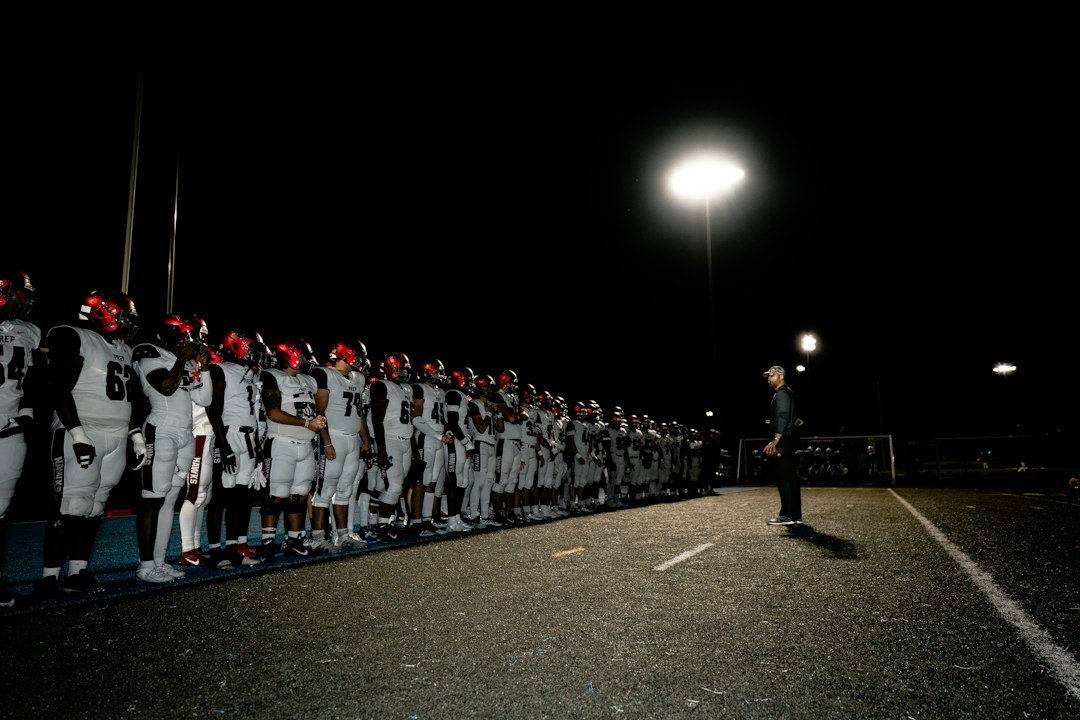




The locker room smell hits you before the memory even fully forms. The specific sound of cleats on a concrete hallway. The weight of a helmet in your hands before a game that actually meant something.
But the Thursday afternoon practice from November of junior year? Not a trace. The away game against the school forty minutes down the highway — the one you definitely played, definitely traveled to — completely blank, as though it never happened at all.
If you've ever paused on this and wondered why high school sports memories fade the way they do — why some moments survive with almost painful clarity while entire seasons dissolve — you're not experiencing a defect in your memory. You're experiencing one of the most well-documented features of how human memory actually works. And the science behind it reveals something important: not just about your brain, but about who you were in the process of becoming while all of it was unfolding.
Why High School Sports Memories Fade: The Brain's Filtering System
Start here, because everything else builds on it: your brain has never operated like a camera or a recording device. It has always been a curator.
Every experience you live passes through a biological selection system. The question that system is always asking, at the most basic neurological level, is: does this matter enough to keep? Routine experiences — the mid-season practice on a gray Wednesday, the game where everything went more or less as expected, the conditioning session indistinguishable from the forty that came before it — rarely clear that bar. They get processed, used for their immediate purpose, and released.
This is not a failure of your memory. It is extraordinarily efficient design.
The hippocampus, which anchors the formation of long-term memories, does not distribute its resources equally across everything you experience. It prioritizes based on two primary signals working together: emotional intensity and novelty. When an experience scores high on both at the same moment, the brain shifts into a deeper encoding mode. The memory gets stored with more neural connections, rehearsed more compulsively in the hours that follow, and linked to more contextual detail than an ordinary moment would ever receive.


A Tuesday practice in October of your sophomore year: low emotional intensity, high repetition, nothing novel. The hippocampus files a general impression and moves on.
The moment your team won a district championship in double overtime with your hands shaking through the final play: every signal in your nervous system fires simultaneously. That memory doesn't get filed. It gets carved.
Forgetting high school sports details from routine weeks is not evidence that those years didn't matter. It is evidence that your brain was doing exactly what it was built to do — sorting signal from noise — and that the moments which survived the filter were the ones that genuinely changed something in you.
What Flashbulb Memories in Sports Actually Are (And What They're Not)
The term "flashbulb memory" was introduced by psychologists Roger Brown and James Kulik in 1977 to describe a specific class of memory that feels photographically sharp — a moment so emotionally significant it seems burned into consciousness with unusual permanence and sensory detail.
Research published in Memory & Cognition has examined how these memories form and why they feel so categorically different from ordinary recall. The finding that surprises most people: flashbulb memories are not necessarily more accurate than regular memories. They feel more vivid and more certain — but the subjective feeling of vividness and the factual accuracy of the memory are two entirely separate things.
What makes flashbulb memories in sports feel so permanent is not perfect recording at the moment of the event. It is the convergence of specific conditions that surrounded the encoding:
- High physiological arousal — adrenaline and cortisol at peak levels during the event itself
- Genuine emotional significance — the moment carried real stakes that your nervous system registered as meaningful
- Sustained social rehearsal — you talked about it immediately afterward, and kept talking about it across years
- Identity consequence — the outcome changed something about who you were, or confirmed something you needed confirmed
Each of these factors strengthens memory encoding independently. Together, they create the sensation that you could close your eyes right now and be standing in that moment — uniform on, everything loud, outcome still uncertain.
The game you remember with that kind of precision wasn't stored better because it was special. It was rehearsed better — by your own brain, compulsively and repeatedly, in the days and years that followed. The emotion was the trigger. The rehearsal is the mechanism.
Why Practice Memories Collapse Into One Composite
Of everything that contributes to forgetting high school sports details, repetition is the most counterintuitive culprit.
You'd expect that doing something hundreds of times would make it more memorable. In one sense it does — your body still remembers how to shoot, how to swing, how to move through a familiar pattern even when your conscious mind cannot locate a single specific practice from your junior season. That physical knowledge lives in procedural memory, stored in a completely separate neural system from the one that handles events and episodes.
But episodic memory — the specific occasions of your athletic life — follows a different rule. When experiences are nearly identical and repeated at high frequency, the brain stops storing them as distinct events and begins merging them into a single composite impression. You stop remembering Tuesday's practice. You remember practice in general. The individual sessions blur into a schema — a dense general impression that stands in for all of them.
This collapse explains several things former athletes notice consistently:
- The pregame routine feels immediately vivid, but no single specific pregame stands clearly apart from the others
- The smell of the locker room is accessible and specific, while the individual afternoons that built that association are completely indistinguishable from each other
- You know approximately what a Wednesday conditioning session involved — you simply cannot place which Wednesday, or which year
The brain's efficiency wins over completeness every time. Instead of storing 180 individual practices as separate retrievable memories, it stores one rich composite and moves on. What felt like it should have been reinforced by repetition was actually dissolved by it.
The Moments That Survive — And the Pattern They Share
Maya R., 29, ran cross-country and track in Oregon across all four years of high school. She says she can recall almost nothing from her freshman season except a single race — a 5K she ran in the rain at regionals, where she passed three runners in the final 400 meters and finished sixth overall. "I can still feel the ground under my feet," she said. "I remember the specific color of the sky. I couldn't tell you a single thing about the meets we ran the month before."
That is not selective memory in the casual sense. That is her brain operating exactly as designed.
The memory of athletic events that survives across years tends to carry a recognizable profile. The moments that remain consistently share at least two of these four characteristics:
- They were first or last — a first varsity start, the final game ever played, the opening win of a new season. Primacy and recency effects are among the most durable forces in memory research, and they apply directly to athletic careers.
- The outcome was genuinely uncertain — the nervous system was fully engaged, not running on practiced autopilot. Real uncertainty triggers the body's stress response, and that response is one of the strongest memory-encoding mechanisms known.
- They were followed by immediate and sustained social reinforcement — you talked about it in the car on the way home, in the hallway the next morning, at every gathering since. Each retelling re-deposits the memory into long-term storage with renewed neural strength.
- They attached to identity — the memory is not only of an event. It is of who you became in that moment, or what the moment confirmed about you at a time when you were still figuring that out.
The routine midseason win against an outmatched opponent checks none of those boxes. Low arousal, certain outcome, no story worth retelling. The overtime loss that kept you awake for three nights afterward checks all of them — and remains available to you now with uncomfortable precision.
Why the Memory of Who You Were Outlasts the Statistics
Run through the memories you still carry from your athletic years — the ones with the clearest sensory detail and the strongest emotional pull. Taken together, they form something more than a highlight reel. They form a map.
Not a map of what happened in a factual sense. A map of what mattered to you at the exact moment your identity was still being constructed.
In our experience, the memories that survive most consistently across former athletes are rarely about individual performance numbers. They are about belonging — the specific moment a collection of people became a team. About something a coach said that landed differently than anything else and never left. About the physical sensation of accomplishing something that once genuinely felt out of reach.
Your brain was sorting for meaning, not just emotional intensity. The experiences that got encoded at depth were the ones that answered questions you were carrying at seventeen or eighteen — questions you probably couldn't have articulated at the time: Am I capable of this? Do I belong here? Who am I when the outcome is real?
The memories that remain are the moments that answered those questions. And because those answers became part of how you understand yourself now, those memories don't feel historical. They feel like evidence — still present, still relevant, still yours.
What a Jersey Carries That a Photograph Cannot
There is a reason former athletes hold onto jerseys long after everything else from those years has found its way to a donation box or a storage unit.
Objects carry what psychologists call context-dependent memory cues — physical anchors that reactivate the full network of associations stored around a significant experience. A jersey from a specific season is not just a garment. It connects directly to an entire emotional geography: the locker room before a big game, the weight of a uniform that signified something, the particular feeling of walking onto a field as part of something that mattered.
A photograph records the surface. A physical object that your memory already recognizes — one inspired by those specific colors, that specific number, your name across the back — does something different. It gives the memory something to hold onto in the present.
Our team hears this consistently from former athletes: the request is rarely about getting every design detail perfect. It is about recapturing a specific feeling that the years have softened but never fully erased. The way a number looked. A color combination that meant your school, your team, your particular years on that roster. The physical object that meets the memory where it lives.
Your jersey is still out there waiting.
Design yours in minutes and see your name and number exactly the way you remember it.
Frequently Asked Questions
Why do I remember losing games more vividly than winning ones?
This is consistent with what research on emotional memory encoding shows. Negative emotional experiences — unexpected losses, close defeats, moments of acute disappointment — trigger strong physiological stress responses that deepen memory storage. The overtime loss you still think about decades later was filed with exceptional care by a brain that treats high-stakes negative outcomes as critical information worth preserving long-term. Winning memories tend to survive with similar sharpness only when the win was also unexpected or the stakes were unusually high — the same emotional intensity threshold applies regardless of whether the outcome felt good or devastating in the moment.
Why can I still feel what it was like to play, even when I can't place specific games?
Because physical skills and episodic memories are stored in entirely separate systems. Procedural memory — the kind that holds how to shoot, how to swing, how to move your body through a pattern you practiced hundreds of times — lives in the cerebellum and basal ganglia, not in the hippocampus where event memories are formed. Your body retained what it repeated. Your episodic memory collapsed those hundreds of repetitions into a general impression rather than a retrievable sequence of distinct events. The sensation of playing is still accessible. The specific Tuesdays are gone.
Does retelling old sports stories make the memories stronger, or distort them over time?
Both happen, and simultaneously. Every time you retrieve and retell a significant memory, you go through a process called reconsolidation — the memory becomes briefly malleable before being re-stored, typically in a strengthened form. Frequent retelling makes the memory feel more vivid and more readily accessible. At the same time, fine peripheral details can shift gradually: the story you've told thirty times becomes slightly smoother and more narrative in shape than the raw experience actually was. The emotional core tends to stay accurate. The surrounding details are subject to gradual drift. This is not a malfunction — it is memory doing exactly what it evolved to do, preserving what mattered and releasing what did not.
Why do sensory details — smells, sounds, physical sensations — outlast factual details like scores and opponents?
Sensory memory, and smell in particular, connects directly to the olfactory bulb, which sits in close anatomical proximity to the hippocampus and the amygdala — the brain's primary emotional processing center. That proximity means sensory experiences attached to high-emotion moments are encoded with exceptional durability. Factual details like scores, opponents, and dates are stored as semantic information without strong emotional anchoring. When that anchoring is absent, factual details are among the first things to fade on a predictable schedule. The smell of the gym survives for decades. The score of a midseason game from sophomore year never really had a chance.
See also: why high school sports still matter so much to adults | the science of why your senior season memories feel so vivid | still dreaming about high school games years later | the loss of athletic identity after high school | the grief that comes with the end of your high school athletic career