



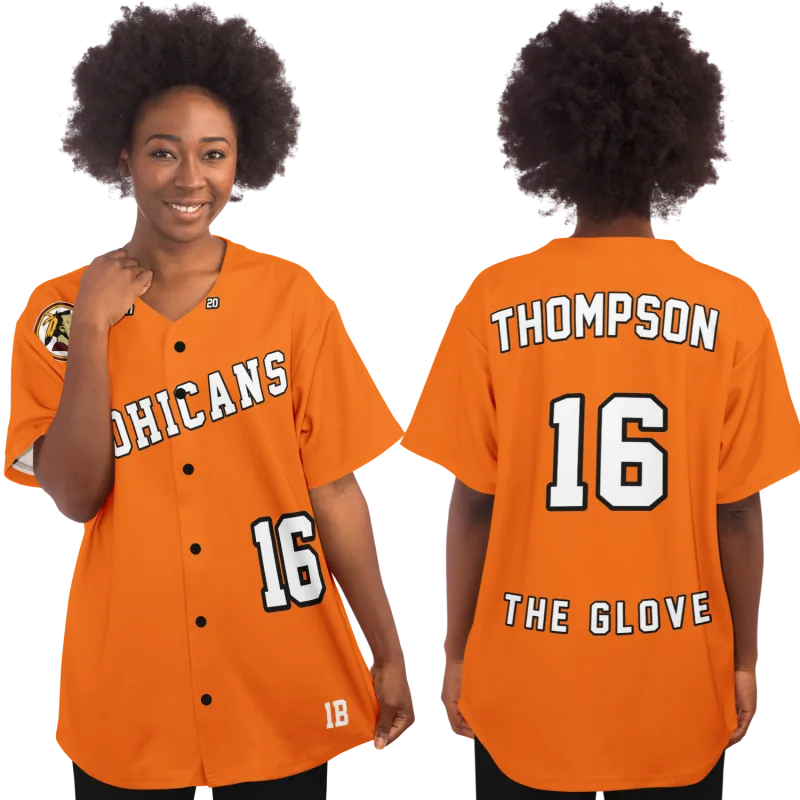


You still remember the number.
Maybe it was 14. Maybe 33. Maybe a single-digit number that felt like it was made for you the first time you pulled that jersey over your shoulder pads, or laced it through your warm-up shorts, or smoothed it flat against your chest before tipoff. You remember the weight of the fabric. The sound of the crowd finding its rhythm. The specific ache in your legs the morning after a playoff game.
And somewhere between then and now, someone told you to stop regretting your high school sports glory days. To let it go. To grow up and move on.
This article is here to tell you that advice is wrong — or at least, deeply incomplete.
Not because the past is a place to live. It isn't. But because the person you became on that field, in that gym, on that court, is not a past version of you that needs to be filed away. That person is still you. And the healthiest thing you can do isn't to move on. It's to integrate.
The Problem With "Moving On"
There's a cultural script that follows former athletes. It shows up in magazine think-pieces, in well-meaning conversations with friends who never played, and occasionally in therapists' offices. It goes something like this: You need to stop living in the past. High school was a long time ago. You have to find your identity outside of sports now.
The intention behind that script is good. The execution is destructive.
Here's what "moving on" actually asks you to do: it asks you to treat the most formative years of your identity development as a compartment that should now remain closed. It treats your athletic career (the discipline, the sacrifice, the team relationships, the physical mastery you built) as a phase rather than a foundation.

The problem is that it was a foundation. Psychologists who study identity development consistently find that the experiences we have during adolescence and early adulthood don't just shape who we are — they become structural. They're not memories we carry. They're architecture we live inside.
Moving on from your athletic identity isn't growth. In many cases, it's amputation.
The question worth asking is how do I bring the best of that past forward into the life I'm building now?
That's integration. And it's a fundamentally different project.
What Integration Actually Looks Like (And Why It Works)
Integration doesn't mean you wear your letterman jacket to job interviews. It doesn't mean you correct people who call your town's current varsity quarterback the best to ever come out of your program. Integration is identity as continuity, not nostalgia as identity.
Here's the distinction that matters: integration is active.
Nostalgia says: Things were better then. Integration says: What I built then is still useful now.
Think about the specific qualities your athletic career demanded of you.
- Discipline under pressure. You trained when you didn't want to. You performed when the stakes were real. You learned what it felt like to fail publicly and come back the next day anyway.
- Coachability. You learned to receive correction, to separate your ego from your performance, to take direction from someone who could see what you couldn't.
- Team orientation. You subordinated personal glory to collective outcome. You learned when to lead and when to support. You understood that your individual failure affected people who depended on you.
- Physical self-knowledge. You learned what your body could do when pushed. You understood recovery, preparation, the difference between pain that signals injury and pain that signals effort.
None of these are past-tense qualities. Every one of them is active and transferable. The person who built them is still you.
Integration means consciously claiming these qualities as yours — not as artifacts of what you used to be, but as core characteristics of who you are — and finding deliberate ways to express them in your current life.
The Real Reason Former Athletes Struggle (It's Not What You Think)
Here's something the "just move on" crowd consistently misses: the grief former athletes feel is about losing a context (a structured environment in which their identity made complete sense) more than it is about missing the glory.
When you were playing, the world had a clear shape. There was a season. There were practices. There were roles you occupied with confidence. There was a community of people who understood exactly what it meant to be you in that context.
That structure doesn't exist in adult life by default. You have to build it. And most former athletes were never taught how, because no one told them that's what the grief was actually about.
Marcus T., 34, was a starting midfielder for his high school soccer team — three-time regional finalist, full-ride to a Division II program before a knee injury ended his playing career at 19. He spent his late twenties cycling through what he described as "low-grade restlessness." He'd join recreational leagues and quit after a month. He'd start training plans and abandon them. He told himself he needed to stop living in the past. What he actually needed was to understand that he was mourning lost structure, not lost glory. Once he understood that, he was able to build the frameworks his adult life needed: a coaching role with a youth club, a leadership position at work that fed his competitive instincts, a weekly training habit that reconnected him to his body. He stopped trying to move on and started building forward.
The difference changed everything.
Four Ways to Bring Your Athletic Past Forward
This is where integration becomes practical. These are specific moves, not abstract concepts.
1. Name Your Transferable Athletic Identity
Sit with this question seriously: What kind of athlete were you?
Not what sport. Not what position. What were your specific competitive traits? Were you the player who made everyone around them better? The one who performed better under pressure than in practice? The one who studied opponents obsessively? The one who led by relentless example rather than words?
Those traits didn't retire when your eligibility did. They're still operating in your life, probably in your career, your relationships, and your approach to challenges. The issue is that most former athletes have never consciously named them in an adult context.
Name them. Write them down. Then find the adult arenas where those traits are still assets. A former point guard who made everyone around her better is a transformational manager. A former linebacker who performed best when the game was on the line is exactly who you want in a high-stakes negotiation.
Your athletic identity is a resource. Name it and use it.
2. Find a Physical Practice That Honors the Standard You Built
One of the most common patterns in the "when to let go of the past athlete" conversation is former athletes who stopped training entirely — not because they lost interest in their physical capability, but because recreational activity felt like a pale imitation of what they used to do.
That's a solvable problem. But the solution isn't to find the closest approximation to your sport. The solution is to find a physical practice that operates at the level of seriousness your identity requires.
Some former athletes find it in martial arts. Some in long-distance running, where the inner competition is total. Some in coaching, which gives them both the physical environment and the relationship dynamic they miss. Some in weightlifting, where progressive overload rewards the same patient discipline that sports training demanded.
The medium matters less than the standard. Find something you can pursue with genuine seriousness, not as exercise, but as practice. Your body still knows how to train. Give it something worth training for.
For a lot of former athletes, that something is organized competition — the best adult rec leagues for former high school athletes offer the structure and shared stakes that casual exercise can't.
3. Use Your Story — Don't Bury It
There is a version of "moving on from being a jock" that looks, from the outside, like maturity, but is actually a form of self-erasure. It's the former athlete who never mentions their athletic career in professional settings, who deflects when someone asks about it, who's internalized the cultural message that sports were a young person's thing and adult seriousness requires leaving them behind.
This is unnecessary and counterproductive.
Your athletic career is legitimately impressive and legitimately relevant in most contexts where leadership, discipline, and performance under pressure are valued, which is nearly every adult professional context.
In my experience as a former player, the ones who integrate most successfully are the ones who learn to tell their athletic story in adult-relevant terms. Not "I was a state champion wrestler" as a brag — but "I spent four years learning how to perform under pressure in front of an audience with real consequences, and that's shaped how I approach high-stakes situations now."
That's not living in the past. That's using your past as evidence of your character. There's a difference.
Put it to work where it matters most: explaining your athletic past in a job interview is a learnable skill, not a gift you're born with.
4. Reclaim the Physical Objects That Mark the Story
This one gets dismissed more than it deserves. But there's a reason people search for their old jersey numbers, buy a jersey with their own name and number on the back, or frame the photographs that mark their playing days.
Physical objects are more than memorabilia. They're anchors — psychological touchpoints that connect the present self to the past self in a way that pure memory cannot.
A 2020 study on nostalgia and identity continuity published in the Journal of Personality and Social Psychology found that nostalgic recall, particularly when anchored by physical objects, strengthens the sense of a coherent, continuous self. In other words: that jersey hanging in your closet, or displayed on your wall, is you maintaining the thread of your own story.
Integrating your athletic past means giving yourself permission to honor the physical markers of it. Not in a way that freezes you in amber, but in a way that acknowledges: this happened, it mattered, and the person it shaped is worth remembering.
Done right, displaying your jersey at home is a mark of pride, not a dorm-room relic — and it's a lot easier to do right than you might think.
The Identity Question Nobody Asks Former Athletes
There's a question at the center of all of this that almost nobody asks directly: Who are you allowed to be now?
The cultural message to former athletes is often, implicitly, that the answer is: "someone who has graciously moved past who you were." Someone who watches the game from the stands now and is okay with that. Someone who has found adult things to care about. Someone who doesn't make other people uncomfortable by caring too much about something that ended a long time ago.
That's an invitation to shrink rather than grow.
Integrating your athletic past means refusing that invitation. It means understanding that the identity you built (the competitor, the teammate, the disciplined practitioner, the person who knew what it felt like to be genuinely excellent at something) is not a phase you outgrow. It's a foundation you build on.
The question is how to bring it with you.
And the answer, as it turns out, is exactly what it sounds like: forward, not away.
Your jersey is still out there waiting.
Design yours in minutes and see your name and number exactly the way you remember it.
Frequently Asked Questions
Is it unhealthy to still think about my high school sports career as an adult?
Not inherently — and in many cases, it's a sign of healthy identity continuity rather than arrested development. The distinction psychologists draw is between nostalgic reflection (using the past to reinforce a coherent sense of self) and nostalgic escape (using the past to avoid engaging with the present). Thinking about your athletic career with pride, using it as a source of identity and motivation, or finding ways to honor it in your current life is integration. Retreating into it as a way of avoiding adult challenges is escape. The first is healthy. The second is worth examining — and the answer is not to stop thinking about the past but to build a present worth thinking about.
How do I explain to people why my high school sports career still matters to me without sounding like I peaked in high school?
Context and framing do the work here. "I scored 30 points in the regional finals" is nostalgia-as-identity. "I spent four years learning to compete at a high level under real pressure, and that experience shaped how I approach challenges now" is identity integration. The first positions your past as the highlight of your story. The second positions your past as the foundation of your current character. Most people who seem like they "peaked in high school" are stuck in the first mode. The second mode is available to anyone willing to reframe their story in present-tense terms.
What if my athletic career ended badly — injury, getting cut, a coach who made it toxic — and I'm not sure I want to integrate that experience?
This is a real and important distinction. Integration doesn't mean uncritically embracing every aspect of your athletic past. If your experience included trauma, chronic pain, a toxic environment, or an abrupt and painful ending, the integration process looks different — and in some cases, working with a therapist who understands athletic identity is genuinely worth pursuing. What integration offers, even in cases where the experience was mixed or painful, is the ability to locate and claim the specific qualities you built during that time, separate from the circumstances that surrounded them. You can claim the discipline without claiming the toxic coach. You can honor the relationships without honoring the injury that ended your career. Integration is selective by design — you choose what to bring forward.
Does owning a jersey with my own name and number actually help with identity integration, or is it just nostalgia?
The research on physical objects and identity continuity suggests it's meaningfully more than just nostalgia — physical anchors strengthen the psychological sense of a continuous self across time. More practically: there's a difference between owning an object that sits in a box and one that exists in your actual daily life. A jersey displayed in a home gym, worn during recreational games, or given to a child as a meaningful object is an active integration tool. One that stays hidden because you're embarrassed by how much it means to you is a sign that the "move on" script has done its work. Give yourself permission to let the object exist in the open.
See also: the grief that comes with losing your athletic identity | how athletic identity doesn't just disappear after high school | why high school sports still matter to adults long after the final whistle | joining an adult recreational league as one way to stay connected to the game | the gap between how you remember performing and how your body feels today