

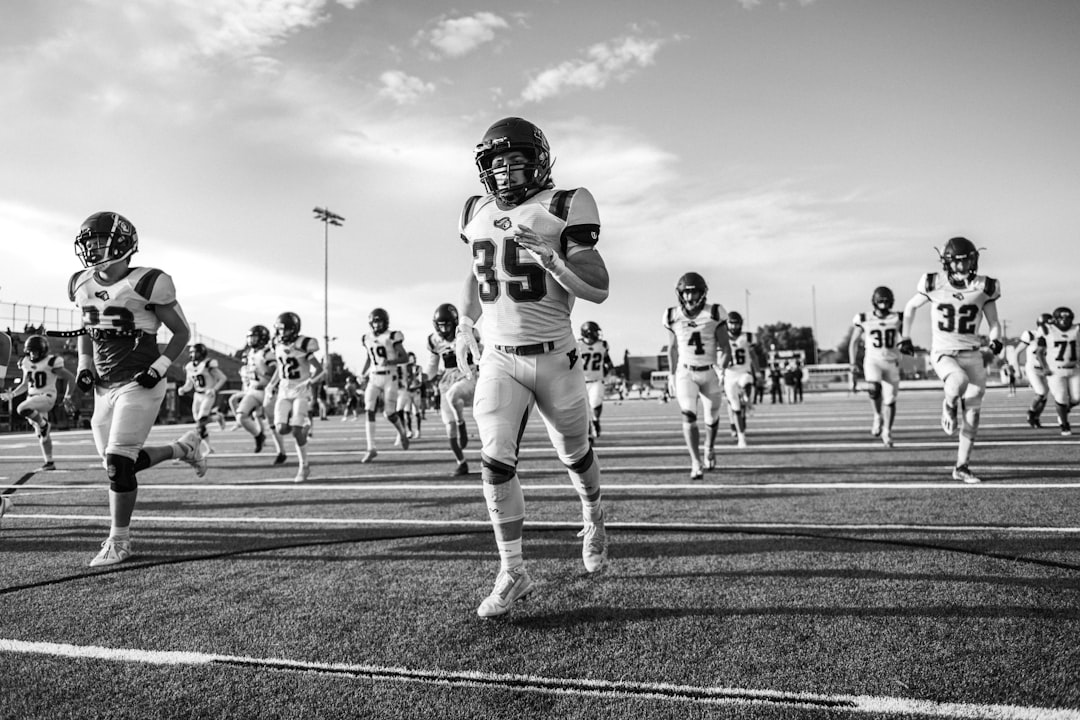




There's a moment every fall — maybe it's the smell of cut grass, maybe it's the sound of a marching band two blocks away, maybe it's just the particular angle of afternoon light in October — when it comes back.
Not just the memory. The feeling.
The locker room before a game. The weight of the uniform. The specific silence right before the whistle. If you played high school sports, you already know what we're talking about, and you already know why high school sports matter in a way that's almost impossible to explain to someone who didn't.
This article is for you.
What High School Sports Actually Teach You (It's Not What the Trophies Suggest)
Most people, when asked why high school sports matter, reach for the obvious answers. Teamwork. Discipline. Physical fitness. And those things are real — but they're also the answers you give when you haven't thought about it long enough.
The deeper answer is harder to say out loud. High school sports hand you a version of yourself under pressure and ask: what are you made of? Not once. Over and over, for four years, in front of your school, your family, your town.
That's not a metaphor for adult life. It is adult life — just compressed into a Friday night.
The Pressure Was Real, Even If the Stakes Seemed Small
Here's what nobody tells you when you're sixteen and playing in front of a half-empty bleacher section: the stakes don't determine the lesson. Performing under pressure when you're terrified and undertrained and the coach is yelling something you can't quite hear — that specific experience of continuing anyway — is a skill that transfers. Every negotiation. Every presentation. Every moment where the outcome matters and the margin for error is zero.
In our experience, the former athletes who describe their high school sports careers as "not that big a deal" are often the same people who, in unguarded moments, credit those years for the composure they carry now.


The scoreboard was real. The lessons were permanent.
Commitment Before You Fully Understood What Commitment Was
You signed up for a season that would cost you weekends, summer days, and more Friday nights than you can count. You did that at fifteen. You didn't fully understand what you were agreeing to — but you showed up anyway, and then kept showing up.
That's a particular kind of formation. Not instruction. Formation. The kind that builds something structural in a person, not something they can simply recall when it's convenient.
Research on youth sport participation consistently connects sustained athletic engagement in adolescence to higher resilience scores in adulthood — and resilience, the APA notes, is not a fixed trait but a set of behaviors developed through practiced exposure to manageable difficulty. Four years of a high school sport is, by most definitions, a concentrated curriculum in precisely that.
The Identity Question: Who You Were When You Wore That Jersey
There's a specific kind of pride that former athletes carry that doesn't have much to do with wins or losses. It has to do with identity.
You were a player. A member of something. You had a number. Your name was on a roster. You ran out onto a field or a court or a track and represented a specific place at a specific moment in time — and no subsequent version of your life can undo that.
That's not nostalgia. That's a fact about who you are.
The Number Still Means Something
Ask a former high school athlete what number they wore. Almost every one of them will answer without pausing. Not because they rehearsed it. Because it's encoded. The number wasn't assigned to you — it became you. It appeared on every game program, every roster sheet, the back of every jersey photograph your parents took.
It became the shorthand for a version of yourself that was completely, specifically, unrepeatable.
Mia T., 34, played varsity volleyball at her high school in central Iowa for three years before a knee injury ended her senior season early. She keeps her old jersey in a drawer she doesn't open often. "I don't need to look at it," she says. "I just need to know it's there. Number 12 was me before I knew who I was going to be."
That's the thing about high school sports. You were still becoming. The jersey caught you mid-formation. And that's why, decades later, you still call yourself a basketball player — because the identity formed in those years doesn't dissolve when the season ends.
The Team Was the Thing — Even When the Team Was Difficult
The mythology of sports is full of perfect locker rooms. In reality, most high school teams are a collection of people who would not necessarily choose each other — different friend groups, different backgrounds, different levels of skill and commitment — forced by circumstance and shared goal into something that occasionally, unexpectedly, becomes cohesion.
Those relationships are strange and specific. Not friendships in the conventional sense. Something different. Something built on the particular intimacy of shared difficulty — of being tired together, of failing together, of winning together when you didn't expect to.
You carry those people differently than you carry other people from your past. You know things about them that no one else knows, because you were in the room when pressure revealed them.
The Lessons That Didn't Come With a Grade
High school sports exist outside the GPA system. They don't appear on your transcript. There's no rubric for what you learn when you lose a game you should have won, or when the coach benches you and you have to decide whether to pout or push harder.
That's precisely why the lessons stick.
Losing Without Collapsing
In academic settings, failure tends to come with cushioning — extra credit, grade curves, makeup assignments. In sports, the loss is final. The clock hits zero. The score is what it is. And then you have to walk off the field and look your teammates in the eye.
Learning to do that — to absorb a real, uncushioned, public outcome and then show up to practice Monday morning — is not something most adults have practiced explicitly. Former athletes have. Repeatedly.
Our team talks to a lot of people who've designed memorial jerseys for themselves or their kids, and one thing comes up again and again: it's rarely about the championships. It's about the seasons where things went sideways and they played anyway. The season they lost six games in a row. The season they got hurt and had to watch. Those are the ones they want to memorialize.
Performing When You Don't Feel Like It
This is the one nobody romanticizes in the highlight reels. You didn't want to go to practice. You were sore. You were tired. You had homework. The season stretched on longer than it felt like it should.
You went anyway. You performed anyway. You found something inside the performance — not every time, but often enough — that wouldn't have existed if you'd stayed home.
That's a skill. A specific, transferable, adult skill. And the repetitions you put in between the ages of fourteen and eighteen are, for many former athletes, the most concentrated block of that training they'll ever receive.
Learning Your Own Limits — And Then Relearning Them
High school sports give you data on yourself that you can't get any other way. You learn what happens to your performance under specific kinds of pressure. You learn whether you rise or contract when the stakes are highest. You learn how your body responds to fatigue, to adrenaline, to disappointment.
That self-knowledge is not theoretical. It was earned, in real time, in front of other people.
Homecoming Season and the Pull You Still Feel
Here's something worth naming directly: if you played high school sports, homecoming isn't just a date on the school calendar. It's a specific kind of gravity.
The week before homecoming has a particular texture for former athletes. Something about the combination of fall air and game-day energy and the sight of younger players doing the things you used to do — it pulls. Not uncomfortably, but undeniably.
That pull is not nostalgia in the sentimental sense. It's recognition. You recognize what those players are in the middle of experiencing. You know what it costs. You know what it gives back. You know that they don't fully understand yet what they're accumulating — the memories, the lessons, the identity — and that by the time they do, the season will be over.
Why the Former Athlete Shows Up
Former athletes come back to homecoming games in numbers that would surprise people who didn't play. Not because they're living in the past. Because they're acknowledging something in the present: that those years shaped them, and that the things that shaped you deserve to be honored.
You go back to the stadium. You stand in the parking lot and smell the popcorn and the late-October cold. You hear the band and feel the crowd and for a few hours you're just who you were — not younger, not less complicated, simply located. You know precisely where you are in the story of your own life, and you know that this chapter was formative.
That's worth showing up for. And sometimes showing up means more than standing in the parking lot with a shared memory — it means finding a reason to lace up one more time, which is precisely why alumni games across the country still fill rosters with forty-year-olds who haven't lost the pull.
The Lasting Impact: What Former Athletes Carry Into Adult Life
The research on long-term outcomes for high school athletes is consistent enough to be useful. Former athletes report higher rates of:
- Self-reported resilience and stress management capacity
- Team-oriented problem-solving in professional environments
- Physical activity maintenance into middle age
- Sense of community belonging tied to their hometown or school
- Lower rates of depression and higher overall wellbeing into young adulthood — longitudinal studies that track athletes from high school into their twenties and thirties find that organized sport participation is associated with better mental health outcomes that outlast the season, a subject we've explored in its own piece on the mental health benefits of having played high school sports
- A measurable habit of giving back — former high school athletes volunteer their time and donate to charity at higher rates than people who never played. The team-first orientation doesn't retire with the jersey; it shows up in how former athletes show up for other people, years later.
The two findings worth naming out loud are the longitudinal ones. The mental-health evidence is the newest in the field — researchers following athletes past graduation are finding the payoff doesn't just hold, it compounds, with organized participation predicting both lower rates of depression and a sustained habit of staying active well into adulthood. The giving-back data points the same direction: the identity formed on the field doesn't only protect the person who lived it, it appears to turn them outward, toward other people. That's a through-line worth noticing — the same formation that built composure and discipline in you is, at the population level, showing up as generosity toward everyone else.
But the number that tends to land hardest in conversations: in a national survey of executives and senior leaders, more than 94% reported having played sports at the high school or college level. That's not a coincidence. It's a curriculum.
The Skills That Transferred Directly
Not metaphorically. Directly.
- Time management — you had practice at 3:30 and a paper due Thursday and a game Friday. You figured it out or you failed at one of them. You mostly figured it out.
- Communication under stress — calling plays, signaling teammates, adjusting mid-game to what the other team was doing. That's not a seminar. That's real-time collaborative problem solving.
- Coachability — accepting correction from someone with authority over your playing time, even when you disagreed, even when it was hard. The adult word for this is feedback receptivity, and it is one of the most valued professional skills that cannot be easily taught.
The Skills That Only Made Sense Later
Some of what high school sports gave you, you didn't have language for until you were thirty. The specific way you handle ambiguity. The fact that you don't panic when the plan falls apart. The thing your manager called "composure under pressure" in your last performance review — that was installed in you at practice, years before either of you knew it had a name.
Your jersey is still out there waiting.
You wore a number. You represented something. That doesn't have an expiration date.
Design yours in minutes and see your name and number just the way you remember it.
Frequently Asked Questions
Does playing high school sports actually improve academic performance?
The relationship between athletic participation and academic outcomes is more nuanced than simple correlation suggests. Athletes are required to maintain GPA thresholds at most schools to remain eligible, which creates an external structure that some students use productively. More meaningful is the time management discipline that multi-season athletes develop — managing practice schedules, travel days, and coursework simultaneously builds the organizational habits that translate into college and professional performance. The impact varies by student and sport, but the structural discipline tends to be the lasting benefit, not any direct cognitive effect.
What if I only played one season or got cut before varsity — does it still count?
Absolutely. The identity formation that happens in high school sports doesn't require a starting position or four years of varsity letters. It happens in the first practice when you realize you're competing for something. It happens in the locker room, in the pre-game warmup, in the decision to show up after a disappointing week. One season of genuine participation contains the full curriculum. The duration extends the exposure — it doesn't determine whether the lessons are real.
Why do former high school athletes feel such strong pulls during homecoming season specifically?
Homecoming concentrates several powerful identity triggers simultaneously — the school, the season, the specific sensory context of fall athletics, and the social ritual of community gathering. For former athletes, the homecoming game isn't just a football game or a volleyball match. It's a living marker of a specific chapter in their own story. Returning to that context activates the same emotional and neurological encoding that made the original experiences formative. It's recognition, not regression — your brain confirming that something that happened there mattered.
Is the nostalgia former athletes feel about high school sports healthy?
When nostalgia functions as recognition — acknowledging that meaningful experiences shaped who you are — it's not only healthy but actively useful for adult identity and wellbeing. The research on nostalgia, particularly work from the University of Southampton, suggests that nostalgic recollection increases feelings of social connectedness, meaning, and continuity of self. Former athletes who honor the experiences without being consumed by them — who use the memories as foundation rather than escape — tend to integrate those years productively into their adult sense of self. We explored the distinction between healthy athletic nostalgia and living in the past in more depth — including when remembering your playing days crosses from recognition into something less productive.
How do I explain to someone who didn't play why high school sports still matter to me?
You probably can't, fully. And you don't have to. Some experiences are transferable in description but not in feeling — and high school sports is one of them. What you can say is this: those years gave you something specific about yourself under pressure, about commitment before you fully understood it, about belonging to something larger than yourself. The details belong to you. The impact belongs to everyone who was shaped by it — which is more people than you think.
See also: why high school sports still matter to adults long after graduation | what high school sports teach you that nothing else could | the athletic identity crisis that follows when the season ends for good | the grief that comes with the end of your high school athletic career