

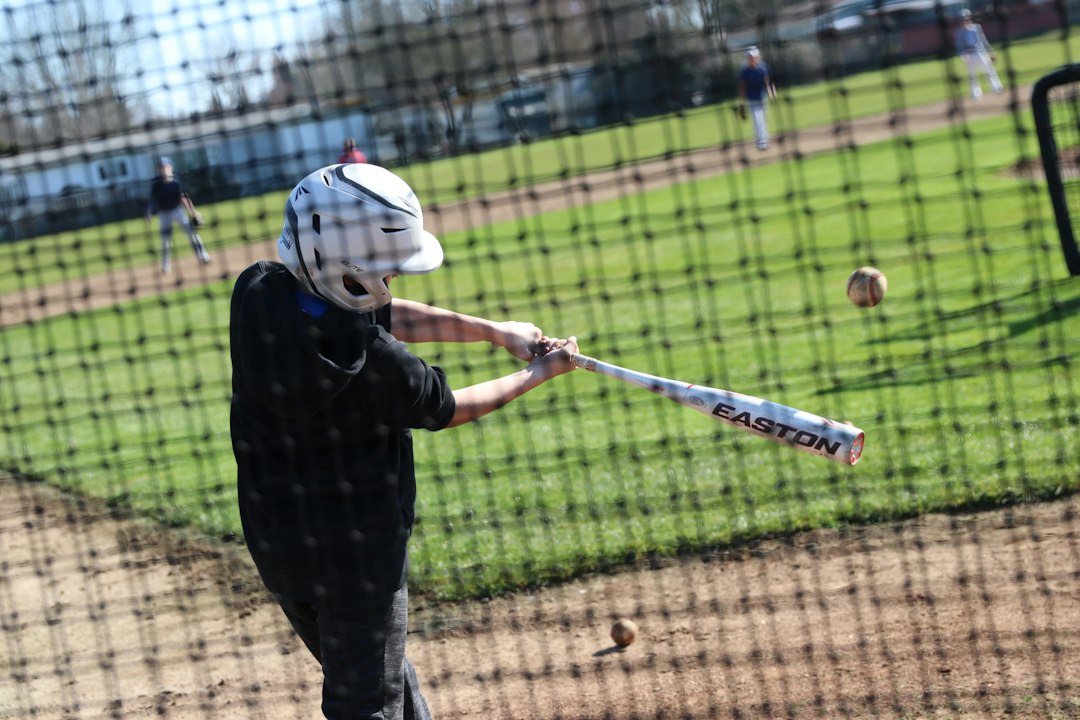




There is a specific kind of silence that happens inside a at-bat when you are genuinely afraid.
Not afraid of the pitcher. Not afraid of the ball. Afraid of yourself — of the version of yourself that is about to be visible to everyone in those bleachers, to your coach, to the kid you like three rows up. The fear of failure in the baseball batter's box is not abstract. It is physical. It has a texture. And almost nobody talks about it from inside the moment — only from outside it, after it's already over, in language that sounds like a coaching manual and nothing like the truth.
This account is not a coaching manual. It's a player's account, written for the player who has stood in that box and felt the world compress into something almost unbearably small, and thought — even briefly — I don't want this pitch to come.
If that's you, keep reading. This one's written for you, not about you.
The Moment Before the Pitch: What Your Body Was Actually Doing
Before we get to the mental side of batting, let's be honest about the physical side — because in those seconds before the pitcher winds up, your body is doing things you probably didn't fully understand while they were happening.
Your heart rate was already elevated. Not from exertion — you'd been standing there, barely moving. But the anticipatory stress response that sports psychologists describe is the same mechanism your nervous system uses for actual physical danger. Your adrenal glands don't distinguish between a linebacker and a packed set of bleachers watching you. They respond to perceived threat, and the perception of public failure is a genuine threat signal.
What that meant in the batter's box:
- Your hands were tighter on the bat than they needed to be. Not consciously — your grip reflex was responding to elevated cortisol.
- Your vision was narrowing. Tunnel vision under stress is a documented response; peripheral awareness compresses.
- Your breathing was shallow, probably faster than normal, which reduced the amount of oxygen reaching your prefrontal cortex — the part of your brain responsible for the kind of calm, sequenced thinking that hitting a baseball requires.
You weren't weak. You were human. And your body was doing exactly what human bodies do when the stakes feel real.


The cruel irony of baseball performance anxiety is that the biological response designed to protect you from danger is precisely the response that makes hitting a moving object while under pressure significantly harder. The mechanism that should save you is the mechanism undermining you.
What the Thoughts Actually Sounded Like
Here's the part that nobody captures accurately in the diagrams and the mental skills workbooks: the specific texture of the thoughts themselves.
Most accounts of fear in sports describe it in retrospect — cleaned up, coherent, categorized. I was thinking about the consequences of failing. I was worried about letting my teammates down. Neat packages, hindsight-organized.
That's not what it sounded like in real time.
In real time, at two strikes, in a close game, the internal monologue was not a sentence. It was overlapping fragments. Something like:
Don't swing at a bad pitch — what if it's a strike though — you struck out last time — everyone saw that — just make contact — no, don't just make contact, actually hit it — he's going to throw that breaking ball low — you can't hit the breaking ball — everyone knows you can't — your hands are too tight — relax your hands — why are you thinking about your hands —
And then the pitch came, and the window for any of that was gone.
According to research published in the Journal of Sport & Exercise Psychology, this kind of cognitive interference — the intrusive, task-irrelevant thought pattern that floods working memory during high-pressure performance — is one of the primary mechanisms by which competitive anxiety translates into degraded execution. The brain's working memory has limited bandwidth. When fear of failure fills that bandwidth with threat-monitoring, the attentional resources available for actual skill execution drop.
Which is a precise, clinical way of saying: the thoughts you were having were the thing getting in the way of the thing.
The Compressed Time Problem
One of the strangest features of standing in the batter's box under genuine pressure is what happens to time.
This is not metaphor. It's a documented perceptual phenomenon. High arousal states alter time perception — specifically, they can cause the period of anticipated action to feel stretched and elastic while the moment of actual action feels almost instantaneous.
What that means in practice: the seconds before the pitcher releases the ball felt long. Too long. Long enough for all of those overlapping fragments to run. Long enough to notice the crowd, your coach's expression, the way your cleats feel on the dirt.
And then the ball left the hand, and you had approximately 400 milliseconds to decide what to do with it. That part was immediate. Almost no time at all.
Hitters describe this consistently across skill levels and ages — the excruciating waiting, followed by the absence of time to do anything with the waiting. The stretch-and-collapse of it. And what makes the fear of failure in the batter's box so specifically brutal is that the stretching phase is where fear lives. The collapse phase is where execution either happens or doesn't.
You can't fix the mechanical problem with fear in those 400 milliseconds. That part is already decided by the time the ball arrives — decided by what your body was prepared to do, what your mechanics had stored in muscle memory, what your nervous system defaulted to under pressure.
The compressed time problem is why sports psychologists who work with high school athletes push so hard on process focus during the stretching phase — not because thinking about process in the moment will fix the mechanics, but because process focus is the one thing that gives working memory something to do that isn't threat-monitoring.
A simple count. A breath. See ball, stay back, let it get deep. Not because the mantra hits the ball — but because the mantra is something real for the fragments to land on instead of free-floating in the cortisol.
When It Got Loud in the Stands
Kylie M., 16, a high school softball catcher from central Illinois, described it to us this way: the crowd didn't feel loud until she was losing. Same stands, same people, same noise level — but when the at-bat mattered, when the tying run was on second in the bottom of the sixth, the sound seemed to press in from all sides. "It felt like I was hearing everything and nothing at the same time. Like the volume was up but the frequency was wrong."
That description — volume up, frequency wrong — is one of the most accurate accounts of acute performance anxiety in a high-pressure at-bat that we've encountered. Because that's exactly what it is: heightened sensory input processed through a threat-detection filter rather than a performance filter. You hear more, but you can process less of what you're hearing as useful information.
The bleachers don't change. Your relationship to the bleachers changes the moment the stakes register as real.
And in high school sports, the stakes have a particular character. It's not professional consequence — it's social consequence. The peers in those stands are your cafeteria, your hallways, your group chats. The performance is public in a way that professional athletes, insulated by scale and distance, rarely experience. When a major league hitter strikes out, ten thousand people watch it happen and then forget it by the seventh inning. When a high school hitter strikes out, six people in the third row saw it, and two of them have first-period English with you tomorrow.
High school sports pressure is real and specific. It's not lesser because it's younger.
What You Were Actually Afraid Of (And It Wasn't the Ball)
Let's name it directly, because naming it is the first step toward doing anything useful with it.
The fear of failure in the batter's box is not fear of the ball. You'd been hit by pitches before. You'd taken a fastball off the forearm in practice and walked it off. The ball was not the threat.
The fear was evaluation. The fear was being seen failing.
Sports psychologists call this evaluative threat — the specific variety of performance anxiety triggered not by the task itself but by the social observation of the task. And it maps cleanly onto what Carol Dweck's research describes as a fixed mindset threat: the fear that a visible failure will communicate something permanent and damning about your ability, your worth, your identity as an athlete.
In the batter's box, the thought is not I might strike out. The thought is If I strike out, they'll know something true and bad about me.
That's a different problem than mechanics. That's an identity threat. And no amount of batting practice addresses an identity threat directly.
What does begin to address it is the thing that experienced players, coaches, and sports psychology practitioners all eventually land on: separating performance from self-worth at the level of belief, not just the level of pep talk. Saying I am not my batting average isn't enough if the nervous system doesn't believe it. The belief has to be built, over time, through deliberate evidence-gathering that the self is stable regardless of the result in this particular at-bat.
That work doesn't happen in the box. It happens in the accumulation of moments when you chose to get back in.
After the At-Bat: The Two Versions
There are two versions of walking back to the dugout.
Version one: You made contact. Maybe you got a hit, maybe you hit it hard at someone, maybe you fouled off three tough pitches and drew a walk. The walk back feels different than the walk out. You're inside your body again. The thoughts are coherent. The crowd sounds like what it is.
Version two: You struck out. Or you popped up weakly. Or you swung at a pitch three inches outside because the fragments told you just do something and your hands listened. The walk back is the longest distance in youth sports. A few seconds, maybe ten feet from the plate to the dugout rail, and the emotional processing happening in that walk is the actual work of competitive development — not the pitch that caused it, but what you do with the walk back.
The players who ultimately manage baseball performance anxiety at a meaningful level are not the ones who stopped feeling it. They're the ones who made the walk back enough times that the walk lost some of its power over the next at-bat.
Resilience in this context is not the absence of fear. It's the reduction of fear's carry time — its ability to extend from one at-bat into the next one, to sit in the dugout with you and compromise your preparation for what comes next.
What Nobody Told You That Would Have Actually Helped
A few things that the coaching conversations around this topic often miss — specifically for the player, not the parent or the coach listening in:
The feeling is information, not a verdict. Elevated heart rate, tight grip, fogged thoughts — those are your nervous system communicating that this moment matters to you. That's not a malfunction. That's investment. The goal is not to feel nothing; it's to get better at performing while feeling something.
The other players are feeling versions of this too. The pitcher on the mound is not immune. The shortstop waiting in the field is not immune. The appearance of composure in sports is often exactly that — appearance. You are not uniquely afflicted. You are participating in the universal tax that high-stakes competition collects from everyone who genuinely cares.
Routine is leverage. Not because ritual has magical properties, but because a consistent pre-pitch routine gives the prefrontal cortex something procedural to run while the threat-monitoring system runs in parallel. The step out, the adjustment, the breath, the look to the dugout — these aren't superstition. They're attentional management. They give the fragment-generating machine a script to follow.
You don't have to solve this before your next at-bat. The players who made the most progress with performance anxiety in high school were not the ones who read the right thing or heard the right speech and then fixed it. They're the ones who kept showing up to the at-bat, kept experiencing the fear, and gradually accumulated evidence that the fear didn't end them. That accumulation is the actual intervention.
Your jersey is still out there waiting.
The batter's box had your name on it. So does the back of a jersey. Design yours in minutes and see your name and number exactly the way you remember it.
Frequently Asked Questions
Is fear of failure in the batter's box normal for high school players?
It's nearly universal. Evaluative performance anxiety — the specific variety triggered by being observed while attempting something that matters — is a documented, common response across all skill levels. The presence of fear in the batter's box is not a sign of weakness or psychological abnormality. It's a sign that you are invested in the outcome and aware that others are watching. The question is never whether you'll feel it. The question is what you do during and after it.
Does baseball performance anxiety go away as you get more experienced?
For most players, the intensity reduces over time — but not because the fear disappears. It reduces because experienced players develop a larger bank of evidence that the fear is survivable, and because their response routines and attentional strategies become more practiced. Elite players still experience competitive anxiety. They've simply gotten more efficient at performing inside it. The goal is not elimination — it's reduced carry time and better functional management.
What's the single most useful thing a player can do about fear of failure during an at-bat?
Give your attention one specific, concrete place to live. Not "relax" — that's not an action your nervous system can execute on command. Instead: one physical cue (feel the weight of the bat, feel your feet on the ground), one process word (your approach word — "see it," "back foot," whatever has meaning for you), one breath timed to the pitcher's movement. These don't eliminate the fear. They give working memory something real to hold while the threat-monitoring system runs. That's enough to reclaim a meaningful portion of your execution capacity in the moment that matters.
How is the mental side of batting different at the high school level compared to older levels?
The core mechanism — evaluative threat under performance conditions — is consistent across ages. What differs at the high school level is the social proximity of the audience. Professional players perform for crowds of thousands, most of whom are strangers. High school players perform for classmates, teammates, coaches who determine playing time, and parents who drove to be there. The social stakes are higher in density, if not in scale. High school sports pressure deserves to be taken seriously on its own terms, not minimized because the level isn't professional.
See also: what athletic identity really means after your playing days are over | the grief that comes with the end of your athletic career | why those high-pressure moments are still so vivid years later | why you still dream about moments like that one at the plate