

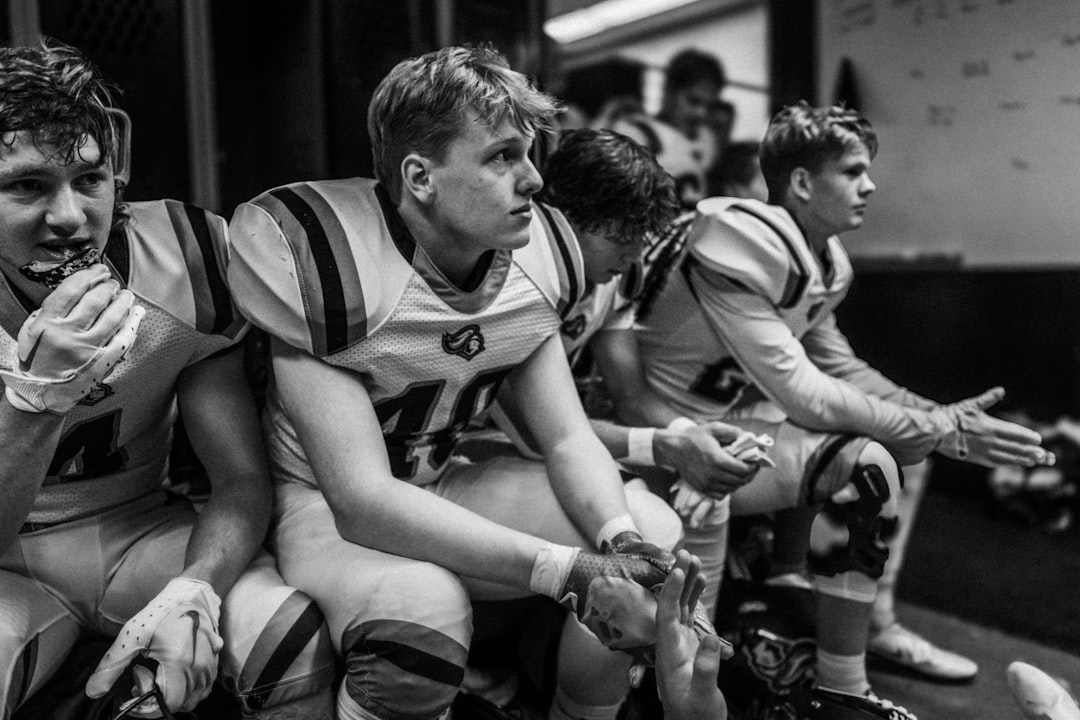




There is a specific walk every former athlete remembers.
It's the walk to the bulletin board, the locker room door, the coach's office window, or whatever surface your program used to post the starting lineup. You'd heard it was up. Someone in the hallway told you, or you saw the cluster of teammates already crowded around it, and your stomach did something that wasn't quite nausea but wasn't far from it either.
You tried to look like you weren't in a hurry.
You were absolutely in a hurry.
That high school athlete starting lineup memory lives in a specific part of the brain: the part that stores the moments that changed the shape of things. The moments that divided time into before and after. If you played, you know exactly what it felt like to scan down a list of names looking for your own, trying to read fast enough to find out but slow enough to look like you already knew. You know what it felt like when you found it. And you know (maybe more than anything) what it felt like in the seconds before you did.
This is about that day. About what it meant then, and what it turns out it meant all along.
The List Was Never Just a List
Coaches in every sport, at every level, have posted starting lineups since organized athletics existed. A sheet of paper. A whiteboard. A typed roster taped to glass. The medium doesn't matter. What matters is what that document represented the moment it appeared.
It wasn't just a game plan. It wasn't just an administrative decision. It was a verdict.
Every athlete who has walked toward that list has understood, at a level below conscious thought, that the piece of paper was going to tell them something about themselves. Not just whether they were starting: that was the surface question. The real question was whether the work had been enough. Whether the effort had been seen. Whether the belief they'd been carrying privately, quietly, sometimes desperately, had been confirmed by someone with the authority to confirm it.


Coaches hold a specific kind of power that very few relationships in a young person's life replicate. A parent's belief in you is unconditional by design; it counts, but it counts differently. A friend's encouragement is warm but not evaluative. The coach's judgment is different. It is rendered from observation, from comparison, from a kind of expertise you haven't yet accumulated. When a coach decides you are ready (when your name appears on that list), it carries a weight that almost nothing else in a young athlete's life carries. It's the moment you finally see what your coach saw in you.
And here's what's worth sitting with: you didn't know, for certain, that your name would be there.
That uncertainty is the thing that made the moment. You had worked. You had competed in practice with everything you had. You had gone home sore and woken up sore and gone back and done it again. But work doesn't guarantee outcomes, and even the athletes who eventually become starters live through a period (sometimes a long one) of genuine not-knowing. Of wondering if what they were putting in was going to translate into what they were hoping for. It's a feeling that fills a new player's entire first year of trying to make the high school team.
The list answered that question. For one day, one season, one specific moment in the years you will carry with you forever. The list said yes.
What You Were Actually Feeling (And Why It Was More Than Nerves)
If you've tried to explain that moment to someone who didn't play (who didn't grow up inside a competitive athletic program) you've probably noticed how hard it is to convey. It sounds like nerves. It sounds like a kid wanting to be picked. From the outside, it can look small.
It isn't small. It never was.
Sports psychologists who study adolescent identity formation have documented what athletes already know from living it: competitive sport participation during adolescence creates identity structures that persist well into adulthood. The athlete identity (the self-concept organized around being someone who competes, who earns things through effort, who belongs to a team) forms during exactly the years when starting lineups get posted. Which means the day your name appeared wasn't just a sports moment. It was a self-concept moment.
You were finding out, in a specific and public way, who you were.
That's why former athletes (decades removed from their playing days, accomplished in careers and relationships and lives that have nothing to do with the sport they played) still feel something when they think about that walk to the bulletin board. The feeling doesn't belong to the sport. It belongs to the version of themselves that was being formed in those years. And that version is still in there.
Every former athlete remembers the specific quality of the silence before they found their name. The way the other names blurred slightly as you scanned. The specific way your eyes moved down the list and the fraction of a second when you registered your own name before your brain had finished processing it. You read it. Then you read it again. Then probably once more.
Not because you doubted it. Because you wanted to be sure you weren't wrong about something this good.
The Athletes Who Waited Longer — and What They Learned
Not every starting lineup story is a first-try triumph. Some of the most permanent memories belong to the athletes who didn't make the list the first time. Who watched it go up, scanned it in the same anxious way, and didn't find what they were looking for.
Those athletes know a different version of the same walk. The walk back from the board. The effort to keep the face neutral. The private recalibration that happens when the work you've done doesn't yet match the outcome you wanted. And then there were the benchwarmers, whose names never made the list at all and whose walk back from the board never turned into a yes.
Marcus J., 34, played varsity soccer and remembers the first two times the starting lineup went up without his name on it more vividly than almost anything else from high school. "I went home after the second one and seriously thought about quitting," he says. "Not because I was soft — because I genuinely thought I'd been wrong about what I was capable of." He didn't quit. The third lineup had his name on it, and he started every game for the next two seasons. "The difference between the athlete I was before I made that list and after — it wasn't physical. I hadn't gotten that much better in three weeks. Something shifted in how I believed in myself."
That gap, between the athlete who hasn't yet made the lineup and the one who has, is one of the most significant psychological distances in youth sports. It comes down to belief more than skill. And crossing it changes something that doesn't fully revert.
The athletes who earned their starting spot after being passed over know something specific that first-try starters sometimes have to learn the hard way: the work was still accumulating during the time it didn't show up on the list, building the foundation that made the eventual yes mean what it meant.
The Teammates Around You When You Found Out
Here's a detail that doesn't always make it into the retelling: you probably weren't alone when you read your name.
There were teammates around you. Some of them were on the list. Some of them weren't. The moment was collective and individual at the same time, which is part of what made it so complicated. Joy and relief and guilt and solidarity, all present in the same ten seconds.
The teammate who grabbed your shoulder when they saw your name. The one who nodded, said nothing, and you understood exactly what the nod meant. The one who didn't make it who you walked away with, because you were teammates before you were starters and would be teammates long after the season was over. These were the people who became my best friends, the team I grew up with.
Team sports create a specific kind of intimacy that most adult relationships don't replicate. You competed against each other for spots and then played beside each other for wins. You knew each other's weaknesses because you'd been the one to expose them in practice. You knew each other's strengths because you'd watched them under real pressure. The starting lineup, the moment it went up, was a test of that intimacy. Could you hold your joy when a teammate didn't share it? Could you hold your disappointment when a teammate earned what you were reaching for?
The athletes who handled that well (and many didn't perfectly, because they were teenagers carrying enormous pressure) were learning something about the gap between personal ambition and collective belonging. Something that shows up, years later, in how they handle a promotion when a colleague is passed over. In how they sit with a team's success when their individual contribution was smaller than they wanted.
The bulletin board was teaching things it never advertised.
What That Memory Is Doing in Your Life Right Now
You don't think about the starting lineup every day. Most former athletes don't. Not consciously. But that memory is doing something.
It's part of the architecture of how you understand work and outcomes. When you've put significant effort into something and you're waiting to find out if it was enough — the job application, the pitch, the performance review — there's a specific quality to that waiting that your body already knows. You've been here before. You learned what this feels like when you were sixteen years old walking toward a bulletin board.
And when the answer is yes — when the effort translates into the outcome — some part of you knows that feeling too. Not just relief. Not just satisfaction. The specific thing that happens when someone with the authority to evaluate you looks at what you've done and decides: yes. You're ready.
That is what the starting lineup gave you, beyond the games you played in it. A template for believing in the relationship between work and recognition. A lived experience of earning something that was genuinely uncertain. A moment you can return to — not for nostalgia, but for evidence — when you need to remember what you're capable of.
The former athletes who hold these memories most clearly are the ones who've learned to use them. Not as trophies from a finished chapter, but as reference points for the life they're still building. That's the heart of how you keep your athletic identity alive after high school.
Your Jersey Is Still Out There Waiting
Your name on a starting lineup was the first time it meant something to see yourself officially on a roster. Your jersey — your number, your name across the shoulders — was the physical version of that same belonging.
Design yours in minutes and see your name and number exactly the way you remember it. If you'd like a look at what other former athletes have made, browse the gallery.
Frequently Asked Questions
Why do high school athlete starting lineup memories feel so vivid decades later?
The vividness is a feature of how the brain encodes emotionally significant events, not a quirk. Moments tied to identity formation — particularly during adolescence, when the sense of self is actively being constructed — are stored with more sensory detail and emotional intensity than ordinary events. The starting lineup moment was never just about sports. It was a moment of self-definition, which is why the brain treated it as worth preserving in high resolution. Former athletes often report remembering the physical details of that moment — what the hallway smelled like, who was standing nearby, the exact quality of light — because the emotional stakes signaled to the brain that this was important.
Is it normal to feel emotional thinking about a starting lineup from twenty years ago?
Not only is it normal — it's expected. The emotion you feel isn't nostalgia for a lost time. It's recognition of a formative experience. The athlete identity that was being built during those years is still part of your self-concept, even if it coexists now with the identity of a professional, parent, or partner. When you reconnect with a memory that was significant to that self-construction, the emotion that was present during the original moment becomes briefly accessible again. That's not regression. That's the brain doing exactly what memory is designed to do.
What does it mean that I remember my name on the starting lineup more clearly than most of my actual game memories?
It means the listing mattered more, emotionally, than the performance. This is common among former athletes and reflects how the brain prioritizes memory by significance rather than by action or duration. The game was where you performed. The lineup was where you were validated. Performance is something you did. Validation is something that happened to you — something that changed how you understood yourself. The brain correctly identified which one of those was more important to hold onto.
How do athletes who never made a starting lineup carry that experience later in life?
With more complexity than people who did make it sometimes recognize. The athlete who worked hard, competed honestly, and didn't earn the spot they were reaching for carries a specific kind of knowledge: what it feels like to want something real and not receive it. That experience, when processed rather than buried, produces a particular kind of empathy and resilience. Many former athletes who didn't start — especially in the seasons where they were trying — report that the experience shaped their work ethic and their ability to handle professional setbacks more than the seasons where things came easily. The answer that came back as no was teaching something the yes couldn't.
See also: why high school sports moments still hit so hard decades later | why your senior season memories are burned into your brain so clearly | the identity that came with being a varsity player