

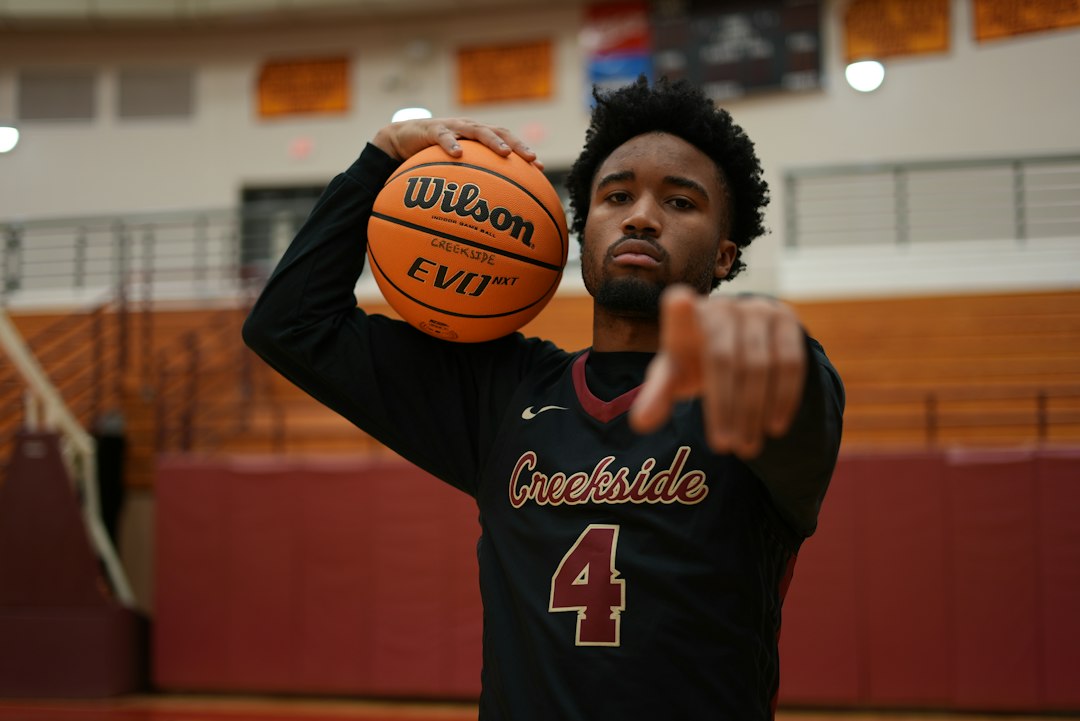




You know the exact spot. Third seat from the left on the folding chairs, maybe fourth if the assistant coach needed room to pace. You had your warmup jacket on — the one with the school name across the back — and you were doing the math in your head: eight minutes left in the third quarter, we're up twelve, this is when he puts me in.
He didn't.
If you were a bench player in high school basketball, that internal calculation is burned into your memory the way certain smells are. You ran the numbers constantly. You watched the clock, watched the scoreboard, watched the coach's clipboard, and tried to read some signal in the way he glanced down the row of chairs. Every bench player high school basketball has ever produced knew that particular arithmetic — and the particular silence when the buzzer sounded and the numbers never added up in your favor.
Nobody writes about that. Coaches write about developing your players. Starters tell their stories in highlight reels. But the backup, the reserve, the kid who suited up every game and got in for two minutes in blowouts — that story sits quietly in thousands of people who still carry it and don't quite know what to do with it.
This is that story. And it's worth telling.
What the Bench Actually Felt Like
Let's be honest about it, because the honest version is the only one that respects the real experience.
There was genuine disappointment. Not once — repeatedly, game after game, sometimes over an entire season. You worked in practice, you hustled on defense drills, you showed up early for open gym on cold Tuesday mornings when you could have slept in. And then Friday night came, the gymnasium smelled like floor wax and popcorn, the other school's student section was loud, and you sat down in your warmup jacket and watched the starters go through layup lines.


The disappointment was real. Pretending it wasn't doesn't honor what you actually went through.
But here's what was also real, and what almost nobody acknowledges: the bench was a master class in observation that the starters never got. When you're out there running the offense, you're inside the play — you can feel it, but you can't always see it. When you're sitting with your elbows on your knees and your eyes on the court, you see everything. You watch the opposing team's two-guard cheat to the right on every defensive rotation. You notice your team's point guard telegraphing the pass to the corner before he even looks that direction. You build a mental model of the game that the players in the game never have time to develop.
In our experience writing about former athletes, this is the detail that stops people cold when they hear it articulated for the first time. They think: yes, that's exactly what I was doing. They just didn't have a frame for it.
The bench wasn't only waiting. It was watching — and watching, at the level a hungry reserve player watches, is a legitimate form of mastery.
The Specific Things Nobody Told You to Feel Proud Of
Here's what you actually did, stated plainly, because it deserves to be stated plainly.
You showed up when showing up was hard.
There is a well-documented difference between the motivation of a starter and the motivation of a reserve. A starter has a built-in incentive system — playing time, recognition, the crowd, the coach's attention. You had almost none of those things on a given night, and you showed up anyway. You ran the scout team. You took charges in practice from guys who were going to play forty minutes on Friday. You were the controlled opposition that made your starters better, and you did it without a standing ovation.
That's a specific kind of character. Not the loudest kind. Not the kind that gets written up in the local paper. But the kind that, in about ten years, starts showing up everywhere in your adult life — in how you handle being overlooked at work, in how you respond when a project you cared about goes to someone else, in how you keep working on something when no external reward is incoming.
You learned to cheer for something you also wanted.
This one is genuinely difficult, and most people who played in the rotation never had to develop this skill at all. When you're a backup basketball player, you are required — emotionally and socially — to cheer hard for the starting guard who plays your position. The guy who is playing the minutes you want. The guy who, if he has a bad game, might create an opening for you.
You had to want him to do well and want to replace him simultaneously. That is an emotionally sophisticated position for a sixteen-year-old to hold. Most adults can't do it gracefully. You had to do it every game, in public, with your school colors on.
You practiced the art of being ready without any guarantee.
Every game, you prepared yourself mentally to enter. You visualized your assignment on the defensive press. You kept your legs warm, your head in the game, your focus on the rotation. Game after game, the call might not come — and you still had to be ready for it, genuinely ready, not just going through the motions of readiness.
That discipline — preparing seriously for an outcome that may not arrive — is the exact discipline that elite professionals, surgeons, pilots, and athletes at the highest levels describe as foundational. You built it in a gymnasium on a folding chair when you were fifteen.
The Moment You Realized the Bench Was Teaching You Something
Marcus T., 34, remembers the exact game where it clicked for him. He was a sophomore backup point guard in a competitive suburban program — good enough to make varsity, not good enough to start. Three minutes into the fourth quarter of a regional semifinal, his coach called his name, looked him in the eye, and said four words: "You know what to do."
He did. Not because he was more talented than the starter. Because he had spent the previous two seasons watching that court with the specific attention of someone who knew his moment might be brief and needed to count. He played six minutes in a game his team won by three. He made one assist that held up under pressure. He ran off the court when the buzzer sounded and cried in the locker room — not from sadness, from something he still doesn't have a clean word for.
What Marcus describes is the specific emotional experience of the bench: not the story of a starter, not the story of the cut player, but the story of the person in between, who existed in the margins of the team's narrative while building an entirely different kind of inner resource.
Riding the Pine and What It Taught You About Teams
Not starting varsity means you spent more time watching team dynamics than almost anyone else on the roster. You saw the starters under pressure, and you saw the seams in how your team handled adversity. You saw who encouraged their teammates and who went quiet when the shots stopped falling. You saw the assistant coach and the head coach disagree with their eyes from across the court.
This is organizational intelligence — the ability to read how a group of people function together under pressure — and you developed it from the best seat in the house. Not the box seats. Not the press row. The bench, which is inside the organism while also being slightly outside it.
The bench experience in high school basketball is, practically speaking, a two-year seminar in what psychologists call perspective-taking: the ability to understand a situation from multiple simultaneous viewpoints. You could feel the game from the inside because you'd practiced it all week, and you could see it from the outside because you were watching it unfold in real time without being inside it. That dual perspective — embodied knowledge plus observation — is genuinely rare.
Most people get one or the other. You got both.
The Life Lessons That Traveled Forward
Here is where the basketball bench experience earns its full meaning — not in the gym, but in the twenty years after it.
Comfort with delayed recognition.
You learned, at an age when recognition matters enormously, that you could do real work without being seen doing it. That is a profoundly useful thing to know. The adult world is full of invisible contributions — the team member who holds the project together without the title, the parent who does the unsexy logistics that make the family function, the colleague who runs the background systems that everyone else benefits from. You were trained for that role on a varsity bench when you were sixteen.
How to support someone who has what you want.
You cheered for your team when your team was the thing between you and playing time. Genuinely. Loudly. Because you were a teammate first and a competitor second. That ordering of loyalties — team before self, even when it's personally costly — is one of the rarest and most valuable things a person can actually live out, and you did it in the specific, concrete context of a high school basketball season.
The specific courage of showing up without a guarantee.
Every practice you attended without starting was an act of commitment to something larger than your individual outcome. That's not a small thing. That's the architecture of integrity — doing the work because the work matters, not because the reward is certain.
Your Jersey, Your Number, Your Story
The bench was part of your basketball story. The warmup jacket, the folding chair, the two minutes in the fourth quarter of a game you'd remember for thirty years — that was yours. The number on your back was yours.
A lot of former players think the jersey only belongs to the starters. It doesn't. You earned yours in practice every week. You wore it to every game. You were on the team.
Your jersey is still out there waiting.
Design yours in minutes and see your name and number exactly the way you remember it — the one you wore on the bench, in the locker room, and on the bus ride home after every game.
Frequently Asked Questions
Was it worth it to stay on the bench instead of transferring or quitting?
For most players, yes — and the reasons typically emerge years later rather than in real time. The experience of staying with a commitment that isn't rewarding you the way you hoped builds a specific kind of resilience that quitting doesn't. That said, every situation is different. If staying on the bench was genuinely damaging your love for the game, the calculus changes. The question worth asking is whether you left with something — perspective, discipline, team loyalty — that you wouldn't have developed elsewhere.
How do you deal with the regret of not getting more playing time?
The most useful reframe is the one that's also the most accurate: you weren't failing to play — you were succeeding at something else. The observation skills, the preparation discipline, the ability to support teammates while managing your own disappointment — those are real outcomes of the bench experience, not consolation prizes. The regret softens when the transfer of those skills to adult life becomes visible, which for most former players happens somewhere in their late twenties.
Is the bench player experience common in high school basketball?
Far more common than the highlight-reel version of youth sports would suggest. In most high school programs, the majority of the roster rides the bench for significant portions of games. Rosters carry twelve to fifteen players; starting lineups have five. The bench player isn't the exception — statistically, the bench player is high school basketball for most people who played it.
Does the experience affect how bench players lead or work later in life?
In our experience, former bench players often describe a specific advantage in professional and collaborative contexts: they're comfortable doing necessary work without recognition, they can hold a systems-level view of how a team functions, and they tend to be effective at supporting colleagues whose success is partly at their own expense. These aren't universal outcomes, but they're consistent enough to be worth naming.
See also: what high school sports actually teach you that nothing else could | athletic identity that doesn't disappear just because you stopped playing | the grief that comes when your high school athletic career ends