

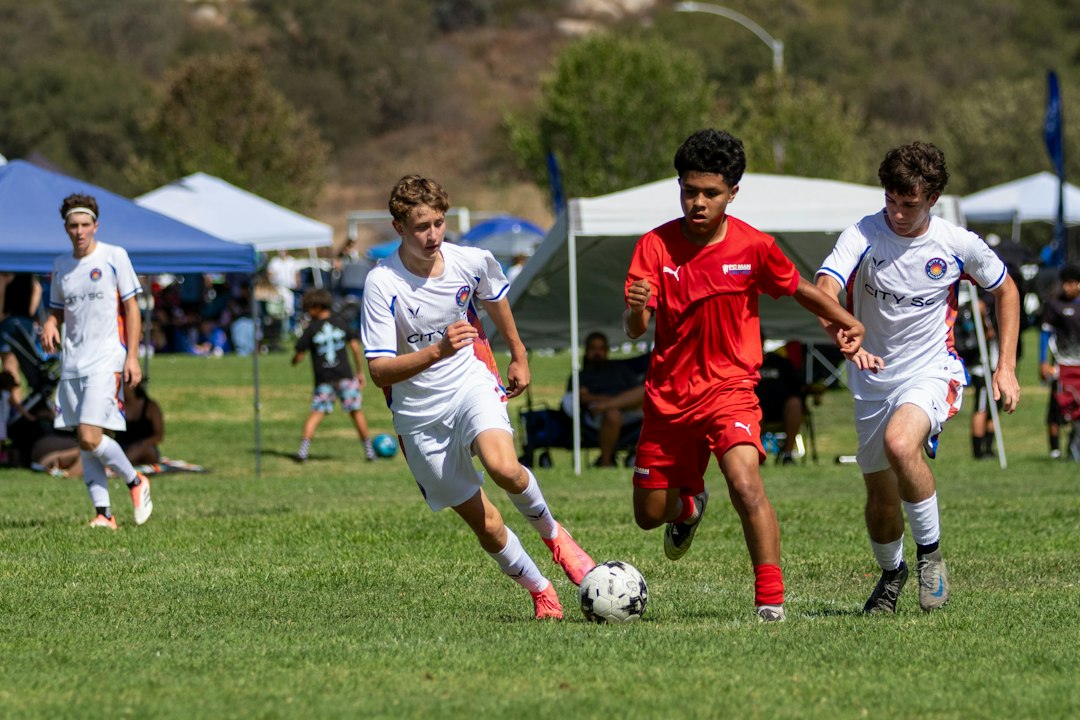




You already know the feeling. A coworker invites you to happy hour. The conversation is easy enough — nobody says anything wrong, the laughs are genuine, the bar is perfectly fine. And yet, somewhere around the second drink, your mind drifts to a specific Thursday night from fifteen years ago. A gym that smelled like rubber mats and old sneakers. A teammate who grabbed your forearm after a loss and said exactly the right thing without using a single word.
The happy hour doesn't stand a chance against that memory.
If you've ever searched for why workplace friendships are weaker than teammates, you weren't looking to confirm that your coworkers are bad people. You were looking for a framework — something that explains why the connections that formed effortlessly during your playing days feel so difficult to approach now. Why the relationships you build carefully across months of shared lunches, Slack threads, and coffee machine small talk never quite arrive at the depth of something that crystallized in a single brutal preseason week when you were seventeen.
This article is that framework. And beyond the explanation, it's the permission you didn't know you were looking for — to stop holding your current relationships to a standard they were never designed to meet.
Why Workplace Friendships Are Weaker Than Teammates: The Real Conditions Behind the Gap
The intensity of friendships from sports isn't nostalgia rewriting history. It's the direct output of a very specific set of psychological and environmental conditions — conditions that almost never appear together in a standard adult workplace.
The foundational ingredient is shared suffering toward a common goal.
When researchers study what causes groups to bond at the deepest level, voluntary shared hardship emerges consistently as one of the most powerful accelerants of trust and closeness that humans experience. A 2014 study in Psychological Science found that people who endured pain together — even in a controlled laboratory setting — showed measurably higher cooperation and solidarity than people who completed pleasant tasks side by side. The mechanism is not complicated: when you suffer alongside someone, your nervous system registers them as safe. As in-group. As the person who was there when it was hardest.


In sport, that suffering is structural. Two-a-days in August heat. Wind sprints until the weakest person in the group decides to finish anyway. The Wednesday practice after a devastating Saturday loss. The moment a teammate tells you to get up — not out of kindness, but because the team needs you vertical. You weren't choosing vulnerability with these people. The circumstances removed that choice entirely.
Your coworkers have never seen you in that state. Most of them never will. That isn't a failure of the relationship — it's simply the absence of the crucible that created something else entirely.
The Uniform as a Psychological Container
The second ingredient compounds the first: a shared external identity that temporarily merges individual selfhood into something collective.
When you wore that uniform — the one with your school name across the chest and your number on the back — you weren't just representing yourself. You became part of something that existed before you arrived and would continue after you graduated. Social psychologists describe this state as identity fusion, where the boundaries between self and group genuinely blur. The result is a willingness to sacrifice for teammates that ordinary friendship rarely produces, because the stakes feel genuinely shared rather than parallel.
At work, you have a job title. A department. A company name on your email signature. But you remain fundamentally an individual navigating an institution. That's a meaningful difference. The workplace produces professional collegiality, which has real value — and is genuinely distinct from what a locker room generates.
The Psychology of Why Team Bonds Are Stronger Than Most Adult Connections
Understanding why team bonds are stronger isn't just an academic exercise. It changes how you interpret your current relationships — and whether you've been grading them unfairly.
Three specific psychological forces operate in athletic team environments that rarely combine anywhere else in adult life:
- Compressed time under pressure. Preseason creates months of emotional development in weeks. The accelerant is stress, not hours logged.
- Enforced proximity without exit. You couldn't opt out of practice when it got uncomfortable. That constraint — counterintuitively — deepens trust faster than any amount of voluntary socializing.
- Consequence that is genuinely shared. When your team loses, you lose. When your teammate is injured, your season changes. Shared consequence creates investment in each other that parallel professional goals rarely generate.
Remove any one of those three elements and the bonding effect weakens substantially. Remove all three — as most workplaces do — and you're left with the slower, quieter process of adult friendship building that feels almost nothing like what sport produced.
This is not a flaw in your current friendships. It is a structural reality of the environments they're forming inside.
Adult Friendship Struggles Athletes Face — And Why the Comparison Is the Problem
Marcus D., 34, played two years of college lacrosse before a shoulder injury closed that chapter. He describes the first few years after graduation as a persistent low-grade disorientation — not depression, but an awareness that something specific was absent from his social life that he couldn't name cleanly. "I'd spend time with people I genuinely liked," he said, "and come home feeling strangely lonely. Like everyone was speaking a language I almost understood."
What Marcus was experiencing is one of the most common adult friendship struggles athletes carry: the mismatch between the depth of connection that competitive sport conditions you to expect and the pace at which adult friendships naturally develop. When your reference point for closeness is something that formed under extreme conditions, ordinary relationship-building registers as inadequate — not because the people are less worthy, but because the environment no longer provides the accelerant.
The author Sebastian Junger explored a version of this in his writing on tribal belonging: that humans evolved for small, interdependent groups where survival depended on genuine mutual investment, and that modern individualist society leaves many people structurally isolated despite abundant surface-level contact. Athletes feel this particular gap more sharply than most, because they've actually lived inside the small interdependent group. They know precisely what they're missing. The absence has a name and a shape.
The Asymmetry of Time
One of the most disorienting dimensions of this comparison is temporal. A meaningful workplace friendship might require two years of consistent contact before it reaches real depth. A meaningful teammate bond could form in two weeks of preseason. When you've experienced the accelerated version, the adult version doesn't feel like a slower path to the same destination. It feels like a fundamentally different — and lesser — kind of thing.
It isn't lesser. It's operating without the environmental shortcuts. A friendship that develops across years of shared context — showing up during illness, navigating professional friction, being present through someone's worst seasons — can reach genuine depth. It just doesn't announce itself the way a preseason did: fast, total, and unmistakable.
A Framework for Appreciating Present Relationships Without Unfair Comparison
Here is the reframe that tends to shift something for people who've been carrying this comparison for years without resolution.
Your teammate bonds were extraordinary. Not because those people were better humans than the ones around you now. Because the circumstances were extraordinary. The conditions were so particular — so unlikely to recur naturally in adult life — that it would be genuinely strange if ordinary relationships produced the same output. You are not surrounded by lesser people. You are surrounded by people who have never been dropped into a pressure cooker with you, and who are choosing to connect with you anyway.
That second part deserves a moment. They're showing up without the structural forcing function. That's actually its own kind of thing.
A practical framework for applying this:
-
Name what the team bond gave you at the specific level. Not "closeness" in the abstract — the exact element. Was it being known at your worst and accepted anyway? Shared purpose that exceeded individual ambition? Pre-game ritual that created predictability inside chaos? When you can name the specific ingredient, you can begin to notice where it appears — even in smaller doses — in your current life.
-
Stop evaluating current friendships against teammate criteria. The coworker who quietly brings you coffee when you look overwhelmed is performing a genuinely caring act. It doesn't look like a teammate pulling you off the floor in overtime, but the impulse is the same — someone noticing you and choosing to respond. Let it register as what it is.
-
Understand that tested depth is still possible, just slower. Adult friendships that survive real difficulty — a serious illness, a job loss, a family crisis — develop the kind of depth that comes close to what shared athletic hardship produced. Life provides the crucible eventually. The key is staying present when it arrives rather than retreating into isolation.
-
Engineer repetition deliberately. The research on adult friendship consistently shows that repeated, unplanned interaction is among the strongest predictors of closeness. Your team schedule did this automatically. As an adult, you can create a version of it — a standing weekly activity with the same small group, low-stakes and consistent — and let compound time do the slow work the preseason used to do fast.
What Your Playing Days Actually Gave You — and Why It's Not Behind You
There is a version of this conversation that ends in grief. In the conclusion that your richest friendships are in the past and everything forward is a diluted substitute. That version is factually wrong, and it's worth being direct about the specific reason why.
Your playing days gave you a proof of concept. You now carry in your body the lived knowledge that genuine depth between people is possible — that humans can know each other at that level, and that you specifically are capable of forming and sustaining bonds that profound. Many people spend their entire adult lives wondering if real connection is achievable and never finding out. You already know the answer. You have the evidence.
That is not something to mourn. That is a map — a specific internal reference point for what you're aiming toward, not a trophy of something permanently lost.
The jersey you wore during those years represents something real: a version of you that was shaped inside conditions most adults never encounter. That player, that teammate, the person who ran until they had nothing left and then ran alongside someone else who was doing the same — that's still you. Those friendships were real and worth honoring. The friendships you're building now, slower and without a shared uniform, are also real and worth tending.
They are not competing with each other. They are different chapters in the same story, written in different conditions, with the same person at the center.
Your jersey is still out there waiting.
Design yours in minutes and see your name and number exactly the way you remember it.
Frequently Asked Questions
Why do teammate friendships feel so much more intense than friendships formed later in life?
The intensity reflects real psychological conditions that were structurally present during your playing days. Shared physical hardship, a unified identity through a team name and uniform, repeated enforced proximity, and genuinely shared consequences all accelerate the bonding process in ways that normal adult social environments rarely produce simultaneously. The friendships feel more intense because the conditions that formed them were more intense. That's not sentimentality — it's the documented effect of shared suffering and collective identity on human social bonding.
Is it possible to build equally deep friendships as an adult without a team context?
Yes, though it typically requires more time and more intentionality. Deep adult friendships tend to develop when people navigate significant shared difficulty together — a serious illness, professional failure, caregiving, or simply years of consistent presence during each other's hardest seasons. The pressure-cooker environment can't be manufactured on a schedule, but life eventually provides one. The key variable is staying present when difficulty arrives rather than retreating, and letting hardship deepen the relationship the way a preseason once did.
Why do adult friendship struggles seem to hit former athletes harder than people who never played team sports?
Former athletes have a specific and named reference point that most adults lack: they know exactly what deep group belonging feels like, because they lived inside it. This makes the contrast sharper and the absence more legible. Someone who has never experienced that level of cohesion might feel generally disconnected in adult life without being able to identify why. Athletes can name the exact thing that's missing — which is painful in the short term but actually gives them something precise to aim for and recognize when they encounter it again.
Does the type of sport affect how strong the team bonds become?
In our experience covering athlete identity across many sports, team sports with collective outcomes tend to produce the strongest identity-fusion bonding, because the shared goal is explicitly collective and the uniform creates a clear group container. That said, individual sport athletes who train together in shared environments — club swimmers, track squads, martial arts dojos, gymnastics teams — frequently report very similar bonding, particularly around the shared suffering of training, even when competition is individual. The key variables are consistent proximity, shared hardship, and a common identity marker. Team sports make all three automatic; individual sport athletes often create them through training culture and shared sacrifice.
How do I explain to current friends that my teammate relationships meant something different — without making them feel like second place?
The framing carries almost everything here. "I had experiences in sport that showed me what deep connection feels like, and I want to build that with the people in my life now" is both honest and generative — it turns nostalgia into an aspiration and an invitation. What doesn't land well is the implied comparison: "those friendships were deeper than ours." The first framing opens a door. The second closes one. Most people respond warmly to being told someone wants to go deeper with them; almost no one responds well to being told they're already falling short.
See also: athletic identity after high school | what high school sports teach you that nothing else could | how to find and reconnect with former high school teammates | the difference between a sports fan and someone who actually played