
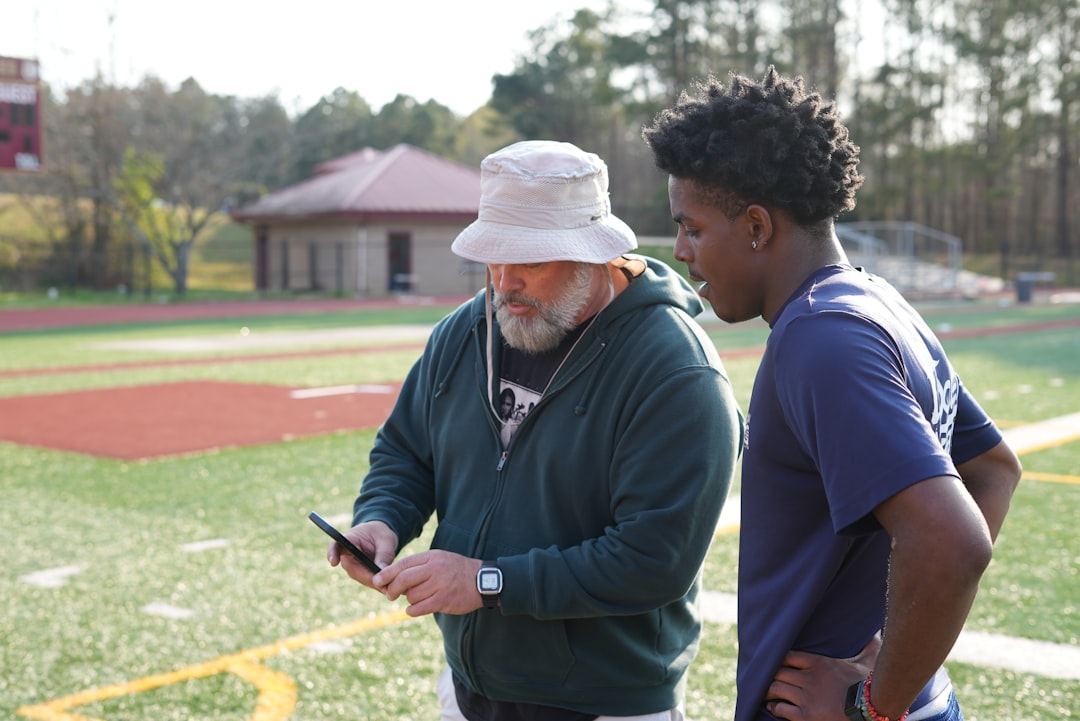
Coach impact on former athletes rarely looks the way people expect — not a trophy presentation, not a highlight reel moment, but a single sentence that found a permanent address somewhere inside you and never moved out.
You know exactly which sentence it is. No searching required. It surfaces on its own schedule — before a difficult conversation, in the middle of something that demands more than you feel ready to give, or on a quiet afternoon when nothing obvious called it forward. It simply arrives. Clean. Settled. Like it belongs there, because it does.
The stats have faded. The jersey is folded somewhere you'd have to look for. The trophies have been relocated to boxes that don't get opened. But the words? The words kept their lease.
The Relationship Nobody Warned You About
You registered for a sport. Nobody mentioned you were also signing up for one of the most consequential relationships of your life — one of the universal experiences every high school athlete shares, with coach relationships being among the most formative.
The coaching relationship doesn't announce itself — that's what makes it so effective at getting past your defenses. It accumulates quietly across practices and games and losing streaks and comeback wins, until one day you recognize that this person has witnessed you at your most depleted, your most humiliated, your most genuinely broken — and kept showing up. Not out of obligation. Because the job required full investment, and they gave it.
Consider the contrast. A parent loves you by design. A teacher holds your attention for one period, one academic year, and then releases you. A coach watches you fail — not once, not by accident, but repeatedly, deliberately, across months and sometimes years — and chooses to remain invested in the person you haven't become yet. That particular quality of witness is uncommon at any age. At fifteen, it can feel like the only real thing in the room.
The weight behind a coach's words comes from what a coach actually sees. They aren't reading your present tense. They're reading your future tense — the version of you that is still under construction — and addressing their words to that person directly. When those words reach you, they don't stop at the surface. They go somewhere foundational, where your future self was already quietly taking shape.
If you played, you remember that feeling. The specific gravity of a coach's full attention landing on you — not the roster, not the starting lineup, not the group — on you, in a moment with real stakes. The way the noise dropped out and everything got precise and immediate.
What Makes a Sentence Stay
Over the course of an athletic career, you absorb thousands of coaching words. Corrections, instructions, tactical adjustments, halftime addresses, post-loss assessments — the overwhelming majority of it dissolves when the season ends. So what separates the sentences that become permanent from the ones that don't?
In our experience talking with athletes across multiple sports and decades of competition, the words that stay share recognizable qualities. Not because they were carefully constructed speeches, but because they arrived at the convergence of the right person, the right moment, and something that was already true.
They were directed at you by name. Not a general call for more effort from the whole team. Your name, followed by the specific thing you were privately questioning about yourself. When a coach addresses the doubt you haven't told anyone about, the sentence has nowhere to go but deep.
They gave language to something you were already experiencing. The most durable coaching words often handed you vocabulary for a feeling you were living but couldn't name. That thing you feel when you want to stop but something won't let you? That's called competitive character. That's what this whole process is building. You already knew the feeling. The coach just named it, and now it was yours to keep.
They landed when you were genuinely open. At the bottom of a bench after a half you'd rather forget. Alone after a practice where nothing went right no matter how hard you tried. In the tunnel before a game that scared you more than you wanted to admit. Coaches who read those moments accurately — and chose them deliberately to speak into — are the ones whose voices stayed. Closed doors turn away comfort. Open ones let truth through.
They asked more than you were asking of yourself. Ease does not echo across thirty years. The sentences that stayed almost always contained a demand you weren't sure you could meet. And then you met it. The word became evidence of something real.
What the Coach Was Actually Teaching
This is the part that requires distance to see: your coach was rarely teaching you only to play better.
The drill that seemed disconnected from anything real — the one you ran past the point of coherent thought, the one with no visible relationship to the game — was teaching you something about trusting a process you couldn't yet see the outcome of. That real development doesn't signal itself while it's happening. That the work done in obscurity is what produces results in the light.
The way your coach responded to a teammate who gave partial effort — not with a confrontation, but with a quiet, specific withdrawal of engagement — was teaching you something about how standards actually function. That excellence isn't loudly required; it's quietly expected, and it belongs to the people who choose it without being asked.
The moment your coach pulled you aside after a performance you were proud of and said, with complete evenness, you can do better than that — that was teaching you that the scoreboard is not the measure of the thing that matters. That satisfaction and complacency are nearly identical from certain angles. That the honest voice in the room doesn't always raise itself to be heard.
A 2019 study published in the International Journal of Sports Science & Coaching found that athletes who described a meaningful positive relationship with at least one coach reported significantly higher self-efficacy and resilience as adults — not just in athletic contexts, but across careers, relationships, and personal challenges. The mechanism is direct: a coach who believed in your potential before you did built something structural inside you. A framework that outlasts the sport by decades and activates in situations that have nothing to do with any scoreboard.
You didn't have language for that while it was happening. You just knew someone kept showing up and kept telling you the truth, and that felt like something worth orienting toward.
The Words Themselves: What Former Athletes Actually Carry
Every former athlete has a version of this. Yours might appear on this list. It might be something entirely private — a sentence between two people in one specific moment that exists nowhere else in the world.
"I'm not asking for perfect. I'm asking for honest."
"The scoreboard has no idea how tired you are."
"You play the way you practice. So practice like the outcome is real."
"I've coached a lot of athletes. What you have isn't common. Don't let it go to waste."
"This is the moment you'll describe to your kids someday. What are you going to tell them?"
None of these sentences originated with a coach. They've been passed forward through generations of athletics. But the first time you heard one aimed directly at you — in your body, in your sport, in that specific moment of doubt or fear or exhaustion — it became original. It became specifically, permanently yours.
Maria T., 38, played four years of collegiate volleyball and has spent the past six coaching youth rec leagues on weekend mornings. She still hears her club coach's voice in hard adult moments — salary negotiations, conversations with people she loves that aren't going well, the private few seconds before she has to do something that genuinely frightens her. "She used to say, 'Be the player you want to be coached by,'" Maria says. "I was seventeen. I had no conception of how far outside volleyball that sentence was going to travel."
That's the part nobody tells you while you're inside it. The sport is the environment. The lesson has a much longer address.
The Coach Who Didn't Give You What You Expected
Not every lasting coaching impact arrives wrapped in encouragement. Some of the most permanent words stung on arrival.
There is a specific kind of coach — you likely had at least one — who had no particular interest in your short-term comfort. Who would observe your genuine best effort and then describe, with precision, what was still inadequate about it. Who would allow honest feedback to occupy the space between you until you figured out what to do with it, without rushing to soften the edges.
That coach was difficult to appreciate at the time. Possibly impossible.
Decades later, that coach is frequently the first voice that surfaces when life becomes genuinely demanding — the one who was there for the season that changed everything, and for every season that followed. Because they modeled something specific and rare: that deep investment in a person and refusal to accept less than their capability are not in conflict. That authentic care sometimes looks like refusal — declining to pretend you've arrived somewhere you haven't, because pretending would be the more comfortable betrayal.
If you had that coach, you know what eventually happened. You grew into the version of yourself they were addressing the entire time. And the words that once stung became the ones you reach for first.
What You Carry Into Every Room
Former athletes carry their coaches into rooms that have nothing to do with sports. The discipline that makes you the person who arrives before it's required. The capacity to stay present inside difficult conversations until something real resolves. The ability to lose without being hollowed by it, or win without being inflated by it.
These aren't traits that belong to athletes. They're human traits that sport happened to be an unusually direct school for — leadership lessons that started in a gymnasium and never stopped traveling. And behind most of them, traced back far enough, there is a specific voice. A specific sentence. A moment on a court or a field or a track where something was said directly to you that you have never fully set down.
Every former athlete remembers the moment the sport stopped being about the sport. When it became clear that what was happening in practice, in competition, in those conversations after performances you'd rather not replay — none of it was contained inside the lines. The game was a laboratory for something that would keep mattering long after the final buzzer, long after the equipment got returned, long after the last name on the roster sheet faded.
Your coach may have understood that explicitly. Or they may have been too absorbed in the next week's preparation to articulate it. Either way, they handed you something still in daily use. Something you may already be passing forward — to your own children, to people you mentor, to the moment in some ordinary week when you hear yourself saying something that sounds remarkably like what was said to you in a gymnasium a long time ago, by someone who believed in a version of you that you hadn't met yet.
The Thing Most of Us Didn't Say
Here is what sits quietly at the back of most former athletes' minds: we didn't say thank you in a way that matched what the words were actually worth.
You were sixteen. You didn't have the vocabulary yet for what was happening to you. The season ended, or you graduated, or you moved on — and the right moment for that conversation kept getting deferred until the window closed in a way that couldn't be reopened.
Some coaches receive letters years later. Out of nowhere, from a former athlete who finally assembled the right words. Some never find out the reach of what they did — what they set in motion with a single sentence on an unremarkable afternoon when they probably thought they were just running practice.
If your coach is still reachable, this is a direct reminder: the sentence hasn't faded. What they said is still operational inside you. The return on their investment has compounded in ways they would be glad to hear about.
And if that conversation is no longer possible — if time or distance or loss has made it so — you carry them regardless. In the standard you hold yourself to when no one is watching. In the way you handle the moments that ask something real. In the thing you say to yourself in the private second before the moment that counts.
The voice doesn't require a phone line to remain present. It never did.
Your jersey is still out there waiting.
Design yours in minutes and see your name and number just the way you remember it.
Frequently Asked Questions
Why does coach impact on former athletes last so much longer than other influences from that period of life?
The coaching relationship combines three elements that rarely appear together: sustained exposure over months and years, high emotional stakes that make the reader genuinely open to input, and specific investment in the athlete's development as a person — not just a performer. When a coach speaks into a moment of real difficulty or real potential, the words land in a context where they are urgently meaningful rather than incidentally received. That combination of emotional intensity, personal specificity, and repeated exposure is what separates coaching words from the thousands of other things said to you during those same years.
Is it unusual to still hear a coach's voice in adult situations that have nothing to do with sports?
It's more common than most former athletes realize, and it's worth understanding why it happens. The coaching relationship didn't teach you athletic skills in isolation — it built a framework for navigating difficulty, effort, and standards that has no sport-specific boundaries. When adult situations share the emotional structure of athletic challenge — uncertainty, the requirement for sustained effort, the choice between the comfortable path and the right one — the framework activates. The voice that helped you navigate those situations at seventeen is the same voice that surfaces at forty-two, because the underlying challenge is the same.
What if the coaching words I remember were harmful rather than helpful?
This deserves a direct answer rather than a deflection. Not every lasting coaching impact is a gift. Some former athletes carry sentences that were unfair, demeaning, or genuinely damaging — and those can be as persistent as the affirming ones, sometimes more so. The presence of a lasting coaching voice doesn't automatically mean it was earned through good coaching. What matters is the choice available to you now: which voices you choose to amplify, which you consciously reframe, and which you decide no longer have standing to run in you. That decision is available at any age, and making it deliberately is its own form of the thing good coaches were always trying to build — agency over your own interior.
See also: why high school sports still matter to adults decades later | the athletic identity that stuck with you long after your playing days ended | why your senior season memories are burned into your brain so clearly | what high school sports taught you that no classroom ever could | saying 'I played' still means something real