

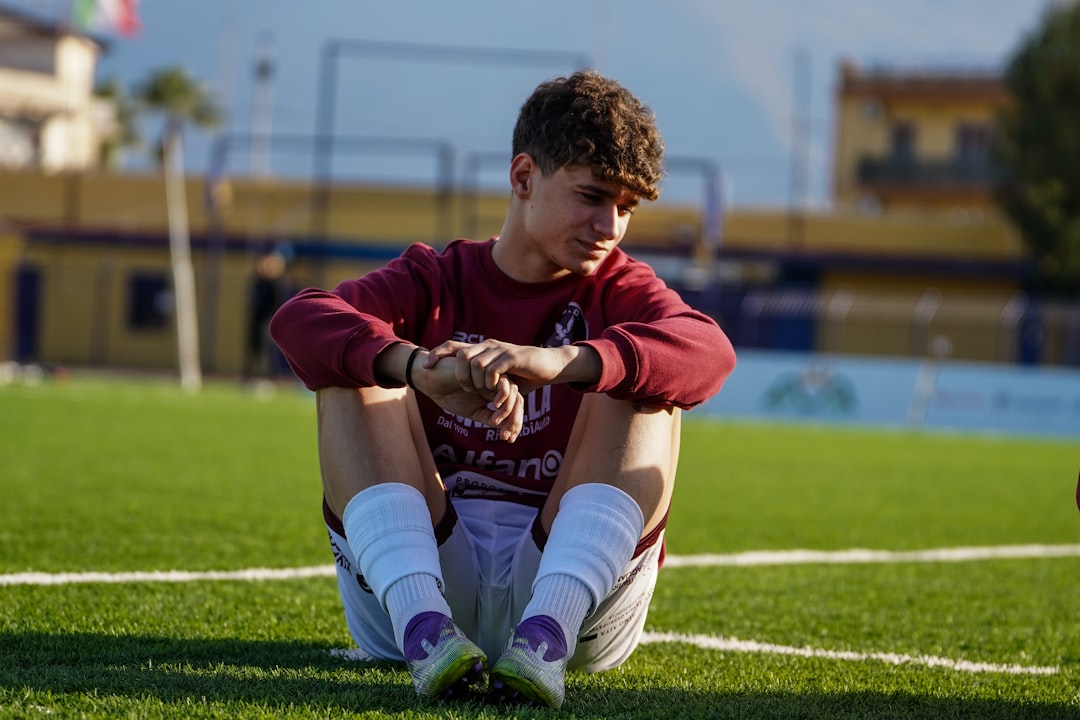




You already knew something was wrong before you told anyone.
That's how it always started. A pop, a catch in the stride, a moment where the body said wait and the competitive brain said not now. The question of playing through injury and athlete identity isn't really a debate about toughness versus weakness. It's something older and stranger than that. It's the question of what you were willing to sacrifice to stay in the story — and what that willingness taught you about yourself long after the final whistle.
Every former athlete carries this particular education. Not the trophy, not the championship, not even the best game of their career. They carry the memory of the day they made a choice about pain — and what they learned about themselves in the making of it.
The Tape, the Wrap, and the Calculation Nobody Talks About
There was always a ritual to it.
Trainers' tables smelled like rubber and antiseptic. The wrapping had a sound — that specific tension of athletic tape pulled tight over an ankle, a wrist, a finger bent a direction it was never supposed to bend. And before you swung your legs off that table and tested your weight, you ran an internal calculation that nobody ever fully explains to young athletes.
Can I make it through practice? Can I make it through the game? Can I hide it well enough that nobody pulls me?
Notice what wasn't in that calculation: whether you should. Whether the long-term cost was worth it. Whether the thing you were protecting — a roster spot, a starting position, a team's expectations of you — was worth more than what you were wagering.
That's not a failure of intelligence. It's a feature of how athlete identity forms. By the time most competitors are old enough to make those decisions consciously, the identity has already been built around a specific relationship with pain. Pain signals effort. Pushing through it signals belonging. Stopping signals — what, precisely? Something that felt worse than the injury itself.


In our experience covering former athletes across sports, the most common thing people say when they look back on playing injured isn't regret about the physical damage. It's this: I didn't know where I ended and the role began.
What "Tough" Actually Meant in the Locker Room
If you played, you know that toughness in a competitive environment is a social currency before it's a personal virtue.
You didn't learn toughness from a coach's speech. You learned it from watching a teammate tape two fingers together and walk back onto the floor without a word. You learned it from the silence that greeted someone who came out of the game — not a cruel silence, just the specific absence of the acknowledgment that staying in would have earned. The message was ambient, structural, nearly invisible: playing through it was the baseline of membership.
This created a culture — and cultures create pressure that feels like personal choice.
The athlete who played on a hairline fracture wasn't necessarily making a rational risk calculation. They were making an identity statement. I am the kind of person who stays in. And that statement, repeated over seasons and years, became as much a part of their self-concept as their position, their sport, their number.
Maria T., 34, a former collegiate soccer midfielder, still remembers playing through a grade-two MCL sprain her junior year — not because anyone told her to, but because missing three weeks meant watching someone else prove they deserved her spot. "It wasn't about pain," she says. "It was about whether the team would still see me as the player they built around. That scared me way more than the knee."
That distinction matters. Because when you understand that the playing-through-pain decision was never purely physical, you can start to understand why it shaped your identity in ways that lasted far beyond the sport itself.
The Line Between Threshold and Damage — And Why Athletes Rarely Find It in Real Time
Here's what nobody tells you when you're nineteen and convinced you're built differently: the human body is extraordinarily good at lying to you when your brain has a strong enough agenda.
Adrenaline suppresses pain signals. Competition focus narrows attention to performance cues and away from injury signals. The social environment of a competitive sport actively rewards ignoring the body's warnings. All of this conspires to make the threshold — the actual line between manageable and this is making it worse — nearly impossible to find in the moment.
Research on athlete pain tolerance has consistently shown that trained athletes demonstrate both higher pain tolerance and higher pain thresholds than non-athletes — but also that this elevated tolerance often leads to delayed injury recognition, not better injury outcomes. The body's warning system is being overridden by the very training that made the athlete competitive.
What this means in plain terms: the gut feeling that you could push through was, for many athletes, a trained response rather than an accurate assessment. You weren't wrong to trust it — it was the best information you had, built by years of competitive conditioning. But you were working with a calibration instrument that had been systematically adjusted away from self-preservation.
The athletes who figure this out mid-career — who learn to hear the body beneath the adrenaline — tend to describe it as a kind of second education. They had to learn, almost from scratch, how to listen to themselves.
That's a harder skill than most people outside of sport ever have to develop.
What the Injury Revealed That the Good Games Couldn't
Here's the counterintuitive thing: the best game you ever played probably didn't teach you as much about yourself as the game you played hurt.
Easy performance confirms what you already believed. Adversity interrogates it.
When you play through real pain — not the theatrical discomfort of effort, but the specific, distracting, focus-fragmenting presence of an actual injury — you find out what your mental game is actually made of. You discover whether you compete from identity or from condition. You learn if your confidence is structural or situational.
Some athletes discover genuine reserves they didn't know existed. They find that the injury strips away everything peripheral — the showboating, the nerves, the crowd-awareness — and leaves only the core competitive instinct. These are the games they remember as some of their best. Not statistically. Experientially.
Others discover the opposite: that without full physical capacity, their mental architecture collapses. That they needed the body working to believe the performance was possible. This, too, is valuable information — though it rarely feels that way at the time.
And some athletes discover something more complicated: that they can perform, that they can compete, but that doing so costs something they can't fully account for until much later. The game was fine. The recovery wasn't. The knee, the shoulder, the back — it was fine, until it wasn't, for years afterward.
Every former athlete remembers the injury that taught them something about the version of themselves they were when no one was watching and nothing was working the way it was supposed to. That memory is one of the most honest self-portraits sport ever produced.
The Part of the Story That Doesn't End When the Career Does
The threshold you found in competition doesn't retire when you do.
Former athletes consistently report that the pain-tolerance patterns, the push-through instincts, and the identity built around endurance migrate into post-athletic life in ways that are both useful and complicated.
On the useful side: the former athlete who sat in a marketing meeting at 28 with a stress headache and kept presenting, the one who pushed through the early years of a business when every signal said quit, the one who managed difficult stretches of parenthood or partnership with the same internal resolve that once carried them through the fourth quarter — these people credit sport, specifically, for that capacity.
On the complicated side: the same former athlete often has no reliable internal mechanism for distinguishing between this is hard and worth pushing through and this is genuinely damaging me and I need to stop. Because that distinction was never the sport's priority. The sport needed you in the game. It didn't need you to have a sophisticated self-care philosophy.
So you enter ordinary life — where nobody is taping your ankle for you, where there's no team expectation keeping you upright, where the only voice telling you to push through is the one you trained over years — and you have to figure out, often slowly and sometimes painfully, where your actual threshold is.
Not the threshold you performed. The one you actually have.
The Reckoning Most Former Athletes Eventually Reach
There's a conversation that happens eventually. Sometimes in your thirties. Sometimes earlier. Sometimes when a doctor tells you something about that old injury that makes you do the math backward through your career.
It's the conversation between the athlete you were and the person you became. And it centers on a question that doesn't have a clean answer: Was it worth it?
This is where the playing through injury story gets genuinely complex, because the answer is almost never simply yes or simply no.
The sacrifice was real. The damage, in some cases, was real. And so was the growth. The identity. The competitive education that didn't come from the wins — it came from the decisions made in the specific conditions of real adversity, in real time, with real stakes.
You can hold both of those things. The former athlete who played through a genuine injury didn't make a stupid decision. They made a decision inside a system that valued a particular kind of courage, with incomplete information about cost, at an age when identity formation and competitive culture were inseparable.
What they earned from it — the knowledge of their own threshold, the hard-won understanding of what they're actually made of — is real. It doesn't disappear when the sport does. It's in how they approach difficulty, how they define resilience, how they understand sacrifice.
The jersey didn't just represent the team. It represented the version of themselves that was willing to find out where their limit actually was.
That's worth something. Even now. Especially now.
Your jersey is still out there waiting.
Design yours in minutes and see your name and number just the way you remember it.
Frequently Asked Questions
Is playing through injury actually a sign of mental toughness, or is it a cultural pressure athletes internalize?
Both — and that's the honest answer. Genuine mental toughness exists, and competitive athletes develop it. But the specific behavior of playing through injury is also shaped heavily by team culture, coaching norms, and the social currency that toughness earns within an athletic environment. Most former athletes, looking back, can identify moments where the choice was truly theirs and moments where the culture made it nearly impossible to choose otherwise. Separating the two is part of the long work of understanding your own athletic identity after competition ends.
Why do so many former athletes have a complicated relationship with rest and recovery later in life?
Because the sport trained them to override rest signals, not honor them. Competitive athletic training systematically rewards pushing through fatigue and discomfort. That conditioning doesn't disappear at the end of a career — it becomes the default operating mode. Former athletes often describe feeling guilty about rest, unable to distinguish productive discomfort from counterproductive damage, or reluctant to stop when something is wrong because stopping was never the answer the sport gave them. Recognizing that this is a trained response — not a character flaw — is usually the beginning of recalibrating it.
How do former athletes reconcile pride in what they endured with the physical costs that showed up later?
Slowly, and rarely in a straight line. The most common pattern is a period of straightforward pride ("I did what it took"), followed by a period of questioning when the physical costs become undeniable, followed eventually by something more integrated — an understanding that the sacrifice was real, the cost was real, and the growth was real, all at once. The competitive experiences that pushed athletes past their threshold didn't just cause damage; they also produced genuine self-knowledge that most people never access. Holding that complexity — neither dismissing the cost nor denying the value — is the work. Most former athletes get there. It just takes longer than anyone tells you.
Does the threshold you found in sport translate to other areas of life?
Yes — though not always in the ways former athletes expect. The capacity to tolerate difficulty, to maintain focus under adversity, to push past the point where a less trained person would stop — these migrate. Former athletes consistently identify that competitive experience gave them a baseline relationship with hard things that serves them in careers, relationships, and personal challenges. The complication is that the threshold in sport was calibrated for a specific context, with a team, with external accountability, with clear performance goals. In ordinary life, the same instinct sometimes produces resilience and sometimes produces a refusal to stop when stopping is the right answer. The translation is real; the calibration still has to happen.
See also: how athletic identity shapes who you are long after the final whistle | what high school sports actually teach you about yourself | the grief that follows the end of an athletic career | the psychology of why those athletic moments still define you