

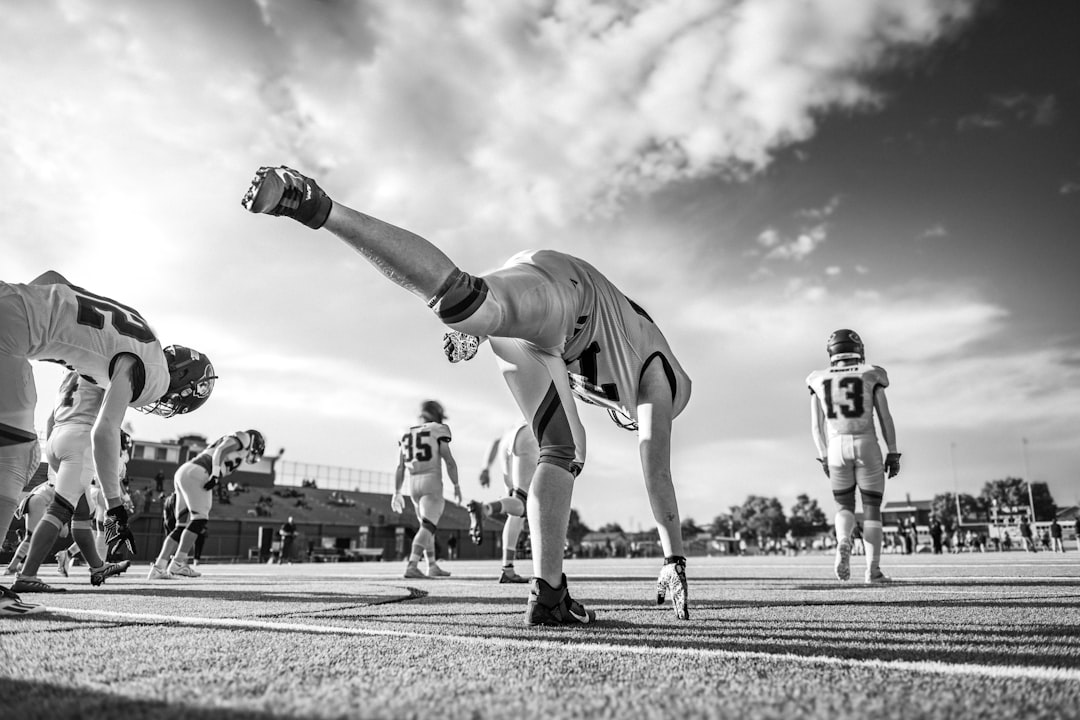




You remember the exact moment the stunt clicked.
Not the first time — the first time was nervous and wobbly and ended with someone's elbow in your ribcage. But the time it clicked. When the base hit the load, the flyer hit the extension, and for one suspended second everyone's weight was exactly where it was supposed to be, and the routine that had felt like controlled chaos for six weeks suddenly felt like one organism moving.
That's the high school cheerleading athlete experience that doesn't make it into the highlight reels. Not the trophy. Not the bow. That half-second of stillness in a crowded gym when the team realized it had become something real.
If you were on a competitive cheer or dance team in high school — not sideline, not pep squad, competitive — you already know what this article is about. You don't need it explained. You need it named.
The Athletic Reality That Nobody Outside the Gym Understood
Let's be clear about something that competitive cheer and dance athletes have been saying for decades: this was a sport. Full stop.
In our experience covering former-athlete stories across dozens of disciplines, competitive cheer athletes describe a training environment that matches or exceeds what their peers in basketball, soccer, and track were doing. Three-hour practices, six days a week, during peak season. Strength conditioning built around the specific demands of lifting, catching, and controlling human weight at height. Tumbling progressions that required months of repetition before a skill was cleared for competition. Choreography that demanded physical precision down to the angle of a wrist.
The physical vocabulary alone separates competitive cheer from what most people picture when they hear the word "cheerleader."
Bases had to develop hip-level strength and grip stability simultaneously. Backspots had to anticipate weight shifts before they happened — pure proprioceptive instinct built through thousands of repetitions. Flyers had to lock their entire body into a straight-line position while hovering above a gym floor, trusting that the four people underneath them were right where they needed to be. Dancers had to execute eight-counts with the kind of precision that required every team member to internalize not just their own choreography but the shape the group was supposed to create.


None of that happened by accident. None of it happened without work that left marks — on the shins, on the palms, on the inside of a forearm where someone's finger had dug in during a catch.
If you played, you know what it felt like to wrap your wrists before practice the way a weightlifter wraps theirs. You know the particular soreness that lived in your shoulders for three months straight during stunt season. You know that "practice runs" of the full routine meant running a two-and-a-half-minute routine at full performance intensity — music, stunts, tumbling, pyramid, everything — until you could hit it clean on the fifth try, then the sixth, then again the next morning.
This was athletic training. The fact that some people needed convincing of that — the fact that people who never played don't understand until they've seen it up close — was its own kind of education.
What the Season Actually Looked Like From the Inside
Every former athlete remembers the particular rhythm of their sport's season. Football had two-a-days. Cross country had the long run on Saturday mornings. Competitive cheer had something that didn't map neatly onto a single week because the demands shifted constantly.
Early season was almost all fundamentals. Skills that had been let go over the summer had to be rebuilt. New team members had to be integrated into stunt groups, which meant rebuilding trust from scratch — because stunt trust isn't abstract. It's physical. You can feel when a base isn't confident. You can feel when a flyer is bracing for impact before anything has gone wrong. Early season practice had a specific tension to it because everyone was figuring out who they were in this configuration.
Mid-season was when the routine started taking shape. This was the period that competitive cheer athletes describe most vividly — the weeks when the choreography was learned but not yet fluid, when the stunts were hitting inconsistently, when the energy in the gym could shift from electric to deflated inside a single run. Coaches pushed hardest here. Corrections came fast. Standards that had been introduced were now enforced.
If you were on a competitive team, you remember mid-season as the stretch that either made your team or revealed where it was going to crack.
Competition season itself had its own specific texture. The tournament-day experience — early call times, hotel rooms shared with six people, warm-up schedules posted in the lobby, the specific way adrenaline sits in your stomach before you walk out onto a competition floor — is burned into the memory of every athlete who lived it. The music starting. The eight-count that separated controlled breathing from full performance intensity. The stunts going up under real-competition noise for the first time.
And then the scoresheet. The deductions column. The all-too-specific language of competitive cheer judging, which athletes learned to read like a second language.
The Sisterhood That the Trophy Didn't Capture
Jasmine R., 28, was a base and tumbler on a varsity competitive cheer squad for three years. She keeps a photo on her phone of the exact moment her stunt group hit their final pyramid at regionals — not because they won, but because she can still feel where her hands were. "That picture is my whole high school," she says. "Everyone in it. Nothing else needs to be in the frame."
The relationships built in competitive cheer and dance have a specific quality that former athletes across sports recognize — but the mechanism in cheer is unusually direct. You were physically dependent on each other. Not metaphorically. Not in the way a basketball team depends on a point guard to distribute. In competitive cheer, your safety, and someone else's safety, lived in the quality of your grip, your timing, your focus on a specific Wednesday afternoon in October when you were tired and the routine wasn't clicking and the coach ran it back.
That forges something. Former competitive cheer athletes describe their team relationships with a specificity that's striking — they remember individual roles with precision, specific people's contributions, who was the anchor of a stunt group and what it felt like when that person had an off day. They remember who stayed late. Who ran the routine one more time without being asked. Who caught someone on a day when the catch wasn't clean.
The sisterhood narrative in competitive cheer is real, but it's not sentimental. It was built in the repetition of physical interdependence. The trust wasn't declared — it was demonstrated, repeatedly, under pressure, in front of judges and crowds and each other.
That's why former competitive cheer athletes describe their team relationships decades later with the same clarity they describe the stunts. The people and the physical memory are encoded together.
What Competitive Cheer and Dance Actually Taught You
The post-sport life of a competitive cheer athlete carries specific transferable skills that don't always get named but are consistently identifiable — because the sport you played shaped the adult you became in ways that only become visible once you're out in the working world.
Performing under pressure with a locked-in routine
Competitive cheer athletes learned to execute a memorized sequence at full intensity while managing adrenaline, crowd noise, and the awareness that any deviation affected everyone else. The professional analog is obvious: presentations, client meetings, high-stakes moments where preparation meets real-time delivery. Competitive cheer athletes tend to be good at this in ways they don't always connect back to the gym.
Reading group energy and adjusting in real time
A stunt that was hitting in warm-up sometimes felt different when the music started. Athletes learned to read the energy of the group — who was locked in, who was hesitating — and adjust their own performance accordingly. This is an advanced interpersonal skill that most people spend years trying to develop in professional contexts.
Accepting correction without collapsing and implementing it immediately
Competitive cheer coaches corrected in real time. The culture required athletes to receive specific, technical feedback mid-practice, integrate it, and demonstrate the correction on the next attempt. This is not how most people learn to take feedback. The athletes who came out of competitive programs had been trained to treat correction as information, not judgment — a distinction that shows up clearly in how they function in team environments later in life.
Carrying the weight of a team result personally
In competitive cheer, there is no "off night." An individual error in a two-and-a-half-minute routine affects the entire score. Athletes learned to hold themselves accountable for a team outcome at a granular level — which is a specific kind of responsibility that shapes how former athletes approach collective work.
The Things Nobody Talked About at the Time
There's a particular kind of experience that competitive cheer and dance athletes had that didn't have a name when it was happening and that former athletes circle back to later with new language.
The body image environment in competitive cheer was intense and specific. The uniform was what it was. The lines of the formation were visible from the judge's table and the bleachers simultaneously. Athletes were aware of their physical presentation in a way that their peers in other sports — in uniforms that covered more, in sports where body type variation was less visually central — were not. That awareness existed alongside genuine athletic demands. The two things coexisted in a way that wasn't always easy and that the sport didn't always address directly.
Former athletes talk about this now with more clarity than they had at sixteen. The recognition that they were training seriously, competing seriously, meeting athletic standards seriously — and simultaneously operating in an environment that placed aesthetic demands on them that had nothing to do with athletic performance — is something they process as adults with more tools than they had as teenagers.
This doesn't diminish what the experience was. It adds to the fullness of it. Competitive cheer athletes were navigating a genuinely complex environment while also learning to stunt and tumble and perform under pressure. That's the full picture of what the experience was.
The other thing that rarely got named was the grief of it ending.
For athletes whose sport lives entirely inside the high school years, the end of senior season is a specific kind of loss. The routine that had been run hundreds of times is run for the last time. The stunt group that had worked together for three years disperses. The gym that was a second home — the specific smell of the mats, the way the fluorescent lights buzzed in the corner by the exit, the coach's handwriting on the whiteboard — becomes a place you drive past.
If you played, you know this feeling. You may not have had words for it at the time. You might have been surprised by how much it hit you. That's not weakness. That's what it feels like when something that required everything from you ends.
Your jersey is still out there waiting.
That number. That name across the back. The colors you wore when you were building something real with people who depended on you.
Design yours in minutes and see your name and number exactly the way you remember it.
Frequently Asked Questions
Is competitive cheerleading considered a real sport?
Competitive cheerleading meets the standard athletic definitions of sport: it involves physical training, structured competition, objective scoring criteria, and the development of specific athletic skills including strength, flexibility, coordination, and endurance. At the high school level, competitive cheer programs operate under governing bodies including the National Federation of State High School Associations, which provides safety standards and competition frameworks. The classification debate has been a long one, but athletes who competed at the varsity level describe a training environment and competitive structure that parallels any other high school sport.
What made competitive cheer different from sideline cheerleading?
The structural difference is the competition element — competitive teams trained specifically for scored performances judged on technical execution, difficulty, synchronization, and presentation. Sideline squads cheered at games to support other teams; competitive squads trained for their own scored performances at regional, state, and national competitions. The training demands, time commitment, and skill development on the competitive side were typically significantly greater, though many athletes participated in both.
How do former competitive cheer athletes describe the experience looking back?
Former athletes consistently describe three dimensions: the physical demands (which they often feel were underestimated by people outside the sport), the team relationships (which they describe with unusual specificity and emotional weight), and the transferable skills (performance under pressure, accountability, receiving and integrating feedback). The nostalgia for competitive cheer tends to center less on wins and losses and more on the specific practices, the people in the stunt group, and the physical memory of what it felt like when the routine clicked.
What skills from competitive cheer carry into adult life?
Former competitive cheer athletes frequently identify: comfort with high-pressure performance environments, the ability to execute a prepared sequence while managing real-time variables, experience receiving direct correction and implementing it immediately, and the habit of holding themselves personally accountable for collective outcomes. These are skills built through repetition in a specific athletic context that transfer directly to professional and collaborative environments.
Why do so many former cheer and dance athletes still feel a strong identity connection to the sport?
Competitive cheer and dance required athletes to build trust through physical interdependence — a form of connection that is unusually direct and memorable. The identity connection persists because the experience was both physically demanding and deeply relational at the same time. Athletes weren't just learning skills; they were embedded in a group of people whose safety was literally connected to their own performance. That combination of physical memory, shared challenge, and genuine interdependence creates an identity attachment that former athletes carry for decades.
See also: what high school sports actually teach you that nothing else could | the identity shift that happens when your athletic career ends | the grief that comes with your last season that almost nobody talks about | why senior night hits different when you've given everything to your team