

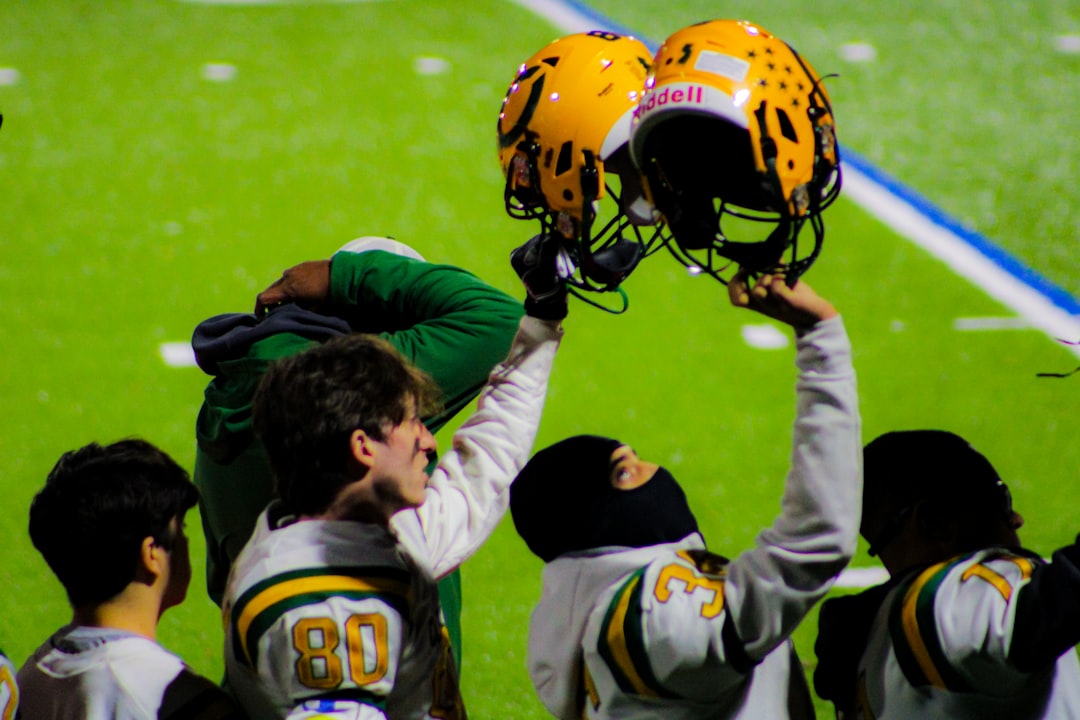



You're standing in a circle. Shoulders touching. Someone's tape is unraveling at the wrist and nobody says a word about it. The coach is talking, but half of you aren't really tracking the words — you're reading the tone. After two seasons inside this same circle, you already know whether tonight is going to be one of those nights.
That's what it's like to be on a high school team. Not the scoreboard. Not the trophies. That circle.
People who never played organized sports have seen the huddle from the outside: from the bleachers, from a parking lot window, from a gym class observation bench. From out there, it looks like a quick meeting. A logistical pause before the real action picks back up.
It's not a meeting. It's something closer to a confession booth and a foxhole occupying the same ten feet of turf. And once you've stood inside one, you spend the rest of your life noticing when you're not.
What the Huddle Actually Is
There's a version of sports built for public consumption: the highlight reels, the walk-off moments, the perfectly lit championship photos. That version is real. It's also the smallest slice of what actually happens inside a team.
The huddle is the part nobody films.
It's where a sophomore who has barely spoken all season suddenly says the right thing, and the senior next to her grabs her arm and holds it without a word. It's where the team's best player says "my fault" after a turnover and genuinely means it — everyone hears it — and something shifts without anyone calling attention to the shift. It's where the joke from three weeks ago surfaces again, and five people laugh immediately and two others still don't get it, and that gap is somehow woven into the fabric of the group rather than smoothed over.


Non-athletes don't fully grasp what the team huddle experience is because it was never really about the sport. It's about what happens when a group of people are under real pressure together, repeatedly, over months, and have to decide every day whether they're going to let each other down.
Most of them decide not to.
That daily decision, unremarkable, unglamorous, completely unphotographable, is the thing athletes carry with them for the rest of their lives.
The Things That Never Make the Highlight Reel
Ask any former athlete what they genuinely remember about their high school team and almost none of them lead with a game-winning shot or a championship run. They describe a practice. A bus ride home. A specific Thursday in October when nothing significant happened except that everyone showed up and did the same hard thing together.
The Inside Jokes That Outlive the Season
Every team develops its own internal language within about three weeks of the first practice. References that mean nothing outside that locker room. Nicknames that would take fifteen minutes of backstory to explain to an outsider. Phrases that started as something a coach mangled once, or something that went sideways on an away trip, or a play that collapsed so completely it became permanent folklore.
This language isn't decoration. It does structural work. It draws a line between inside and outside. Fluency in it means you belong. Not recognizing it means you don't — yet.
That "yet" carries real weight in a team environment. Part of what being part of a sports team means is watching someone move from outside the language to inside it. Watching a newer player suddenly laugh at the right moment, without prompting, because they've now logged enough shared hours to understand the reference. That crossing-over is a form of initiation. It's quiet, unmistakable, and it carries more meaning than any formal welcome ever could.
It's the same machinery that runs under the chants and handshakes that outlast the season: small, repeated, apparently trivial rituals that quietly certify who's in and who's still earning it.
The Vulnerability Nobody Talks About
Here's one of the things non-athletes genuinely don't know about sports: it demands a form of public vulnerability that almost no other adolescent activity does.
In a classroom, you can keep most of yourself hidden. In a sport, that option disappears.
Your exhaustion is visible. Your hesitation is visible. The moment you pull back from a ball you should have gone for — visible. The moment your legs stop doing what you're asking them to do in the fourth quarter — visible to everyone on your team, on the opposing team, and in the stands.
And then you walk back to the circle with the people who just watched all of it.
A specific kind of trust only forms this way. Not from shared interests or similar backgrounds, but from shared exposure. You have been witnessed at your limit by the same group of people, over and over, and they kept returning. That accumulation — of witnessed exhaustion, witnessed failure, witnessed recovery — is what athletes mean when they say "those are my people." It's not that they necessarily like each other more than anyone else in their lives. It's that they've seen each other in ways most people never see anyone outside their own family. That accumulation is how a team actually becomes a family, formed by being witnessed together, over and over, until the choosing stops mattering.
What It Costs — and Why Athletes Pay It Anyway
Maria C., 31, played varsity volleyball for three years at a mid-sized school in the Midwest. She describes the week before state semifinals as the hardest stretch of her athletic career: double practices, mounting academic pressure, an ankle she was quietly managing because she didn't want to come out of the lineup. What she remembers most clearly from that stretch isn't the physical grind. It's that her libero tapped her on the shoulder every single day before they walked onto the court. No words. Just the tap. "I didn't realize until years later that she was doing it every time," Maria said. "I thought it was random. It wasn't random at all."
That tap was the huddle, compressed into a single gesture.
Being part of a sports team costs something real. The early mornings cost something. The lost weekends cost something. The experience of losing, publicly, costs something, especially when you're seventeen and loss still feels permanent rather than instructive.
Athletes pay it because of what waits on the other side of the cost. Not trophies. The tap on the shoulder. The circle. The private language that exists nowhere else. The quiet knowledge, accumulated over a season or two, that the person next to you has seen you fall apart and showed up the next morning regardless.
The Part That Surprised You Even While You Were Living It
Most athletes don't fully register what they're experiencing while they're inside it. The proximity is too close. You're focused on the next practice, the next opponent, the next week of school on top of everything else. The meaning arrives later, sometimes years later, when you're in a professional setting or a social situation and you notice something missing.
A specific calibration. The ability to read a room full of people who are all under pressure simultaneously. The instinct to recognize who needs the equivalent of that tap on the shoulder and who needs to be left alone to reset. A lot of former athletes only find the words for it later, when they catch themselves carrying that team culture into the workplace without ever having decided to.
Those capacities were built in a huddle. Most former athletes don't have a clean name for them. They just know they have them, and they know where they came from.
What Non-Athletes Often Get Wrong
This is an observation worth naming clearly, not a criticism.
People who never played organized sports tend to interpret athletic dedication through one of two frameworks: they see it as primarily physical (the athlete is disciplined and strong) or primarily competitive (the athlete wants to win). Both are partially accurate. Neither is the center of it.
The center of it is relational.
The training exists to put you in the circle. The competition gives the circle its stakes. The stakes are what make the relationships inside the circle real in a way that most other adolescent relationships aren't built to be. You cannot perform closeness with teammates. You're either in it or you're not, and everyone in that circle already knows which one is true.
What Sports Teaches That Classrooms Don't
A classroom rewards individual performance on individual tasks. A team rewards something considerably harder to measure: the ability to elevate the person beside you, to function under collective pressure, and to recover from failure in front of witnesses who will still be there tomorrow.
These are not peripheral skills. They're foundational ones. Research on adolescent development consistently identifies team participation as one of the highest-yield environments for building emotional regulation and prosocial behavior in teenagers — not because of the physical activity itself, but because of the relational structure surrounding it.
The huddle is that structure, compressed.
Four things happen inside a huddle that almost never happen in any other adolescent context:
- High-stakes, real-time communication where the consequences of a missed signal are immediate and public
- Hierarchical authority — the coach, the captain — existing alongside genuine peer accountability at the same time
- Collective ownership of individual failure — when one person breaks down, the whole group absorbs some of it
- Emotional exposure with no available exit
You can walk out of a classroom. You cannot walk out of a huddle mid-play.
The Longing That Follows Athletes for Decades
The clearest sign that non-athletes don't fully grasp what sports meant to athletes is this: most former athletes don't miss the sport as deeply as they miss the team.
Talk to someone who played twenty-five years ago. They can usually reconstruct a game-winning moment in reasonable detail. But ask them what they actually miss, and they'll describe a locker room on a Wednesday. A bus ride back from a road loss. The practice where nothing connected and they ran it again anyway. The assistant coach who didn't have the right words and so said nothing but stayed until the lights went off.
The sport was the vehicle. The team was the destination.
That's what non-athletes see from the bleachers but don't quite reach — they're watching the vehicle move. What athletes are living is everything happening inside it.
The Jersey at the End of It All
At some point the season ends. The team disperses. Different colleges, different cities, different lives pull everyone in directions that make the daily proximity impossible to maintain.
What remains is not nothing.
It's the jersey folded in the back of a drawer. The photo from senior night. The clear memory of whose hands were on your shoulders in the fourth quarter of the regional final — what they did, what you did back, what nobody said because nothing needed to be said.
The jersey is the physical record of something that was never really about how it looked from the outside. It isn't a trophy. It's a marker. Evidence that says: I was in that circle. I showed up for those people. They showed up for me.
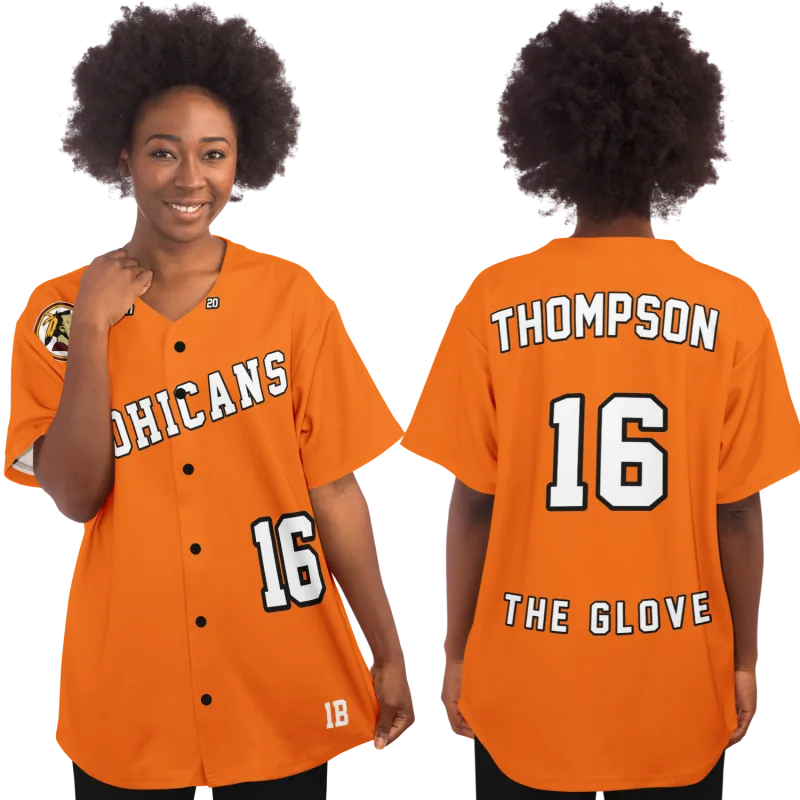
Athletes who pull an old jersey out of a box years later aren't retreating into the past. They're touching proof of something that shaped how they move through everything that came after. The number on the back, the name above it — those aren't nostalgia items. They're coordinates. They mark the place where something real happened to a person who was still becoming who they'd eventually be.
Your jersey is still out there waiting.
Design yours in minutes and see your name and number the way you remember them.
Frequently Asked Questions
What do athletes mean when they say "team chemistry"?
Team chemistry is the shorthand athletes use for a specific relational calibration that only develops when a group has been under pressure together long enough to stop performing closeness and start functioning as a unit. It has nothing to do with whether teammates share interests or genuinely like each other outside the sport. It's built from shared adversity, accumulated over time, until the group develops a working knowledge of each other's limits, tendencies, and recovery patterns. That knowledge can't be manufactured in a pre-season dinner or a team-building exercise. It accrues through actual difficulty, shared.
Is the bond from a high school team really different from other adolescent friendships?
In most cases, yes — and the difference is structural rather than sentimental. Most adolescent friendships form around shared preferences: music, humor, neighborhood, classes. Team bonds form around shared exposure. Your teammates have watched you fail publicly, recover publicly, and return publicly. That's a different relational foundation than shared taste, and it produces a different kind of trust. Former athletes consistently describe this distinction decades later, even when they've lost regular contact with their teammates.
Why do so many adults feel nostalgic about high school sports even if they rarely played?
Because the core of the experience had nothing to do with playing time or performance. The athlete who came off the bench for two minutes a game stood in the same circle, learned the same internal language, and made the same daily decision to show up for people they were accountable to. Status within the team structure is real, but the relational texture of belonging to a team, the part that produces the nostalgia, was available to every member regardless of where they appeared in the lineup. The longing is for the belonging, not the achievement.
What happens when former teammates reconnect years later?
Almost universally, former athletes describe a compression of time — a near-immediate return to a shared register that requires no warmup. The private language comes back. The shorthand. The mutual knowledge of who that person was at their most pressured during a season that ended decades ago. This compression happens because the bond was built on witnessed vulnerability, and witnessed vulnerability doesn't fully expire the way surface-level familiarity does. The people who saw you at your limit retain access to a layer of you that most later relationships never reach.
See also: what high school sports actually teach you that nothing else could | the difference between being a sports fan and someone who actually played | why high school sports still matter so much to adults who played