

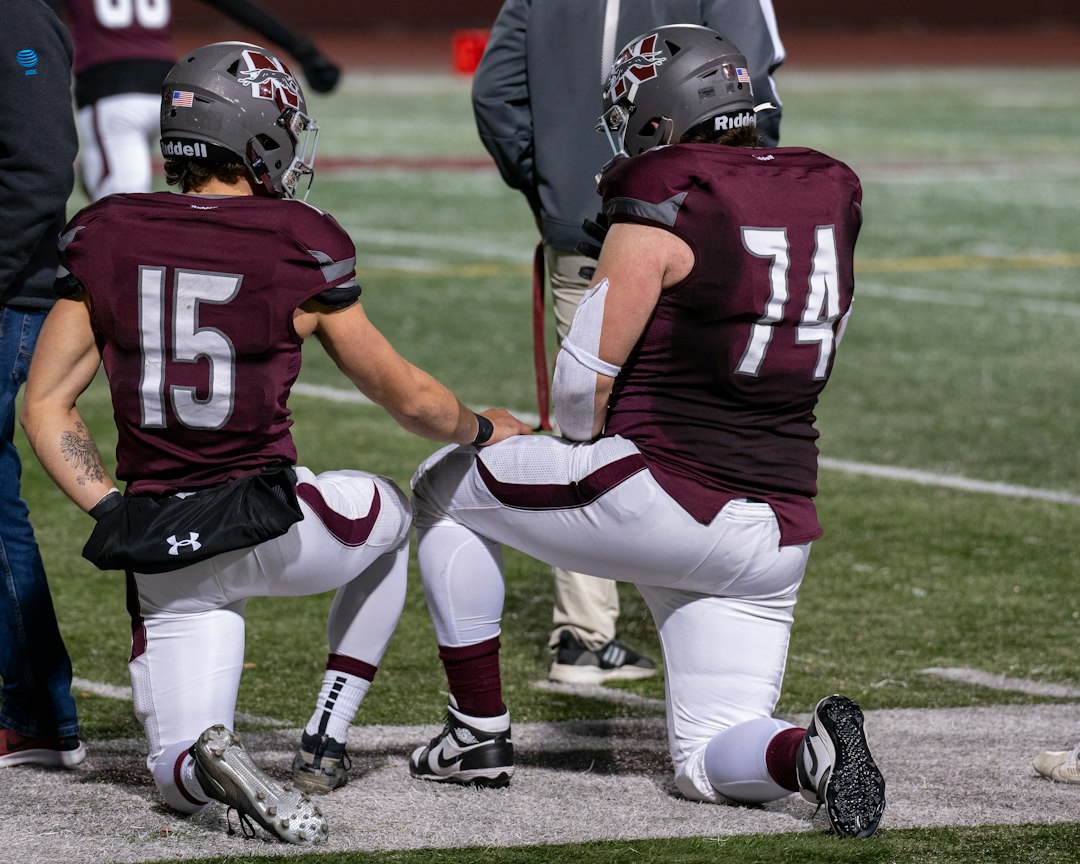




The group chat went quiet sometime in July. Not dramatically — it wound down the way a conversation does when everyone is tired and nobody wants to be the one who ends it. Someone sent a highlight clip. A few people reacted. Nobody said anything after that. By September you had stopped checking it entirely, and somewhere in the silence of not checking, you realized the season wasn't the only thing that had ended.
That is what social isolation after high school sports actually sounds like. Not a conflict, not a goodbye, not a moment you can point to. Just the gradual, irreversible dispersal of the most structurally reliable social world most young athletes will ever inhabit — and almost no one prepares you for it.
Most writing on this subject focuses on the fitness void or the loss of competitive drive. That framing arrives at the wrong wound. The competition was always a vehicle. The tribe was what you were really there for. And when the final season closes, the tribe does not go on hiatus — it dissolves. What you are left with operates less like nostalgia and more like grief. Until you name it that way, the path through it stays invisible.
This article is about naming it precisely, understanding why it hits with the weight it does, and finding the specific conditions that make belonging possible again after losing teammates and friends who were the center of your daily world.
The Huddle Was Never Just About the Game
Take the jerseys and the scoreboards out of the picture. Look at what a team actually is underneath all of that.
It is a group of people bound by a shared physical language — the same pre-game sequences, the same warm-up cadences, the shorthand that means nothing to anyone who wasn't in that specific locker room with you. It is a structure that tells you where to be, when to arrive, and exactly what your function is within a group that genuinely requires you to fill it. It is daily, non-negotiable proximity to people carrying the same weight — the same two-a-days, the same film sessions, the same coach's words that follow you home long after practice ends.


That is not a club with shared interests. That is a tribe, in the most functional, oldest sense of the term.
Researchers who study human social bonding identify shared adversity as one of the most potent cohesion forces a group can experience. When people endure something genuinely difficult together — sustained physical hardship, repeated failure, the specific pain of a loss they spent months trying to prevent — the bond that forms is categorically different from bonds built on shared geography or mutual interest. You were not friends who decided to play together. You were forged together under pressure, and that process produced something durable. When the forge goes cold, the metal does not hold its shape on its own.
This is the precise thing that separates the social cost of leaving high school athletics from other transitions young people move through. Those friendships were not incidental connections. They were load-bearing walls. Most former athletes discover just how load-bearing they were only after the structure is gone — when everything in their social life feels subtly, persistently tilted, and they cannot immediately name the reason.
What Social Isolation After High School Sports Actually Looks Like
Here is the part that consistently catches former athletes off guard: this kind of isolation rarely presents as obvious sadness.
Former athletes are not typically sitting alone in quiet rooms. They are at orientation events, at their first job, at a friend's gathering — present, functional, socially capable — and carrying a quiet awareness that something essential is absent from every room they enter. The ability to engage is intact. The sense of genuine belonging is not.
The symptoms tend to cluster into recognizable patterns:
- Present in the room, peripheral to the group. You're there, you're participating, you're making people laugh. But you haven't felt genuinely inside a group — not adjacent to one — since the last practice ended.
- New relationships that plateau before they deepen. Not because the people aren't worth knowing. Because the mechanism that converted acquaintances into people who would run through a wall for you — shared daily suffering over sustained time — is no longer operating.
- Your playing days surface in conversation more than feels comfortable. Not because you're living in the past, but because that chapter is the last time your social identity had a clear shape that the people around you could see and recognize.
- A low-level restlessness in situations that should feel good. The party is full, you know everyone there, and you feel — without a satisfying explanation — alone in the middle of it.
This is former athlete loneliness in its most common form. It does not announce itself as isolation. It presents as disconnection — as a frequency you were once perfectly calibrated to receive, now just slightly out of range.
The Anatomy of Team Brotherhood Loss
To understand why the disconnection holds on, it helps to itemize specifically what a team provides that ordinary adult social life does not build automatically.
Mandatory daily contact. You did not arrange time with your teammates. You were simply there together, every day, without negotiation. This is the social architecture that most adult friendships never develop — and compensating for its absence requires deliberate, consistent effort that most former athletes don't know they need to make until years have quietly passed.
A shared external challenge. The opponent on the schedule. The recruiting standard overhead. The clock on the scoreboard. A common external pressure generates internal cohesion almost automatically. Without it, groups of adults must construct reasons to pull together, and most social environments don't supply that catalyst on their own.
A role with visible, specific value. You were the setter. You were the one who anchored the relay. You were the midfielder the defensive shape was built around. Your contribution had a defined form, and the people around you could see it. Entering environments where your value is ambiguous or invisible — a large university, a first job, a new city — is a harder adjustment than most former athletes anticipate.
Physical synchrony. This element is consistently underestimated. Moving in coordination with other people — executing the same play, running the same route, lifting in the same rhythm — produces a measurable social bonding effect that conversation alone does not. Research published in the Proceedings of the Royal Society B found that synchronized physical activity significantly increased social bonding and pain tolerance among participants compared to individual activity. Your team gave you that every single day. Its absence is real, even when it is hard to name.
Priya M., 21, ran cross-country and track for four years and earned all-conference recognition as a junior. Her first semester at a large state university, she described feeling "surrounded and invisible at the same time." She had a full class schedule, a roommate she genuinely liked, and a busy residence hall. None of it addressed the specific void the team had left. "I kept thinking I just needed to meet more people," she said. "It took me over a year to understand that what I missed wasn't running. It was being miserable at six in the morning with the same people, every day, and having that make us closer than any normal friendship ever did." She eventually joined a competitive club running group that trained six mornings a week — not because the racing mattered most, but because the structure did.
Priya's experience illustrates the central misunderstanding: team brotherhood loss is consistently misidentified as missing a sport, when the actual wound is the loss of a social architecture that the sport happened to house.
Why "Just Put Yourself Out There" Is the Wrong Prescription
Well-meaning people — family members, advisors, the articles that skim the surface of this topic — tend to land on the same advice: join a club sport, go to more events, meet new people. The advice is not wrong. It is simply insufficient, and understanding precisely where it falls short matters more than dismissing it entirely.
The difficulty is not that former athletes lack social skills. Most of them are confident in groups, practiced at building rapport quickly, and comfortable in new environments — the team developed those qualities deliberately over years. The difficulty is that they are optimized for a social ecosystem with very specific structural properties, and the ordinary landscape of post-high school life does not naturally reconstruct those properties.
A Thursday-night recreational league helps. It genuinely does. But it is not a tribe. It does not provide daily contact. It does not carry genuine stakes. It does not produce the depth of shared suffering that built the original bonds. It offers something real — but not the same thing as what was lost.
What the former athlete actually needs is not more social activity. It is social activity with the right structural qualities: a shared external challenge, consistent and repeated proximity with the same people, a role that carries visible contribution, and enough accumulated time for deeper bonding to form. That is a considerably more specific prescription than "get out more" — and it begins with correctly naming what was lost in the first place.
Diagnosing the Void and Rebuilding Toward Belonging
Before anything can be rebuilt, the athlete's social circle change needs to be examined honestly. Four questions help establish the picture:
-
Where does your mandatory daily contact come from right now? If the answer is class or a job: do those contacts share a meaningful external challenge with you, or are they simply nearby? Proximity without shared stakes produces familiarity. Familiarity is not the same as belonging.
-
When did you last feel genuinely inside a group rather than near one? The first specific memory that surfaces is your diagnostic data. What structural conditions were present in that situation that are absent from your social life now?
-
Are you filling your schedule, or rebuilding a tribe? A crowded social calendar and a social structure that meets the same needs the team did are two distinct things. Both are achievable. Only one closes the actual gap.
-
Have you named this as loss rather than as a personal deficiency? This question carries more practical weight than it appears to. Athletes are trained to push through discomfort, not to sit with grief. That same discipline — the thing that made them excellent — can become the precise mechanism that prevents accurate diagnosis and blocks the path forward.
The route back to belonging is specific, not vague:
- Look for shared struggle, not shared interest. A tribe is a group working toward something genuinely difficult together. Training for a race, building something that requires real coordination, committing to a challenge with stakes — these generate the conditions for real bonding. A group with a common hobby, on its own, generally does not.
- Choose repetition over intensity. The team worked because you were there every day. Two high-quality social events per month will not build what you are looking for. Seek commitments that create regular, repeated proximity with the same people over time. The bonding accumulates in the consistency, not in any single remarkable gathering.
- Reconstruct a visible role. Coach a youth team. Organize the training group. Lead the effort. Find a context where your specific contribution has a recognizable shape and the people around you can see it — not just your presence as a personality, but your function as part of something collective.
- Give the process the time it actually requires. The original tribe took years to form under conditions of daily forced proximity and shared adversity. What comes next will not arrive in one semester. The discipline required here — patience with a process that does not produce immediate feedback — is, as it happens, a discipline former athletes have already developed. It carried them through two-a-days. It will carry them through this.
Your jersey is still out there waiting.
Design yours in minutes and see your name and number exactly the way you remember it — a tribute to the years, the team, and everything you built together.
Frequently Asked Questions
How long does social isolation after high school sports typically last?
There is no single timeline. Duration depends heavily on whether the former athlete actively rebuilds the structural conditions for belonging or waits for them to appear organically. Athletes who find communities built around shared challenge and consistent proximity within the first year after their sport ends tend to move through the acute disconnection phase within 12 to 18 months. Athletes who address the fitness gap but leave the social structure unexamined can carry former athlete loneliness for years — sometimes as a persistent low-grade dissatisfaction they never accurately trace back to its origin.
Is it normal to feel closer to former teammates than to people I've known longer since then?
Yes, and the explanation is structural rather than sentimental. The bonds formed through shared daily adversity and physical synchrony during high school athletics are built on cohesion mechanisms that most adult friendships don't naturally reproduce. This does not mean new friendships cannot reach the same depth — they can — but doing so typically requires deliberately constructing similar conditions: a shared external challenge, consistent proximity, and time measured in months rather than individual interactions. What you feel toward former teammates is not nostalgia exaggerating a memory. It is an accurate recognition of the conditions under which those bonds were made.
How do I talk about this with people who never played on a team?
The most useful frame is grief rather than nostalgia. Grief is a recognizable, specific experience — the functional absence of something that was central to how you understood yourself and your place among people you depended on. When you describe the loss of your team's social structure in those terms, rather than as missing games or missing competition, most people who care about you will understand it more completely. What you are navigating is not sentimentality about the past. It is the adjustment required when a primary social architecture disappears and nothing has been built yet to take its place.
Do recreational leagues actually help, or are they only a partial answer?
Both are true simultaneously. Recreational leagues restore physical synchrony and provide a team context that ordinary adult social life rarely offers on its own. What they typically don't provide — especially early on — is daily contact, genuine stakes, and the accumulated shared difficulty that built the original bonds. The former athlete who joins a recreational league and also invests in building consistent proximity and shared challenge outside of it is on a more complete path back to belonging than one who treats the league as the entire solution. Use it as a foundation, not the finished structure.
See also: losing your athletic identity after high school | grief nobody talks about when your athletic career ends | reconnect with former high school teammates | adult recreational leagues built for former athletes