

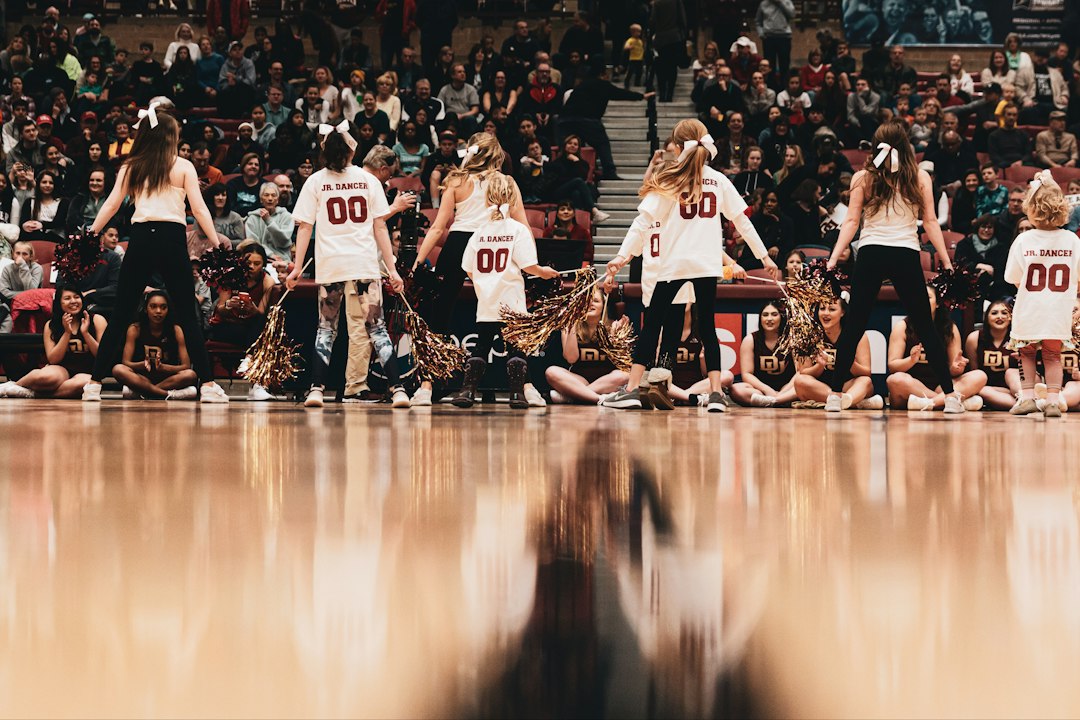




There is a moment — and if you were a competitive cheerleader, you have lived this — when a song comes on in a car, a gym, or a grocery store aisle, and your hands move before you consciously decide to move them.
Not a general urge toward nostalgia. Not a warm memory floating to the surface. Your hands move. Your weight shifts to the ball of your foot. Count 3 arrives and your shoulders are already set, your chin is lifted, and some part of you is entirely, unmistakably back on that floor.
Former cheerleader nostalgia is not the soft, hazy thing that people outside the sport assume it to be. It is physical. It is precise. It is the strange and specific experience of carrying an entire competitive season inside your body — every count, every sharp arm position, every transition — long after the last performance ended.
This piece is for the person who knows exactly what that feels like. And more than that, it is for the person who has wondered what it actually means — why the counts stayed, what the staying says, and whether the training that built that memory was as serious as it felt at the time.
It was. Here is why.
How Your Body Stored That Routine Below the Level of Conscious Thought
Competitive cheerleading does not ask you to memorize a routine the way you memorize a phone number or a recipe. It asks you to move an entire sequence of actions into a category of memory that operates underneath deliberate recollection — below the layer where you have to think in order to retrieve.
Researchers call this procedural memory: long-term motor knowledge stored not in narrative or factual systems but in patterns embedded in the cerebellum and basal ganglia. It is the same category that lets a trained pianist play a complex piece with their eyes closed, or allows a martial artist to block a strike they never consciously registered. Crucially, it is the category of memory most resistant to degradation over time — more stable than episodic memory, more durable than verbal recall.


What this means for you practically: the routine you drilled in a gymnasium, on a mat, in a parking lot, in someone's driveway in the dark — that routine was not stored alongside your memories of high school hallways or summer weekends. It was absorbed differently. More completely. Into the part of your brain that governs automatic, expert movement.
That is why the music activates the movement before your mind catches up. In those moments, you are not consciously retrieving anything. Your motor system is simply running a program it never deleted. The sequence is there the way walking is there — not as a memory you access but as a capacity that executes.
The implication is direct: the fact that you still carry the counts, still feel the weight transfer on count 8, still know exactly where your arms land on count 12 — that is not sentimentality. That is evidence of the volume and specificity of training you completed. Durable procedural motor memory is built by serious, repeated, exacting practice. You cannot have the memory without having done the work.
What It Actually Took to Build That Encoding
People who never competed in cheerleading at a serious level carry an image of what the training involved that is almost entirely inaccurate. The image involves enthusiasm and performance. It does not involve what the training actually demanded.
It involved count-by-count choreography drilled until deviation from the sequence felt physically wrong — not just incorrect, but dissonant, the way a wrong note feels to a trained musician. It involved stunting that required not just individual technical skill but synchronized timing across four or five athletes simultaneously, where being a half-count off was not a minor error but a safety failure. It involved the kind of conditioning that was not secondary to the performance but structurally prerequisite to it: the explosive jumping capacity, the core stability, the shoulder strength, the flexibility maintained under competitive pressure.
Brianna K., 31, competed in college cheerleading for three years and now teaches a fitness class that incorporates tumbling fundamentals. Her description of the training threshold is precise: "People think I'm being dramatic when I say I can run the full routine from our national qualifier start to finish. But it's not dramatic — I genuinely cannot stop once the music starts. My coach used to say we drill it until your body argues with you when you try to quit. That is exactly what happened. My body still argues."
That phrase — drilling until the body argues with stopping — is not motivational language. It is a description of the specific threshold at which a skill transitions from declarative memory into procedural memory. Your coach was, whether they knew it in those terms or not, describing the neurological process of motor encoding. You crossed that threshold repeatedly. For every count of every section of a routine your squad performed that season.
In our experience covering the former athlete's relationship to their playing days, the sports that leave the deepest physical imprint share two characteristics: they demanded exactness, and they demanded that exactness thousands of times. Competitive cheerleading required both. That combination is what makes the memory structural rather than narrative.
The Athletic Identity That Training Built — and That Culture Often Refuses to Name
Here is something that does not get said directly enough: competitive cheerleaders are routinely told — by people outside the sport, by cultural shorthand, by the absence of recognition that other athletes receive — that what they did was not really athletic. That it was performance rather than sport. That the appropriate response to "I was a cheerleader" is polite acknowledgment rather than the recognition that would follow "I played college soccer" or "I was a competitive gymnast."
This has always been wrong. The muscle memory you carry is among the more direct available arguments for why.
You do not develop durable procedural motor encoding through low-demand activity. The brain does not build that category of structural memory without genuine athletic load — without real repetition, real precision requirements, real physical output. The fact that your body still knows every count is not proof that you cared deeply about your sport (though you may have). It is proof that the training was serious enough, specific enough, and repeated enough to leave a permanent mark on your motor system.
Every former athlete has a version of the moment when they understood that their sport had changed them structurally — not just in memory or sentiment, but in how their body actually moves through the world. For former competitive cheerleaders, that moment often arrives in adult life, sometimes years out. The music starts. The counts return, fully formed and in sequence. And there is a recognition — clear, physical, undeniable — that what was built during those training years was real. That the development was real. That the athlete was real.
If you competed, if you drilled, if you ran formations until they were automatic — you already know what that recognition feels like. And once you feel it in your body, it does not require external validation to be true.
Why This Particular Nostalgia Arrives Physically Before It Arrives as Memory
Most sports nostalgia works narratively. You remember the game, the season, the outcome, the locker room afterward. The memories arrive as stories — with sequence and characters and emotional arc.
Cheerleading nostalgia arrives differently. The counts come back before the story does. The movement precedes the recollection.
This is not coincidental. It follows directly from the structure of the sport. Competitive routines are not improvised or situationally adaptive — they are fixed sequences designed to be performed identically across an entire season and through the pressure of competition. The entire model of competitive cheerleading is built around the exact, consistent reproduction of a choreographed performance. Which means what gets trained into the body is not a general skillset to be flexibly deployed but a specific sequence to be precisely reproduced.
When that is what you drilled, that is what lives in you. Not just the movement capacity — the specific sequence. Your routine. The one your team performed together. The one with the specific arm variation on count 5, the specific weight shift before the pyramid build, the specific eight-count your squad ran cleaner than any other section all season.
That specificity is exactly what makes former cheerleader nostalgia so visceral and so complete. You are not remembering cheerleading as a general experience. You are carrying one specific competitive artifact — your routine, that season's work — stored in motor memory. When it surfaces, it surfaces whole. You do not retrieve fragments of it. You retrieve it the way you performed it: from the top, every count, in sequence.
That is remarkable. Most of us carry almost nothing with that degree of completeness. The fact that your competitive routine is one of the things you carry says something specific and important about the training that put it there.
What That Training Transferred Into the Rest of Your Life
The motor memory is the most visible evidence of what competitive cheerleading built. The other transfers are less dramatic but arguably more durable in daily effect.
Precision as a performance standard. Competitive cheerleading does not reward approximate effort. Judges evaluate deviation from what the routine requires. Training inside that standard — where "close enough" is not a category that exists — builds a relationship with precision that transfers. Former competitive cheerleaders frequently notice it in how they approach work that has clear quality requirements, in how they respond when teammates or colleagues produce approximate rather than exact output, in the gap they feel between their own standards and what many environments settle for.
Synchronized timing as a learned skill. Stunting requires multiple athletes to operate with timing measured in fractions of a count — not rough synchrony but coordinated exactness. Learning to time your movements to other people's bodies, to feel the rhythm of a group in motion and calibrate to it precisely, is a specific interpersonal and physical skill. Most adults never develop it formally. You developed it through thousands of repetitions, under pressure, with real consequences for deviation. It shows up in how you read group timing in meetings, in team projects, in any context where multiple people need to move together toward a shared outcome.
Performed exactness under judgment. You competed. That means you delivered a precise, prepared performance in front of judges and crowds, repeatedly, across a season. Most people spend considerable energy avoiding that specific kind of exposure. You trained for it, prepared for it, and executed under it — not once but across an entire competitive career. That shapes how a person relates to high-stakes performance in adult life in ways that are specific and measurable: a higher baseline comfort with being evaluated, a more developed capacity to separate preparation anxiety from performance capability, a fundamentally different relationship with pressure than people who never competed.
These are not vague benefits. They are specific, transferable outputs of serious training. You brought them with you when you left the sport.
Your jersey is still out there waiting.
Design yours in minutes and see your name and number exactly the way you remember it.
Frequently Asked Questions
Is it normal to still remember a cheerleading routine years or even decades after competing?
Completely normal — and physiologically expected. Competitive routines trained through high-volume, high-precision drilling are stored as procedural memory: a form of long-term motor knowledge held in the cerebellum and basal ganglia. This category of memory is notably resistant to degradation over time, outlasting episodic and verbal memory in most people. Former competitive cheerleaders regularly report being able to run a full routine — start to finish, every count in sequence — years and sometimes decades after their last performance. The more intensely and repeatedly the routine was drilled, the more durable the motor encoding. When the music plays and your body moves, that is procedural memory executing a program it never erased.
Does remembering the routine mean I could actually perform it again?
The motor blueprint is intact, but physical execution depends on your current conditioning. Your body retains the sequence and the timing — the full choreographic structure is stored in motor memory. What changes over time is the physical capacity to execute the more demanding elements: tumbling passes, stunting sequences, sustained explosive output under performance pressure. Many former cheerleaders find that returning to less physically demanding elements — arm placements, count transitions, formation movements — feels immediate and accurate. The high-demand elements require reconditioning to perform safely. The memory is complete and real; the performance depends on where your body is right now.
Why does cheerleading nostalgia feel more physical and complete than nostalgia from other sports?
Because competitive cheerleading encodes a fixed, specific sequence rather than a flexible general skillset. Most sports develop adaptive capabilities — footwork patterns, court awareness, throwing mechanics — deployed responsively across varying game situations. Those skills live in motor memory too, but they are not attached to a single fixed sequence. Competitive cheerleading drills one specific choreographed routine to exact, consistent reproduction. What gets stored is not "the ability to cheer" as a general capability — it is your actual routine, with your specific counts, your specific transitions, your specific formation placements. When that surfaces, it surfaces as the complete sequence rather than as fragments or general impressions. That completeness is what makes it feel so physically specific — because what was stored was physically specific.
Was competitive cheerleading serious enough to count as real athletic training?
Yes — and the motor development it produces is one of the clearest forms of evidence available. Building durable procedural motor memory requires genuine athletic demand: high-volume repetition of physically complex movements performed with exacting precision under performance pressure. The same neurological processes that encode a competitive cheerleading routine into long-term motor memory are documented in elite gymnastics, competitive dance, and martial arts research. The training volume, the synchronization requirements, the conditioning prerequisites, the precision standards — these are the markers of serious athletic development, regardless of how the sport has historically been categorized. The physiology of what competitive cheerleading produces in practitioners is the most direct available answer to anyone who questions whether it counted.
See also: the psychology of athletic nostalgia | why your senior season memories are so vivid | athletic identity that doesn't disappear after high school | still dreaming about high school games