





There are things your body never forgets.
The feeling of stepping into the batter's box is one of them. The instant your back foot drags through the dirt and your front foot settles into position, something shifts — inside your chest, behind your eyes, in the muscles of your hands around the handle. You have done this a thousand times. Your body knows every part of it. And yet, standing there, it always feels like the first time and the last time at once.
If you played baseball or softball at any level — especially those high school years when the stakes felt genuinely enormous — you already know what this article is about. You felt it in your gut the second you read the title.
This is for you.
What the Bat Feels Like Before You Even Swing
Before the pitch. Before the wind-up. Before any of that.
There is the bat.
Holding a baseball bat is one of the most familiar physical experiences in a player's life, and yet it never becomes ordinary. The weight of a baseball bat sits differently in your hands than any other object — somewhere between 28 and 36 ounces, depending on what you swung, but the number never captured the feeling. It wasn't about the ounces. It was about the distribution. The way the barrel pulled forward. The way the handle sat in the webbing between your thumb and index finger, knuckles aligned just so, the grip tape worn smooth in exactly the spots where your hands always landed.
You knew those spots without looking.
In our experience talking to former players, the grip is the first thing they describe when you ask them to go back. Not the field. Not the crowd. The grip. The specific texture of pine tar or batting glove leather against worn tape. The way the bat felt alive when you choked up half an inch. The way it felt dangerously long when you slid your hands down and committed to full extension.


The weight of a baseball bat changes depending on what's happening around you. In the on-deck circle, swinging your weighted donut, it feels light. Then you remove the donut and take a few practice swings — and suddenly the bat feels lighter than it has any right to be. You can feel every ounce of it, feel the whip of it through the air, and you think: this is the one. This is going to be the at-bat.
Then you step in. And the bat feels heavy again. Not bad heavy. Purposeful heavy.
Like it knows what it's there for.
The Hands Are Always First
The sensory experience of batting begins in the palms.
Your grip determines everything downstream — your swing path, your contact point, your ability to adjust to an off-speed pitch at the last half-second. The best hitters in any lineup know this without having to think about it. They find the grip before they find the stance. They settle the hands before they settle the feet.
What your hands feel in that moment:
- The specific temperature of the handle — warmer on summer afternoons, almost cold in early spring twilight games when the air carries a bite
- The resistance of the grip tape, which your palms have memorized so completely that a new bat, before it's broken in, always feels slightly wrong
- The tension in your forearms, which you're actively trying to release because your coach told you a hundred times that tight hands kill bat speed — and you know he's right, and yet your hands tighten anyway
That last point matters. It's not a flaw. It's the physical evidence that you care.
The Moment Your Cleats Hit the Dirt
The batter's box is approximately four feet wide and six feet long. You have lived inside that rectangle more than any scorebook could capture — batting practice, live pitching, scrimmages, games that mattered and games that felt like they mattered more than they probably did.
But stepping in never gets routine.
Your front foot goes first, usually. You find the front line of the box with the toe of your cleat, then drag your back foot through the dirt until you find your spot. That drag — that specific, deliberate motion — is one of the most automatic things your body has ever learned to do. You do it without watching your feet. You do it the same way every time because your body decided long before your mind that this is how it's done.
The dirt in a game batter's box is different from practice dirt. It's been worked over. Other batters have already stepped through it, dug their holes, dragged their back feet in the same instinctive motion. There are divots. There is chalk dust that has mixed with the infield clay. Sometimes there is a hole exactly where you want to plant your back foot, carved out by the cleanup hitter who bats before you, and you either make it work or you kick it level with a few quick stamps.
Then you set.
And in that moment — the settling-in — the sensory experience of batting collapses from everything happening on the field down to almost nothing. The crowd gets quiet. Not actually quiet. Your focus gets loud. The pitcher gets big. Everything else gets small.
The Crouch, the Load, the Breath
Your stance is yours. Nobody else's. You built it over years of tee work and cage sessions and small adjustments your coaches suggested that you either adopted or politely ignored. Your stance is biographical. It is the record of every player who coached you, every hitter you watched and tried to imitate, every mechanical adjustment that stuck and every one that didn't.
Standing in it now, even in memory, feels like home.
The load — that subtle backward weight shift and hip turn that begins the kinetic chain of the swing — is something most hitters do without conscious instruction by the time they're playing varsity ball. It happens in response to the pitcher's motion. Your body reads the motion and responds before your brain sends a signal. This is what thousands of repetitions produce: a physical intelligence that operates below thought.
And the breath.
Nobody talks about the breath enough.
Most hitters exhale slowly as the pitcher comes set. Some hold the breath through the pitch. Some release it through contact. In our experience, the breath is where you can feel physical anxiety at the plate most clearly — because anxiety disrupts the breath first, before it disrupts the hands or the feet or the eyes.
When you're in a slump, the breath gets short. Shallow. You might not notice it consciously, but your body notices. The swing gets tight. The load gets small.
When you're locked in — when you're seeing the ball well, when you've had a good day and the pitcher looks hittable — the breath comes easy. Long and slow out. And you stand there in that box, holding that bat, and you feel something that is difficult to name accurately.
Calm inside noise. Ready inside pressure. Completely present.
Physical Anxiety at the Plate — and Why It's Not the Enemy
Let's be honest about something that most baseball nostalgics soften when they tell the story later.
It was nerve-racking.
Especially in high school. Especially when the game was close, when there were runners on base, when your coach was watching, when the girl you liked was in the bleachers, when you'd struck out your last at-bat and could feel the at-bat before this one sitting in your chest like a stone.
Physical anxiety at the plate is real, and it's specific, and every player who has stood in knows exactly what it feels like. Your heart doesn't just beat faster — it beats irregularly. It skips. It thuds. Your hands grip tighter than they should. Your vision narrows without you telling it to.
And here's what most people don't tell you until much later: that feeling is the point.
Anxiety at the plate is your nervous system recognizing that what is about to happen matters. The same physiological response that makes a hitter nervous is the response that sharpens focus, speeds reaction time, and makes great at-bats possible. The feeling isn't the problem. The relationship with the feeling is what determines what happens next.
The hitters who struggled most in high school weren't the most anxious. They were the ones who were most afraid of the anxiety itself — who stepped in already trying to get rid of the feeling rather than taking it with them to the plate.
The hitters who were dangerous were the ones who felt all of it — the arrhythmic heart, the tight hands, the narrowed vision — and stood in anyway. Who dug that back foot in anyway. Who found the grip anyway.
Marcus T., 24, remembers his best high school at-bat as the one where he was most nervous. Two outs, bottom of the seventh, down by one in a regional semifinal, bases loaded. He says his hands were shaking before he stepped in — visible shaking, not the kind you hide. He grounded a two-run single through the six-hole on a 2-2 curveball. "I don't know how," he told us. "My hands were still shaking when I got to first base."
That's not despite the feeling. That's with the feeling.
The Vision Narrows: What You're Actually Looking At
Ask a hitter what they see in the box and they'll say "the ball." That's the correct answer. It's also incomplete.
What you're actually watching — what the brain is actually processing while the eyes track the release point — is the pitcher's hand. More specifically, the release point. The specific spot in space where the ball separates from the fingers. Your eyes find that spot the first time a pitcher winds up, and they go back to it automatically for every pitch that follows.
This is a learned skill, but it becomes invisible through repetition. By the time you're playing varsity, you're not consciously thinking "find the release point." You've just learned to be still until the ball appears, and then your body responds to what it sees.
The window in which a high school hitter must decide to swing or take is roughly 400 milliseconds from pitch release to contact zone. During that time, your brain is doing an enormous amount of work that never reaches conscious thought — reading spin, projecting trajectory, deciding location, initiating or killing the swing. The sensory experience of batting, in those milliseconds, is not a list of observations. It's a total immersion. Everything happening inside that rectangle, inside that moment, inside the gap between the pitcher's release and the ball's arrival.
Players sometimes describe great at-bats as feeling slow. The pitch looks bigger. The seams are visible. There is a sense of extra time.
That is not time slowing down. That is complete attention — the rarest and most powerful state a competitor can enter.
And it starts the moment you drag your back foot through the dirt.
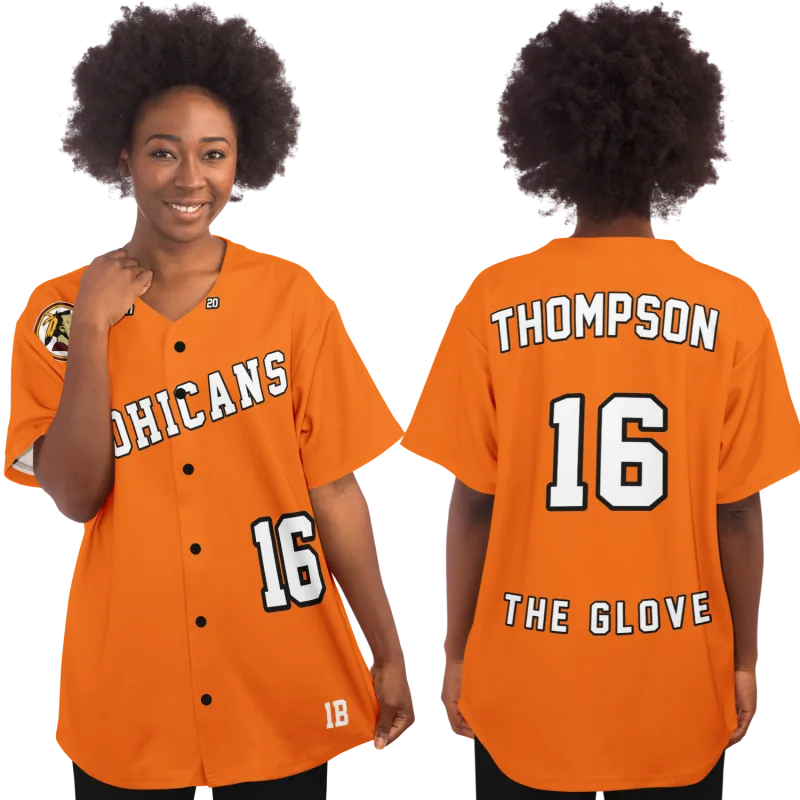
Your jersey is still out there waiting.
Design yours in minutes and see your name and number exactly the way you remember it.
Frequently Asked Questions
What does it physically feel like to step into the batter's box for the first time?
The first time is a sensory overload in slow motion. The grip feels unfamiliar because you haven't worn the handle smooth yet. Your stance doesn't feel like yours because you haven't lived in it long enough. Most first-time batters describe a strong awareness of the pitcher — of how far away the mound actually is, which feels both farther and closer than expected. The physical anxiety at the plate is high, and the tendency is to grip the bat too tight and swing too early. What stays with you isn't whether you got a hit. It's the specific weight of the bat in your hands the moment you dug in.
Why does holding a baseball bat feel so different in a game versus practice?
The bat doesn't change — but your nervous system does. In practice, the stakes are low and your grip naturally stays loose, which is actually optimal for bat speed. In a game, your body reads the situation and responds with elevated arousal: tighter muscles, faster heart rate, narrower focus. This changes the way the bat feels in your hands. It also changes how you perceive its weight. The same 32-ounce bat can feel light in batting practice and heavy in the seventh inning. Neither perception is wrong. They're accurate readings of two different physical and psychological states.
How do experienced hitters manage the anxiety of being in the batter's box?
They don't eliminate it — they absorb it. The most effective approach, according to research on athletic performance psychology, is what's called "anxiety reappraisal": actively reinterpreting the physical symptoms of anxiety (elevated heart rate, muscle tension, tunnel vision) as signs of readiness rather than threat. Experienced hitters develop pre-at-bat routines — a specific number of practice swings, a breath pattern, a way of adjusting their batting gloves — not because these rituals have mechanical value but because they create a consistent bridge between the on-deck circle and the plate. The routine is a signal to the body that the moment is familiar, even when the stakes are new.
What is the weight of a baseball bat, and does it matter for how batting feels?
Official baseball bats used in high school range from approximately 28 to 36 ounces, with the most common weights for high school players falling between 30 and 33 ounces. Softball bats tend to run slightly lighter. The weight matters enormously for the sensory experience of batting — not just for swing mechanics but for how the bat communicates through your hands. A bat that's too heavy produces a dead, resistant feeling at contact. A bat that fits your strength and swing speed produces something that hitters often describe as "the bat doing the work" — a satisfying, almost effortless transfer of energy that you feel from the handle to the barrel in the split second of contact. That feeling — when it happens — is one of the reasons former players never fully stop thinking about it.
Is the silence hitters describe in the batter's box real, or is it psychological?
Both. Physiologically, elevated focus narrows attentional bandwidth — the brain reduces the processing of peripheral sensory input (crowd noise, ambient sound) to maximize resources for the task at hand. The silence is a real neurological event. But it is also experienced as psychological: the feeling that the world has contracted to two points — the pitcher's hand and your bat — is not metaphor. It is an accurate description of what focused attention actually does to perception. Former players reliably report this experience across decades of remove from their playing days. The body remembers that contraction of the world, even when everything else about the game has faded.
See also: why high school sports stay with you long after the final out | why those moments are burned so clearly into your memory | the grief that comes when those moments are gone for good