




You hear your name before you fully process it.
The public address speaker crackles. The announcer stretches the syllables of your last name just a half-beat longer than you expect. Your walk-up song drops — maybe it's something hard, maybe it's something with a slow build, maybe it's the song you argued about with three of your teammates before the season started — and your feet are already moving before your brain has caught up.
Walking up to bat in high school baseball is not just an at-bat. It is a ceremony. A ten-second corridor of pure, undiluted pressure and possibility, and if you played even one season of competitive ball, that walk lives somewhere in your body right now. Not just in your memory — in your chest, in your palms, in the way your jaw tightens a little just reading these words.
This article isn't about mechanics. It's not about approach, launch angle, or pitch recognition. It's about the walk itself — the feeling of walking up to the plate in a game that mattered, the world narrowing to a single chalk rectangle, and what that ten seconds actually meant.
The On-Deck Circle: The Last Quiet Moment
There is a specific quality to waiting in the on-deck circle during a big game. It is not peaceful — but it is private. You are the only person on the field who is not yet doing something. The pitcher is working. Your teammate at the plate is executing. The infielders are cheating, reading, shifting. Everyone has a job.
And you are just swinging a weighted bat in slow arcs, pretending to watch the pitcher's mechanics, when really you are somewhere slightly outside your own body.
This is where the psychology of the plate appearance actually begins — not in the batter's box, not at the pitcher's first motion, but here, in this dirt circle twenty feet from the plate, where the game is happening without you and you are rehearsing something that hasn't occurred yet.

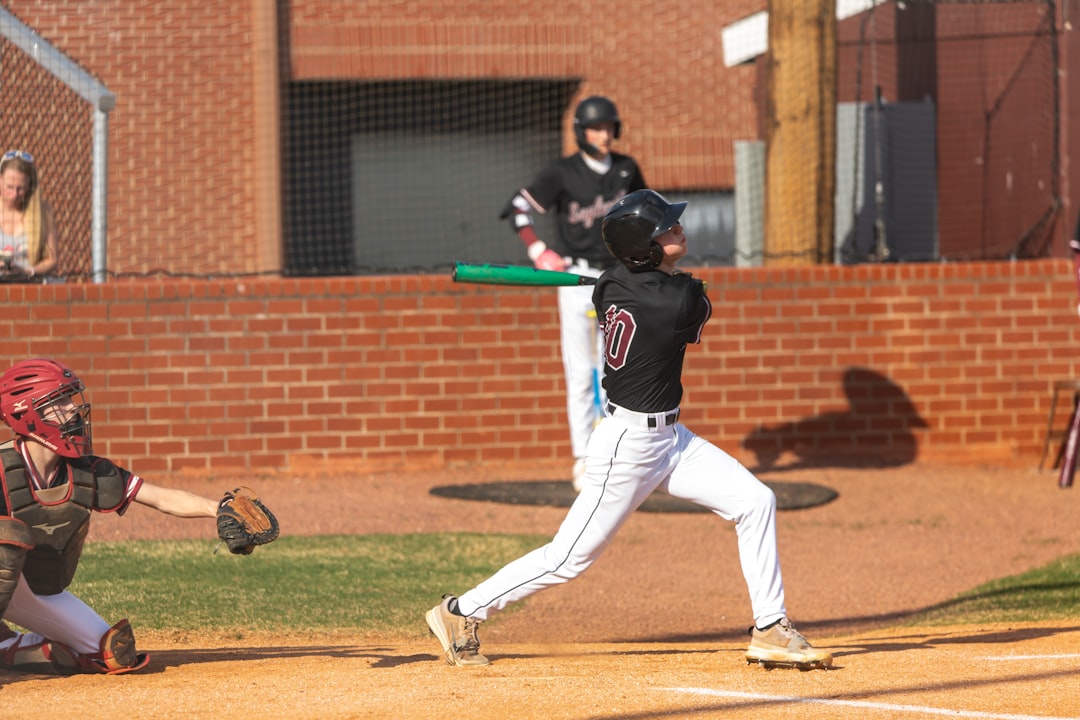
The sounds are different from the on-deck circle. You hear individual voices from the stands. You hear your own breathing. You hear the pop of the catcher's mitt on pitches that seemed slower from the bench but look much different from here. The field feels enormous and too close at the same time.
What Your Mind Is Actually Doing
Athletes and coaches often talk about "preparation" in the on-deck circle as something intentional and systematic — studying the pitcher's release point, timing his mechanics, identifying his go-to put-away pitch. And yes, you are doing some of that. But there is a parallel process happening underneath all of that useful, coachable thought.
You are running the at-bat before it happens. You are seeing the first pitch in three or four different forms. You are negotiating with yourself about what it will mean if you strike out, what it will mean if you get a hit, who is watching from those metal bleachers, whether your parents are standing up right now, whether the scout who showed up for Marcus is also watching you.
You are, briefly, doing everything your coach told you not to do.
And then your teammate either gets on base, makes an out, or gets hit — and your name gets called — and all of it stops. The negotiation ends. The film in your head cuts to black. There is only the walk.
The Ten Seconds That Last Forever
The distance from the on-deck circle to the batter's box at most high school fields is somewhere between fifteen and twenty-five feet, depending on the park. In real time, the walk takes between eight and twelve seconds.
In felt time, it is the longest walk of your athletic life.
Here is what actually happens, in order, though you won't register it this way in the moment:
- Your cleats make contact with the dirt outside the chalk lines and you hear them differently than you did during warm-ups. The sound is sharper. More deliberate.
- The crowd noise — which has been present the entire game — undergoes a change you cannot fully describe. It doesn't get quieter. It gets less specific. It becomes texture rather than information.
- You adjust something. Your batting gloves. Your helmet. The grip on your bat. Every hitter does this, and it is not superstition — it is the body reasserting control over the one thing it can control right now.
- You see the pitcher. Not as a person but as a shape, a delivery, a set of tells you've been cataloging for the last two innings. He sees you. There is a moment — brief, real — of mutual recognition. This is about to happen.
- You step into the box. You tap the plate. You find your stance. And the world, which had been crowded with variables and voices and stakes, compresses into a single point twelve inches in front of the pitcher's release hand.
Jenna R., 27, played varsity softball in southern Illinois and remembers her final regular-season at-bat more clearly than her graduation day. "I remember the exact sound my cleats made on the gravel path between the circle and the box," she says. "I don't remember the pitch. I don't remember what happened after. Just those three or four steps, and the way everything got quiet that wasn't actually quiet."
That's not nostalgia distorting the memory. That's the brain doing exactly what it's supposed to do under high-stakes conditions — recording with unusual fidelity the moments of highest consequence.
The Walk-Up Song: More Than Entrance Music
Ask any former high school baseball player about their walk-up song and watch what happens. The song comes back instantly. They can tell you the exact timestamp where the audio clip started — not the beginning of the song, but the specific moment. The drop, the hook, the first lyric. They chose it specifically. They argued for it. They owned it.
The psychology of the walk-up song is more interesting than most coverage of the phenomenon gives it credit for. Most articles on this subject focus on song selection — what makes a "good" walk-up song, how to pick one, lists of options. But the actual function of the song in the architecture of the at-bat is something different.
The walk-up song is an identity declaration made at the exact moment of maximum visibility. It is the one moment in team sports where an individual gets to announce who they are — not just to the crowd, not just to the opposing team, but to themselves.
High school players typically don't think about it in those terms. They just know which song feels right. They know it in the same way they know which stance feels right, which grip feels right. The song is the external expression of the internal state they are trying to access when they step to the plate.
Research on pre-performance music has documented what athletes have intuitively understood for decades: music with high tempo, strong rhythm, and personally meaningful lyrics measurably affects arousal state, mood, and perceived effort. For a high school player walking into the most pressurized moment of their week, the walk-up song is not decoration. It is preparation — external rhythm matching internal rhythm, identity soundtrack activating the state the player needs to perform.
What the Right Song Actually Does
The ideal walk-up song for any given player accomplishes two things simultaneously:
- It creates a consistent psychological state — a reliable bridge between the uncertainty of the on-deck circle and the demand of the batter's box. The song is a trigger, and when it plays, the body knows what to do next.
- It communicates something true about the player to everyone watching. Not manufactured bravado — something genuine. The players who choose songs that don't actually resonate often change them by the second week. The players who choose the right one keep it for four years.
The walk-up song is the only piece of genuine self-expression built into the structure of a baseball game. Uniform numbers are assigned. Positions are determined by ability and roster needs. Batting order is set by the coaching staff. But the walk-up song is yours. That's why it stays with you.
The Last Walk Up to the Plate
There is a version of this walk that happens once, and you never know it's happening until long after it's over.
The last walk up to the plate in high school baseball is not announced. It doesn't get a ceremony. There's no moment before it where someone tells you to pay attention because this is the last time. You just walk up, and you take the at-bat, and either it ends in a strikeout or a flyout or a ground ball or something better — and then the game ends, and then the season ends — and then you're standing in the parking lot in your uniform and the lights are still on over the empty field and something has changed that you can't quite name yet.
The high school baseball at-bat memory that most former players return to isn't usually the best at-bat. It isn't the game-winning hit (though some are lucky enough to have that). It's the walk itself, replayed. The specific quality of the air that evening. The sound of the crowd at that exact size and temperature of that specific crowd. The way the bat felt in your hands when you were sixteen and strong and had no idea that the sport was about to become something you watched instead of something you did.
In our experience talking with former players and athletes about these moments, the pattern is remarkably consistent: the play itself fades. The walk stays. The specific sensory details of the approach — the sound of the cleats, the compression of the crowd noise, the physical weight of the helmet — these are the things that persist for decades.
Because the walk is not about baseball. It is about the feeling of being fully present in a moment that matters. It is about being the person walking toward the thing, not away from it. That sensation — of moving toward the plate under a sky full of lights with a game on the line — is available to you for exactly four years, and then it isn't.
Why This Moment Lives in a Different Part of You
The reason the walk to the plate in a big game feels so different from almost any other athletic experience is that it is one of the few moments in a team sport that is genuinely, structurally solitary.
Football has the huddle. Basketball has the bench within earshot. Soccer is continuous motion and collective improvisation. But baseball has the at-bat — one player, in a box, facing one pitcher, with nine defenders arranged around him and nowhere to diffuse the moment. There is no teammate to take the next step for you. The walk is yours. The at-bat is yours. The result — whatever it is — is yours.
That structural solitude is why the walk feels so cinematic when you're inside it. You are not just a participant in a game. You are, for eight to twelve seconds, the protagonist of the scene. The crowd exists in relation to you. The field opens up toward you. The opposing pitcher's entire focus narrows to you.
You are sixteen or seventeen years old, and you matter in a way that is specific and visible and physically real.
That's what the walk is. That's why it never fully leaves.
Your jersey is still out there waiting.
Design yours in minutes and see your name and number exactly the way you remember it.
Frequently Asked Questions
What does it feel like to walk up to the plate in a big high school game?
Most players describe a compression of sensory experience — the crowd noise becomes texture rather than individual sound, peripheral vision narrows, and the walk itself feels both very slow and very fast simultaneously. The physical sensations (the weight of the helmet, the grip of the bat, the sound of cleats on dirt) are often remembered with unusual clarity long after the at-bat itself has faded. The psychological experience is one of isolation within a collective setting — you are surrounded by people, but the moment is entirely your own.
Why do walk-up songs feel so personal in high school baseball?
The walk-up song is the only element of a baseball game that a player selects entirely for themselves. In a sport where uniforms, positions, and batting order are all determined externally, the walk-up song is an act of self-expression at the moment of maximum visibility. Players often describe their walk-up song as a psychological trigger — a reliable bridge between the anxiety of waiting and the focused state required to hit. The song doesn't just signal an entrance; it activates an identity.
Why do former players remember the walk more clearly than the actual at-bat?
The walk to the plate contains a specific combination of conditions that promote strong memory encoding: high emotional stakes, sensory novelty (the field from inside the lines feels different from the on-deck circle), and complete solitude within a social setting. The at-bat itself is often dominated by reactive processing — reading the pitch, timing the swing — which is less likely to be encoded as a coherent narrative memory. The walk, by contrast, is anticipatory and intentional, which is why it tends to crystallize. Former players almost universally report remembering specific sensory details of the walk — the sound, the feel, the air — long after the outcome of the at-bat has disappeared.
Is the experience of walking up to bat different in high school than in other levels of baseball?
High school baseball occupies a specific emotional register that separates it from youth leagues below and college or professional levels above. The stakes feel maximum — the crowd often includes family, classmates, and occasionally scouts — while the players are old enough to process the significance of the moment but young enough that it hasn't become routine. College players describe a professionalization of focus that changes the texture of the walk. Youth players often don't yet have the self-awareness to register the walk as distinct from the at-bat. High school is the level at which the ceremony of the walk — the song, the solitude, the specific pressure of that audience — is most fully felt.
See also: why high school sports still matter to adults | the grief that follows the end of your athletic career | why your senior season memories feel so crystal clear