

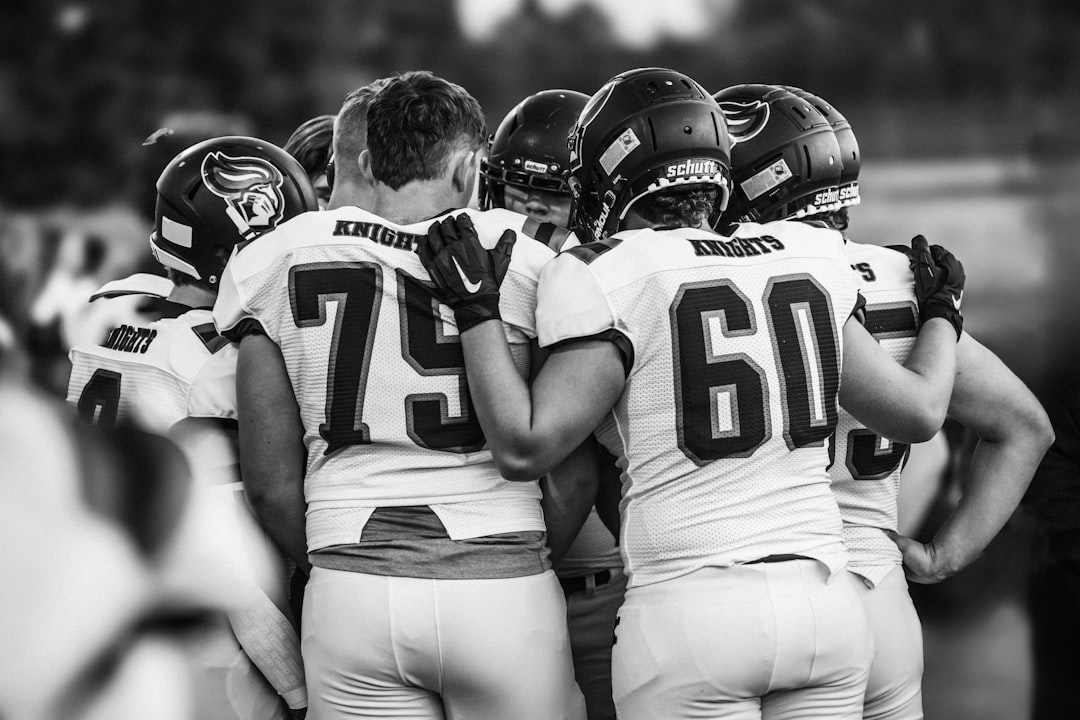




There's a specific moment that happens at homecoming.
You're standing in the parking lot, or in the gym, or on the old sideline — and something somebody said to you twenty years ago surfaces without warning. A line your coach delivered during a Tuesday practice that you half-heard, maybe rolled your eyes at, and filed somewhere in the back of your mind under things adults say.
And now, standing there in your thirties or forties with a mortgage and a career and a kid who's about to play the same sport you once played, you hear it again — clearly, completely — and it stops you cold.
The things your coach said that make sense now have a way of arriving precisely when you need them, long after the whistle has been blown for the last time.
This is for the former athletes who lived these lines before they understood them — the coaches' quotes that stuck with you from high school that now read like a message you were too young to receive.
The Practice Field Was Never Really About Practice
Every sport has its version of it. The drill nobody wanted to run. The conditioning session at the end of a two-hour practice when your legs were already gone. The thing your coach made you do when you were certain — absolutely certain — that it was pointless.
"We don't practice until we get it right. We practice until we can't get it wrong."
You probably heard some version of this. You probably thought it was coach-speak. A motivational poster in cleats.
It wasn't.
What your coach was actually teaching you — in the only language that makes sense to a sixteen-year-old who thinks they already know everything — was the neuroscience of deliberate practice. Repetition until something becomes automatic. Until the right response isn't a decision anymore; it's a reflex.


In our experience talking to former athletes, this is the line that lands hardest in adulthood. Because now you know what it's called. You've read about it in a book, or heard it in a podcast, or watched it play out in your own professional life when a new skill finally clicked after the hundredth attempt, not the tenth.
Your coach didn't assign it a name. They just made you run the play again.
The line you thought was about the game: "Do it until you don't have to think about it."
What it was actually about: Every presentation you rehearsed alone in your car. Every difficult conversation you mentally prepared for before it happened. Every professional skill you drilled into automaticity until it stopped costing you energy.
The practice field was a classroom. The subject was the rest of your life — a syllabus of life lessons you learned from your coach without ever realizing it.
The Things Nobody Told You About Losing
There was always a locker room after a loss. And there was always a coach who had to stand in it.
Some coaches yelled. Some coaches were quiet in a way that was somehow worse than yelling. And some coaches — the ones you remember decades later — said something you couldn't process at the time.
"Lose like a champion. Because the way you leave a field tells everyone who you actually are."
At seventeen, losing felt like the end of the world in the specific, total way that only seventeen allows. The idea that the loss itself was an opportunity — that something of value was being demonstrated in the losing — was genuinely incomprehensible.
And then adult life handed you its version of losses.
The job you didn't get. The relationship that ended. The business that failed quietly, without an audience, without a final buzzer to mark the moment. The project you gave two years of your life to that got cancelled in a Tuesday morning meeting.
You lost, and nobody was watching, and there was no locker room. Just you, deciding how you were going to leave the field.
That's when the line landed.
What your coach was really teaching you: Resilience isn't the absence of pain after a loss. It's the specific behavioral choice you make in the immediate aftermath. Your coach was training that choice when the stakes were low enough that you could afford to learn it.
By the time the stakes were high, the training was already in place.
The Persona: When Coaching Wisdom Came Back Around
Renee M., 38, was a varsity soccer goalkeeper in the mid-2000s — three years starting, one regional championship appearance, and a coach who ran the same communication drill every Friday before home games.
She didn't understand it until she became a team lead at a healthcare company fifteen years later.
"My coach made us narrate our decisions out loud during practice. Not explain them afterward — narrate them as they happened. 'I'm tracking the ball, I'm calling my angle, I'm committing.' At the time I thought it was embarrassing. Now I run the same exercise with my team before high-stakes client reviews. The principle is identical."
Your coach was right, Renee. You just needed the context.
She had a custom jersey made — her old number, her old school colors — and brought it to her ten-year reunion. It was, she said, the most conversation she had all night.
"How You Do Anything Is How You Do Everything"
This is the one.
If there is a single line that former athletes across every sport, every level, and every generation seem to have heard in some form — it's this one. And it is the one that was most thoroughly ignored in the moment of receiving it.
Your coach said it when you jogged instead of sprinted on a play that didn't matter. Or when you half-folded your practice jersey instead of folding it properly. Or when you were thirty seconds late to a meeting that "wasn't important."
"How you do anything is how you do everything."
You were fifteen. You did not care how you folded a jersey.
And then one day — and there is always a specific one day — you watched yourself do something small, unobserved, and inconsequential, and you did it badly because it didn't matter, and something shifted.
Because your coach's voice was suddenly there.
The mechanism your coach understood: Character is not a setting you switch on for important moments. It's a habit formed by the accumulation of small moments nobody is watching. The athlete who takes shortcuts in practice takes them in games. The professional who phones it in on minor deliverables phones it in on major ones, too — not because they're lazy, but because the habit of non-effort has calcified.
Your coach was doing character architecture. At the time it looked like an angry person caring too much about a folded jersey.
The Lines About the Team That Were Actually About Everything Else
There is a category of coaching wisdom that sounds, on the surface, like sports-specific motivation. And then you join a company, or a family, or a community, and you realize your coach was not talking about sports at all.
-
"There's no stat for what you just did." Said after a player made a sacrifice play — took a charge, set a screen, threw a block — that never shows up in any box score. Your coach was teaching you to value contribution over credit. To do the work that doesn't get measured, because that's usually the work that matters most. You've used this principle in every collaborative environment you've been part of since.
-
"The scoreboard is a result. Focus on what produces results." Process over outcome. Input over output. You couldn't have articulated it then, but you know now that your coach was teaching you the precise mental framework that behavioral economists, performance psychologists, and elite coaches at every level have spent decades formalizing. Your high school coach got there first.
-
"We win together or we figure it out together. There is no third option." Said after a loss that had a clear individual cause. Your coach declined to assign blame publicly — not because accountability didn't matter, but because public blame destroys collective trust faster than any opponent can. The lesson was about how teams stay functional under pressure. You've watched organizations fail because no one had learned it.
-
"I don't coach talent. I coach what talent does on a Thursday in February when no one's watching." This one takes the longest to land. Because it requires you to have been the talented person who underperformed, or to have managed the talented person who underperformed, before you understand precisely what your coach meant. Talent is common. Discipline applied to talent is rare. Your coach was not interested in the common thing.
The Uncomfortable Ones — The Lines That Were Hard to Hear
Not every coaching line was a warm life lesson delivered with perfect timing.
Some of them were hard. Some of them were delivered in a tone that felt, in the moment, like humiliation or unfairness. Some of them you're still working out your relationship with, even now.
And yet.
"I'm harder on you because I believe you can handle more." This one split rooms when it was said. It still does. Because the line can be used as cover for poor coaching behavior — and sometimes it was. But when it came from the right coach at the right moment? When you were genuinely underperforming relative to your own capability and someone refused to accept that?
It changed things.
The distinction, which you can now make with adult clarity, is between a coach who pushed you toward your own ceiling and a coach who pushed you toward theirs. The first is a gift. The second is a burden. Both used the same line.
"You're not tired. You're uncomfortable." Your body has opinions about this line that your mind has since overruled, repeatedly, in situations that had nothing to do with a track or a weight room. The ability to distinguish between I am in danger and I am in discomfort is one of the most functionally useful things a young person can develop. Your coach was teaching it through the only available curriculum: getting you to the edge of your comfortable and then making you take one more step.
You hated it. You use it constantly.
What Homecoming Actually Surfaces
Homecoming is not really about the game.
The game is the occasion. What homecoming actually does is hand you a corridor back to a version of yourself that existed before adult life overlaid everything with its complications.
You were an athlete. You wore a number. You ran plays and made mistakes and had a coach who believed — sometimes more than you did — that you were capable of something worth working toward. That belief is the heart of what your coach saw in you that you didn't see in yourself.
The things your coach said that make sense now are not just memories. They are the architecture of how you make decisions, handle setbacks, show up when no one is watching, and lead other people through hard moments.
Your coach was building something. You were the project.
And homecoming is the moment you get to look back and see the shape of what was built.
Your jersey is still out there waiting.
Design yours in minutes and see your name and number just the way you remember it.
Frequently Asked Questions
Why do coaching lessons feel more powerful as adults than they did when we heard them?
Context is everything in how we absorb information. When you're a teenager, you lack the reference experiences that make abstract lessons concrete. A coach saying "process over outcome" means very little to someone who hasn't yet experienced the outcome of a flawed process in a high-stakes professional or personal context. Adulthood provides the reference library that coaching wisdom requires. The lesson was planted correctly — it just needed decades of experience to germinate.
Is nostalgia for your playing days healthy, or does it keep you stuck in the past?
The research on nostalgia and psychological wellbeing consistently shows that reflective nostalgia — engaging with positive memories from the past in order to inform present values — correlates with stronger sense of identity and resilience. The distinction that matters is between nostalgia as escape (avoiding the present) and nostalgia as reference (using the past to orient in the present). Revisiting what your coach taught you in order to apply it now is the latter. That's not being stuck. That's being resourceful.
What's the best way to honor your playing days at homecoming?
The most meaningful ways tend to be specific rather than generic: showing up in your number, bringing back physical artifacts from your playing days, or reconnecting with the teammates who shared the experience with you. Former athletes consistently report that wearing their jersey — or a recreation of it — to homecoming events creates more genuine conversation and emotional resonance than anything else. It's a specific, visual statement: I was here. That time mattered. I still carry it.
What if I had a coach who wasn't a positive influence?
Not every coaching relationship is a clean source of wisdom. Some former athletes are sorting through experiences that were genuinely harmful rather than productively hard. The coaching lines worth reclaiming are the ones that, in honest reflection, were about your development rather than a coach's need for control or their own emotional regulation. If a specific line still carries weight that feels more like damage than wisdom, it belongs in a different conversation — one worth having, but outside the scope of a homecoming reflection.
See also: what high school sports actually taught you | the athletic identity you carried long after the final whistle | why those years still feel so emotionally significant | the grief that quietly followed the end of your playing days | why your senior season memories are so sharp and lasting