

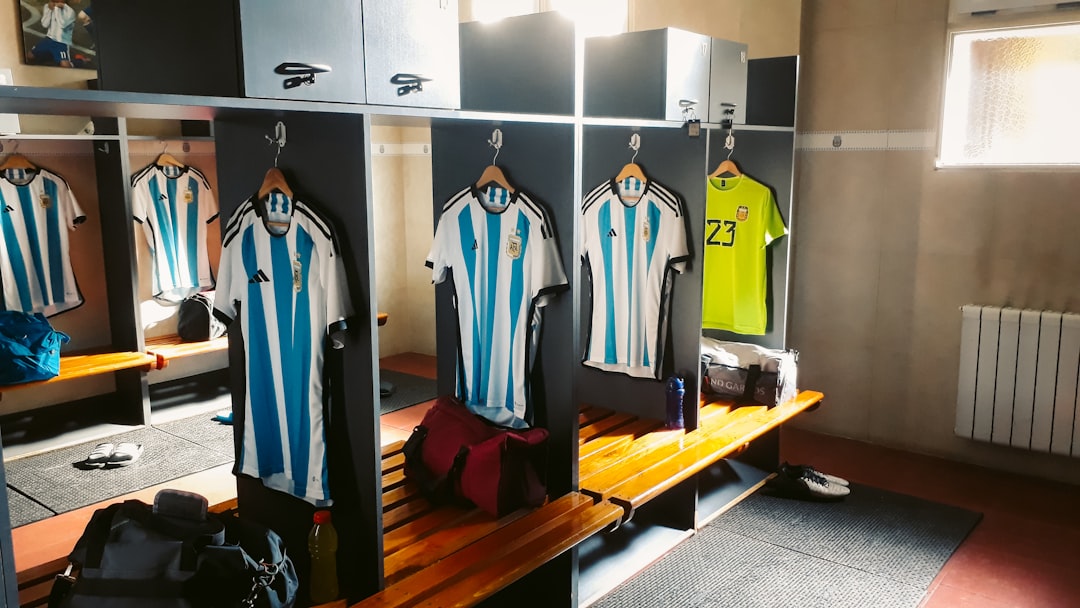




There was a number you had in your head before the first day of practice.
Maybe it was the number your favorite player wore. Maybe it was the number a sibling or parent had made famous in your family. Maybe you'd been wearing it since rec league and it had followed you all the way to the door of the high school equipment room. The point is: you had a number. It was yours. It was already yours before anyone handed you anything.
Then the coach called your name, passed you a jersey, and you looked down at the number on the chest — and it wasn't it.
This is one of the most quietly universal experiences in the life of a high school athlete. The moment of choosing a jersey number, or more accurately, not getting to choose (that gap between the number you wanted and the number you were assigned) is something every former athlete carries somewhere. It's small enough that you never talked about it much. It's specific enough that when someone finally names it out loud, you feel it immediately.
This article is for those athletes. For the people who wanted 12 and got 58. Who lobbied for 23 and ended up with 44. Who spent their entire varsity career under a number that wasn't theirs — until the day it was more theirs than any number they'd ever imagined wanting.
Years later, when you pull that custom jersey out of the box and see your name above a number you never chose, the feeling isn't regret. It's recognition. That number wasn't a compromise; it was the frame around everything you actually did.
The Number You Had Before You Had a Jersey
Ask a hundred former high school athletes what number they wanted, and the answers cluster immediately around the same names. Jordan's 23. Gretzky's 99. A favorite quarterback's number. A sibling who went before them. A grandfather who played in a different era and made one number feel like a family inheritance.


This is the first thing worth understanding about how jersey numbers work psychologically: we don't actually want a number. We want to inhabit a story. The number is the shorthand for a set of qualities we're trying to claim for ourselves — the grace, the toughness, the legend, the legacy.
When Marcus Allen wore 32 at USC, young running backs all over California started wanting 32. When your older sister wore 10 for four years and made all-conference, 10 stopped being a number and became an aspiration you could put on your back.
Here's the irony hiding inside those two famous numbers: they were second choices, too. Michael Jordan wanted 45 (his older brother Larry's number) and only landed on 23 because 45 wasn't available, so he split it in half and rounded up. Wayne Gretzky wanted 9, Gordie Howe's number, and doubled it to 99 when 9 was taken. The two most iconic numbers in sports were consolations. Nobody handed Jordan his first choice, and 23 still became the number an entire generation of guards wanted to inhabit. That's the quiet proof underneath this whole story: the number that ends up mattering isn't always the one you asked for.
The number you wanted was never just a number. It was a character you were auditioning to become.
Which is exactly why not getting it felt like more than a minor administrative disappointment.
What Actually Happens in the Equipment Room
The reality of jersey assignment at most high school programs is considerably less ceremonial than the fantasy.
Across dozens of sports, the process almost always falls into one of two categories: seniority claims and what's left.
The seniors pick first. This is nearly universal. The upperclassmen who've earned their place in the program get first access to the numbers with history behind them. If your school had a legendary running back who wore 34, the current senior captain gets 34 if he wants it. When a number carries that kind of weight, it sometimes becomes a retired number the whole school honors. That's just how it works. The sophomore who showed up with 34 burning in his chest all summer is going to learn patience whether he wanted to or not.
The second category, what's left, is where most freshmen and sophomores end up. The remaining numbers are distributed by necessity, by position, or simply by the order your name was called off a clipboard. You got what was available. Sometimes a coach made a note of what you asked for. Sometimes that note made a difference next year. Often it didn't.
The Rules You Never Saw Doing the Deciding
Sometimes the reason you never got your number had nothing to do with a senior beating you to it. It was decided long before you ever walked into the room, by the rulebook of your sport.
Football is the most rigid about this. In most leagues, your position dictates which numbers are even legal for you to wear. Receivers, running backs, and defensive backs are generally limited to 1 through 49 and 80 through 99. Offensive linemen are boxed into 50 through 79. So when a lineman tells you he "ended up with" 63, the honest answer is that 63 was one of a small handful of numbers he was ever allowed to touch in the first place.
Basketball carries its own quiet restriction. In high school and college, the numbers 6, 7, 8, and 9 are often forbidden because referees signal a player's number with their hands, and showing two fingers per digit gets clumsy. You wanted 6 because it was your birthday or your dad's number? You'll usually be handed 16, 23, or 42 instead — a number an official can signal cleanly with one hand.
Hockey goes after the extremes. The number 0 and 99 are heavily restricted or retired across levels, so the number that looked cool from the stands was never really on the table.
And in 2024-25, even the color of the number got regulated. The NFHS tightened its rule so the entire body of a jersey number must be a single solid color that clearly contrasts with the jersey's color — the old allowance for a contrasting border or outline around the number is gone, in football and basketball alike. It's one more rule you never saw, quietly deciding what your number could even look like before you put it on.
And here's the part that shapes which numbers we want in the first place: perception. Research published in PLOS ONE found that athletes wearing lower numbers, in the 10-to-19 range, were consistently judged thinner and faster than athletes wearing higher numbers in the 80-to-89 range, even when the bodies were identical. We don't just want the number that tells a story. We're drawn to numbers that make us look the part before we've played a single snap. And for some, number superstitions and lucky numbers run just as deep.
What almost nobody tells you in that moment is that the number you're holding is about to start a negotiation with you. A slow negotiation. One that takes an entire season, or two, or four.
Growing Into a Number You Never Chose
Picture a midfielder from the Midwest who spent her freshman season in number 17 and wanted 10, the playmaker's number, the number she associated with technique and vision. Seventeen felt arbitrary.
By junior year, the arc had already reversed. The biggest goal of her career had landed in that number, and her teammates had started calling her just Seventeen. The day came when she realized she didn't want 10 anymore. What would she even do with 10? Seventeen was her number.
This is the arc that almost no jersey number story acknowledges on the front end. The number you're assigned becomes associated with your actual performance, your actual growth, your actual relationships inside that program. The number you wanted was attached to someone else's story. The number you got got attached to yours.
There's a concept in sports psychology sometimes called "identity anchoring" — the way external symbols like uniforms, numbers, and equipment become genuine cognitive shortcuts for self-concept over time. Research from the Journal of Sport and Exercise Psychology has explored how uniform elements affect athletic identity formation, particularly during the developmental years of adolescence. The finding that holds up consistently: the more you perform in a symbol, the more that symbol becomes inseparable from your sense of athletic self.
The number you got is the number you actually performed in. That's why the meaning of a jersey number stays with you for years. It was present for every good game and every bad one. It was there when your team won the regional championship. It was there when you had the worst game of your sophomore year. It saw everything.
The number you wanted never had a chance to become that for you.
The Stories Athletes Carry About Their Numbers
What makes the jersey number stories athletes tell so interesting is how consistent their shape is, even when every detail is different.
The story almost always has three movements.
Movement one: the wanting. This is the number with a name attached to it — a player, a family member, a specific association. The wanting feels very certain at the time.
Movement two: the assignment. The gap between what was wanted and what was received. Sometimes this gap was two numbers. Sometimes it was the difference between a single digit and a double. The gap's size mattered less than the fact of it.
Movement three: the reversal. Somewhere in the middle of a season, or between sophomore and junior year, or in the final weeks before the last game ever played under that number, the equation flips. The assigned number stops feeling like a consolation and starts feeling like the real one.
The reversal is the part nobody talks about while it's happening. It happens quietly. You stop noticing the number on your chest isn't the one you originally wanted because you've stopped thinking about the one you originally wanted. You're thinking about what you're doing in this number. Right now. Tonight.
When the Number Becomes the Name
Some numbers don't just get accepted. They get absorbed completely into an athlete's identity in ways that outlast the sport itself.
Take a wrestler who competed all four years of high school. He was assigned number 11 his freshman year and wore it every season. He didn't love it initially — no particular story behind 11 for him, no legend it pointed toward.
Ask around any program and you'll find a version of this: a father who came to every home match and always sat in the same section. Before the first whistle, his son would find him in the stands, and the father would hold up both index fingers — two ones. Eleven. It became a thing between them, a signal. Long after the wrestler stopped competing, 11 stayed the number he tied to his father, to those matches, to everything from that part of his life.
The number 11 had no meaning when he was assigned it. It accumulated meaning entirely because of what happened while he was wearing it. That's not a story about a number. It's a story about a career, a relationship, a set of years that shaped him — and 11 is the shorthand for all of it.
There's a similar shape in basketball. Picture a guard from Ohio who spent four years in number 24 because his coach handed it to him. He had wanted 3 — Allen Iverson's number, the crossover king. He was so disappointed at that first practice that he almost asked to switch. Then he dropped 24 points in a playoff game his junior year, and after that, 24 was untouchable. The irony is that the number he never chose became the one he'd defend against anyone who tried to take it. Getting your jersey number assigned (even when it wasn't the one you'd hoped for) is one of the moments that define you as an athlete, the kind of experience that stays with you long after the final whistle, whether you chose the number or it chose you.
This is why former athletes who build custom jerseys — to frame, to give as gifts, to hold onto something from that time — so often choose the number they were assigned rather than the number they originally wanted. Because the assigned number is the one that was actually there. When someone gives a gift that captures what that number meant, they're not giving a piece of fabric — they're giving back a piece of the story only that number can tell.
The Number You Would Choose Now
Here's a question worth sitting with: if you could design your jersey today (your name on the back, your high school's colors, your position, your sport), what number would you put on it?
For most former athletes, the answer isn't the number they lobbied for before freshman year. It's the one that's attached to actual memories.
Twenty-three might still have Michael Jordan's gravity. But 47 has the memory of a specific fourth-quarter drive on a Friday night in October with rain starting to come down and the crowd making more noise than you'd ever heard directed at you specifically. Twenty-three was always someone else's number. Forty-seven is yours.
The number you got turned out to be the right number. Not because of fate or luck or a coach with unusual foresight. Because you made it yours through the simple, unglamorous process of showing up in it repeatedly until it stopped being a jersey number and started being an identity.
That's the story. It just takes a few seasons to get there from the equipment room.
When you go to design your own jersey, you're not just picking a number from a dropdown. You're putting a piece of your history back on your shoulders. The design tool lets you pick your sport, your school's colors as you remember them, and type in your name and number. There's no waiting on anyone else — you build it yourself, and the preview shows you how it will look before you order. If you're ordering a custom jersey that fits your adult frame, a little attention to sizing makes all the difference. And when you see that number come to life on the screen, it's a reminder that the number you ended up with was the one that mattered.
Your Jersey Is Still Out There Waiting
Design yours in minutes and see your name and number exactly the way you remember it.
Frequently Asked Questions
Why do high school athletes care so much about specific jersey numbers?
Jersey numbers are rarely just numbers for high school athletes — they're identity shortcuts. Most athletes arrive at tryouts with a number already attached to a player they admire, a family member who wore it before them, or a story they want to step into. The process of choosing a jersey number as a high school athlete is, psychologically, the process of choosing which story you want to tell about yourself. That's why the gap between the number you wanted and the number you were assigned can feel disproportionately significant in the moment.
Is it common to grow attached to a jersey number you were assigned rather than the one you wanted?
Extremely common. And it's the more frequent outcome of the two. The number you wanted carried borrowed meaning from someone else's career. The number you were assigned accumulated original meaning from your own. Every good game, every important match, every relationship built inside that program happened under your assigned number. By the time most athletes finish their high school careers, the assigned number has more genuine personal history attached to it than any number they could have chosen before they'd played a single game.
Why do former athletes want custom jerseys with their original number rather than a different one?
Because the jersey isn't about aesthetics — it's about the specific memory the number unlocks. A former athlete commissioning or designing a custom jersey is almost always trying to hold onto something specific: a season, a team, a version of themselves that existed in that number. The assigned number is the one that was actually present for all of it. Choosing a different number on a custom jersey would be like writing a memoir and changing your own name. The number you wore is the number that was there.
What if I never made peace with the number I was assigned — is that a common experience too?
Completely. Not every jersey number story ends in the clean reversal described in this article. Some athletes finished their careers still wishing they'd gotten the number they wanted, especially if they felt their assigned number was chosen arbitrarily or without any acknowledgment of what they'd asked for. What's universal is the gap itself, not the happy ending. Every former athlete has some version of the number they wanted and the number they got. What you did in that number is the story that matters most, whatever your relationship with the number itself turned out to be.
How do jersey number traditions work in most high school programs?
Most high school programs follow an informal hierarchy: seniors and established starters have first claim on the numbers with program history, often claiming numbers worn by notable alumni or former team captains. Underclassmen are typically assigned from the remaining inventory, occasionally with input from a coach if a strong case is made. In some programs, specific numbers are formally retired or reserved. In most, it's a more informal process based on availability and seniority — which is exactly why the gap between wanting and getting is such a consistent experience across sports, schools, and generations.
Can I design a jersey with a different number than the one I wore, if I always wanted that number?
Absolutely — the design tool lets you choose any number you like. But we've noticed something over the years: most former athletes end up choosing the number they actually played in, even if they once dreamed of a different one. That assigned number is the one tied to every bus ride, every pre-game speech, every time your name was called over the loudspeaker. Still, if there's a number that means more to you now, you get to make that call. It's your jersey, your story.
How do I create a jersey on iPlayedFor.com?
It's straightforward: you start by picking your sport, then you select your high school colors from a palette. You enter your name and the number you want, choose your size, and you'll see a preview of how it will look. The whole process is self-guided — no back-and-forth, no waiting on a designer. You design it, you order it, and it shows up at your door. It's a way to put that piece of your past back into the present, one stitch at a time.
See also: why personalized details like a jersey number hit differently than generic gifts | how athletic identity shaped who you were long after the final whistle | the science behind why your senior season memories are still so vivid