

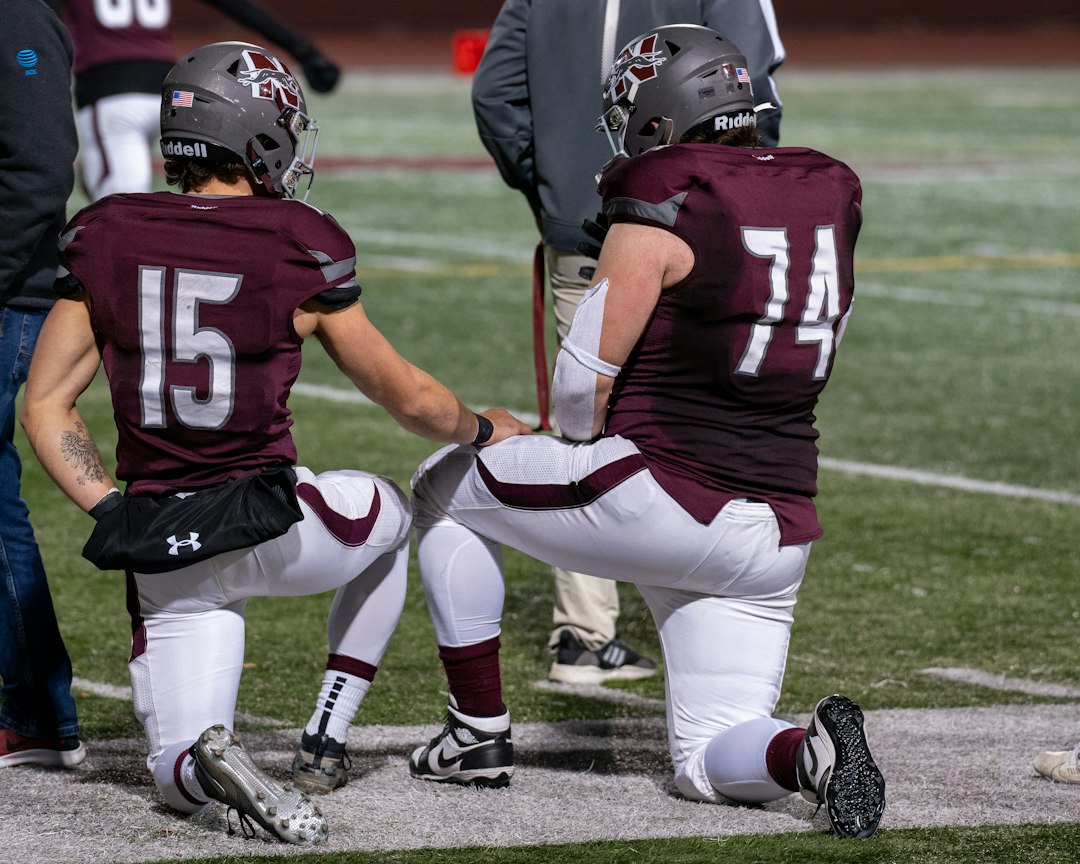




Every August, thousands of young men walk into their high school as football players. By the following May, that identity — the one that took years to build, the one everyone in the building recognized — is gone. If you've ever Googled anything close to "athletic identity crisis former football player," you already know exactly what that loss feels like. You just may not have had a name for it yet.
This article is for the guy who was the football player. Not one of them — the one. The kid whose name the announcer knew. The one teachers called on differently, whose jersey number was its own kind of language in the hallway. And now you're eighteen, or nineteen, or maybe twenty-two, and someone at a party asks what you do and your mouth opens and nothing comes out that feels true.
That pause is not weakness. It's what happens when your entire sense of self was constructed inside one arena, and then that arena closed.
When the Final Whistle Is Also a Question Mark
Most sports end quietly for most players. A season wraps up. You age out of a league. Life moves on. Football doesn't work that way.
Football is the most publicly performed identity in American adolescence. Your name is on the scoreboard. Your number is on the back of shirts sold at the booster table. Your performance is discussed at Sunday dinners by families you've never met. The community doesn't just watch you play — they narrate you. They make you into something larger than a person who can throw or tackle. They make you into a symbol of what this town, this school, this Friday night is about.
That level of public identity construction creates something psychologists call identity foreclosure — a state where you've committed deeply to an identity before you've had the chance to explore who else you might be. For football players, foreclosure often happens at twelve or thirteen. You're "the football player" before you're old enough to know what other options even exist.


The research on this is specific. A 2020 review published in the Journal of Sport and Exercise Psychology found that athletes with high athletic identity and low exploration of other identity domains experience significantly more distress during athletic transitions than peers who maintained broader self-concepts. The effect is amplified in contact team sports — football chief among them — where the group identity compounds the individual one.
Translation: you didn't just lose a sport. You lost the answer to "who am I."
The Three Stages Nobody Warns You About
The transition out of high school football rarely announces itself as a psychological crisis. It tends to arrive in stages that feel like separate, unrelated problems. In our experience covering athlete transitions, the pattern is consistent enough to map.
Stage One: The Schedule Disappears
For most of your conscious memory, August meant two-a-days. September meant Friday nights. November meant playoffs. Your year had a shape. Your body knew what month it was by what was being demanded of it.
When that structure vanishes, the first thing most former players describe isn't sadness — it's a strange, restless boredom they can't explain. You have all this time. You don't know what to do with it. You're used to your body being a tool in service of a mission. Without the mission, the body just exists. That feeling — that purposeless physical energy with nowhere to go — is the first signal that what you're experiencing goes deeper than "missing football."
Stage Two: The Social Geography Shifts
The locker room is not just a room. It is, for most high school football players, the primary social architecture of their adolescence. The team doesn't just play together. It eats together, suffers together, gets screamed at together, wins together. The bond is structural — built into the daily schedule, the shared adversity, the common language.
When the season ends permanently, that architecture doesn't just go quiet. It dissolves. Teammates scatter. The daily contact that felt permanent turns out to have been held together entirely by the program. This is when the question "who am I without football" starts to sharpen into something more uncomfortable: "who are my people without the team?"
Stage Three: The Identity Audit
This is the stage where lost athlete identity football players describe in language that overlaps heavily with depression — and sometimes is depression. The audit arrives differently for different people. For some it's a moment: someone introduces you at a party as "just" something, and the "just" lands like a verdict. For others it's gradual: you notice that the stories you tell about yourself are all past tense. Everything that makes you interesting happened before now.
Former high school athlete depression is real and clinically documented. It is not always full clinical depression, but the symptom overlap — low motivation, social withdrawal, loss of purpose, difficulty imagining a positive future — is significant enough that if these stages have persisted for more than a few months, talking to a counselor is not overcorrection. It's appropriate.
The Specific Brutality of the Football Identity
Here's what makes football different from other athletic identities, and why a generic "life after sports" framework often doesn't fit.
The body is the credential. In football, your physical size, strength, and toughness are not just tools — they are the primary basis of your social standing. The linebacker who moves through the high school hallway occupies a different physical and social space than almost anyone else in the building. That's not ego. That's just true. When football ends, the body that made you someone doesn't disappear. But the context that gave it meaning does. A lot of former players describe feeling suddenly self-conscious about their own size, their own physicality — a body that used to be an asset now feels like a costume from a show that closed.
The identity was public property. Your performance was discussed in the community. Your name was in the local paper. Other people's narratives about you — their pride, their expectation, their collective memory of that one fourth-quarter drive — don't end when your eligibility does. You're still "the football player" to the people in town long after you've stopped being one to yourself. That gap between how others still see you and how disoriented you privately feel is isolating in a way that's hard to explain to someone who hasn't lived it.
Toughness culture made it harder to notice. Football programs — by design — train players to suppress vulnerability, push through discomfort, and treat acknowledgment of pain as weakness. This is adaptive inside the game. Outside it, the same training makes it genuinely difficult to recognize or articulate an identity crisis until it's been compounding for months.
Marcus D., 19, played starting linebacker for three years at a competitive Texas 5A program. After graduation, he enrolled at a community college forty minutes from home — far enough to lose the daily team context, close enough that people still recognized him from Friday nights. "I didn't know what was wrong," he said. "I just kept starting things and not finishing them. Classes, jobs, friendships. I thought I was lazy. It took me almost a year to figure out I was just completely lost about who I was supposed to be when nobody was watching."
That delay — the year of misreading the symptom — is one of the most common patterns in the former football player identity transition. The crisis doesn't announce itself as an identity crisis. It announces itself as motivation problems, relationship friction, academic underperformance, or a general sense that the best part of your life is already behind you at nineteen.
A Framework for Rebuilding: The Four Domains
The framework that actually works for former football players isn't "find a new hobby." That framing misunderstands what was lost. You didn't lose an activity. You lost a self. Rebuilding requires rebuilding identity at the structural level — across the four domains that football used to fill simultaneously.
Domain 1: Competence
Football gave you a specific, measurable, publicly validated arena for competence. You knew when you were good. Other people knew when you were good. The feedback loop was immediate and legible.
The first step in rebuilding is deliberately entering new competence arenas — not to replace football, but to rebuild the experience of being someone who is good at things. This is not about finding your "passion." It's about finding contexts where effort produces measurable improvement.
Concrete starting point: pick one physical domain (a new sport, a strength training goal, a martial art) and one non-physical domain (a technical skill, a creative craft, a professional certification). The physical one matters specifically because your body is already trained to learn through physical challenge. Use that existing pathway.
Domain 2: Brotherhood
The team structure provided daily, high-context, adversity-bonded relationships. Most post-football social contexts don't do that automatically. You have to build it deliberately.
This doesn't mean trying to recreate the locker room. It means finding communities where people are working toward something hard together. Volunteer organizations, intramural competitive leagues, military service, trade apprenticeships, startup environments — the specific context matters less than the structural presence of shared challenge and shared accountability.
Domain 3: Purpose Architecture
Every day of football season had a purpose. Practice had a purpose. Film study had a purpose. The weight room in February had a purpose — it was all in service of a season, a team, a goal that was bigger than any individual session.
Without football, most former players have days but no season. The work is to build what we call purpose architecture: a medium-term goal (6–18 months) significant enough to give individual days direction, with short-term milestones that provide the weekly feedback loop that game weeks used to provide.
This is not the same as "set goals." It's the deliberate construction of a temporal structure that makes daily effort feel connected to something that matters.
Domain 4: Public Identity
This is the domain most frameworks ignore, and it's the most specific to the football experience.
You need a new public answer to "who are you." Not because other people's perception of you is what matters — but because the absence of a legible public identity creates a vacuum that your own internal narrative fills with "nobody special." That's not a truth statement. It's just what happens when you haven't given yourself a new story yet.
The new public identity doesn't have to be as dramatic as "the football player." It just has to be something. "I'm training for my first powerlifting meet." "I'm in a welding apprenticeship." "I'm building a landscaping business." The specificity is the point. You need a present-tense sentence about yourself that isn't about who you were.
What Recovery Actually Looks Like
Recovery from an athletic identity crisis is not a single moment of realization. It's a slow accumulation of new reference points. The former player who's genuinely through it doesn't stop valuing what football gave him — he carries it differently. The discipline, the capacity to function under pressure, the comfort with physical discomfort, the understanding of what high-level team execution actually requires: these are not football skills. They are human skills that football developed. They transfer.
The shift happens when you start using past-tense football not as your identity but as your credential. "I know how to work because I spent four years doing two-a-days in August heat." That's different from "I used to be a football player." One is a story about who you were. The other is a statement about what you're made of.
The identity isn't gone. It's unfinished. Football built the foundation. The rest of the structure is yours to design.
Your jersey is still out there waiting.
Design yours in minutes and see your name and number exactly the way you remember it.
Frequently Asked Questions
How long does the athletic identity crisis last for former football players?
There's no fixed timeline, but most former players who actively work through the transition describe meaningful stabilization at 12–24 months post-graduation. Players who don't recognize the transition as a psychological process — who interpret the symptoms as laziness, depression, or social failure without understanding the underlying identity loss — often describe the disorientation lasting three to five years. Early recognition significantly shortens the timeline. If symptoms of former high school athlete depression (persistent low motivation, social withdrawal, inability to imagine a positive future) persist beyond three to four months, speaking with a counselor who has experience with athlete transitions is a concrete, practical step.
Is feeling lost after football ends the same as clinical depression?
Not automatically, but the overlap is real enough to take seriously. Identity foreclosure in athletes produces many of the same surface symptoms as depression — low motivation, anhedonia, social withdrawal, difficulty with future orientation. The distinction matters clinically because the interventions are somewhat different: identity crisis responds well to structured identity-building work, while clinical depression requires clinical treatment. The practical answer is: if you're unsure, see a professional. Getting evaluated and being told "you're going through a transition, not a clinical episode" is not a wasted visit. Missing clinical depression because you assumed it was "just" an adjustment is a meaningful risk.
Can you rebuild an athletic identity around a new sport after football?
Yes, and for many former players it's one of the most effective paths — specifically because it uses an existing learning pathway (physical challenge, team accountability, measurable improvement) in a new domain. The key is choosing a sport or physical pursuit where your existing physical capacity is an asset, not a liability. Powerlifting, rugby, CrossFit, MMA, and rowing are common effective transitions for former football players. The goal isn't to replace football — it's to re-enter a competence domain where effort produces measurable, publicly visible results. That experience of being good at something physical again is often the anchor point from which the broader identity reconstruction becomes possible.
What do you say when people still introduce you as "the football player"?
This is one of the most specific and uncomfortable features of the football identity transition, particularly in smaller communities. The most effective reframe in our experience isn't correcting the introduction — it's adding a present-tense sentence immediately after. "Yeah, I played — right now I'm [current thing]." The "right now I'm" construction does two things: it honors the football chapter without making it the whole story, and it forces you to have a present-tense answer ready, which accelerates your own internal identity shift. The former player who can say "right now I'm..." with conviction is already through the hardest part.
See also: athletic identity after high school | the grief that comes with the end of your athletic career | what happened to the athlete who didn't get a scholarship