



There's a version of that room you've never left.
The smell of it (sweat and concrete and whatever someone was eating on the bus) still hits you if the conditions are right. The fluorescent lights that buzzed too loud. The way everyone went quiet when the door swung open and the coach walked in. You were down, or you were tight, or something had gone wrong in the first half that nobody had words for yet. And then the words came.
Every former athlete carries a halftime speech athlete memory that doesn't soften with time. It doesn't blur the way other memories do. It stays specific — the exact phrase, the exact pause before it, the way the room changed temperature when the right words landed. You were seventeen, or twenty-two, or somewhere in between, and someone said something that crossed from coaching into something else entirely. Something closer to truth.
This is about that moment. What it actually was. Why it's still with you. And what it says about the athlete you were — and the person you became.
What Was Really Happening in That Room
Halftime speeches are not strategic briefings. The adjustments — the X's and O's, the matchup changes, the assignment corrections — those happen too, but they're not what anyone remembers forty years later.
What you remember is the humanity of it.
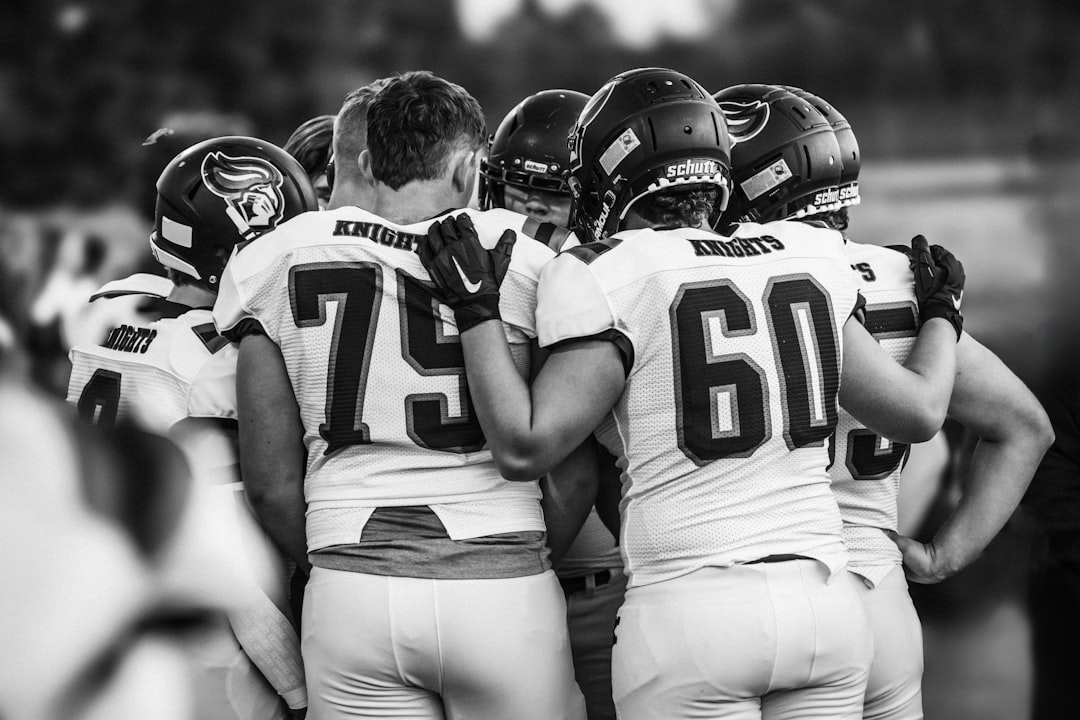
A coach standing in front of a group of people who are tired and scared and uncertain, trying to say the thing that cuts through all of that and reaches whatever is underneath. The attempt itself is vulnerable. The coach doesn't always know if it's working. The players don't always know if they're going to respond. There's something genuinely at stake in that room, not just the outcome of the game, but the question of who you are when things get hard.

The speeches that stay with us are the ones that answered that question in a way we didn't expect.
The memorable halftime moments almost never involve tactical genius. They unfold in the same charged space that holds the tension in the locker room before the big game — that pressurized quiet where everyone is already on edge before the coach even speaks. They involve a coach who seemed to see through the scoreboard entirely and speak directly to the identity of the group. The coach who didn't talk about the game at all — who talked about what they believed about the people in that room. The coach who got quiet when everyone expected loud. The coach who said three words and then walked out.
Those moments work because they operate below the level of strategy. They reach the part of a competitor that isn't thinking about points — the part that's asking whether this is worth it, whether I'm capable, whether the people next to me will hold when it gets worse before it gets better.
The answer those speeches give is never really about the game.
The Architecture of a Moment That Lasts
Not every halftime speech becomes a memory. Most of them don't. A former athlete might hear hundreds of halftime talks across a career (youth leagues, high school, college, recreational leagues in adulthood) and the vast majority dissolve into the general background noise of having played.
The ones that stick share a specific architecture, even when the words and circumstances are completely different.
The Coach Dropped the Performance
The speeches that last are the ones where the person giving them visibly stopped performing and started meaning it. You could see the difference. There was a moment — sometimes it came right at the start, sometimes it came partway through — where something shifted and you understood that this wasn't the prepared version. This was the real version.
Athletes can sense inauthenticity the way a compass senses magnetic north. A locker room full of people who have been training together, suffering together, and competing together develops an almost cellular awareness of when something is genuine. When a coach stopped managing the moment and started living in it, the entire room responded.
Something Personal Was Said
The most durable halftime speeches contain at least one moment where the coach said something that applied specifically to the people in that room, not to athletes in general, not to teams in general, but to this group of people with this specific identity. A reference to something that had happened in practice. An acknowledgment of a sacrifice that most people outside that circle would never know about. A name said with a weight that made the named person sit differently.
That specificity is what transforms a speech into a memory. Generic inspiration fades. Precision endures.
The Room Went Quiet First
Almost every athlete who recalls a defining halftime moment describes a silence that preceded it. Not the polite quiet of an audience settling in — a different kind of silence. The kind that arrives when a group of people collectively recognizes that something real is about to happen. That silence is the room giving its attention not because it was demanded, but because something earned it.
The speeches that lasted were the ones that earned the silence before they filled it.
If You Played, You Know This Feeling
Every former athlete remembers the specific geography of those moments.
Where you were sitting. Who was to your left. Whether you were looking at the coach or at the floor. The way time seemed to decelerate so that individual seconds became distinguishable from one another, because your nervous system understood, even then, that this was worth retaining. The same nervous system that locks in the sound of a gym at tip-off — that specific acoustical fingerprint every basketball player knows in their bones — was doing its work here too.
You might not remember the score going into halftime. You might not remember what the adjustments were or whether they worked. But you remember the feeling of that room shifting. The feeling of something that had been fragmented becoming, briefly, unified. Twelve people or thirty people or forty-five people with different temperaments and different skill levels and different reasons for being there, all of them arriving at the same emotional place at the same moment.
That convergence is rare. Outside of sports, most of us spend years without experiencing it. The halftime speech, at its best, is one of the few contexts in which a group of people can be moved into the same internal space simultaneously, not through manipulation, but through recognition. The coach who says the right thing at halftime isn't creating a feeling. They're naming something that was already in the room, waiting to be acknowledged.
What the Memory Is Actually Carrying
Marcus T., 44, played soccer through college and has coached youth leagues for the past decade. He described a halftime speech from his freshman year of college that he still thinks about before his own team talks. "Our coach never raised her voice," he said. "She walked in, sat down in a folding chair, and said, 'I'm not worried about the score. I'm worried that you're playing like you don't trust each other.' And then she just waited. That was it. Fifteen seconds of silence and then we went back out. We won by two." He keeps that template somewhere in the back of his head every time his U-14 girls are struggling at halftime.
What Marcus describes is something broader than a sports memory. It's a lesson in leadership that arrived at exactly the moment he was developmentally ready to absorb it. The halftime speech became a transmission, not just of motivation for that specific game, but of a principle he's carried forward into every room where he's been responsible for other people.
This is what former athletes are actually carrying when they carry those memories. Not just nostalgia for the game. A compressed education in what it means to lead, to follow, to be honest under pressure, to belong to something larger than individual performance.
The locker room at halftime was, without anyone announcing it as such, a classroom. And the lesson that landed that day didn't require a textbook or a lecture series. It required one person saying the true thing at the moment when the true thing was most needed.
Why the Memory Gets Stronger, Not Weaker
Most memories degrade. The neuroscience of this is well-documented. The more often you recall something, the more you're recalling your last memory of it rather than the original event, which means each recollection introduces small distortions. Memories, in this sense, are reconstructive rather than reproductive.
But emotionally significant memories are encoded differently. Research on emotional memory consolidation consistently shows that high-arousal emotional experiences engage the amygdala in ways that produce stronger, more stable long-term encoding. The heightened state of a competitive athlete at halftime — physiologically elevated, emotionally raw, acutely attuned to social signals — creates ideal conditions for deep encoding.
This is why the halftime speech that moved you at seventeen is more vivid now than things that happened last month. It wasn't just important. It was encoded at a moment of maximum neurological receptivity.
The memory isn't distorted sentiment. It's a record of a genuine peak experience, stored with unusual fidelity precisely because of the conditions under which it occurred.
What It Means to Carry It Forward
Here's the part nobody talks about when they talk about halftime speeches: they don't end at the final whistle.
The athlete who heard those words went home that night. They went to school on Monday. They grew up, got a job, had a hard conversation with someone they loved, stood at the front of a room trying to find the right thing to say to people who were struggling. And somewhere in that moment, the locker room came back.
Not as a memory to be admired. As a resource to be used. What your coach said that you still hear decades later isn't a recording you replay but a tool you reach for when you need it most.
The coach who sat in that folding chair and trusted silence to do the work modeled something. The coach who said the specific, true thing instead of the safe, general thing demonstrated something. The coach who showed up in the hardest moment without a script — who let the moment require something real from them — left something behind that lasted longer than any trophy.
Former athletes carry this differently depending on what they went on to do with their lives. Coaches carry it as template. Parents carry it as a kind of standard. Managers and leaders of all kinds carry it as a reference point for what it looks like when words actually reach people. Even those who never led anything formal carry it as a private measure, a memory of what genuine presence looks like, available for quiet consultation when life asks for it.
The halftime speech gave you more than a second half. It gave you a model for what it looks like when someone means what they say.
The Speeches Nobody Recorded
There is no archive for most of these moments. No film, no transcript, no oral history project captured what was said in the locker room of a mid-level high school program in a mid-sized city during a game that didn't make the local paper.
And yet those speeches (the unrecorded ones, the ones that only the people in that room will ever know about) shaped the people who heard them as surely as any of the famous ones. The coach nobody outside that program ever heard of. The assistant coach who stepped up when the head coach was ejected. The senior captain who said the thing in the corner, quietly, before the coach even came in.
Those are the speeches that most former athletes are actually carrying. Not the famous ones. The private ones. The ones that belong only to the people who were in the room.
That privacy is part of what makes them so potent. The halftime speech you remember isn't something you can fully explain to someone who wasn't there. You can tell the story, but the weight of it doesn't transfer completely. It lives at a frequency that only the people in that room can receive.
Every former athlete has one of these. A moment that crystallized something about why they played, what they were capable of, who the people around them were, what the game was actually for. A moment so specific to its room and its people and its exact second in time that it will never be replicated, and so it lives instead in memory, permanent and particular, as vivid as the day it happened.
Your jersey is still out there waiting.
Some moments — like the halftime speech that still gives you chills — deserve more than memory. They deserve to be worn.
Design yours in minutes and see your name and number the way you remember them from those Friday nights.
Start Designing My Jersey | Browse the Gallery
Frequently Asked Questions
Why do halftime speeches feel more memorable than most of the games themselves?
Halftime speeches tend to occur at moments of heightened emotional and physiological arousal — the athlete is physically elevated, socially attuned, and psychologically open in ways that everyday life rarely produces. High-arousal emotional experiences are encoded more durably in long-term memory, which is why the specific words and atmosphere of a defining halftime moment can remain more vivid than entire seasons of competition that surrounded it.
Is it common for former athletes to still think about things their coaches said?
Extremely common. The coach-athlete relationship is one of the few adult authority relationships that combines genuine stakes, emotional investment, and sustained proximity over time. Instructions and corrections fade. The moments where a coach said something true and specific (particularly under pressure) tend to remain accessible for decades. Many former athletes describe these moments as formative not just for their athletic development but for how they approach leadership, relationships, and hard situations in adult life.
Does the sport matter, or do these halftime memories cross all sports?
The specifics vary. A wrestling coach's between-period talk is different from a basketball coach's locker-room speech, but the underlying dynamic is consistent across sports and levels. The common elements are the same regardless of sport: the compressed timeline, the heightened stakes, the enclosed space, the social bond between competitors, and the presence of someone trying to say the true thing. Former athletes from individual sports describe similar moments (a coach's pre-event conversation, a quiet exchange at a critical juncture) that carry the same emotional weight.
What makes a halftime speech actually work versus one that falls flat?
The speeches that land tend to drop the performance. Athletes are acutely sensitive to the difference between a coach managing the moment and a coach actually inhabiting it. The speeches that work are specific — they reference the actual people in that room, not athletes in general. They acknowledge something real rather than denying it. And they tend to trust the athletes with the truth rather than projecting false confidence. The speeches that fall flat, in contrast, often feel rehearsed, avoid the actual problem, or mistake volume and intensity for authenticity.
See also: the psychology of athletic nostalgia | why your senior season memories are so vivid | the grief of losing your athletic identity after high school