

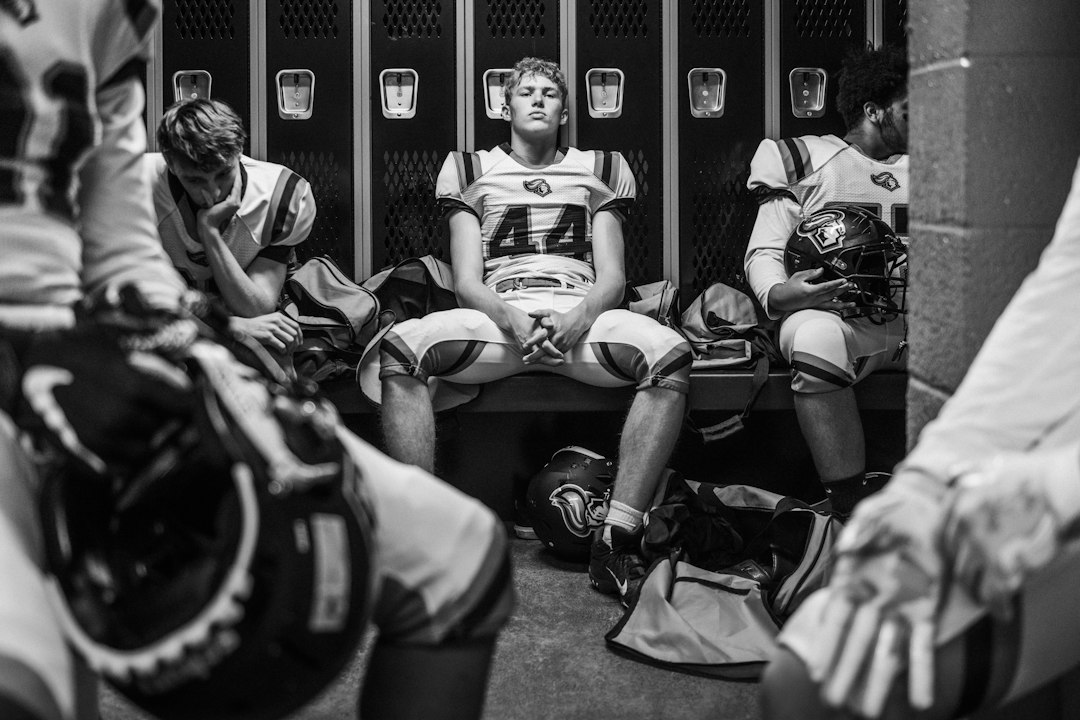




The alarm goes off at 6:47. Same time it always did — every fall Saturday for four years. And for one half-second before your brain catches up, your body already knows what comes next. Cleats. Bag. Field.
Then it remembers.
That gap — two or three seconds between waking and remembering — is the most precise description anyone has offered for the first fall without sports. Not sadness in the clean, nameable sense. Not emptiness. Something closer to reaching for a light switch in a room where the wall has been moved two inches to the left. You're not lost. But nothing lands quite where you expect it to.
If that's what brought you here, this article is written for you. Not for the professional athlete with a retirement press conference and a financial advisor in the room. Not for the college senior who at least knew a final season was coming. For the high school athlete who played their last game in April or May, walked to the parking lot after the final out, and stepped into September wondering why everything feels subtly, persistently wrong.
The Season That Stopped Without Saying So
Fall is a sports season. That isn't sentiment — it's the structural reality of how your last four years were organized. September meant practice schedules, early dismissals, lineup cards, and a specific kind of 9pm exhaustion that came from using your whole body all day. The calendar had a shape. Your week had a spine.
Now September is just September.
What you're navigating has a name in sports psychology, though it almost never gets applied to high school athletes: athlete identity foreclosure. It's the disorientation that surfaces when a significant portion of your self-concept — the part built around being a player, a teammate, a person with a position and a number — suddenly has no arena to perform in. The literature on this experience concentrates almost entirely on collegiate and professional transitions. But the mechanism doesn't care what level you played at.


A 2019 review in the Journal of Clinical Sport Psychology found that athletes who organized their identity heavily around sport participation experienced measurably higher psychological distress during transition periods — independent of the level at which they competed. The distress wasn't about prestige or scholarship loss. It was about the structure disappearing.
That finding matters. It means what you're feeling this fall is not an overreaction. It's not something to push through faster because you "were only in high school." It is a documented, specific response to a real structural loss — one that deserves to be treated as such.
What makes the high school version particularly disorienting is the absence of any ceremony around the ending. Professional athletes get farewell tours. College seniors get senior days and at least the cognitive preparation of knowing their final season is the final one. High school athletes often play their last game in a regional tournament, lose by two runs in the sixth, and walk to the parking lot with no particular awareness that the walk is the last one. No announcement. No transition protocol. Just a gap where the schedule used to be.
What Your Body Is Still Expecting
The physical dimension of this transition gets almost no attention, and it should get more — because it explains a lot of what feels inexplicable right now.
For four years, your body operated inside a specific seasonal rhythm: conditioning in summer, ramp-up in late August, full competitive load through the fall. Your cardiovascular baseline, your sleep architecture, your cortisol pattern across the week — all of it calibrated to that cycle. When the cycle stops abruptly, your body does not immediately revise its expectations. It keeps waiting for the signal that practice is coming.
This is why the Saturday morning confusion is so particular. It isn't purely psychological. Your nervous system has been trained to prepare for physical output on those mornings. The preparation runs before your conscious mind catches up — which is why you feel the pull before you remember there's nowhere to go.
In conversations with athletes moving through this specific transition, the physical restlessness surfaces early and gets noticed late. "You look fine" is not a useful observation when what's wrong is internal and structural. Some of what athletes describe in the first fall without sports:
- Waking earlier than intended, with a vague sense of something unresolved
- Afternoon fatigue despite not having trained
- Irritability on weekday evenings — the hours that used to be practice
- The phantom urge to check a schedule, a group chat, a coach's announcement that isn't coming
None of these are clinical signals. They are the signs of a body recalibrating from a rhythm it lived inside for years. That recalibration takes longer than most people expect — often the full fall season before a new baseline begins to settle.
The Phantom Schedule and What It's Actually Saying
Baseball and softball athletes describe one specific behavior more than athletes from other sports, and it's precise enough to name directly.
They keep opening the old team group chat. Not to send anything. Just to check. For weeks after the season ends, the habit of monitoring that channel runs on autopilot — because the channel was never just a communication tool. It was daily evidence that you were part of something with ongoing operational reality. The schedule made the season real. The chat made the team real. When both go quiet, the silence means something beyond a lack of activity.
Marcus D., 18, described checking his team's group chat every morning for nearly a month after the season ended. Nothing was ever posted. He knew nothing would be posted. But the act of checking was how he had participated in the team's existence — and the habit outlasted the reason for it by weeks.
The phantom schedule works identically. You're not checking because you forgot the season is over. You're checking because the act of checking was part of how the season was real. Stopping the check means accepting that the reality has ended. That acceptance takes longer than the calendar would suggest it should.
This is also why "just find something else to do on weekends" lands as hollow advice. The weekends weren't blocks of time being filled by sport. They were organized around a shared purpose, with people who knew your specific role and expected your specific presence. Replacing the time doesn't replace the structure that gave the time its shape.
Life After High School Baseball: What the First Year Actually Looks Like
The transition literature on life after high school baseball — the athlete retirement transition at the high school level — is almost nonexistent. What exists was written for professionals managing public identity and financial planning concerns. The high school version is quieter, and in some ways harder precisely because of that quiet.
Here is what the first year tends to look like, described by athletes who lived it:
Fall: The disorientation phase. Everything feels marginally wrong in ways that resist articulation. The weekends are the sharpest. The mornings. The specific quality of October light on a baseball diamond. This phase isn't a problem to optimize away — it's a period to move through. Attempts to skip it by immediately filling the time rarely work. The disorientation has to be acknowledged before it recedes.
Winter: The comparison trap. College-committed teammates start posting from their new programs. D1 signings, campus visits, fall practice photos. The comparisons feel involuntary and they feel bad. What's useful to know here is that the feeling isn't primarily envy — it's the absence of a clear narrative for your own next chapter. They have a story. You are still locating yours. Stories take longer to find than people expect, and finding them rarely happens on someone else's timeline.
Spring: The most concrete month of loss. April arrives and baseball season starts again — at your old field, with the current varsity team, without you. The field is right there. The season is happening. You are not in it. Most athletes who have navigated this describe spring of the first year as the sharpest moment, more specific and more physical than anything in the fall.
Summer: The turn. Not arrival at something better — just the recalibration completing. Enough time has passed that the previous rhythm no longer feels like the default. A new pattern has begun to form. The phantom schedule has mostly gone quiet.
What to Actually Do With a Free October
The most common advice given to athletes in this situation is to find a replacement — join a rec league, stay busy, keep the body moving. These aren't wrong suggestions in isolation. But they treat the disorientation as a scheduling problem. The disorientation is an identity problem. Filling the schedule doesn't resolve it.
The approach that tends to actually work involves two things running at the same time, not sequentially.
Let the fall be what it is for a few weeks. The disorientation is information. It's telling you that what you lost mattered — specifically and significantly. Giving that loss a few weeks of honest recognition isn't wallowing. It's proportionate. You built something over four years. It ended without a proper ending. Acknowledging that directly, before rushing to replace it, is not dramatic. It's accurate.
Reconnect with the physical experience of competence. This is different from filling the schedule. It means deliberately seeking activities — not necessarily sport — that give your body the experience of being used well and feeling capable. Lifting, running, pickup games with no stakes, hiking, swimming — anything that returns the signal that your body is still a functional, capable thing. Part of what sport provided was the regular experience of physical competence. That experience can exist outside of sport. It just requires intentional seeking rather than automatic scheduling.
What consistently does not help: passive recreation that asks nothing of the body, extended inactivity, and sustained comparison of the current fall to the previous ones. The comparison is human and inevitable in small doses. As a primary activity, it extends the disorientation rather than moving through it.
The Part That Transfers
Every athlete who has moved through the first fall without sports and come out the other side describes some version of the same realization — usually in hindsight, usually in the second year.
The sport gave them something specific that transfers. Not the sport itself. The capacities the sport built through years of repetition and stakes.
The ability to function inside a structured team effort. The ability to receive coaching without ego collapse. The ability to fail publicly and return the next day without needing the failure to mean something permanent. The ability to read a situation quickly and adjust. The ability to perform when tired and uncomfortable and with something on the line. These are not baseball skills. They are durable human capacities that baseball — or softball, or any team sport practiced seriously over years — develops with unusual efficiency.
The first fall is disorienting partly because those capacities feel, temporarily, like they have no arena. They have many arenas. The arenas don't announce themselves the way tryouts did. Finding them is the actual work of the transition, and it is work that most athletes who commit to it describe, eventually, as more formative than any individual season they played.
That's not consolation. That's the actual arc.
Your jersey is still out there waiting.
Design yours in minutes and see your name and number exactly the way you remember it.
Frequently Asked Questions
Is it normal to feel this disoriented after high school sports end, even if I wasn't a standout player?
Yes — and the research is specific on this point. The disorientation after high school sport ends is not proportional to how successful you were as a player. It's proportional to how central the sport was to your daily structure and your sense of identity. A player who started every game and a player who came off the bench for four years can experience equally significant transitions — because both organized four years of their life around the same rhythm, the same team, and the same sense of belonging. If it felt significant while it was happening, its absence is a significant adjustment. That's not dramatic. It's proportionate.
How long does the disorientation actually last?
There's no universal answer, but athletes who describe moving through this transition well tend to report that the sharpest phase — the phantom schedule, the morning confusion, the strange weekends — lasts roughly six to ten weeks into the fall. The broader recalibration, where the previous rhythm genuinely stops feeling like the default, tends to complete somewhere around the following summer. That's a longer arc than most people expect. Anticipating a faster resolution tends to make the transition harder, not easier, because every week that still feels off reads as a failure to recover rather than a normal part of the timeline.
Should I try to keep playing in rec leagues or pickup settings, or take a full break from the sport?
Both can work. Both can backfire. The honest question to ask yourself is this: can you play in a lower-stakes setting and enjoy it for what it is — or will every game function as a comparison to what you used to have? For athletes who can genuinely participate without measuring, continued play often helps. For athletes who find that every pickup game highlights the gap, a clean break tends to serve them better. Neither answer is the wrong one. The wrong move is choosing based on what seems like the tougher, more stoic option rather than what's actually true about how you experience the sport right now.
What do I do about the teammates who are playing in college — the social media posts, the highlights?
Mute them without guilt, at least for this fall. This is not bitterness and it's not permanent. It's a practical acknowledgment that daily exposure to a parallel life that diverges exactly where yours hurts is not useful in the disorientation phase. You can unfollow and refollow later. You can congratulate sincerely and then close the app. The comparison trap in winter is worst for athletes who were consuming the most during the fall. The reduction is simple, it costs nothing, and it helps more than most athletes expect it to.
See also: the grief that comes with losing your athletic identity | what it means to carry an athletic identity into regular life | why those senior season memories still feel so close | adult recreational leagues that scratch the competitive itch