

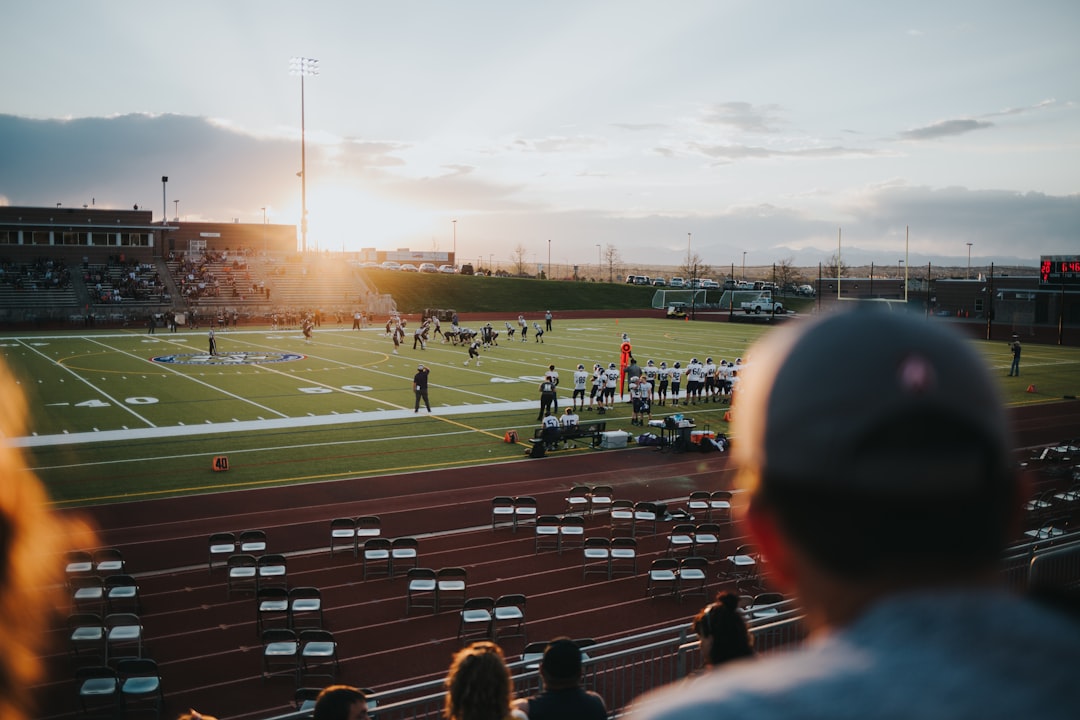




You already know what this feeling is.
Even if it hasn't happened yet, even if there are still Friday nights left in the season — some part of you already knows it's coming. Every senior year high school football player carries that awareness somewhere behind the sternum, quiet and persistent, like a sound you can't quite locate. The season is the same as every other season. And it is nothing like any other season that came before it.
The top ten results for this search will tell you how to get recruited. How to build your highlight reel. How to plan for what comes after. Those are useful things. But they're not why you're here at this particular moment.
You're here because you want someone to acknowledge what this actually feels like. The weight of it. The strange doubleness of loving every practice while already grieving it. The way the smell of a freshly cut field under the Friday night lights (grass, sweat, the faint bite of November air) now carries a significance it never carried in your freshman year.
This is that article.
What Makes the Senior Season Different Before the First Kickoff
There's a shift that happens in the offseason before your final year, and most players can't pinpoint exactly when it occurred. One day you were just playing ball. Then somewhere between the last game of junior year and the first day of two-a-days in August, the whole thing changed color.
Suddenly you're noticing things you never noticed before.
The specific sound of cleats on concrete as you walk from the locker room to the field. The way the practice field looks under the late-summer heat, that particular shade of green before the grass starts to wear thin in the middle. The way the sideline fills up before a game: helmets resting on the ground, chinstraps unbuckled, the same pregame rituals your team has been running so long nobody remembers who started them.


You're noticing because some part of your brain has started cataloguing. It knows, even if you haven't consciously decided anything, that these details are finite now. They have a number attached to them, and that number is getting smaller.
This is one of the quietly profound things about the end of a high school football career — it turns ordinary moments into something worth remembering. The season becomes its own memorial, running alongside itself in real time.
If you talk to former players, most will tell you this dual awareness (fully present AND already nostalgic) is nearly universal among seniors, regardless of whether they plan to play in college. It's not about the future. It's about what's being completed.
The quarterback with the D1 offer and the backup lineman who's closing out his playing career in November feel the same thing on some afternoons at practice. The talent level is different. The stakes afterward are different. The feeling of this being the last time it's all like this — that part is identical.
The Architecture of a Senior Season: From Two-a-Days to Senior Night
Two-a-Days
There's a specific cruelty and a specific beauty to how football chooses to end. Unlike baseball, which stretches its farewell across months and gives you time to rehearse the goodbye, football compresses its emotional weight into ten or eleven Friday nights and then stops sharply. There's no patience in it. Four quarters at a time, one snap at a time, and then it's simply gone. Design your own custom football jerseys.
The last season high school football gives you is short enough that you never really see it coming. You practice in the August heat of two-a-days, when the shoulder pads are heavy and the water breaks are never long enough. You play through the grind of a long bus ride to a road game when everyone's legs are heavy and nobody's sleeping enough. You argue over the depth chart and playing time and who left the locker room a mess. It's deeply, relentlessly ordinary.
And that ordinariness is the gift. The season doesn't announce itself as precious. It just keeps happening, game by game, and you keep showing up, and eventually you realize that showing up is the thing. That the accumulation of ordinary days is what you'll miss most.
Senior Night
No moment in the final season is more explicitly designed for grief than senior night football.
Every program does it slightly differently: some do it before the last home game, some halfway through the season — but the structure is the same everywhere. You walk out to the 50-yard line. Your parents walk with you. Your name gets read over the PA system. Someone hands your mother flowers. Your coach says something that is somehow both adequate and completely inadequate for the moment.
And you stand there in your jersey, on your field, under the Friday night lights you've played under for four years, and you try to look composed.
The thing nobody tells you about senior night is that the composure usually holds right up until it suddenly doesn't. It's rarely the big moments that break it. It's the specific small detail (the way your dad's hand lands on your shoulder, the way the crowd sounds when your name gets called, the face of the freshman who's going to wear your number next year) that finds the seam in the armor.
That moment of not-quite-composure is not weakness. It's the appropriate response to something that matters. Every player who walks that line and feels something is right on schedule.
The Last Snap
Marcus T., 22, played middle linebacker for a small-school program in central Ohio. He still remembers the down: fourth and goal, his team down by one, seven seconds on the clock. He filled the gap and met the running back at the line. The whistle blew. The game was over. The season was over. He stayed down on one knee on the turf for exactly one second before he understood what had just happened. "I didn't even feel it," he said. "Not right then. It hit me about an hour later in the parking lot."
The final snap in high school football is rarely cinematic. Movies would have you believe it ends with a Hail Mary. A last-second touchdown as the clock hits zero. A game-winning field goal that splits the uprights with the season on the line.
For most players, the last snap high school gives you is something quieter. A run stuffed at the line. A pass that falls incomplete on fourth down. A punt that drifts out of bounds. The final moment of your playing career arrives in an ordinary play you couldn't have predicted, in a quarter you couldn't have scripted, and it's over before you can properly hold it.
This is not a disappointment. This is exactly right.
Because how it feels to play the final high school game (really feels, not how it looks in the memory you curate later) is that you are completely in it until you suddenly aren't. The snap is urgent and total and real. You're reading the formation, hearing the snap count, taking your assignment. You're a player doing the thing you do. And then the final whistle blows, and you are something else. Someone who was a player. Past tense, arrived without announcement.
The walk to the locker room after the final whistle is one of the most specific experiences in youth sports. It's a hundred yards, from the 50-yard line to the tunnel, and you've made that walk dozens of times. This time, something in the body knows it differently, even if the mind is still catching up.
What the Final Season Teaches That No Other Season Can
There is a particular kind of attention that scarcity produces, and the senior season is the only season that gives it to you while you're still playing.
In freshman year, you take the time for granted because there's so much of it ahead. In sophomore year, you're learning. In junior year, you're competing. In senior year, you see it all (the learning and the competing and the camaraderie) through the specific lens of knowing it ends in November.
That lens changes everything.
The teammate who drives you crazy at practice becomes more bearable because you know you'll miss him. The coach whose pre-game speech you've heard seventy times starts to sound different, because you're counting how many more times you'll hear it — and you begin to suspect his voice will still be in your head when you're forty. The bus ride home from a loss, which in any other season is just uncomfortable, becomes something you notice yourself being present for.
There is genuine educational value in this. Not the kind that colleges evaluate. The kind that doesn't show up on transcripts.
The final season teaches:
- That the ordinary is what actually constitutes a life
- That loving something completely does not protect you from losing it — and that this is fine, that the loss is part of the love
- That a team is a specific, temporary thing that will never be exactly this configuration again, and that this is what makes it worth anything at all
- That effort given to something that's ending is the only effort that fully counts
These are not lessons that can be rushed or front-loaded. They require the specific pressure of finality to become visible. The senior season is the only mechanism that delivers them.
After the Final Whistle: The Hours and Days That Follow
The game ends. The team gathers at midfield. Somebody cries. Somebody else tries not to. The handshake line with the other team happens the way it always does (quick grip, quick look, keep moving) except this time there's no "see you next week" anywhere in the future.
The shoulder pads come off. The helmets go back into the lockers. The field empties out.
And then there's the strange open space of a Tuesday evening in November when you would normally have practice.
According to the NCAA's most recent participation data, roughly 7% of high school football players go on to play at the collegiate level. For the vast majority of players, the last game of their senior season is genuinely the last competitive game of their lives. This isn't a crisis. It's a threshold. But it's a real one, and it deserves to be named rather than quietly processed alone in the parking lot.
The days after the final game have their own texture:
- The physical feeling of not having to be somewhere
- The muscle memory that persists: the instinct to grab a helmet, the habit of checking the Friday night forecast
- The conversations with teammates that have a different register now, because the shared context that organized your days together no longer operates in real time
Most former players describe a week or two of low-grade disorientation before the winter reorganizes itself around them. This is the appropriate aftermath of something that mattered, not a sign that anything is wrong.
The jersey comes off for the last time and hangs in the locker. Or the closet. Or gets folded into a box. And it carries, in the specific way that objects can carry things, the complete record of everything that happened while you wore it. Years later, you'll wonder what to do with it: keep it, donate it, or frame it — and the weight of that question will finally make sense.
The Piece of It That Stays
Here's what the recruiting articles can't tell you, because it's not useful information in the traditional sense.
The part of the senior season that stays is not the statistics, not the wins and losses, not even the individual performances, though those matter.
What stays is the feeling of a specific evening on the practice field during a late-season week when the light was doing something particular and everyone on the team was loose and laughing about something that nobody will be able to reconstruct later, and for about ninety seconds everything was exactly right.
That ninety seconds is the actual inheritance of the senior season.
It's not transferable. It can't be ranked or recruited. It won't appear on a highlights reel. It will simply be there, thirty years from now, appearing without warning in the middle of an ordinary Wednesday, as vivid and specific as the day it happened.
Every player who showed up for the last season high school football offers (who played through the grind and the cold and the team drama and the ordinary losses) carries one of these moments. Or several. They accumulate quietly across a season that is simultaneously too short and catastrophically short.
The senior year does not owe you a championship. It does not owe you a last snap in the spotlight. It owes you nothing, and it gives you everything anyway — if you were present enough to receive it.
That's the only real instruction: be there for it. The details you pay attention to now are the ones that come back to you later. And when they come back, when someone you love turns out to have lived through the same thing, you'll know how to honor it, whether that's a long conversation, a game ball, or a gift for someone who played football in high school.
Your jersey is still out there waiting.
Design yours in minutes and see your name and number exactly the way you remember it.
Frequently Asked Questions
How do most senior year high school football players describe the emotional experience of their final season?
Most players describe a layered experience that combines genuine joy with background grief: a dual awareness of being fully present in a season while simultaneously processing that it's ending. The feelings don't cancel each other out. The love for the game and the sadness about its conclusion coexist throughout the season, and the intensity of both tends to peak around senior night and the final few games.
What typically happens on senior night football, and how should players prepare emotionally?
Senior night typically involves a pre-game ceremony where seniors walk out with family members to the 50-yard line, are introduced individually, and are recognized by the program. Emotionally, players often find the specific small details (a parent's reaction, a coach's words, the crowd's response) more affecting than the formal ceremony itself. There's no useful preparation beyond deciding to be present for it and not apologetic about whatever you feel.
Is it normal to feel a sense of loss after the end of a high school football career, even if you didn't plan to play in college?
It's not only normal — it's nearly universal. The end of an activity that has organized your schedule, identity, and social world for four years creates a genuine transition, regardless of what comes next. Most former players describe a brief period of disorientation after the final game before the rest of life reorganizes around them. Naming it directly tends to make it easier to move through.
What's the best way to honor the last season high school football gives you while you're still in it?
Pay attention to the specifics while they're happening. The sounds, the rituals, the particular texture of your team's dynamic this year. Don't try to make every moment significant — that makes it exhausting. Just let the ordinary moments register. The ones that stay are usually the ones that arrived without announcement.
See also: the grief that comes with the end of your athletic career | why senior night hits harder than anyone expects | how your athletic identity begins to shift after high school | why those senior season memories stay so sharp years later