

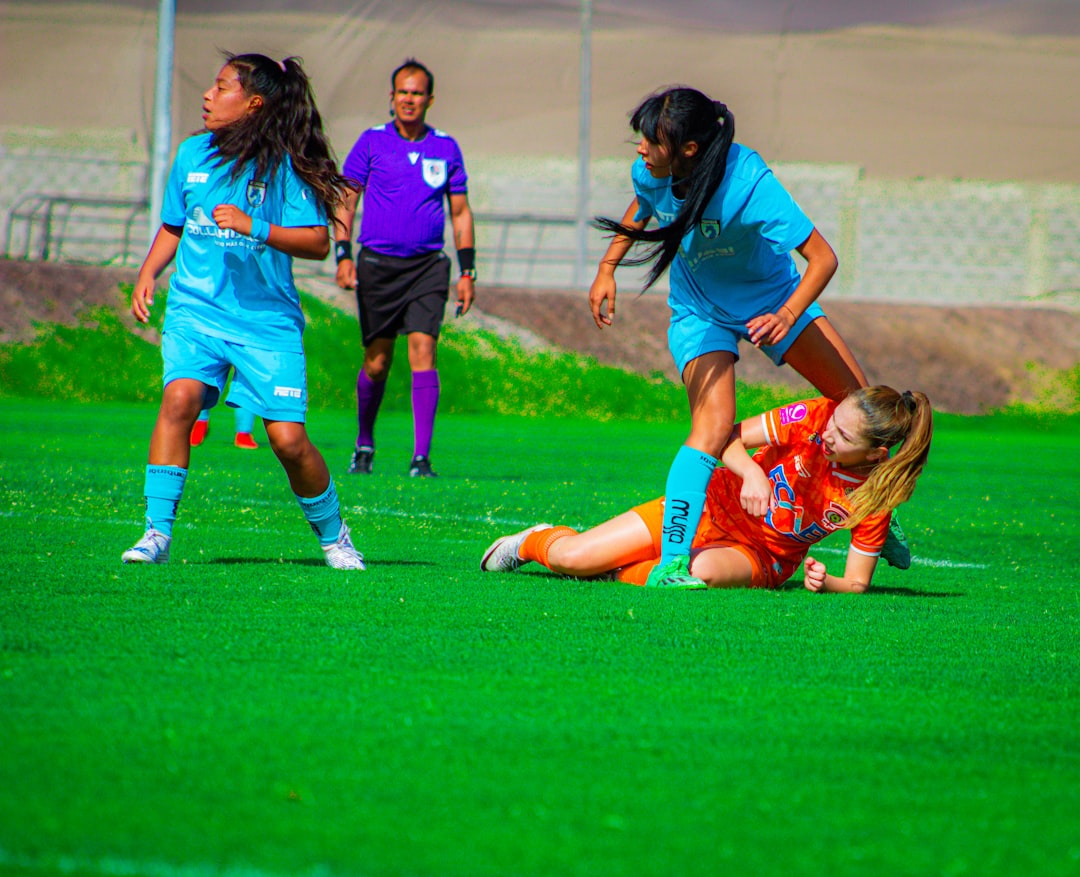




There's a moment that happens on a youth soccer sideline that nobody really talks about.
Your daughter makes a run — a perfectly timed diagonal, the kind that opens up space she couldn't have seen unless she already felt it — and before you can think, your body leans forward. Your hands come up. Something rises in your chest that is not quite pride and not quite memory but lives somewhere between the two.
If you're a youth soccer parent and a former athlete, you already know the moment I mean. You've been there. You've felt it. And you've probably spent a few seconds afterward wondering why it hit you so hard.
This article is about that moment. About what it means to watch your child play the sport that once formed you. About the strange, specific ache of sitting on the outside of something you used to live on the inside of. And about why, if you played — really played, for years, in a way that made the sport part of your identity — the sideline is never just a sideline.
You Never Really Left the Field
Every former athlete carries the game with them. Not as nostalgia, exactly — more like a second language you learned young enough that you still think in it sometimes. The body remembers things the mind has filed away.
When your daughter controls a ball that's coming fast and at an awkward height, something in you reads the physics before she connects with it. You know what a first touch that sets up the next move looks like versus a first touch that doesn't. You know the body posture that means she's about to shoot versus the posture that means she's looking for the pass. You know all of this in a way that the parent next to you who never played simply does not.


That knowledge doesn't go away just because you stopped playing. It sits in you. And on a Saturday morning with dew still on the grass and small cleats tearing through it, all of it comes flooding back, because you remember the field that made you.
This is what it means to be a youth soccer parent who was a former athlete. You are never just watching. You are simultaneously watching, remembering, understanding, and feeling — all at once, through the specific lens of someone who has been exactly where your daughter is standing.
The soccer moms who drove an hour to watch through chain-link fences? The ones who memorized the offside rule before most people even knew it was complicated? They weren't just supportive parents. They were former athletes, or partners of former athletes, or people who had spent enough years inside the culture of competitive sport to understand that what was happening on that field was serious and formative and deeply real.
They were right to treat it that way.
What You're Actually Watching When You Watch Her Play
In our experience talking with former athletes who are now raising young players, the hardest thing to articulate is this: you're not watching one thing. You're watching at least three things simultaneously.
You're watching your daughter, specifically. Her particular way of moving. Her tendencies — does she cut left when she's nervous? Does she look for the easy pass when the right play is the hard one? You know her game in a way her coach is still learning.
You're watching the game itself. The shape of it. The spaces that are opening and closing. The moment before a goal when the geometry of the field shifts just slightly and something becomes possible that wasn't possible two seconds ago. You see all of this because you were trained to see it.
And you're watching yourself at her age. This is the one nobody says out loud. But it's there. Every time she does something you recognize — not because she learned it from you, but because it's the same instinct, the same competitive reflex, the same read of the game that you had at eleven or thirteen — you feel something that doesn't have a clean name.
It's recognition. It's continuity. It's the strange experience of seeing your own athlete identity reflected back at you from a decade or more in the past.
Priya M., 38, played collegiate soccer before trading the field for a career in healthcare. She describes watching her daughter's first real competitive season as "disorienting in the best way — like being handed a photograph of something I'd forgotten I was." What she noticed most was that her daughter had developed a habit of tracking the goalkeeper's feet before every shot — exactly the way Priya had been coached in high school. Nobody had taught her daughter that. She'd figured it out on her own. "That moment felt like proof of something I couldn't explain," Priya said. "Like the sport was a thread connecting us."
That's the word. Thread. The sport is a thread.
The Weight of What You Know (And When to Hold It Back)
Here's where it gets complicated for former athletes on the sideline.
You know things. Real things. Things that took years to learn, things that cost you something to understand — a bad season, a lost tournament, a coach who pushed you past comfortable into competent. You have that knowledge, and it lives in you, and when you watch your daughter make the same mistake you made at her age, every cell in your body wants to tell her the thing.
The thing that would fix it. The thing someone told you at thirteen that you didn't understand until you were sixteen. The thing.
The former athlete's great sideline discipline is knowing when to speak and when to sit with what you know.
This is not about being passive. It's about something more precise: understanding that what formed you was not the advice you were given but the process of figuring things out inside the crucible of competition, where the stakes felt enormous and the decisions had to be made in real time.
Your daughter needs that crucible. The same one you had. Not the shortcut through it — the thing itself.
The parents who got this right — the ones whose kids went on to really love the sport and really grow inside it — tended to be the ones who saved their knowledge for the quiet moments. Not the drive home from a tough loss, when emotions are still raw. Not the sideline, where correction lands as criticism. But later. Over dinner. When she brings it up herself. When she asks.
If you played, you know the coach who respected that timing — who could look at you after a rough practice and say exactly the right thing in exactly the right register. Be that person. Even when it's hard. Especially when it's hard.
The Identity Shift Nobody Prepares You For
There's a version of this article that's purely warm and celebratory. And that version is true. It is genuinely wonderful to watch your child play a sport you love, to see them discover something that once anchored you.
But there's another layer that deserves acknowledgment, because former athletes are honest people who don't love being handed a sanitized version of their experience.
When you stop being an athlete and become a parent of an athlete, something shifts in your identity that takes time to fully process — and what happens to your athletic identity when your kid starts playing your sport is a shift few people see coming. For years — maybe a decade, maybe two — "athlete" was one of the first things you would have said about yourself. It organized your time, your friendships, your self-understanding. And then, gradually or suddenly, it stopped being the current chapter and became backstory.
Watching your daughter play reopens that chapter. Not always cleanly.
There are parents who admit, quietly and only to people they really trust, that the sideline can be hard. Not because they aren't supportive — they are, fiercely — but because watching someone else live the part of life you loved most is a particular kind of bittersweet. The sport didn't wait for you to finish. It moved on. And now it's hers.
The healthiest former athletes we've spoken with tend to have made a specific peace with this: they've separated their own athletic identity from their child's athletic journey. These are two distinct stories. Theirs is written. Their child's is still being written. The gift is not reliving your own story through your daughter — it's getting to be a witness to a completely different story that you happen to be uniquely equipped to understand.
That shift — from protagonist to witness — is one of the more significant emotional negotiations in the life of a former athlete who becomes a sports parent. It's worth making deliberately rather than stumbling through by accident.
Every Former Athlete Remembers the Parents Who Got It Right
If you played, you know the parents who got it right.
You remember them because they were rare enough to stand out.
They were the ones who were loud in the good moments — really loud, the kind of loud that felt like fuel — and quiet in the hard ones. Not absent. Not falsely cheerful. Just quiet in a way that communicated I see this, and it's okay, and we'll talk when you're ready.
They were the ones who talked about the sport with genuine knowledge but never turned the car ride home into a coaching session. Who celebrated a good defensive play as enthusiastically as a goal, because they understood what good defensive play actually costs a player.
They were the ones who showed up. Not to manage, not to perform their own investment for the other parents, but to actually be there — to stand in the wind or the rain or the blazing early-September heat and watch their kid compete with the full attention of someone who understood what competing meant.
Those parents shaped the experience. Not by controlling it. By honoring it.
If you played, you have everything you need to be that parent. The technical knowledge. The emotional fluency. The understanding of what it feels like to lose a game that mattered and have to show up again the next week. You've lived the whole curriculum.
The only question is how you carry it onto the sideline.
What the Jersey Actually Means
There's one more thing worth saying, and it's specific to the way former athletes understand uniforms.
A jersey is not just clothing. You know this. You knew it at twelve, and the knowing didn't leave you — it's why the girls who suited up before Title IX made it easy deserve one too.
When your daughter pulls on her jersey before a game — when the number is on the back and the name is right and she looks at herself in the mirror for a second before heading out — she is doing something you recognize from the inside. She is becoming the athlete version of herself. Stepping into the identity that the game gives her, the one that exists only on the field, the one that is braver and more focused and more capable than everyday life usually requires.
That moment is serious. It always was. It still is.
The jersey is the first signal to herself and to everyone else that this is who she is when it matters. Her jersey matters just as much as his — and as a former athlete, you are one of the few people in her orbit who understands why that's true without needing it explained.
Your jersey is still out there waiting.
Design yours in minutes and see your name and number the way you remember it.
Frequently Asked Questions
How do former athletes balance their knowledge with letting their child develop independently?
The most effective approach is creating a distinction between two roles: the parent on the sideline and the mentor in a quiet moment. The sideline is your child's space — keep it supportive and emotionally clean. Save your specific athletic knowledge for conversations she initiates, or for moments well after the game when the emotional temperature is low. Former athletes who maintain this boundary consistently report that their children come to them more often for genuine guidance, precisely because they trust that guidance isn't coming with strings attached.
Is it normal to feel emotionally overwhelmed watching your child play a sport you used to play?
Completely. The response is neurologically real — you are activating memory, identity, emotion, and competitive instinct simultaneously. Former athletes watching their children play are experiencing a unique form of recognition that most parents don't have access to. The intensity of that response tends to settle over the course of a season as the novelty adjusts, but the depth of feeling often remains. Many former athletes describe it as one of the more profound experiences of their parenting years.
How can a former athlete support a child who plays the same sport at a lower level of intensity or skill?
With care and specificity. The worst outcome is a child who senses — even without being told — that their parent's investment in the sport is conditional on performance matching some internal standard from the parent's own playing days. The best former-athlete parents are explicit with themselves about separating their own athletic experience from their child's. Your daughter's relationship with soccer is hers to define. Your job is to make sure that relationship has room to grow into whatever it's going to be — not to shape it toward what yours was.
What should a former athlete do when they strongly disagree with a coaching decision?
The general principle: unless there is a safety concern, stay out of it. Coaching disputes, even when the parent is objectively more knowledgeable than the coach, almost always damage the child's experience when the parent intervenes. If you have genuine technical knowledge that could help, the appropriate channel is a calm, private conversation with the coach — never in front of the team, never immediately after a game. Your child needs to learn to navigate relationships with authority inside the sport. Letting that process happen, even imperfectly, is part of what the sport is actually teaching her.
See also: what high school sports actually taught you that nothing else could | athletic identity doesn't disappear when the final whistle blows | why high school sports still mean so much to adults | the grief that comes with hanging up your cleats at 18