

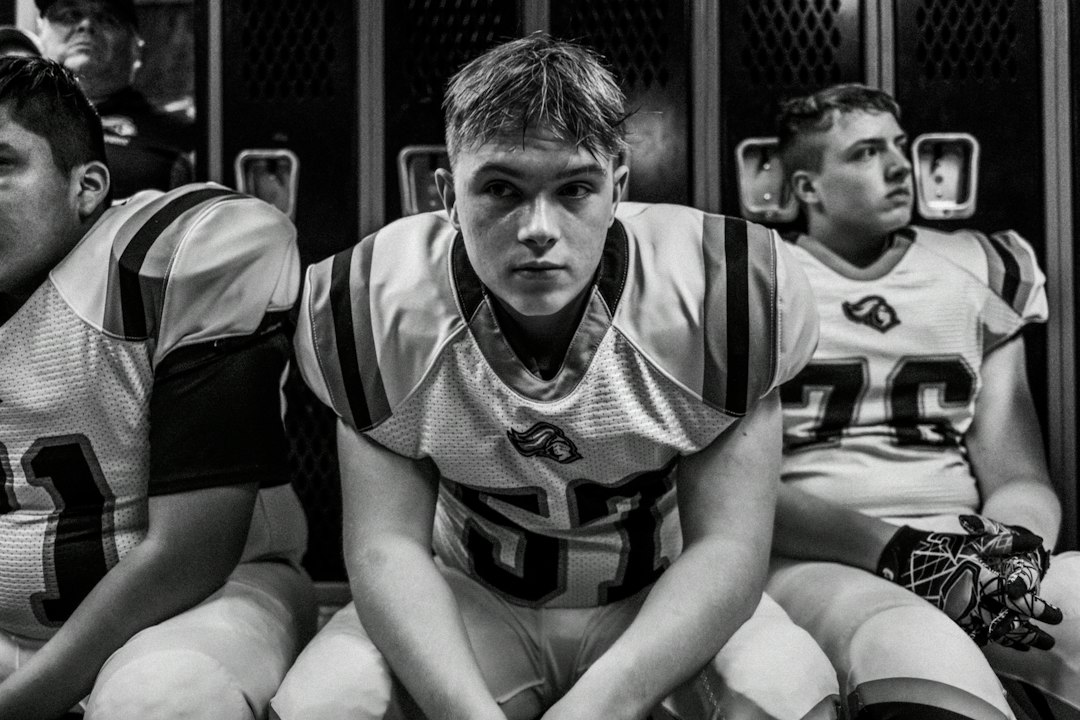




There is a smell that never fully leaves you.
Rubber soles baked against a gymnasium floor that hadn't been refinished in a decade. Canvas sneakers in a locker room where the air moved only when someone opened the door. The particular musk of shared equipment — pads, helmets, batting gloves — that had been through seasons you weren't part of yet. If you played high school sports in the 1980s, you know the smell. And right now, reading this, some part of your nervous system just recognized it.
High school sports in the 1980s occupied a different universe than the one today's athletes train in. Same fields. Same courts. Same fundamental games. But the culture, the equipment, the coaching philosophy, the daily reality of being an athlete — those were shaped by a set of conditions that produced something specific in the people who came through them. A generation of athletes who learned what they were made of in weight rooms that doubled as storage closets, on tracks with soft spots they memorized by necessity, under coaches who communicated primarily through disappointment.
This is an account of what that was. What it felt like. What it made.
The Physical World of the 80s High School Athlete
To understand what 80s high school athletics did to the people who lived it, you have to start with the environment — because the environment was the first lesson.
There was no climate-controlled turf facility. No altitude tent. No hyperbaric chamber tucked behind the varsity locker room. In most public schools across the country, the weight room was wherever they could fit one — a converted storage area, a corner of the wrestling room, a basement space with a ceiling low enough that overhead pressing required careful foot placement. The equipment was a universal machine with a fraying cable, a handful of Olympic bars, mismatched plates, and a mirror that had been cracked at some point before you arrived and would be cracked when you left.


You built yourself there anyway.
The track was cinder in older schools, crumbling asphalt in newer ones. The pool, where it existed, smelled like chlorine and competitive longing. The gymnasium floor had dead spots — particular squares of hardwood where the ball died instead of bouncing true — and the home team knew every one of them. You learned your facility. Not because anyone told you to, but because the facility didn't adjust for you. You were the variable. The building was fixed.
Weight training in the modern sense — periodized programming, progressive overload tracked in a spreadsheet, deload weeks built into the annual plan — didn't exist at the high school level in the early 1980s. What existed was the bench press, the squat, the power clean if your coach had attended a clinic recently, and a widely shared belief that more was better and that rest was what you did in July. Recovery science hadn't filtered down to public school athletics yet. You ran. You lifted. You ran again the next day. When something hurt, you taped it and continued.
That last part — the playing-through-it culture — produced something genuinely double-edged. Athletes of the 80s era developed a real capacity to perform under physical discomfort, to distinguish between pain that meant stop and pain that meant keep going. That capacity is not nothing. It shows up decades later in the way those athletes approach difficulty in other domains. The other edge of that same blade: stress fractures that went undiagnosed for weeks. Shoulders that needed surgery and got cortisone instead. Concussions that were called getting your bell rung and treated with a few minutes on the sideline. The era was not a golden age of sports medicine. Both things — the toughness it built and the cost it extracted — are part of the honest account.
The Uniform Was the Identity
Ask someone who played in the 80s about their jersey and something specific happens to their face.
Football jerseys were heavy — genuine double-knit polyester that absorbed sweat and held it through a four-hour practice, adding weight as the afternoon went on. The shoulder pads underneath were enormous by current standards, giving even undersized players the silhouette of someone significantly larger. Helmets were reconditioned rather than replaced — repainted, re-padded, re-caged — and they carried the visible history of previous wearers in ways the current owner noticed and chose not to think about too carefully.
Basketball uniforms ran small and satiny, the short-shorts-and-tank-top combination that looks remarkable in old photographs. The numbers were tackle-twill — sewn directly onto the fabric, raised and textured, with a physical weight you could feel when you ran your thumb across them. They weren't heat-transferred graphics that peeled at the edges after six washings. They were built into the uniform and they stayed there.
Baseball flannel persisted into the early part of the decade before double-knit polyester absorbed that sport too. Track singlets were thin enough to be nearly transparent. Field hockey players ran on grass in knee socks and pleated skirts through most of the decade. Volleyball uniforms, by modern standards, were extraordinarily minimal.
Every uniform in every sport shared one defining characteristic: it was issued, not selected. You wore what the program had. The colors were the school's colors. The size was whichever was closest to yours in the available stack. And the uniform showed wear — because programs didn't replace them annually. They bleached them, repaired them, retired the worst ones, and kept the rest in circulation. The jersey you wore had been worn before. It would be worn after.
That number on your back was a hand-me-down and an inheritance simultaneously. Whoever had worn it before had done something in it — won something, lost something, built something. When you pulled it on, you stepped into that lineage whether you thought about it that way or not.
What the Coaches Were Actually Teaching
Maria C., 54, grew up playing soccer in suburban New Jersey and still describes her high school coach the way people describe formative weather — something that altered the landscape permanently rather than passing through it. "He never once told us we did a good job," she says. "Four years. Not once. What he said, when things went right, was: 'That's the standard.' Just that. Nothing else." She made varsity as a sophomore. She played at the Division III level. She credits neither outcome entirely to natural ability.
The coaching culture of 80s high school athletics operated from a set of foundational assumptions. Some of those assumptions have held up under scrutiny. Others have not.
What held up: consistent accountability, high standards maintained regardless of scoreboard outcomes, and the expectation of effort as non-negotiable produce real competitive character. Athletes who trained in environments where excellence was the baseline — not celebrated but expected — internalized a relationship with standard-setting that persisted well beyond the sport.
What hasn't held up: emotional distance deployed as a deliberate pedagogical tool. The withholding of encouragement as a motivational strategy. The treatment of any acknowledgment of difficulty as evidence of weakness. These approaches produced athletes who were hard in certain ways and quietly struggling in others — struggling with things they had been trained never to name, in contexts where naming them would have been penalized.
What coaches in this era almost universally did well was teach the actual sport. The technical knowledge carried by 80s high school coaches was specific and deep, passed through chains of mentorship that went back decades — oral tradition from coach to coach, refined through seasons of direct application. How to execute a pick-and-roll. The mechanics of a proper power clean. The split-step before a return. Line footwork for an offensive guard. These weren't concepts absorbed from online tutorials. They were things coaches had played, studied, argued about, and refined, and they transmitted them with a specificity that demanded real attention from the athletes receiving them.
Practice was long. Three hours was ordinary. August football two-a-days were a ritual that several states have since restricted for heat-safety reasons — restrictions grounded in real data about heat illness in adolescent athletes. The conditioning was embedded in everything; there was no separate "conditioning block" because the entire practice was conditioning. If you weren't gasping at the end, the general read was that you hadn't been pushed far enough.
Sports psychology, as a discipline accessible to high school athletes, did not exist in any practical sense. What existed was the coach's version of pre-game mental preparation: team superstitions, competitive anger channeled into focus, and the occasional locker room speech that functioned more as theater than science. The theater often worked. That doesn't mean it was optimal. It means adolescents are receptive to narrative and ritual in ways that coaches, some of them intuitively, understood how to use.
What Stayed
The question worth sitting with, four decades later, is what actually persisted.
Not the specific skills — those erode without maintenance. Not the records — most have been broken. What persisted was the experience of constructing a capable version of yourself through sustained effort, inside a system that had no particular interest in managing your feelings about the process. The 80s high school athlete learned, through direct experience rather than instruction, that there is a version of yourself accessible only on the other side of doing a hard thing. That you cannot reason your way into that version. You have to earn it through repetition in conditions that are uncomfortable.
That lesson is durable in a way that's difficult to manufacture through other means.
A 2018 study published in the Journal of Youth and Adolescence tracking former high school athletes into mid-adulthood found that sustained team sport participation correlated with measurably higher outcomes in persistence, collaborative capacity, and tolerance for structured adversity — outcomes that held even when the subjects' physical activity levels had declined substantially in the years since. What the research is measuring, in part, is the residue deposited by those long practices on cracked-asphalt tracks and under gymnasium fluorescent lights that buzzed just slightly and nobody ever fixed.
The 80s athlete also learned to lose without dissolving — to come back to practice Monday and do it again. They learned to subordinate individual preference to team function, not as an abstract value but as a practical necessity the game enforced in real time. They learned that the number on the back of a jersey carried obligation, not just identity.
They also learned things that cost them. The suppression of physical pain as a norm. The equation of help-seeking with weakness. The performance of emotional neutrality as competitive virtue. Those lessons had real costs that showed up later — in bodies that carried unaddressed damage, in athletes who didn't have language for what they were experiencing because the language had been systematically removed from the vocabulary of their sport.
The honest accounting of the 80s athletic experience includes both registers. It was formative in ways that genuinely served the people who came through it. It was also incomplete in ways that left specific gaps. The athletes who thrived longest were, in many cases, the ones who found what the era gave them and supplemented what it withheld.
How the Game Has Changed — And What It Kept
Sit a 1984 high school basketball practice next to one running today and you are looking at two distinct sporting cultures sharing a rulebook.
Today's practice involves video review, individualized skill sessions, real-time biometric tracking, and a coaching staff that has received formal training in athlete mental health communication. The floor is the same dimensions. The basket is still ten feet. Everything surrounding the act of playing has been rebuilt.
The modern athlete has four genuine advantages over the 80s athlete:
- Sports science access: Recovery protocols, nutrition periodization, biomechanical analysis, and injury prevention approaches available at the high school level today would have read as speculative fiction in 1983.
- Psychological infrastructure: The cultural shift around athlete mental health has made it possible — still imperfect, but possible — to acknowledge and address psychological difficulty without the competitive penalty that would have applied in an earlier era.
- Equipment engineering: The materials, fit tolerances, and safety engineering in modern athletic equipment represent a substantive improvement over what was available in the 80s, particularly in head protection.
- Technical specialization: Year-round position-specific development has produced athletes who arrive at the college level with technical refinement their 80s counterparts didn't achieve until much later.
What the modern athlete navigates differently — not worse, but differently, with its own specific pressures:
- Perpetual documentation. The 80s athlete performed in relative privacy. A missed shot, a bad race, a turnover at the wrong moment — those stayed in the gym. Today's athlete performs into a camera feed that reaches an audience before the play is over. That is a categorically different psychological context.
- Early specialization pressure. The data on single-sport specialization before high school — on injury rates, on burnout incidence, on long-term athletic identity — is not encouraging. The 80s multi-sport default, which happened less by design than by the absence of year-round club alternatives, may have been accidentally protective.
Neither era produced superior athletes in some absolute sense. They produced athletes shaped by different pressures, different resources, and different cultural assumptions. The 80s produced athletes who were resourceful and mentally durable in specific ways. The current era is producing athletes who are technically refined and psychologically aware in specific ways. Both portraits are incomplete.
The Number You Were
Something gets lost when the conversation stays at the level of cultural comparison — what was different, what was the same, what each era did better. What gets lost is the granular, embodied, particular experience of being that specific person wearing that specific number on that specific team in those specific years.
Your number wasn't chosen from a dropdown. It was assigned. By seniority, by position, by availability — by whatever system your program used that had nothing to do with your preference. You took what you got. And then, over the course of a season or four seasons, wearing it in practice and in games and in the photograph your parents kept, it became yours in a way that selected numbers don't quite become yours.
When the season ended, you returned it. The equipment manager folded it into the pile for next year. Someone else would wear your number. Someone else would become that number, in the eyes of coaches who still remembered you when they saw it cross the field or the floor or the track.
A lot of those actual jerseys are gone now. Programs replaced them. Schools consolidated. Equipment rooms flooded, cleared out, started over. The specific object that absorbed four years of your formation is no longer in the world.
But the number is still yours. The name is still yours. The school colors still mean something specific when you see them — not nostalgia exactly, though nostalgia is part of it. Recognition. The recognition of the version of yourself that was built in that place, wearing that number, in those years.
That version of you deserves to be honored in something tangible. Not a direct copy of what was issued to you — something made in tribute to it. A custom jersey in your school colors, your number, your name, inspired by the uniform that made you part of something larger than yourself.
Your jersey is still out there waiting.
Design yours in minutes and see your name and number exactly the way you remember it — a tribute to the athlete you were and the team that shaped you.
Frequently Asked Questions
What was training like for high school athletes in the 1980s?
Training in the 1980s was high-volume and low-technology by any current standard. Most high school athletes worked with basic free weights, performed extensive conditioning runs, and practiced for three or more hours without the periodization, recovery protocols, or sports science support available today. Coaches built programs from direct experience and mentorship tradition rather than data. The result was mental toughness forged through repetition and sustained physical demand, frequently without sophisticated guidance on injury prevention or recovery management.
How were 80s high school sports uniforms different from today's?
80s high school uniforms were typically heavy double-knit polyester, issued by the program rather than selected by the athlete, and kept in circulation across multiple seasons. Numbers and lettering were tackle-twill sewn directly onto the fabric — raised, textured, built to last. Equipment, particularly football helmets, was reconditioned rather than replaced annually. These uniforms carried visible history and connected each wearer to the athletes who had worn the same number in previous seasons.
Did high school athletes in the 1980s play multiple sports?
Multi-sport participation was the norm in the 1980s. Most high school athletes competed in two or three varsity sports across fall, winter, and spring seasons, without the year-round single-sport club and travel programs that are now standard. Early specialization at the high school level was uncommon — less by philosophical design than by the absence of the club infrastructure that now makes specialization possible at young ages. Sports scientists now recognize that multi-sport participation during adolescence is protective against overuse injury and early burnout.
What made the mindset of the 80s athlete distinctive?
The 80s athlete formed in an environment that combined limited resources, high performance expectations, and minimal emotional support infrastructure. That combination produced athletes who were resourceful and accustomed to performing without external validation — and also athletes who had learned to suppress acknowledgment of difficulty in ways that carried real costs. The era's genuine contribution to mental toughness and its genuine gaps in psychological support are both part of the accurate account. The athletes who thrived longest were often those who carried what the era gave them and found ways to supplement what it withheld.
See also: what high school sports actually teach you that nothing else could | why high school sports still matter to adults decades later | the athletic identity many carried long after the final whistle | why senior season memories from that era remain so remarkably vivid | playing under the Friday night lights