




The Iowa High School Football Homecoming Game Off Due To Bad Student Behavior story out of Oskaloosa hit differently if you ever wore a number on a Friday night — because you know instantly, without needing the details explained, exactly what those players lost when that game disappeared.
If you ever taped your ankles in a locker room that smelled like sweat and Tiger Balm and something inexplicably like hope, you know what homecoming week feels like in your body, not just in your memory. There's an electricity to it. A weight that no other regular-season game quite carries. It's the night where everyone shows up — where alumni come back, where the whole town seems to exhale for four quarters — and in Oskaloosa this year, that night never arrived.
According to reporting from SI High School Sports, Oskaloosa's planned homecoming contest against Washington was forfeited following an incident involving students. The game was gone before the opening kickoff.
For anyone who ever ran out of that tunnel, that's not just a canceled game. That's something harder to name and harder to shake.
What a Forfeited Homecoming Actually Costs
You cannot reschedule homecoming. That's the part people who never played don't fully grasp. It's not like a rainout you make up on Tuesday afternoon when the fields dry out. Homecoming is a fixed point in a calendar that exists once per season, once per year, and for the seniors on that Oskaloosa roster — exactly once in a lifetime.
Every player on that squad had been pointing at this game in the quiet, almost embarrassed way teenagers admit that something matters to them. They'd been through summer two-a-days for this. Early morning lifts for this. Chalk talks and film sessions and the slow, grinding accumulation of a season building toward a week where everything feels a little more permanent, a little more worth keeping.

The Washington players who made the trip and found no game waiting — they lost something too. Road homecoming games carry their own specific memory. The hostile crowd, the borrowed atmosphere, the chance to be the team that ruins someone else's celebration. That story got taken from them the moment the forfeit was confirmed.
In our experience covering the intersection of sport and memory, few things land harder for former athletes than the image of a Friday night that simply didn't happen. Not because of weather. Not because of injury. Because of something that could have been prevented — and wasn't.
That particular flavor of loss is its own thing entirely.
Every Former Player Knows This Feeling
Remember being seventeen and having the week of the big game pull at you like gravity?
Practice was different that week. The coaches were either looser than usual or wound tighter than a drum — no middle ground, and either way you felt it in the air the moment you walked through the gym doors. The school hallways had that homecoming-week charge that cannot be manufactured: the spirit days, the pep rallies, the way the whole building seemed to be organized around Friday evening in a way it never was for a regular game.
Every former player knows what it feels like to walk onto the field for pregame warmups with the stands already half-full. To look up and see people who graduated five and ten years ago leaning against the fence because they came back for this specifically. To feel the weight of a game that means more than its record implications because the community is present, because everyone is watching, because this is the one Friday where high school football is the absolute center of the entire world for your entire town.
That is what the players in Oskaloosa did not get.
Marcus T., 34, played linebacker for a small Iowa town not unlike Oskaloosa. He still talks about his senior homecoming game the way some people talk about milestones that reorient everything — not the score, not even the final outcome, but the specific feeling of running out of the locker room with the band playing and knowing his whole family was somewhere in those stands. "I could pick out my dad's voice from the parking lot," he said. "That's what I remember. That's what I'd have lost if the game never happened."
The score fades. The sensory details stay with you for decades.
What the Forfeit Teaches — Whether Anyone Wants to Hear It
There is something uncomfortable in this story that former players understand from the inside: actions that seem disconnected from the game have a way of reaching all the way down into the game itself.
High school athletics exist inside a larger structure — a school, a community, a set of expectations about how teams carry the names of the places they represent. That was always true. Coaches told you some version of it. You wore the school's name on your chest, not just your own, and what happened off the field had the potential to affect what happened on it.
Most players absorb that lesson as an abstract principle. The Oskaloosa players — and the Washington players who made the drive — absorbed it as an actual lived consequence.
There is no editorial to write here about specific fault or blame. The details of the incident are not the point. The point is what the result cost, and what it cost is undeniable: a homecoming game that existed in everyone's preparations, in the game-week routine, in the senior players' mental countdown, was simply removed from the schedule before it could become a memory.
That is a hard way to learn something. It is also, in the long arc of what sport actually teaches, one of the things sport has always been in the business of teaching.
The Stands Were Already Set Up in Someone's Mind
Here is the detail that stays.
Somewhere in Oskaloosa, there was a parent who had already figured out where they were going to park. Who had the blanket ready for the October cold, the phone charged for the photos, the plan to text old teammates and say "come watch, it's homecoming." Who had told their kid — the one in pads — "we'll be there, we'll be loud."
Those plans dissolved too.
This is the ripple that cancellations create that rarely gets acknowledged in the coverage. The game is not only for the players. Homecoming specifically is the game where the community comes back to itself. The alumni return. The parents who drove their kids to 6 AM practice all summer long come to collect something — not a trophy, just the sight of their player on a lit field in front of a full crowd, doing the thing they've been grinding toward since August.
Former players understand both sides of this. You were once the player on the field. Eventually, you become the parent with the early parking spot and the blanket. The game bridges those two phases of life in a way almost nothing else manages to do cleanly.
When the game disappears, both versions of you feel the absence.
What Homecoming Actually Means When You're Standing in It
There's a difference between homecoming as a line on the schedule and homecoming as a felt experience. From the outside, it looks like a football game with extra decorations and a halftime ceremony. From the inside — from the position of someone who stood in that locker room the night before, who heard a coach give the kind of speech that lands because the moment is finally big enough to hold it — it is something else entirely.
It is one of the rare moments in a young athlete's life where everything seems to be simultaneously important and worth celebrating at exactly the same time. The record matters. The crown matters. The band matters. The people in the stands who drove an hour and a half matter. The fact that your name is on the back of your jersey, and that jersey is going to be in someone's photograph by the end of the night, matters in a way that is genuinely difficult to articulate until years later, when you're trying to explain it to someone who wasn't there.
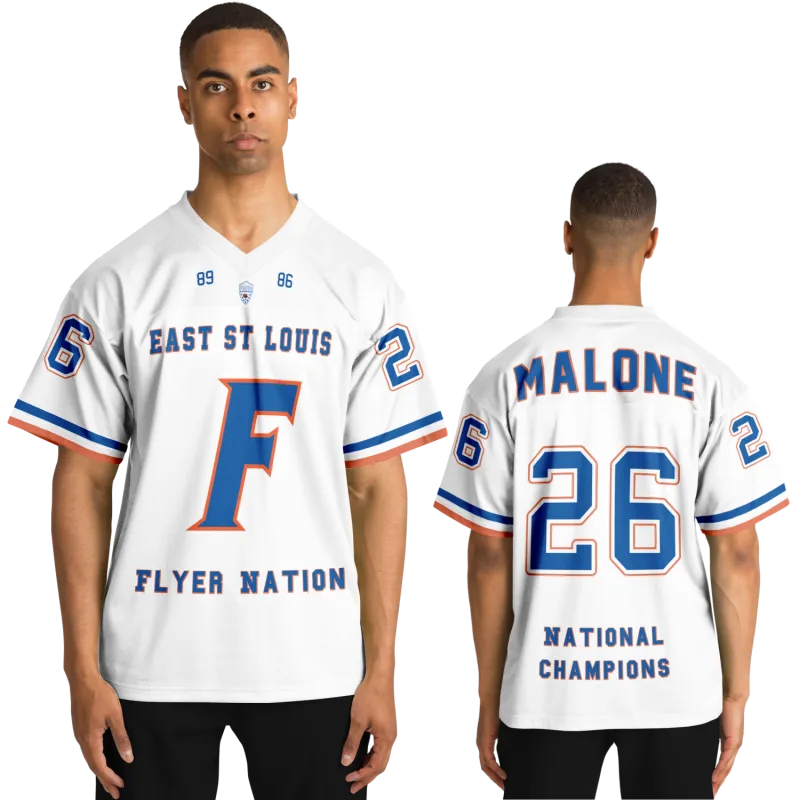
The jersey. Former players come back to it consistently — not always the wins, not always the stats, but the jersey. The way your number felt like it belonged to you specifically. The way seeing it hung in your locker on game day was its own kind of signal that tonight was real, that all the preparation had been pointing at something that was actually arriving.
For the Oskaloosa players who didn't get their homecoming game, there is a jersey that was put on and never got its night under the lights. That is the detail that lingers.
Your Jersey Is Still Out There Waiting
The game ends. The season ends. The career ends. What the jersey meant doesn't have to.
If you played high school football — or any sport, at any level — and you've spent more than five minutes thinking about what it meant to wear your number on a night that actually mattered, there's a way to carry that forward.
Design yours in minutes and see your name and number exactly the way you remember it — a tribute to the player you were and the nights that shaped you.
Not a generic keepsake. The one with your name, your number, your colors — inspired by the real thing you wore, built to put you back in that moment for as long as you want to stay there.
Frequently Asked Questions
What happened to the Oskaloosa homecoming game against Washington?
Oskaloosa's homecoming football game against Washington was forfeited following an incident involving students, according to reporting from SI High School Sports. The game was called off before it was played, leaving both programs without their scheduled contest and the Oskaloosa community without their homecoming night.
Can a high school football game be forfeited before it is played?
Yes. State athletic governing bodies and conference rules allow forfeitures in situations where conduct — by players, staff, or affiliated students — violates established standards. A forfeit before kickoff is less common than one resulting from an on-field situation, but it is a recognized outcome under most state athletic association guidelines. The Iowa High School Athletic Association maintains conduct and eligibility standards that cover these circumstances.
Does a pre-game forfeit affect a team's official win-loss record?
Generally, yes. Under most high school athletic association rules, a forfeit is recorded as a loss for the forfeiting team and a win for the opposing team regardless of whether the game was played. The specifics vary by state and conference, but the competitive record is typically affected in the same way as a played loss would be.
What do senior players lose when a homecoming game is forfeited?
For seniors, the loss is largely irreversible in one specific sense: homecoming arrives once per season, and for players in their final year, exactly once in their career. The competitive loss on the record is something a team can respond to in future games. The loss of the homecoming experience itself — the crowd, the ceremony, the specific feeling of that night — has no equivalent replacement on the schedule.
How rare are game forfeits in Iowa high school football?
Forfeits in Iowa high school football are uncommon, and pre-game forfeits tied to conduct incidents are rarer still. When they do occur — particularly for a game carrying the significance of a homecoming matchup — they tend to draw attention from the broader high school sports community precisely because of how unusual and consequential the outcome is for everyone involved.
See also: what high school sports teach you about discipline and community | the emotional weight of a cancelled senior night | why high school football still matters so deeply in certain states