

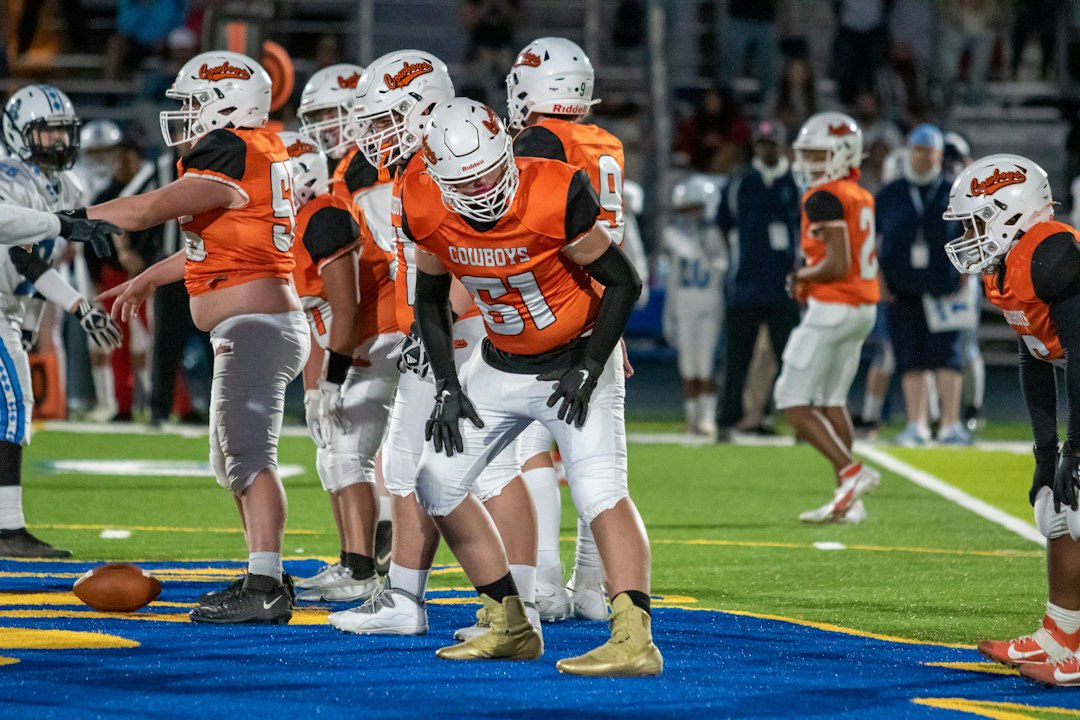




High school football traditions don't end when the final whistle blows — they move in with you and stay.
They live in the way you carry yourself into a difficult room. In what happens in your chest when stadium lights cut through an October sky on a Friday night. In habits and instincts your playing days installed so completely that you stopped registering them as something that was installed at all. The pregame meal, the bus ride that smelled like joint spray and anticipation, the locker room silence that nobody called for — those rituals were never really about football. They were about forming a version of you that would outlast the sport.
This is a catalog of the traditions every player still carries. And more than a catalog, it's a return to why they mattered then and what it means that they still show up now.
The Bus Ride: Where the Game Actually Began
Every former player remembers the bus. Not always warmly — cramped rows, windows that fogged and stayed that way, the one teammate's playlist that everyone complained about and privately needed to hear. But the bus ride was never really transportation. It was transition.
It was the last shared space before the game stopped being something you prepared for and became something you were inside.
On the bus, the team existed in a kind of suspension — between the ordinary world of school and homework and everything that didn't matter tonight, and the heightened world of the field where everything did. Nobody was fully themselves yet. Nobody was fully the player they were about to have to be. The bus was a threshold, and football has always understood, without anyone having to say so, that thresholds require their own ceremony.
Some teams prayed together the moment the engine turned over. Some went immediately silent. Some had a seating arrangement that was never written down anywhere and was never once violated — an unspoken map that new players absorbed quickly and freshmen got wrong exactly once. Some teams turned the music up loud enough that conversation became physically impossible, which was exactly the point. You didn't need to talk. You needed to arrive at the field already feeling like a team.


In our experience talking to former players across positions and eras, the bus ride surfaces more consistently than almost any other memory. Not because it held the most dramatic moments — the field kept those — but because it held the most shared ones. Fifty people breathing the same recycled air, carrying the same weight, moving toward the same thing for the same reason. That quality of collective experience is genuinely rare in adult life. Most people spend years searching for something that feels like it without being able to name what they're actually looking for.
What the Bus Built Without Saying a Word
The bus ride installed a mental architecture that athletes at higher levels spend serious time and effort learning to construct consciously: the intentional transition from ordinary state to performance state. The deliberate shift from who you are the rest of the time to who you need to be for the next few hours.
Players who went on to compete in college or professionally describe spending real resources — coaches, sports psychologists, elaborate warmup routines — trying to reproduce what the bus had always done automatically, structurally, and collectively. The bus handled the transition so invisibly that most players didn't recognize what it was doing until it was gone.
If you played football, you learned to shift gears before you understood that shifting gears was a skill worth learning.
The Pregame Meal: Superstition With a Fork in Its Hand
Before every Friday night game, there was a meal. The team organized it, or it happened at a teammate's house, or it was a specific restaurant that became — through one winning streak, through the gravity of routine — permanently and non-negotiably part of the sequence.
Pasta, almost certainly. The reasoning was loosely nutritional. The actual function was entirely psychological.
The pregame meal was the same every time because sameness was the point. You ate the same food in the same place at roughly the same hour because that consistency sent a specific signal to your nervous system: this is the sequence. This is how it goes before it goes well. We have done this before. We know what comes after this.
Superstition in sport gets dismissed as irrational, but it's actually sophisticated anxiety management in informal clothes. Athletes figured out empirically — through repetition, through the evidence of their own bodies under pressure — that routine reduces pre-competition anxiety. That familiarity signals safety to a system that is always scanning for threat. That doing the same thing before a high-stakes event borrows confidence from every previous time that same sequence preceded a good outcome. The meal was never about the pasta. It was about building a bridge between who you were sitting at that table and who you'd been the last time it went right.
Marcus D., 34, who played offensive line in the Texas Hill Country, still makes the same pasta dish the night before anything he considers a genuinely high-stakes day — a difficult client meeting, a performance review, a conversation he's been preparing himself for. He says it isn't a conscious decision anymore. His wife noticed the pattern before he did. "She asked me why I always made that specific thing before something important," he said. "I didn't have a great answer. I just said: it works."
That's the tradition living forward. The ritual outlasted the sport that created it because the underlying logic — preparation, sequence, borrowed confidence from prior success — turns out to apply to a great deal more than fourth-and-goal.
The Locker Room Before: The Room That Did the Real Work
If former players describe any single space with something close to reverence, it's rarely the field. The field was where you performed. The locker room before the game was where you became the person who could.
Coaches gave speeches in there. Some were memorable. A lot weren't, and that rarely mattered — the content was almost never what landed. What landed was the act itself: a coach or a captain standing up in that room and saying, in whatever words they found, I believe in what's about to happen. I believe in these specific people. Tonight, this matters.
Players taped each other's ankles and wrists with a focused efficiency that felt almost meditative — the rhythmic sound of tape pulled from the roll, the sharp smell of analgesic cream cutting through everything else. Equipment checks that were partly practical and partly a physical confirmation: pads on, chin strap buckled, gloves secured. The moment was actually arriving.
There was music. There was motion — people pacing, stretching, shadowboxing the lockers, finding whatever physical outlet matched the electrical feeling inside. And then the quiet came in without being called.
That locker room operated on a specific emotional logic: it converted private anxiety into shared purpose. Every person in the room was managing their own internal version of the same fear — the mistake, the wrong read, the moment where it might fall apart publicly. The room didn't address any of that directly. It held all of it, absorbed it, and transformed it collectively into something that felt, by the time the door opened, like readiness.
Most people never experience this kind of collective emotional alchemy. It's one of the real privileges of team sport, specific and difficult to describe to someone who hasn't lived it. It's also part of why former players describe adult professional life as structurally lonelier — not from self-pity, but from the honest recognition that something which was a built-in feature of their playing years has no obvious equivalent in most workplaces or communities.
The Smell That Collapses Time
Specific and entirely unreproducible. Former players describe the locker room scent with involuntary precision — the exact compound of plastic, sweat, adhesive, floor cleaner, and analgesic that means one thing and one thing only: it is almost time.
Smell encodes memory more directly than any other sense. A specific scent can return you, without warning and without permission, to a complete and embodied memory of a specific place — not just the image but the full physical feeling of being there. If you played high school football, you already know this firsthand, because it has happened to you. You walked into a gym somewhere, or a sporting goods store, or your kid's school locker room, and for three full seconds you were seventeen years old again, in that room, waiting.
That's the tradition asserting itself. Letting you know it never actually went anywhere.
The Handshake Line, the Coin Toss, the Lineup: Ritual as Mutual Respect
Before the game officially belonged to anyone, there was a sequence of formalities that carried more weight than their surface suggested. The handshake line between teams — formal, sometimes tense, occasionally genuine. The coin toss, which most players describe as feeling more significant than any rational accounting could justify. The lineup along the sideline for kickoff, which was simultaneously the longest and the shortest moment of the whole night.
These formal rituals served a function the sport understood clearly: they marked the boundary between ordinary time and the time inside the game. Within that boundary, different rules applied. Effort mattered in an absolute way. The scoreboard was the only real truth. Your teammates were the only people who fully existed in the world.
The handshake line carried a compressed emotional intelligence that players absorbed before they had words for it. You lined up across from the team you'd just competed against — sometimes the one that had beaten you, sometimes the one you'd beaten — and you went down the line, hand to hand, helmet to helmet. That gesture acknowledged something real: we were both in that same space tonight. We were both in it all the way.
Former players who went on to competitive careers in law, finance, medicine, and business return to that handshake line more often than you might expect when they describe where they learned what competitive respect actually feels like. The understanding that your opponent's excellence doesn't diminish your effort. That you can compete with everything you have and still extend dignity when it's over. That's not a minor lesson. Football delivered it in a handshake line before most players were old enough to articulate why it felt important.
After the Whistle: What the Post-Game Held
Win or lose, the game ended in a specific way. A gathering — on the field, in the locker room, wherever a coach could hold the group together for a few minutes. Either the particular quality of silence that follows a loss or the particular quality of noise that follows a win. Both were shared. Both meant something that individual outcomes couldn't touch. Both live in memory differently than anything specific about the game itself.
Losing taught the harder lessons, and the post-game rituals after a loss were where those lessons took hold. The coach who found something honest and true to say after a lopsided defeat. The senior who held himself together in the locker room until everyone else had cleared out. The quiet drive home during which you replayed every mistake in sequence, without needing anyone to catalogue them for you — an uncomfortable but precise form of self-accountability.
Winning had its own rituals: an unspoken hierarchy to the celebration, specific gestures between specific teammates that meant more than the score did, the distinction between wins that genuinely marked you and wins that simply happened and were then gone. The ones that marked you almost always involved real difficulty — a comeback, a rival, a moment where the outcome was genuinely uncertain. Those wins live somewhere specific. They are still there.
What These Traditions Actually Built
Here is the honest accounting of what high school football traditions constructed in the people who lived inside them:
- A working relationship with discomfort. Two-a-days in August heat. Fourth quarters with nothing left in the legs and a play still to run. The traditions didn't eliminate difficulty — they normalized functioning inside it. They made discomfort something to move through, not retreat from.
- Collective accountability. The traditions were shared, which meant individual failures carried group weight and the group's struggles landed on individuals. That's a specific form of responsibility that's structurally absent from most adult professional environments, where accountability is diffuse and individual performance can be quietly separated from collective outcome.
- Belonging that was earned rather than assigned. Not belonging to a team in the abstract, but belonging to this specific group of people who shared specific experiences that outsiders didn't have and couldn't fully access. That kind of earned belonging shapes identity in ways that persist across decades without diminishing.
- A felt, physical understanding of what real effort is. Not the cultural idea of effort — the actual concrete, exhausting, unmistakable experience of giving what you genuinely have in a moment that genuinely matters. Once you know what that feels like in your body, you can recognize its absence. You know when you're holding something back. That self-knowledge is the longest-lasting inheritance the traditions left behind.
Every former athlete remembers a specific moment when one of these lessons surfaced in their adult life not as a conscious thought but as a reflex. The meeting that turns difficult and something in you knows exactly how to stay in it. The project that needs one more push than you thought you had, and you find it anyway. The handshake after the deal falls through that you extend cleanly, without hesitation, because that's how you were taught to compete.
That isn't nostalgia. That's formation. The traditions built a particular kind of person — and that person still shows up every time something difficult is required.
Sports psychologists have documented that pre-performance rituals significantly reduce competitive anxiety and improve execution across domains — which is why the instinct to carry these structures forward into adult life isn't sentiment. It's pattern recognition. The traditions worked. Your nervous system already knows it.
Your jersey is still out there waiting.
Design yours in minutes and see your name and number exactly the way you remember it.
Frequently Asked Questions
What makes high school football traditions different from traditions in other team sports?
Football's traditions are shaped by a specific structural reality: one game per week, large rosters, and a physical intensity that creates a shared ordeal unlike most other sports. The one-game weekly rhythm means every pregame ritual carries the full compression of seven days of preparation — there's no distributing that weight across a multi-game schedule. The internal traditions — locker room rituals, pregame sequences, post-game gatherings — remain consistent across regions and eras because they emerge from the psychology of collective performance, which doesn't change by geography or decade.
Do high school football traditions look the same everywhere in the country?
Significantly different on the surface, remarkably similar underneath. In Texas and across much of the Southeast, the scale of high school football traditions extends well beyond the team — towns reorganize around Friday night games, and the community's social identity can center on the program. In the Northeast and Pacific Northwest, traditions tend to be more contained within the team itself. But strip away the scale and the setting, and the internal traditions — the pregame silence, the locker room before, the handshake line — are consistent across all of it, because they emerge from the shared psychology of collective performance rather than from any particular regional culture.
Why do former players feel so connected to these traditions long after they've stopped playing?
Experiences that occur during periods of high physical arousal and genuine emotional stakes are encoded with particular depth and durability. High school football traditions didn't happen in low-stakes moments — they happened inside real pressure, physical intensity, and social meaning, repeated often enough to become instinctive. That combination of repetition and significance is exactly the condition that produces lasting identity formation. Former players don't describe these traditions as things they remember the way they remember a class or a film. They describe them as things they still carry — because that's closer to what's neurologically and psychologically accurate.
Is it common for former players to carry pregame rituals into adult life?
More common than most people openly acknowledge. Former players frequently describe pre-performance habits — specific music, specific food, specific physical sequences before high-stakes moments — that trace back to their playing days without being consciously modeled on them. The pregame meal that became the night-before-the-big-presentation meal. The warmup sequence that became the routine before a difficult conversation. The logic transfers naturally to any domain requiring peak performance under pressure, because it's the same psychological mechanism operating in a different context.
What tradition do former players most consistently say they miss?
The one that surfaces most reliably, across positions and eras and regions, is the simplest: the locker room before. Not the game itself. Not the outcome. The specific quality of being in that room with those people in those particular minutes before everything became real. Former players describe missing not just the people but the feeling — the precise combination of shared anxiety and shared purpose that the locker room held and transformed. It's a feeling that most adult professional life doesn't reproduce, which is why it comes up so consistently when former players are asked what they miss most. What they're naming isn't a wish to be young again. It's the honest recognition that they experienced something specific and valuable that most of what followed has not quite equaled.
See also: why high school sports still matter so deeply to adults | Senior Night ceremonies that still make grown adults emotional | what it actually felt like to play under the Friday night lights | the science behind why these memories stay so vivid decades later | the states where high school football is practically a religion