

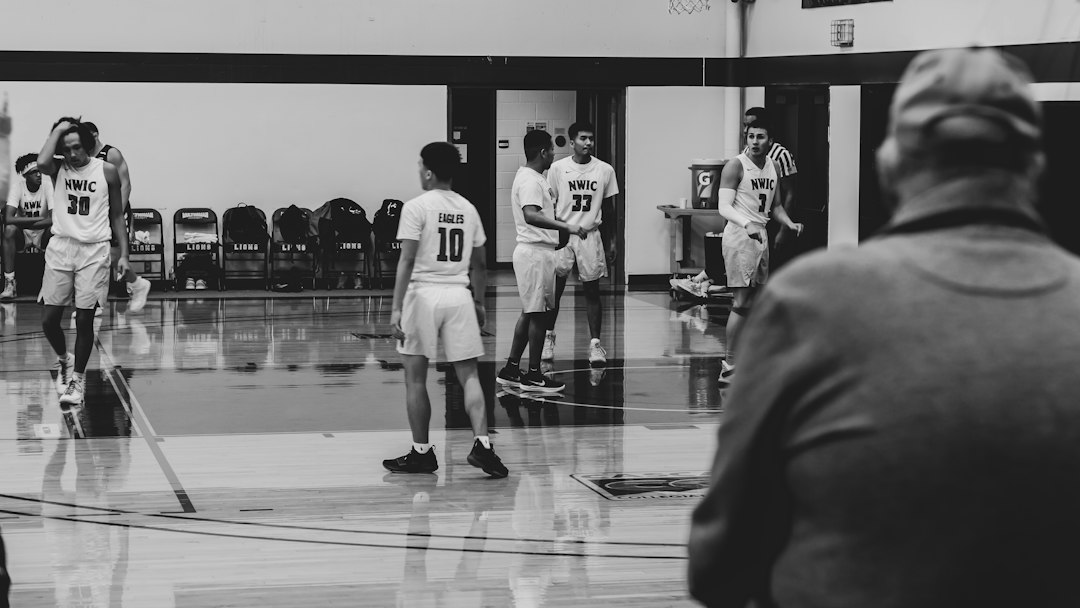




You still feel it.
Not as a thought — as a physical sensation. The way your chest tightened. The way the noise from the stands dropped away. The way time stretched like taffy until every second felt like something you could hold in your hands.
High school sports overtime memories don't live in your head the way most memories do. They live somewhere lower. In your sternum. In the soles of your feet. In the specific burn of your lungs when your body had nothing left and the game demanded everything anyway.
This is the piece for anyone who's been there. Anyone who knows what it means when the clock hits zero and the scoreboard says you're not done yet.
When the Clock Hits Zero and Nothing Is Settled
There is a particular kind of silence that happens at the end of regulation when the score is tied.
It isn't the silence of a crowd that has stopped caring. It's the opposite — a held breath so collective, so synchronized, that thousands of people momentarily forget they are individuals. Parents. Coaches. Opponents. Officials. For one suspended second, everyone in that gym or on that field is waiting together.
Then somebody screams. A coach. A teammate. A parent in the third row who has no idea she's on her feet.
And you realize: we're not done.
If you played — at any level, in any sport — you know the exact voltage of that moment. The sudden death announcement. The overtime whistle. The penalty kick. The extra period. Whatever form it took in your sport, the feeling underneath was universal: everything counts more now, and there are no more chances to be wasted.
Every former athlete remembers the first time they experienced that feeling. Not the outcome — the feeling. The way it reorganized your relationship with the next few minutes of your life. The way ordinary time stopped being ordinary.


That's not just adrenaline. That's identity formation happening in real time.
What Makes Overtime Different From Every Other Moment in Sports
Regular season games build character gradually. You practice your positioning across a hundred repetitions. You develop muscle memory through months of conditioning. You learn to read the game through accumulated exposure — play after play, game after game, season after season.
Overtime compresses all of that into a single crystallized moment where none of the accumulation matters unless it shows up right now.
This is why high school sports overtime memories outlast almost everything else from those years. The brain does not encode ordinary experiences with the same intensity it encodes high-stakes, emotionally charged, unpredictable moments. The neuroscience term is enhanced consolidation under arousal — essentially, the more emotionally activated you are during an experience, the more deeply it gets written into long-term memory. Your brain treats overtime as information it cannot afford to lose.
So when you're standing in your kitchen thirty years later and a song comes on — or someone mentions a gym, or you smell the specific combination of hardwood and sweat that only exists in high school gymnasiums — your nervous system retrieves that overtime moment not as a distant file but as something almost present.
That's not nostalgia. That's your brain doing exactly what it was designed to do.
The Compression of Everything You've Been
Here's what overtime actually is, below the surface level of extra periods and penalty rules:
It's a compression event.
Every drill you ran in October that you thought was pointless. Every play your coach made you repeat until you could do it half-asleep. Every time you stayed after practice when everyone else went home. Every morning you rolled out of bed at 5 AM for a run you didn't feel like taking.
Overtime doesn't care about effort in the abstract. It only cares about what you can access right now, in this exact moment, under this exact pressure.
Former athletes who have been through overtime understand something about high-pressure performance that is genuinely difficult to explain to people who haven't experienced it: the preparation doesn't feel like preparation in the moment. It just feels like what you know how to do. The panic that should be there isn't, because the body already knows the next move. Months of repetition pay out like interest — quietly, automatically, in exactly the moment you need it.
That's the gift overtime gives you. Not just a memory. A proof of concept about who you are when it matters.
The Losing Side Nobody Talks About
Here is something the highlight reels leave out.
The athletes who lose in overtime carry those moments just as permanently as the ones who win.
More permanently, sometimes.
Keisha R., 34, played libero on her high school volleyball team in a regional semifinal that went to a fifth set tiebreaker. Her team lost on a serve that clipped the net and dropped in — not her serve, not her error, not a play she could have changed. She's described that moment to her own daughter using the same words every time, twelve years later. The specific sound the ball made hitting the floor. The way her setter looked at her across the net. The way the other team's celebration happened in what felt like slow motion.
She doesn't describe it as a bad memory. She describes it as a formative one.
The losses in overtime teach something the wins can't. They teach you that you can survive the worst version of the outcome. That you can give everything and still not get the result you wanted, and that giving everything was still the right thing to do. They teach you that you are not defined by the scoreboard — you are defined by what you brought to the moment.
Every former athlete who has been on the losing side of a sudden death game knows: it doesn't make you less. It makes you someone who has been tested at a level most people never experience.
That matters. It stays with you. And eventually, if you let it, it becomes part of what you're proud of.
The Difference Between Sports and the Stage It Gives You
There is a reason former athletes across every sport describe overtime moments in terms that sound almost sacred.
Not because sports are sacred. But because the stage sports creates — particularly in high school, before professionalism or money or career pressure enters the equation — is one of the few places in modern life where a young person is handed a genuine, unambiguous test.
You either make the free throw or you don't. The clock runs out or it doesn't. The defense holds or it doesn't.
This kind of clarity is rare. Most of life happens in ambiguity — where the right choice isn't obvious, where outcomes are delayed and diffuse, where success and failure blur into long gray stretches of ordinary days.
Overtime in high school sports is the opposite of gray. It is a single, burning point of clarity. There is a problem. There is a time limit. There is a team. There is a set of skills you either have or don't. Go.
The former athletes who describe those moments most vividly are often not describing the outcome. They're describing what it felt like to live in a moment of that kind of clarity — to exist fully, without the ambiguity that characterizes most of adult life, inside a challenge that required everything they had.
What Carries Forward
In our experience, the athletes who talk most powerfully about overtime aren't always the ones who won. They're the ones who were present — who didn't check out mentally when the pressure became overwhelming, who stayed in their body and in the game when every instinct said to protect themselves emotionally by withdrawing.
Staying present under pressure is not a natural skill. It is developed through exposure — through exactly the kind of high-stakes situations that overtime provides.
The football player who held his blocking assignment on the final drive learned something about focus under pressure that he would use in every professional negotiation he would ever enter. The basketball player who stepped to the free throw line with her team down one learned something about internal stillness that would later get her through medical school. The soccer goalkeeper who stayed locked on the penalty taker instead of the crowd learned something about filtering noise that would serve her in every leadership role she would ever hold.
Overtime didn't teach these skills directly. But it provided the testing ground where they were discovered.
The Specific Sensory Archive Your Body Keeps
Ask any former athlete to describe their most intense overtime memory and watch what happens to their face.
They don't think first. They see it first. Or they feel it — the court under their shoes, the weight of the ball, the specific temperature of the air in that gym on that night.
This is not metaphor. The sensory specificity of high-stress athletic memories is a documented feature of how intense emotional experiences are encoded. The details that seem incidental — the color of the opponent's uniforms, the way the announcer's voice echoed in the gymnasium, the exact feel of your jersey against your skin — get archived alongside the central event because your brain, in a state of high arousal, is capturing everything.
Which means that an object from that time — a jersey, a photo, a program — doesn't just trigger a thought about the memory. It triggers the sensory archive. The whole thing comes back: the smell, the sound, the feeling in your chest.
This is why former athletes describe holding an old uniform as something more than nostalgia. They're not just looking at a piece of fabric. They're accessing a moment that their body remembers more completely than almost anything else from those years.
The jersey you wore in overtime isn't memorabilia. It's a key.
The Community That Forms Around These Moments
No one who played high school sports goes through overtime alone.
Even if you were the one who took the last shot or made the final save or ran the last play — you were surrounded by people who shared the same elevated, compressed, suddenly-crystallized moment with you.
Teammates who experienced overtime together describe a particular kind of bond. Not because they went through something difficult — plenty of difficult experiences don't produce this — but because they went through something where everything counted simultaneously, where the accumulated work of a season arrived at a single point of demand, and they faced it in the same space at the same time.
That shared experience becomes a reference point. Years later, those teammates don't need to explain to each other what that game meant. They already know. They were there.
This is the social architecture that high school sports builds underneath the wins and losses — a network of people who share a reference point that cannot be fully communicated to anyone who wasn't in the room. Former athletes who played together in high-stakes situations often describe those bonds as among the most durable relationships of their lives.
Not because they were the most visible relationships. Because they were formed in the most compressed and real ones.
Your jersey is still out there waiting.
Design yours in minutes and see your name and number exactly the way you remember it.
Frequently Asked Questions
Why do high school sports overtime memories feel more vivid than other memories from that time?
The brain encodes emotionally intense experiences differently than ordinary ones. During high-stakes athletic moments — especially overtime and sudden death situations — elevated adrenaline and cortisol signal to the brain that this experience is critical to retain. The result is what researchers call enhanced memory consolidation: the details, sensations, and outcomes of those moments get written into long-term memory with unusual depth and clarity. This is why a former athlete can recall the exact feeling of a playoff overtime decades later while struggling to remember what they had for lunch on an ordinary Tuesday.
Does it matter whether you won or lost in overtime?
Less than most people assume. The psychological research on formative athletic experiences consistently shows that the intensity and clarity of the moment — not the outcome — is the primary driver of how deeply it shapes identity and memory. Athletes who lost in overtime often describe those experiences as more formative than wins, because losing tests a different and often deeper set of character resources: resilience, perspective, and the ability to separate effort from outcome. Both winning and losing in overtime produce lasting memories. The difference is in what specific lesson the athlete carries forward.
Why do former athletes across different sports describe overtime so similarly?
Because the structure of the experience is the same regardless of sport. Sudden death moments — whether a fifth-set tiebreaker in volleyball, an overtime period in basketball, a penalty shootout in soccer, or a two-minute drill in football — all share the same essential architecture: compressed time, maximum stakes, no margin for error, and a complete demand for everything you've trained to do. The sport changes the specific skills required, but the psychological and emotional structure of the moment is universal. This is why athletes from completely different sports can describe overtime to each other and immediately recognize the experience.
How can I help a young athlete prepare mentally for overtime situations?
The most effective preparation is exposure to high-pressure situations in practice — not simulations designed to feel comfortable, but scenarios where the stakes feel real and the consequences of underperforming are immediate and visible. Coaches who create practice conditions that regularly include pressure-testing moments (final possession drills, penalty practice under fatigue, game-ending simulations) give athletes repeated low-stakes exposure to the psychological structure of high-stakes situations. The goal isn't to eliminate the pressure response — it's to give athletes enough experience with it that the response becomes familiar rather than overwhelming when it arrives in a real game.
See also: why high school sports moments stay with adults long after graduation | the science behind why certain high school games stay so vivid | why you still dream about those games years later | the silence on the bus ride home after a loss