

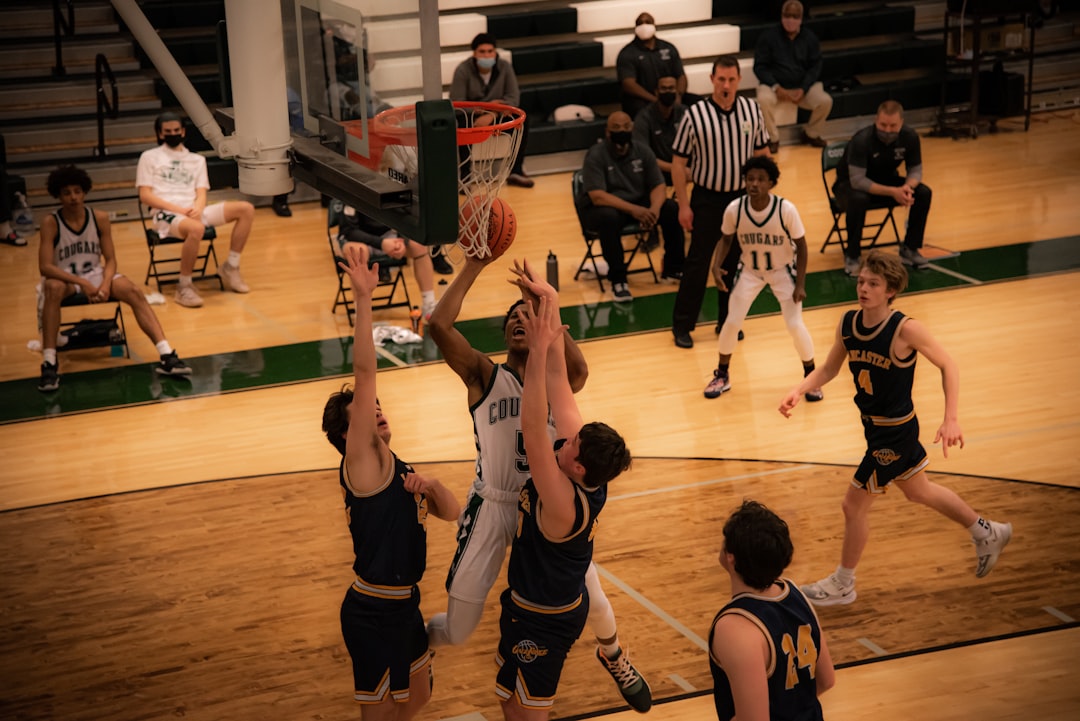




There is a moment — one you probably carry somewhere close — when you walked into that gymnasium and understood that the next three days were going to matter more than almost anything you'd done before.
The squeak of sneakers on hardwood. The echo of a ball bouncing somewhere across the court. The way thirty other kids all pretended they weren't nervous, and the way you could tell they were anyway.
High school basketball tryouts don't just select a roster. They do something bigger and stranger than that. They become a permanent fixture in memory, the kind you can still feel in your chest twenty years later, whether your name was on that list or not.
This isn't a coaching guide. This isn't twelve drills to run before tryouts or a breakdown of what coaches look for on day one. There are a hundred articles like that, and they all say roughly the same things.
This is about what a basketball tryout actually means: what the experience feels like from the inside. The sensory details of being evaluated. The particular weight of the waiting. The moment everything resolves, one way or the other, and you find out who you are on the other side of it.
What the Gym Feels Like When Everything Is on the Line
Walk into any high school gymnasium during basketball tryout season and the air is different. That's not poetry — it's a physical fact. Forty kids in a space built for ten, everyone radiating a specific kind of heat that comes from effort mixed with anxiety.
The coach is watching everything, and you know it. You know it so completely that you become self-conscious of things you've never thought about before: how you stand while waiting in line, whether you're talking too much or not enough to the kid next to you, the way you jog to a spot on the court versus walk to it.


Tryout nerves are their own category of sensation. They're not the nerves of a test where you might forget an answer. They're the nerves of a performance where you might forget how to be yourself.
In my experience around the game, the athletes who describe their tryout memories most vividly almost never lead with the drills. They lead with the smell of the gym. The sound of the coach's whistle. The particular way time moved during those two-hour sessions — simultaneously too fast and somehow interminable.
The drills themselves are almost secondary in the memory. What stays is the feeling of being watched.
The Sensation of Being Evaluated
There is a skill assessment happening on the surface of every tryout: Can you dribble with both hands? Can you finish at the rim under pressure? Can you execute a pick-and-roll? Coaches are tracking those things, absolutely.
But there is a second evaluation happening underneath the skills layer, and most athletes don't fully recognize it until years later.
Coaches are watching how you respond when something goes wrong. They're watching what you do in the ten seconds after you miss a layup. They're watching whether your effort level stays constant on the seventeenth defensive rotation or drops off when you think the whistle is about to blow.
They're watching your body language when someone else makes a great play. Are you the one who nods and gets back into position, or are you the one whose shoulders fold?
Marcus T., 17, described his sophomore tryout this way: "I thought I was being judged on my crossover. Turns out I was being judged on what I did after I lost the ball on my crossover." He made the JV squad that year. Three things changed his approach the following season. None of them were ball-handling drills.
The technical basketball evaluation and the character evaluation happen simultaneously, and coaches who run varsity basketball tryouts have gotten very good at doing both at once.
Basketball Tryout Cuts: The Architecture of Three Days
Most high school basketball tryouts run across two to four sessions. The structure is nearly universal, with small variations depending on program size and coaching philosophy.
Day one is the largest crowd you'll ever see in that gym. Everyone who signed up shows up on day one. The coach runs baseline assessments: skill stations, conditioning, simple scrimmages. They're sorting the field into rough tiers. By the end of day one, experienced coaches have already identified, with reasonable certainty, most of the players who are not going to make the roster. They won't announce that. The day two invitation goes to everyone.
Day two is where the real pressure arrives. The crowd is the same size, but something has shifted in the room. Everyone knows that cuts are coming. The scrimmages are longer. The defensive assignments are harder. The coach stops the action more to correct mistakes. Who gets corrected, and how, becomes a subject of intense analysis among the players on the sidelines.
Being corrected by a coach during tryouts is not a bad sign. Being ignored is the bad sign. Correction means the coach sees something worth developing. Silence can mean they've already moved on.
Day three — or whatever the final evaluation session is — carries a weight that is almost impossible to describe to someone who hasn't been through it. Every action feels freighted with consequence. The warm-up layup line. The water break. The final scrimmage of the final session.
Then it ends. The coach says something like "check the list tomorrow" or "we'll post the roster by end of day." And everyone files out into a hallway that has suddenly become a different place than it was seventy-two hours before.
What the Waiting Actually Does to You
The hours between the end of tryouts and the posting of the roster are their own distinct experience.
Your phone becomes a strange object during that time. You check it compulsively, even though you know the list isn't posted yet and won't be for hours. You run through conversations in your head: the one you'll have if you made it, the one you'll have if you didn't. You replay moments from the sessions, not the ones where you played well but the ones where something went wrong, and you assign them significance they may or may not deserve.
Keisha M., 16, made her high school varsity roster as a sophomore, one of only two sophomores selected that year. She remembered the waiting period more clearly than the tryouts themselves. "I went home and couldn't eat dinner. My mom made my favorite food and I sat there and moved it around the plate. I kept thinking about a pass I threw in the scrimmage that got deflected. For two hours I was completely certain that pass had cost me my spot. It hadn't, obviously. But that's where my brain went."
Sleep the night before the list goes up is its own category of restless. Not quite awake and not quite asleep, and in the spaces between, you're playing basketball in a gymnasium that keeps shifting its dimensions.
The Moment the List Goes Up
There is a physical experience of reading a posted roster that anyone who has been through high school basketball tryouts will recognize immediately.
You approach the list — whether it's taped to the gym door, posted outside the coach's office, or sent via email — with a particular physiological state. Heart rate elevated. Vision slightly narrowed. A tendency to scan too fast the first time, so the names blur together and you have to slow down and start over.
If your name is there, the first thing that happens is not joy. The first thing is relief. Pure, physical, almost dizzying relief: the same relief you'll feel all over again the day the coach posts the starting lineup. The joy comes a few seconds later, after the relief clears enough space for it.
If your name is not there, the first thing that happens is a very particular kind of disbelief. You read the list again. You read it a third time. You look for your name in places on the list where your name clearly isn't, as if alphabetical order has somehow failed and your name might be hiding somewhere unexpected.
Both experiences, making the list and not making the list, produce a version of the same sensation: the definitive end of uncertainty. After days of not knowing, you now know. And the knowing, whatever its content, is almost a relief in itself.
What Making the Team Actually Means
Making the high school basketball team marks the beginning of a harder story, not the end of one. What it's actually like to make the high school team for the first time is its own education: one nobody hands you a playbook for.
The basketball roster selection process narrows a field of thirty or forty or fifty kids down to twelve or fifteen. The players who make it have cleared one gate. They now enter a room where everyone else has also cleared that gate, which means the competition doesn't decrease — it reorganizes. Now you're competing for playing time, for starting positions, for the trust of a coaching staff that will spend the next four months deciding who is reliable under pressure. Not everyone in that room will start, of course. Some will spend most of their season on the bench, and the players who make peace with that role often become the heart of the team in ways the box score never shows.
Players who understand this use the relief of making the team as fuel for roughly forty-eight hours, and then they reset. The ones who carry the relief too long sometimes find themselves on the wrong side of the list at the next season's tryouts, having spent a year not quite as hungry as the players around them.
What Not Making the Team Actually Means
Here is what almost no one tells a sixteen-year-old who doesn't see their name on the list:
Being cut from a high school basketball team has produced some of the most important athletes, coaches, executives, and human beings in the sport's history. This is a documented, repeated pattern, not a consolation.
Michael Jordan's sophomore year cut at Laney High School has become cultural shorthand — perhaps overused as a motivational reference — but it points to something real. A tryout cut is a snapshot of a specific athlete at a specific moment, evaluated by a specific coaching staff against a specific set of competitive needs, rather than a judgment on a ceiling.
What you do in the weeks and months after a cut is, in many ways, more revealing of your basketball future than what you did during the three tryout days. Players who use the cut as information, actionable information about what they need to develop, and who put in the work to address it often arrive at the following year's tryouts as genuinely different players. Players who treat the cut as a verdict tend to stop.
The gymnasium is still open. The ball still bounces. The decision about what the cut means belongs entirely to you.
The Things Nobody Says Out Loud During Tryouts
Every high school basketball tryout has an unspoken layer: things that are happening and being felt that no one quite articulates in the moment.
The coach is exhausted. Making a basketball roster is genuinely difficult. Good coaches lose sleep over it. They know that the players they cut are real people with real investment, and they know that their evaluation, however careful, is imperfect. The coach who seems impassive during cuts is often the one who goes home and second-guesses two or three roster decisions. The callous coach and the confident coach look the same from the outside.
The players who made it last year are nervous too. Not about being cut, most of them aren't in real danger of that, but about where they land in the new hierarchy. A returning player who held a role last year is being evaluated for a larger one. That's its own pressure, and it lives in the same gym as everyone else's pressure.
What unites everyone in that gymnasium, across all those different circumstances, is the same thing: they care about this enough to be afraid of losing it. That particular kind of caring about a game is a big thing. It doesn't go away when the tryout ends. It goes somewhere else, and it shapes things.
What Stays With You
The memory of your high school basketball tryout — whether you made the team or not, whether you played four seasons or one — has a particular durability.
Decades later, people who played high school basketball can describe the gym in sensory detail. The color of the floor. The sound of a drill. The feeling of their legs during the final conditioning run. The way a coach's voice sounded when they called out instructions.
This durability is not an accident. It's what happens when something genuinely matters. The tryout mattered because basketball mattered, and basketball mattered because of something real inside the person playing it — not a manufactured urgency but an authentic investment in something difficult and beautiful and worth being afraid of losing.
That investment doesn't require a particular outcome to be valid. The player who made the varsity squad and the player who didn't both carried something real into that gymnasium. The experience of being evaluated, fully, under stakes, is its own education, independent of the result.
What you wore. What you said in the car on the way there. What you ate afterward, or couldn't eat. The face your best friend made when the list went up.
These details persist. They become part of the story you tell about who you are and where you came from. High school basketball tryouts, in that sense, are never really over. They just become memory — and then, eventually, something you can wear.
Your jersey is still out there waiting.
Design yours in minutes and see your name and number exactly the way you remember it.
Frequently Asked Questions
What do coaches actually look for during high school basketball tryouts?
Coaches are running two evaluations at once. The visible one is skill-based: ball handling, shooting mechanics, defensive positioning, conditioning, court vision. The less visible one is behavioral: how a player responds to mistakes, whether effort stays constant throughout a long session, how they interact with teammates during scrimmages. At the varsity level, coaches are selecting players they can coach — meaning players who are coachable, competitive, and consistent. Raw skill paired with attitude problems or selective effort often loses to solid skill paired with high coachability and genuine competitive intensity.
How long does it take to find out if you made the basketball team after tryouts?
Most high school programs post rosters within twenty-four to forty-eight hours of the final tryout session. Some programs announce cuts on a rolling basis during the tryout period itself — releasing players after day one or day two — while others hold all announcements until the full evaluation is complete. If no information has arrived within forty-eight hours of the final session, reaching out to the coach or athletic director to ask about the timeline is entirely appropriate. Programs vary considerably in how they handle the announcement, so knowing your school's process before tryouts begin is worth the effort.
If you get cut from basketball tryouts, should you ask the coach why?
Yes — and the framing of that conversation matters enormously. Approaching a coach after being cut with genuine curiosity ("I want to understand what I need to develop to have a stronger tryout next season") produces a very different conversation than approaching with defensiveness. Most coaches at the high school level will give honest, actionable feedback to a player who asks respectfully and demonstrates a real desire to improve. That feedback — even when it's hard to hear — is among the most valuable basketball education available, because it comes directly from the person who evaluated you and identifies the gaps worth addressing. Players who act on that feedback and return the following year having done the work earn real respect from coaching staffs, regardless of what happened the season before. Design your own — custom basketball jerseys.
Is it normal to feel emotionally drained after tryouts, even if you made the team?
Completely normal — and more common than athletes tend to admit in the moment. The tryout experience is emotionally and physically demanding in a way that's distinct from regular practice or a game. The sustained performance under evaluation, the anxiety of the waiting period, and the resolution of the roster announcement all produce a genuine emotional comedown, regardless of outcome. Players who made the team often describe a strange flatness in the days immediately after — the absence of the anxiety they'd been carrying, which leaves a gap that takes a few days to fill with something else. Give yourself a few days to adjust before drawing any conclusions about how you feel about the season ahead.
See also: athletic identity that gets built and sometimes broken during those years | the grief that follows when the sport you loved doesn't go the way you planned | why those high school sports moments stay with us so long after they're over